Archive
05/09/2023 – Ephemeris – The planet Uranus’ rings
This is Ephemeris for Tuesday, May 9th. Today the Sun will be up for 14 hours and 35 minutes, setting at 8:57, and it will rise tomorrow at 6:20. The Moon, 3 days before last quarter, will rise at 1:56 tomorrow morning.
Today, the planet Uranus is in conjunction with the Sun. I don’t talk about Uranus that much, because it can’t be spotted in the sky with the naked eye. However, the James Webb Space Telescope observed it, and gave our clearest view of the planet since Voyager 2 flew past it in January 1986. Uranus has a system of rings, which were discovered in March 1977. Though not visible, they blocked the light of a star. Astronomers at the time were trying to get a more accurate diameter of the planet by timing the disappearance of a star behind the planet. Extra short dips in brightness before and after the main occultation revealed the existence of the rings. Uranus also has an extreme axial tilt of 98 degrees.
The astronomical event times given are for the Traverse City/Interlochen area of Michigan (EDT, UT –4 hours). They may be different for your location.
Addendum
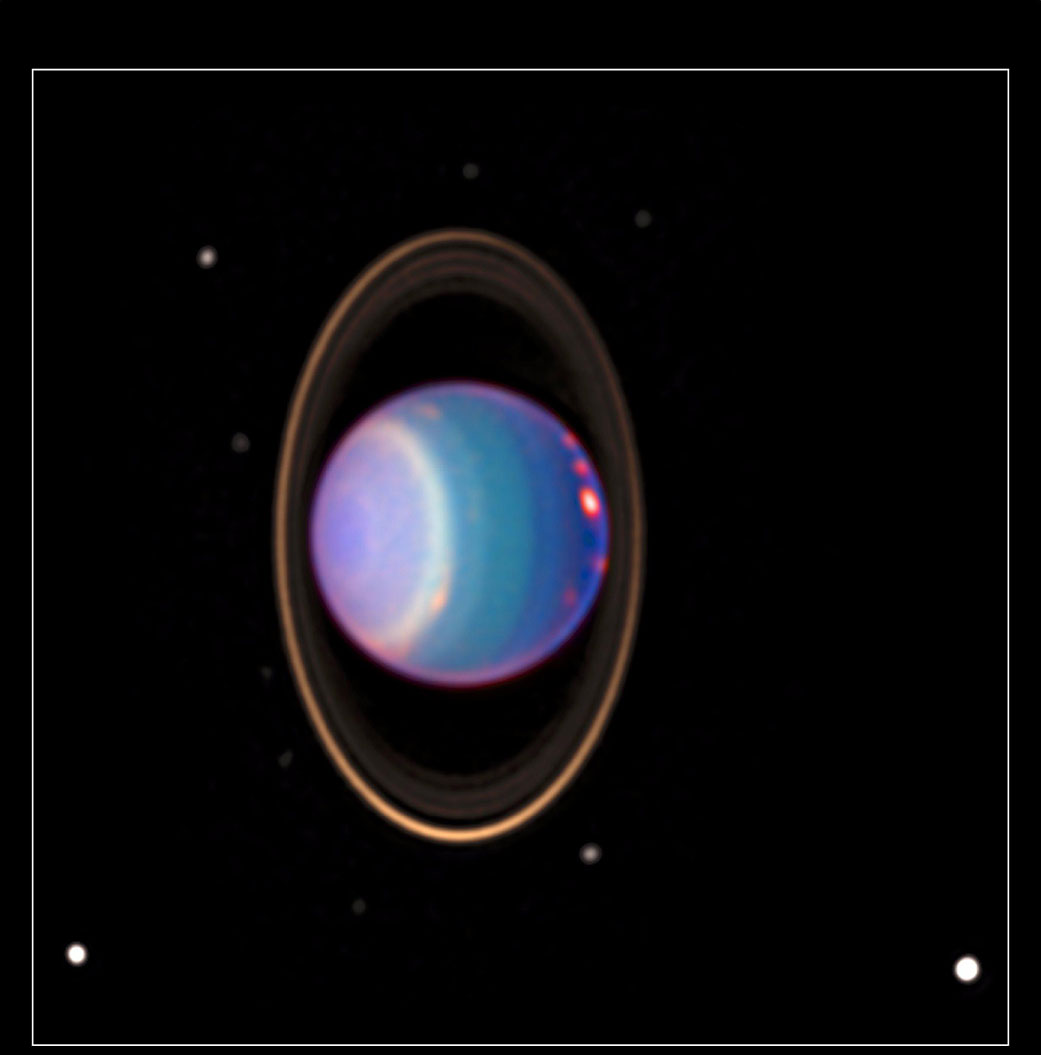
Uranus and its rings as photographed by the Hubble Space Telescope. Credit NASA/ESA.
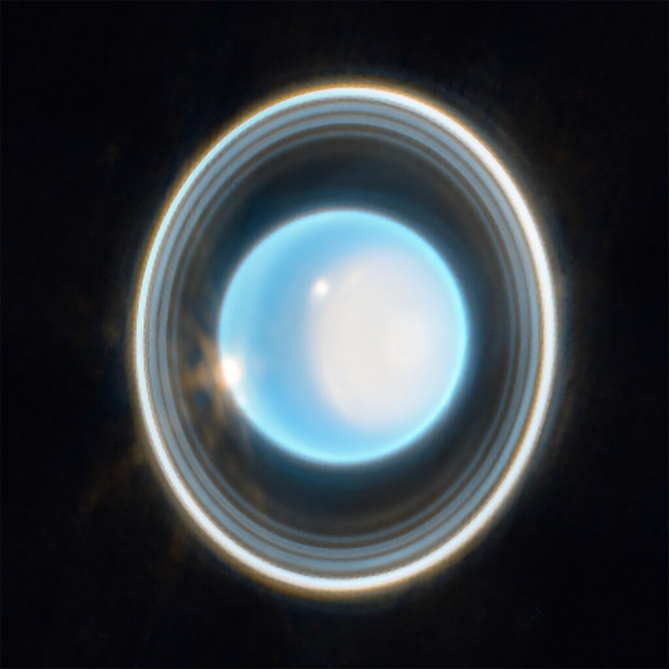
Uranus and its rings as photographed by the James Webb Space Telescope. The rings are much brighter in the infrared. Credit: NASA\CSA\ESA.
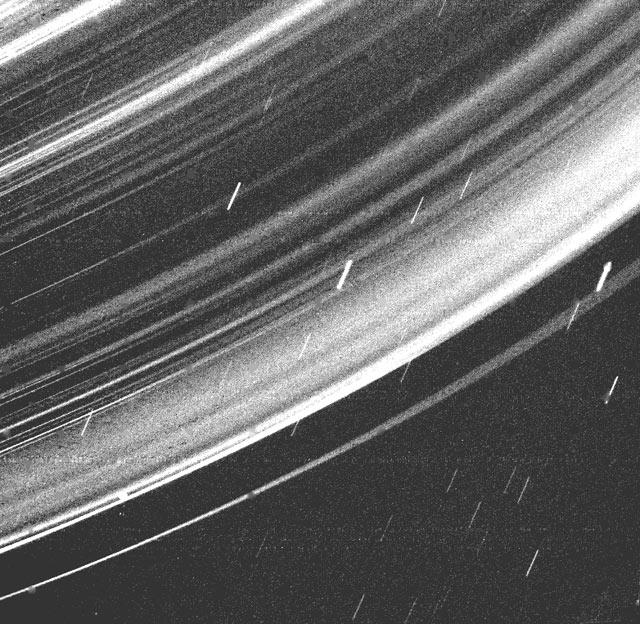
Closeup of the Uranian rings from Voyager 2. The stars are trailed due to the spacecraft turning to focus on the rings as it moves through the Uranian system in this time exposure. Credit NASA/JPL.
02/13/2019 – Ephemeris – Let’s look at the bright planets for this week
Ephemeris for Wednesday, February 13th. Today the Sun will be up for 10 hours and 21 minutes, setting at 6:08, and it will rise tomorrow at 7:44. The Moon, 1 day past first quarter, will set at 3:10 tomorrow morning.
Let’s look at the planets for this week. Our only evening planet visible now is Mars. It will be in the southwestern sky this evening and will set at 11:48 p.m. Mercury should become visible next week. In the morning sky we have Jupiter which will rise tomorrow at 3:55 a.m. It is second to Venus in brightness, and now is west of Venus. In small telescopes up to four of Jupiter’s moons are visible. Venus, which is about to pass Saturn next Monday morning, will rise at 5:24 a.m. tomorrow. In small telescopes it is a smalls slightly gibbous moon shape. Its phase will now grow more toward full as its size shrinks as it moves around and behind the Sun. Saturn will rise at 5:47 a.m. tomorrow in the east-southeast.
The times given are for the Traverse City/Interlochen area of Michigan. They may be different for your location.
Addendum
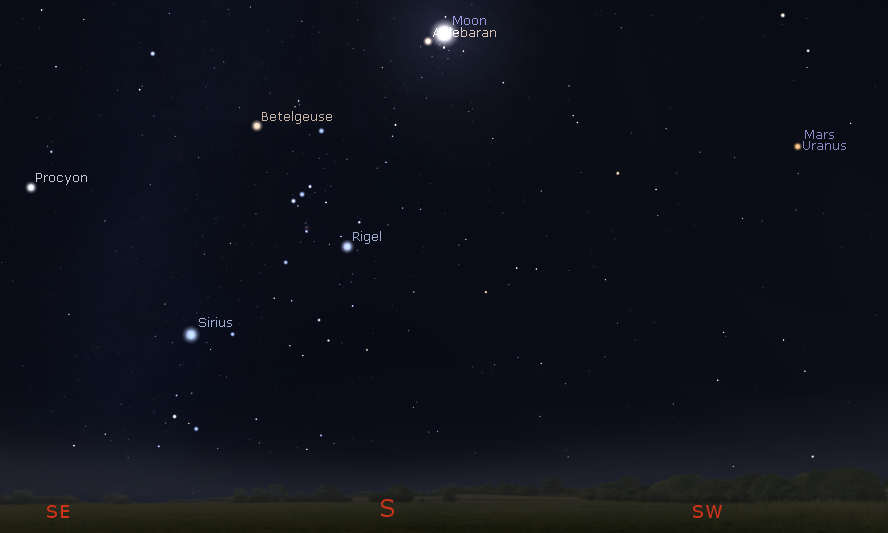
Mars and the Moon tonight at 8 p.m. February 13, 2019. Click on the image to enlarge. Created using Stellarium.
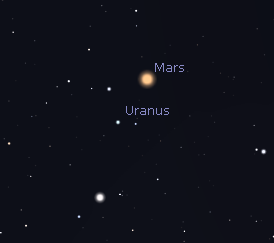
Mars and Uranus as it would be seen in binoculars or small telescope at 8 p.m. February 13, 2018. The planets will be about a degree apart (2 Moon widths). Created using Stellarium.
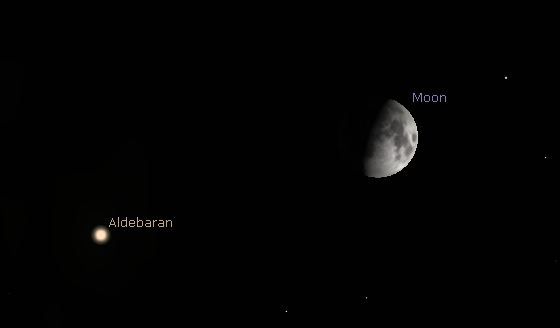
The Moon and Aldebaran at 8 p.m. February 13, 2019. Created using Stellarium.
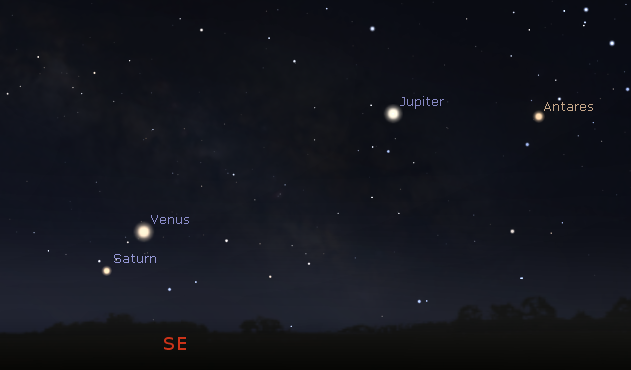
The morning planets at 6:30 a.m. February 14, 2019. Saturn is joining Venus and Jupiter. Created using Stellarium.
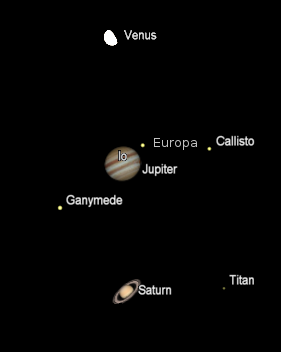
Venus, Jupiter and Saturn with the same magnification at 6:30 a.m. tomorrow morning February 14, 2019. The moon Io is behind the planet at that time. Created using Cartes du Ciel (Sky Charts).
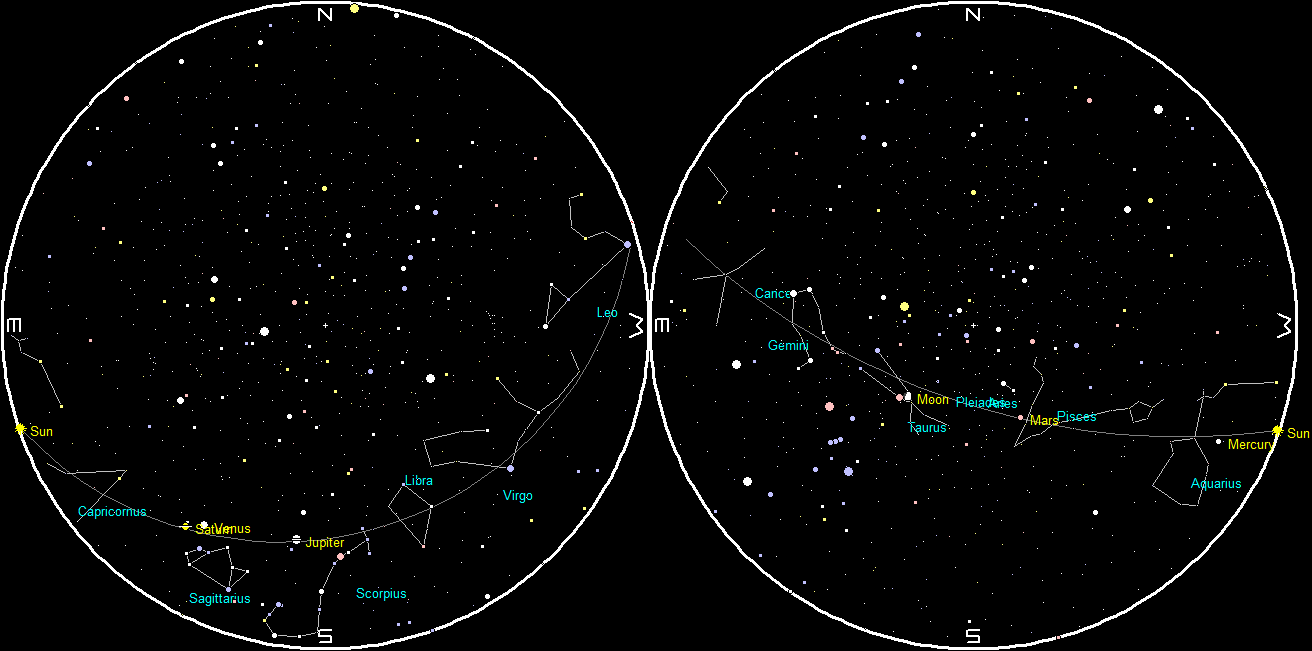
Planets and the Moon at sunset and sunrise of a single night starting with sunset on the right on February 13, 2019. The night ends on the left with sunrise on the 14th. Click on the image to enlarge. Created using my LookingUp program.
02/06/2019 – Ephemeris – Saturn is back, and a look at some other bright planets
Ephemeris for Wednesday, February 6th. Today the Sun will be up for 10 hours and 2 minutes, setting at 5:58, and it will rise tomorrow at 7:54. The Moon, 2 days past new, will set at 7:47 this evening.
Let’s look at the planets for this week. Our only evening planet Mars will be in the southwestern sky this evening and will set at 11:50 p.m. It’s too far away to see much detail in a small telescope. In the morning sky we have Jupiter which will rise tomorrow at 4:17 a.m. It is second to Venus in brightness, and now is west of Venus. In small telescopes up to four of Jupiter’s moons are visible. Venus will rise at 5:17 a.m. tomorrow. In small telescopes it is a featureless slightly gibbous moon shape. Its phase will now grow more toward full as its size shrinks as it continues its long journey around and behind the Sun. Saturn is making an appearance in morning twilight rising at 6:12 a.m. tomorrow in the east-southeast.
The times given are for the Traverse City/Interlochen area of Michigan. They may be different for your location.
Addendum
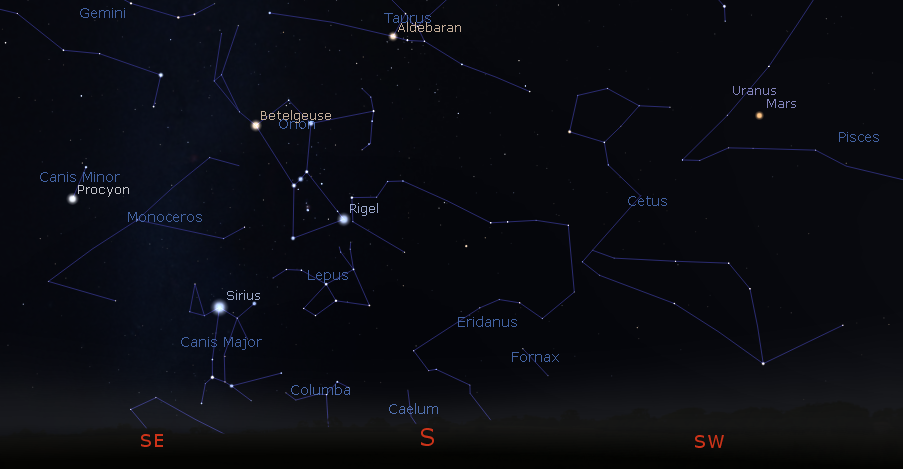
Mars and the evening constellations tonight at 8 p.m. February 6, 2019. Note the faint planet Uranus near Mars. They will appear only a degree apart next Wednesday night for a telescopic treat. Click on the image to enlarge. Created using Stellarium.
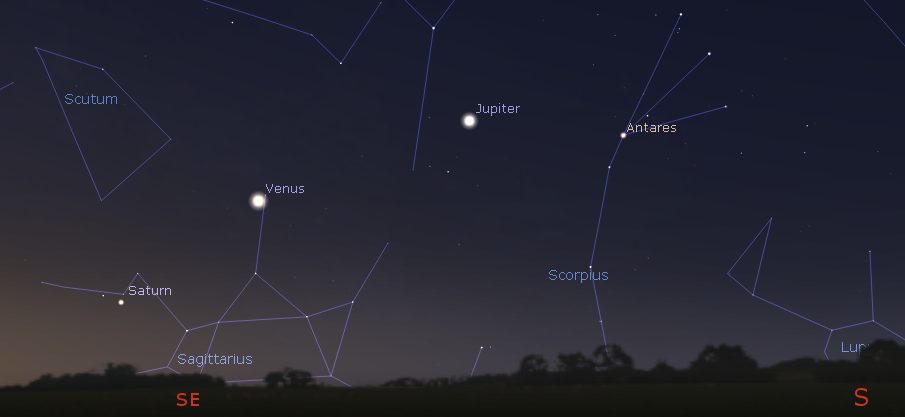
Jupiter, Venus, and the rising Saturn at 7 a.m. tomorrow morning February 7, 2019. Created using Stellarium.
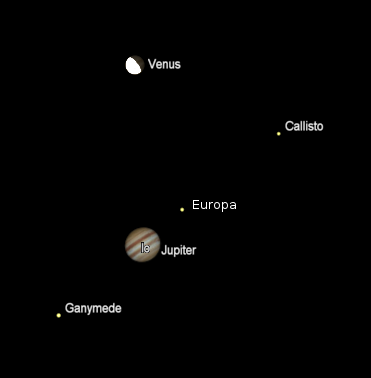
Venus and Jupiter with the same magnification at 6 a.m. tomorrow morning February 7, 2019. Io is just peeking out on the lower left edge, though not quite showing up in this chart. Created using Cartes du Ciel (Sky Charts).
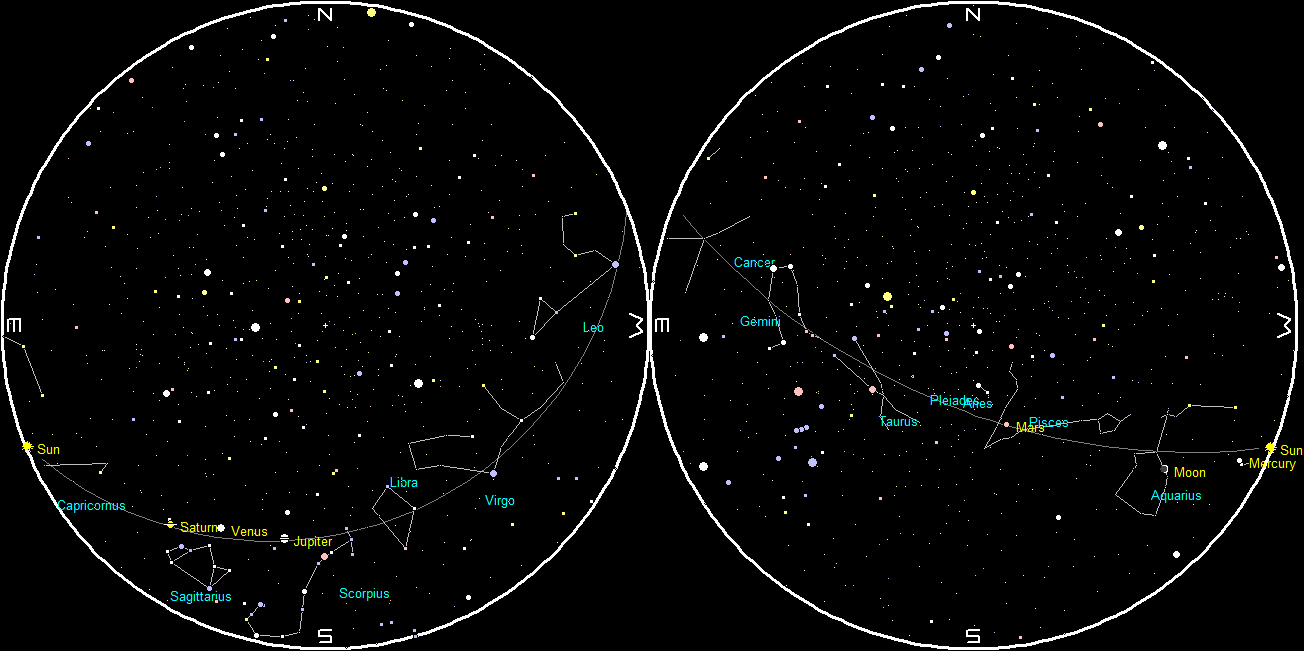
Planets and the Moon at sunset and sunrise of a single night starting with sunset on the right on February 6, 2019. The night ends on the left with sunrise on the 7th. Click on the image to enlarge. Created using my LookingUp program.
10/23/2018 – Ephemeris – Uranus is at opposition from the Sun today
Ephemeris for Tuesday, October 23rd. The Sun will rise at 8:08. It’ll be up for 10 hours and 36 minutes, setting at 6:44. The Moon, 1 day before full, will set at 7:48 tomorrow morning.
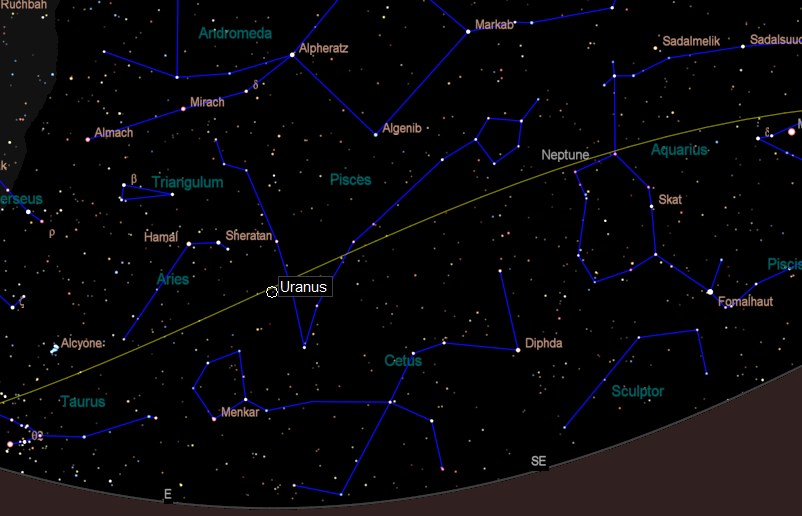
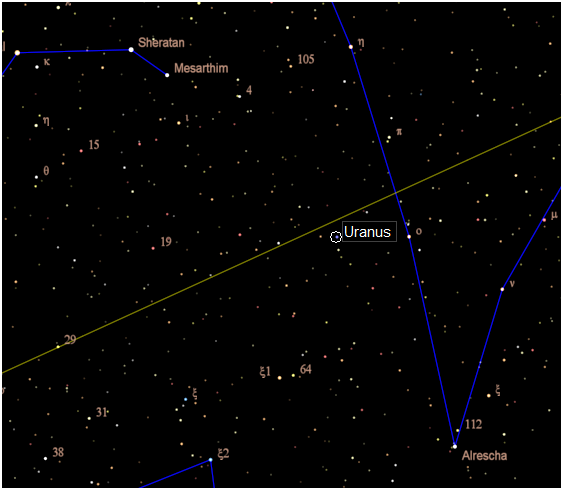
Later tonight the planet Uranus will reach opposition from the Sun. This is also about the time it is closest to the Earth at 18.9 Astronomical Units, or 18.9 times the Earth’s distance from the Sun, or 1.8 billion miles away. Uranus now is just barely visible to the naked eye by those with perfect vision at magnitude 5.7. It is fairly easy to spot in binoculars as a blue-green star. There are no blue-green stars. However it is in a rather star poor part of the sky. It is close to the bright Moon tonight, so I’d wait until Sunday night to try to spot it in dark skies. Then Uranus will be in the east at 9 p.m. below and right of the rightmost star of the three brightest stars of the constellation Aries. About half way from that star to the bottom leftmost star of Pisces. Uranus was the first new planet found since antiquity by William Herschel in 1781.
The times given are for the Traverse City/Interlochen area of Michigan. They may be different for your location.
Addendum
 Bob Moler's Ephemeris Blog