Archive
06/05/2023 – Ephemeris Extra – Venus prepares to leave the evening sky
Based on the article of the same name printed in the Grand Traverse Astronomical Society’s June Stellar Sentinel newsletter.
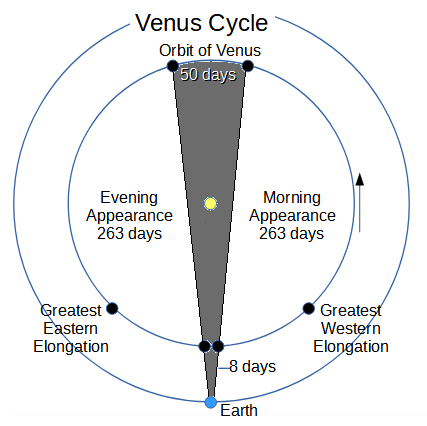
Venus will not only leave the evening sky in dramatic fashion, but will enter the morning sky in an even more dramatic fashion in the latter half of August. Venus takes 225 days to orbit the Sun, but from an Earth also orbiting the Sun, the period from successive inferior or superior conjunctions of the Sun take 584 days or 19.2 months (1 year 7.2 months), or 9.6 months in the evening and morning skies respectively.
The interval from greatest eastern elongation, and inferior conjunction, when Venus passes between the Sun and the Earth is around 70 days. On June 4th, Venus will be at its greatest eastern elongation. The sight line from the Earth to Venus will be tangent to Venus’ orbit. Any Venusians, floating above their clouds, would see the Earth at quadrature, that is 90 degrees from the Sun.
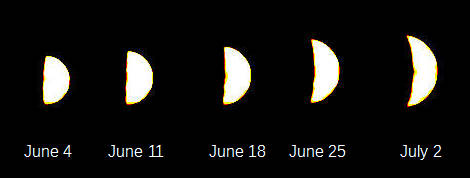
Venus, at greatest eastern elongation, is heading straight toward us, so it will grow rapidly in apparent size. Venus begins the month with an apparent diameter of 22.9”. (” means seconds of arc. 1 second of arc = 1/3600 of a degree). At the end of the month Venus will have increased in apparent size to 33.5”, as can be seen with the illustration below. For comparison, Jupiter’s average apparent diameter is around 41”.
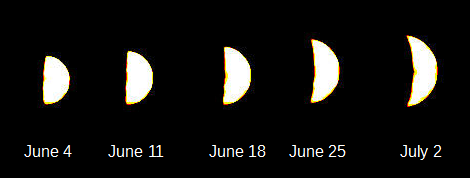
Sometime in July Venus will appear large enough to be able to detect it’s crescent phase in seven power binoculars. At inferior conjunction its apparent size will grow to 57.8”. Pity there won’t be a transit of Venus of the Sun to see it. By the way, if you missed the transits of 2004 and 2012, you won’t see another, unless you are a small child now, and will live to a very old age. There won’t be another transit of Venus until 2117.
The Mayan culture of Central America and the Yucatan Peninsula based one of their calendars on the Venus Cycle. It turns out that five Venus cycles equals a period just shy of eight years. That’s why we had 2 Venus transits eight years apart, June 8, 2004 and June 6, 2012. The next transits will be December 11, 2117 and December 8, 2125.
The Dresden Codex is one of only a handful of surviving Mayan books. It has a whole section on the Venus Cycle and how it fits into an 8 year Sequence. 13 eight year sequences equals 104 years, a Venus Round. Well, not quite, 103.91 years actually.
Venus has been ignored by NASA since the Magellan mission in the 1990s which mapped the surface through the clouds with radar. Recent reexamination of the results have suggested that there may have been relatively recent volcanism on the planet, even during the period that Magellan was imaging the surface of the planet.
NASA plans two missions to the planet toward the end of this decade. VERITAS stands for “Venus Emissivity, Radio Science, InSAR, Topography, and Spectroscopy” it’s a satellite map the surface in much greater detail than Magellan did. It will also map infrared emissions from Venus’ surface to map rock types.
DAVINCI+ stands for “Deep Atmosphere Venus Investigation of Noble gases, Chemistry, and Imaging” and will drop through the atmosphere taking measurements, and will take images of the surface like the Huygens probe did on Saturn’s largest moon Titan back in 2005.
In the past the Soviet Union sent landers and floated balloons in Venus’ atmosphere. The only active spacecraft that I know of orbiting Venus now is Japan’s Akatsuki, which is studying its atmosphere. However spacecraft using Venus as a gravity assist to get to Mercury or close to the Sun, have turned their instruments to Venus as they passed by.
Major Venusian events for the rest of 2023 (Eastern Time)
- June 4, 6:59 am – Venus at greatest eastern elongation 45.4°
- June 13, 7:05 am – Venus 0.5° north of the Beehive cluster
- June 21, 8:47 pm – Venus 4.1° south of the Moon
- July 1, 2:48 am – Venus in a quasi-conjunction with Mars, separation 3.6°
- July 7 – Greatest brilliancy, magnitude -4.7 (~36 days before inferior conjunction)
- July16, 3:49 am – Venus in a quasi-conjunction with Regulus
- July 27, 7:00 am – Mercury 5.1° north of Venus
- August 13, 7:10 am – Venus at inferior conjunction, 7.4° south of the Sun
- September 19 – Greatest brilliancy. Magnitude -4.8
- October 9, 2:10 am – Venus 2.3° south of Regulus
- October 23, 5:59 pm – Venus greatest western elongation 46.4°
- November 9, 4:28 am – Venus 1.1° south of the Moon
- November 29, 5:29 am – Venus 4.2°north of Spica
- December 9, 11:53 am – Venus 3.9° north of the Moon
Created from NASA’s SKYCAL Sky Events Calendar.
06/05/2023 – Ephemeris – Venus was it’s farthest apparent distance from the Sun yesterday
This is Ephemeris for Monday, June 5th. Today the Sun will be up for 15 hours and 25 minutes, setting at 9:24, and it will rise tomorrow at 5:58. The Moon, 2 days past full, will rise at 11:47 this evening.
Yesterday, Venus was as far away from the Sun as it gets in this evening appearance of Venus. The event is called greatest eastern elongation, meaning it’s as far to the east of the Sun as it gets. Both Venus and Mercury have these events, because they orbit the Sun inside of the Earth’s orbit, they never stray far from the Sun. In less than two and a half months, Venus will leave the evening sky, pass between the Earth and Sun in inferior conjunction, and enter the morning sky. Until then Venus will get larger in telescopes and become a thinner and thinner crescent, as we see more of its night side and less of its day side. By mid July, Venus should appear large enough to see its tiny crescent in a pair of binoculars.
The astronomical event times given are for the Traverse City/Interlochen area of Michigan (EDT, UT –4 hours). They may be different for your location.
Addendum
10/29/2021 – Ephemeris – Venus is at its greatest separation east from the Sun today
This is Ephemeris for Friday, October 29th. Today the Sun will be up for 10 hours and 18 minutes, setting at 6:35, and it will rise tomorrow at 8:18. The Moon, 1 day past last quarter, will rise at 1:39 tomorrow morning.
Tonight, Venus will be at its greatest separation east of the Sun of 47 angular degrees. Having an orbit inside the Earth’s orbit, Venus never strays more than a 47-degree angle from the Sun. It has been moving away from around behind the Sun to its present position since March 26th. That’s 217 days. And now it will take only 72 days to head back to pass between the Earth and the Sun in inferior conjunction and leave the evening sky on January 9th. For this next 70 or so days, Venus will look great in telescopes. It will get larger as it approaches us and become a dazzling crescent in telescopes. Toward the latter half of December, the tiny crescent can even be made out in binoculars. It is the very best time to view Venus in a telescope.
The astronomical event times given are for the Traverse City/Interlochen area of Michigan (EDT, UT – 4 hours). They may be different for your location.
Addendum
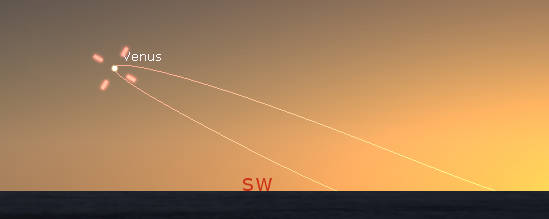
Venus at greatest elongation, seen at 7 pm tonight, October 29, 2021. Note how shallow the orbit is compared with Mercury’s orbit was on Monday’s (10/25/2021) post of Mercury’s greatest western elongation as seen in the morning. Created using Stellarium.
07/31/2018 – Ephemeris – Previewing August skies
Ephemeris for Tuesday, July 31st. The Sun rises at 6:27. It’ll be up for 14 hours and 41 minutes, setting at 9:09. The Moon, half way from full to last quarter, will rise at 11:17 this evening.
Let’s look ahead at the month of August in the skies. Daylight hours will decrease from 14 hours and 39 minutes tomorrow to 13 hours 17 minutes on the 31st. The altitude of the sun at local noon, that is degrees of angle above the horizon will decrease from 63 degrees tomorrow to just over 53 degrees on the 31st. Straits area listeners can subtract one more degree from those angles. Local noon, when the Sun is due south, is about 1:43 p.m. The Perseid meteor shower will reach its peak all night on the 12th. It will be a dark night with the one day old moon setting at 10 p.m. The radiant point, where the meteors will seem to come from, will be rising higher in the northeastern sky all night. On the 17th Venus will reach ts greatest separation from the Sun in the evening sky.
The times given are for the Traverse City/Interlochen area of Michigan. They may be different for your location.
Addendum
August Evening Star Chart
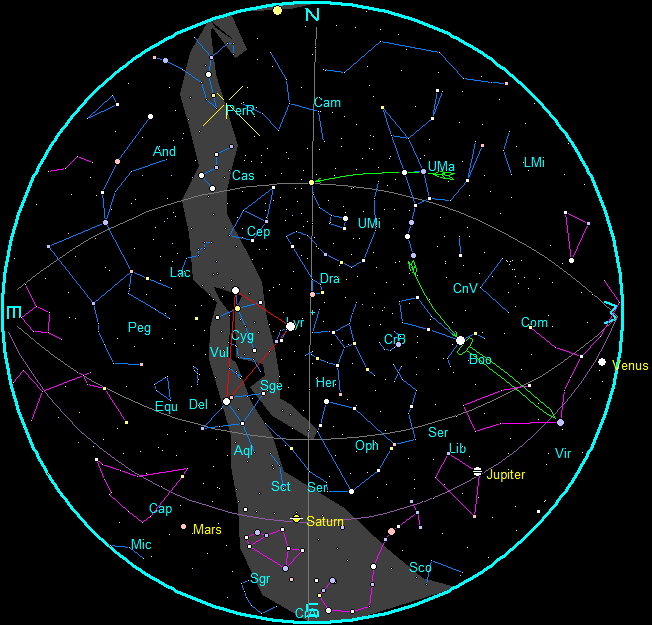
Star Chart for August 2018 (10 p.m. EDT August 15, 2018). Created using my LookingUp program. Click on image to enlarge.
The planets and stars are plotted for the 15th at 10 p.m. EDT in the evening and 4:30 a.m. for the morning chart. These are the chart times. Note that Traverse City is located approximately 45 minutes behind our time meridian. (An hour 45 minutes behind our daylight saving time meridian during EDT). To duplicate the star positions on a planisphere you may have to set it to 1 hour 45 minutes earlier than the current time.
Note the chart times of 10 p.m. and 4:30 a.m. are for the 15th. For each week before the 15th add ½ hour (28 minutes if you’re picky). For each week after the 15th subtract ½ hour. The planet positions are updated each Wednesday on this blog. For planet positions on dates other than the 15th, check the Wednesday planet posts on this blog.
August Morning Star Chart
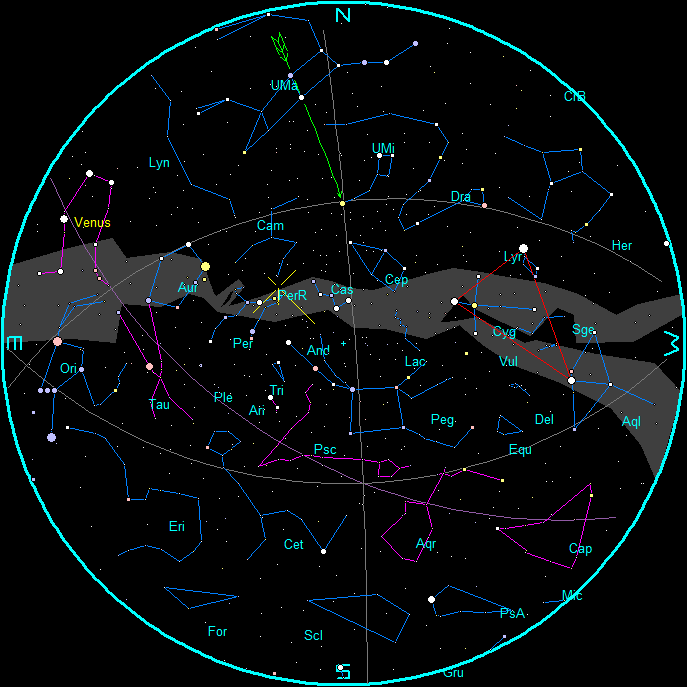
Star Chart for August 2018 mornings based on 4:30 a.m. August 15th. Created using my LookingUp program. Click on image to enlarge.
For a list of constellation names to go with the abbreviations click here.
- Pointer stars at the front of the bowl of the Big Dipper point to Polaris the North Star.
- Leaky Big Dipper drips on Leo.
- Follow the arc of the handle of the Big Dipper to the star Arcturus and
- Continue with a spike to Spica.
- The Summer Triangle is in red.
- PerR – Perseid meteor shower radiant
Twilight
| Morning | Twilight | Evening | Twilight | Dark | Night | Moon | |
| Date | Astronomical | Nautical | Nautical | Astronomical | Start | End | Illum. |
| 2018-07-31 | 4h28m | 5h17m | 22h28m | 23h17m | 23h17m | 23h17m | 0.89 |
| 2018-08-01 | 4h30m | 5h18m | 22h27m | 23h15m | 23h15m | 23h43m | 0.82 |
| 2018-08-02 | 4h32m | 5h20m | 22h25m | 23h13m | 23h13m | – | 0.74 |
| 2018-08-03 | 4h34m | 5h21m | 22h24m | 23h11m | 23h11m | 0h09m | 0.64 |
| 2018-08-04 | 4h36m | 5h23m | 22h22m | 23h09m | 23h09m | 0h37m | 0.53 |
| 2018-08-05 | 4h38m | 5h24m | 22h20m | 23h07m | 23h07m | 1h08m | 0.42 |
| 2018-08-06 | 4h40m | 5h26m | 22h18m | 23h05m | 23h05m | 1h44m | 0.31 |
| 2018-08-07 | 4h42m | 5h27m | 22h17m | 23h03m | 23h03m | 2h26m | 0.20 |
| 2018-08-08 | 4h43m | 5h29m | 22h15m | 23h00m | 23h00m | 3h18m | 0.11 |
| 2018-08-09 | 4h45m | 5h30m | 22h13m | 22h58m | 22h58m | 4h19m | 0.05 |
| 2018-08-10 | 4h47m | 5h32m | 22h11m | 22h56m | 22h56m | 4h47m | 0.01 |
| 2018-08-11 | 4h49m | 5h33m | 22h10m | 22h54m | 22h54m | 4h49m | 0.00 |
| 2018-08-12 | 4h51m | 5h35m | 22h08m | 22h52m | 22h52m | 4h51m | 0.03 |
| 2018-08-13 | 4h53m | 5h36m | 22h06m | 22h49m | 22h49m | 4h53m | 0.08 |
| 2018-08-14 | 4h55m | 5h38m | 22h04m | 22h47m | 23h01m | 4h55m | 0.16 |
| 2018-08-15 | 4h56m | 5h39m | 22h02m | 22h45m | 23h29m | 4h56m | 0.26 |
| 2018-08-16 | 4h58m | 5h41m | 22h00m | 22h43m | 23h59m | 4h58m | 0.36 |
| 2018-08-17 | 5h00m | 5h42m | 21h58m | 22h41m | – | 5h00m | 0.47 |
| 2018-08-18 | 5h02m | 5h44m | 21h56m | 22h38m | 0h30m | 5h02m | 0.57 |
| 2018-08-19 | 5h04m | 5h45m | 21h54m | 22h36m | 1h03m | 5h04m | 0.67 |
| 2018-08-20 | 5h05m | 5h47m | 21h53m | 22h34m | 1h40m | 5h05m | 0.76 |
| 2018-08-21 | 5h07m | 5h48m | 21h51m | 22h32m | 2h22m | 5h07m | 0.84 |
| 2018-08-22 | 5h09m | 5h50m | 21h49m | 22h29m | 3h09m | 5h09m | 0.90 |
| 2018-08-23 | 5h11m | 5h51m | 21h47m | 22h27m | 4h00m | 5h11m | 0.90 |
| 2018-08-24 | 5h12m | 5h53m | 21h45m | 22h25m | 4h56m | 5h12m | 0.95 |
| 2018-08-25 | 5h14m | 5h54m | 21h43m | 22h23m | – | – | 0.99 |
| 2018-08-26 | 5h16m | 5h55m | 21h41m | 22h20m | – | – | 1.00 |
| 2018-08-27 | 5h17m | 5h57m | 21h39m | 22h18m | – | – | 0.99 |
| 2018-08-28 | 5h19m | 5h58m | 21h37m | 22h16m | – | – | 0.97 |
| 2018-08-29 | 5h21m | 6h00m | 21h35m | 22h14m | – | – | 0.92 |
| 2018-08-30 | 5h22m | 6h01m | 21h33m | 22h11m | 22h11m | 22h40m | 0.86 |
| 2018-08-31 | 5h24m | 6h02m | 21h31m | 22h09m | 22h09m | 23h09m | 0.78 |
Twilight calendar was generated in Cartes du Ciel.
NASA Calendar of Planetary Events
Date        Time    Event
Aug 01  We          Venus: 45.1° E
    04  Sa  2:18 pm Last Quarter
    06  Mo  2:35 pm Moon-Aldebaran: 1.1° S
    08  We  6:33 pm Moon North Dec.: 20.8° N
    08  We  9:59 pm Mercury Inferior Conj.
    10  Fr  9:40 am Moon Ascending Node
    10  Fr  2:05 pm Moon Perigee: 358100 km
    11  Sa  5:47 am Partial Solar Eclipse (NE Canada to Asia)
    11  Sa  5:58 am New Moon
    12  Su  8:44 pm Perseid Meteor Shower: ZHR = 90
    14  Tu  9:35 am Moon-Venus: 6.4° S
    17  Fr  6:38 am Moon-Jupiter: 4.8° S
    17  Fr 11:59 am Venus Greatest Elongation: 45.9° E
    18  Sa  3:49 am First Quarter
    20  Mo 10:07 pm Mercury-Beehive: 5.9° S
    21  Tu  5:55 am Moon-Saturn: 2.4° S
    21  Tu 10:58 pm Moon South Dec.: 20.8° S
    23  Th  7:23 am Moon Apogee: 405700 km
    24  Fr 12:51 am Moon Descending Node
    26  Su  7:56 am Full Moon
    26  Su  3:59 pm Mercury Greatest Elongation: 18.3° W
Sep 01  Sa          Venus: 45° E
Sky Events Calendar by Fred Espenak and Sumit Dutta (NASA’s GSFC),
http://eclipse.gsfc.nasa.gov/SKYCAL/SKYCAL.html
If you go to the above site you can print out a list like the above for the entire year
or calendar pages for your time zone.
Sun and Moon Rising and Setting Events
     LU              Ephemeris of Sky Events for Interlochen/TC
     August, 2018    Local time zone: EDT
     +-----------------------------------------------------------------------+
     | DATE |  SUN     SUN  DAYLIGHT|   TWILIGHT*    |MOON  RISE OR    ILLUM |
     |      |  RISE    SET    HOURS |  END    START  |PHASE SET** TIME FRACTN|
     +=======================================================================+
     |Wed  1| 06:29a  09:08p  14:39 | 10:23p  05:13a |      Rise 11:43p   77%|
     |Thu  2| 06:30a  09:07p  14:37 | 10:22p  05:14a |      Rise 12:09a   68%|
     |Fri  3| 06:31a  09:05p  14:34 | 10:20p  05:16a |      Rise 12:37a   58%|
     |Sat  4| 06:32a  09:04p  14:32 | 10:18p  05:17a |L Qtr Rise 01:08a   47%|
     +------+-----------------------+----------------+-----------------------+
     |Sun  5| 06:33a  09:03p  14:29 | 10:17p  05:19a |      Rise 01:44a   37%|
     |Mon  6| 06:34a  09:01p  14:27 | 10:15p  05:20a |      Rise 02:27a   26%|
     |Tue  7| 06:35a  09:00p  14:24 | 10:13p  05:22a |      Rise 03:18a   17%|
     |Wed  8| 06:37a  08:59p  14:22 | 10:11p  05:23a |      Rise 04:20a    9%|
     |Thu  9| 06:38a  08:57p  14:19 | 10:10p  05:25a |      Rise 05:30a    3%|
     |Fri 10| 06:39a  08:56p  14:16 | 10:08p  05:26a |      Rise 06:45a    0%|
     |Sat 11| 06:40a  08:54p  14:14 | 10:06p  05:28a |New   Set  09:21p    1%|
     +------+-----------------------+----------------+-----------------------+
     |Sun 12| 06:41a  08:53p  14:11 | 10:04p  05:29a |      Set  09:58p    4%|
     |Mon 13| 06:42a  08:51p  14:08 | 10:02p  05:31a |      Set  10:30p   10%|
     |Tue 14| 06:44a  08:50p  14:06 | 10:00p  05:32a |      Set  11:00p   17%|
     |Wed 15| 06:45a  08:48p  14:03 | 09:59p  05:34a |      Set  11:29p   27%|
     |Thu 16| 06:46a  08:46p  14:00 | 09:57p  05:35a |      Set  11:59p   36%|
     |Fri 17| 06:47a  08:45p  13:57 | 09:55p  05:37a |      Set  12:29a   47%|
     |Sat 18| 06:48a  08:43p  13:54 | 09:53p  05:38a |F Qtr Set  01:03a   57%|
     +------+-----------------------+----------------+-----------------------+
     |Sun 19| 06:49a  08:42p  13:52 | 09:51p  05:40a |      Set  01:40a   66%|
     |Mon 20| 06:51a  08:40p  13:49 | 09:49p  05:41a |      Set  02:22a   75%|
     |Tue 21| 06:52a  08:38p  13:46 | 09:47p  05:43a |      Set  03:09a   83%|
     |Wed 22| 06:53a  08:37p  13:43 | 09:45p  05:44a |      Set  04:00a   89%|
     |Thu 23| 06:54a  08:35p  13:40 | 09:43p  05:46a |      Set  04:56a   94%|
     |Fri 24| 06:55a  08:33p  13:37 | 09:41p  05:47a |      Set  05:54a   98%|
     |Sat 25| 06:56a  08:31p  13:34 | 09:39p  05:48a |      Set  06:54a  100%|
     +------+-----------------------+----------------+-----------------------+
     |Sun 26| 06:58a  08:30p  13:31 | 09:37p  05:50a |Full  Rise 08:54p  100%|
     |Mon 27| 06:59a  08:28p  13:29 | 09:35p  05:51a |      Rise 09:21p   98%|
     |Tue 28| 07:00a  08:26p  13:26 | 09:33p  05:53a |      Rise 09:47p   94%|
     |Wed 29| 07:01a  08:24p  13:23 | 09:31p  05:54a |      Rise 10:13p   88%|
     |Thu 30| 07:02a  08:23p  13:20 | 09:29p  05:56a |      Rise 10:40p   81%|
     |Fri 31| 07:04a  08:21p  13:17 | 09:27p  05:57a |      Rise 11:09p   72%|
     +-----------------------------------------------------------------------+
     * Nautical Twilight
     ** Moon rise or moon set, whichever occurs between sunrise and sunset
Ephemeris of Sky Events is created with my DOS version LookingUp program.
06/04/2015 – Ephemeris – Venus’ greatest eastern elongation from the Sun is Saturday
Ephemeris for Thursday, June 4th. Today the Sun will be up for 15 hours and 24 minutes, setting at 9:23. The Moon, 2 days past full, will rise at 11:06 this evening and tomorrow the Sun will rise at 5:58.
On Saturday Venus will reach its greatest eastern elongation or separation from the Sun of 45.4 degrees angle. It’s phase should be that of exactly half illuminated by the sun. The problem is that the date it is exactly half illuminated can vary from 1 to 4 days from the greatest elongation. Of course this is something that has to be seen in a telescope. Try to catch Venus in bright twilight so its bright glare is minimized. I find that a moon filter fitted to the eyepiece gets rid of the glare nicely. After that time Venus will to begin to move toward the Earth, then curve around in its orbit to pass between the Earth and the Sun. As it does so it will increase its apparent size and its phase will become a crescent.
Times are for the Traverse City/Interlochen area of Michigan. They may be different for your location.
Addendum
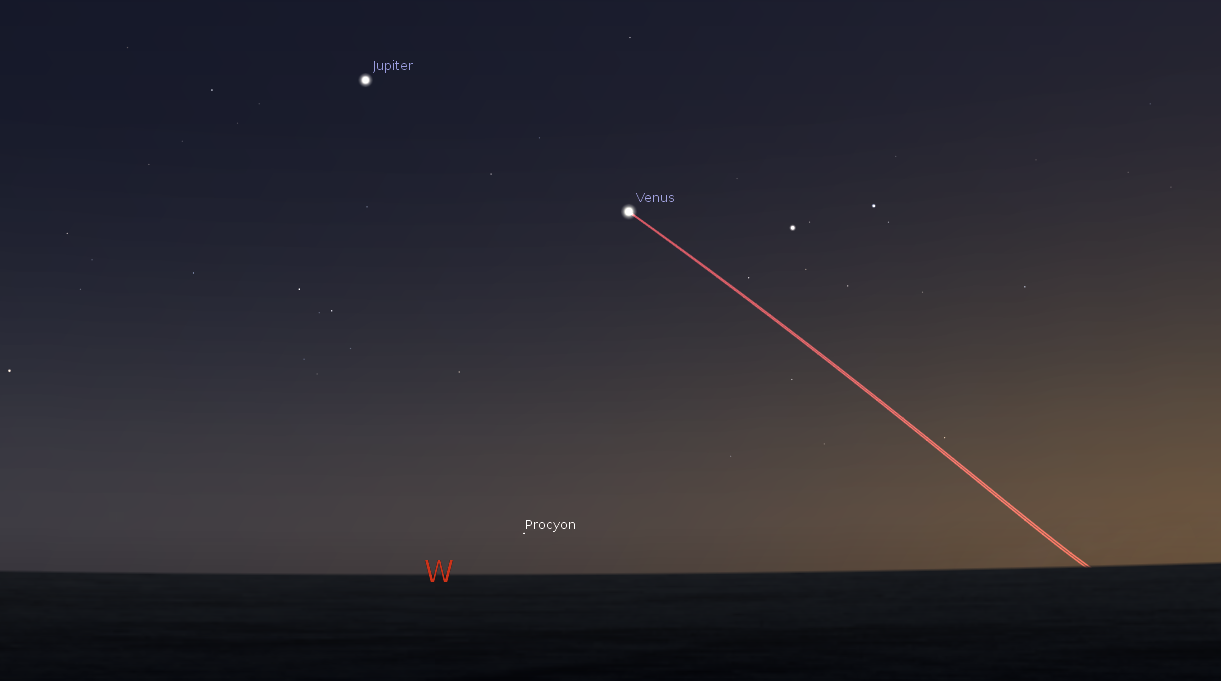
Venus at elongation with a plot of its orbit as seen from Earth at 10:30 p.m. June 6, 2015. Note that the orbit appears at a line. It is this time of year that the Earth passes through the plane of Venus’ orbit. Back in 2012 this occurred when Venus was at inferior conjunction on June 5th. It passed in front of the Sun in the rare transit of Venus. Created using Stellarium.
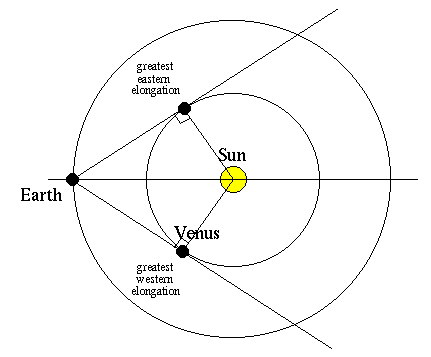
Diagram showing the geometry of a greatest elongation. Note that the sight line is perpendicular to the Venus-Sun line. So the phase should be exactly at dichotomy (half illuminated). Additional lines added to an uncredited diagram.
06/01/2015 – Ephemeris – Starting orbit 41 looking at June skies
Ephemeris for Monday, June 1st. Today the Sun will be up for 15 hours and 20 minutes, setting at 9:21. The Moon, 1 day before full, will set at 6:17 tomorrow morning and tomorrow the Sun will rise at 6:00.
We’ll start Ephemeris’ 41st orbit of the Sun by looking at the skies of June. There’ will be a lot of sun in June and very little night. The daylight hours will increase a bit from 15 hours and 20 minutes today to 15 hours and 34 minutes on the 21st, retreating back to 15 hours 31 minutes at month’s end. At this time of the year the sunset times for Ludington, Interlochen, Petoskey and Mackinaw City are very nearly the same. However the sunrise times are at their most divergent. With Ludington’s sunrise being 14 minutes later than Mackinaw City’s. The altitude of the sun above the southern horizon at local noon will hover around 68 to 69 degrees. Local noon, when the sun is actually due south will occur at about 1:43 p.m. Here’s what we’ve been waiting for: Summer will start on the 21st at 12:38 p.m.
Times are for the Traverse City/Interlochen area of Michigan. They may be different for your location.
Addendum
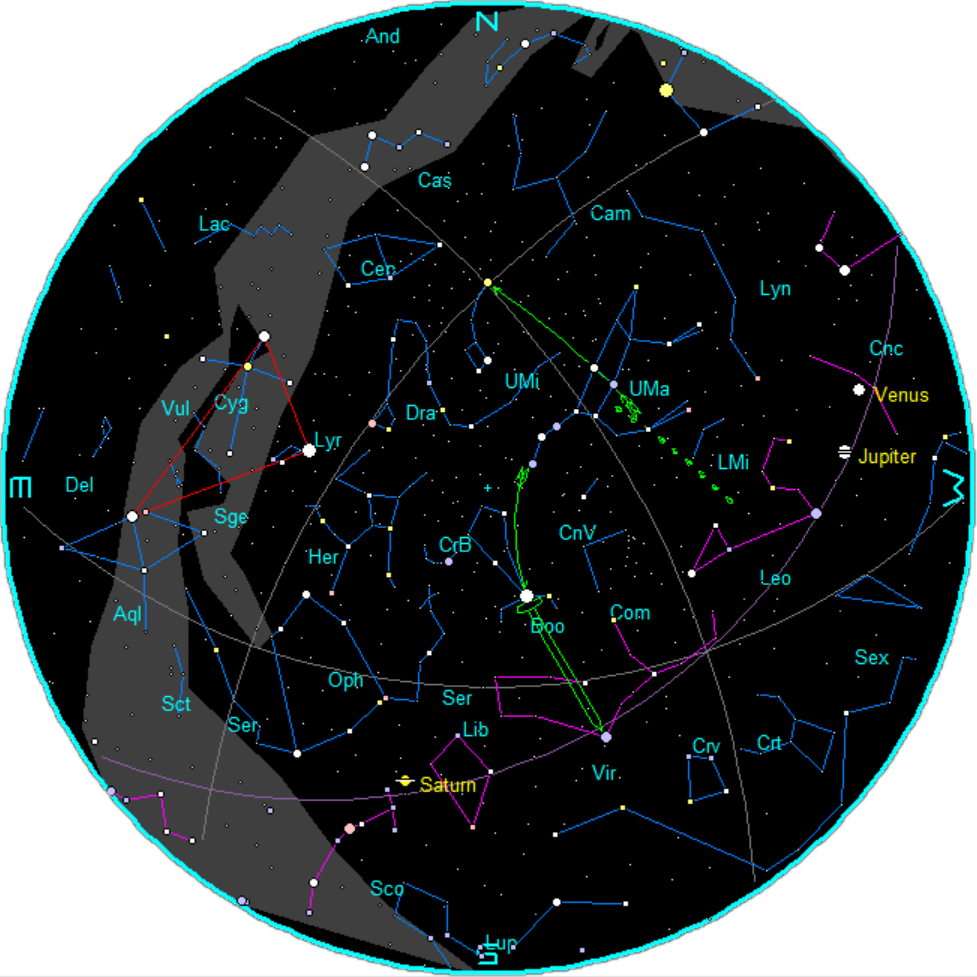
Star Chart for June 2015. Created using my LookingUp program.
The Moon is not plotted.
The planets and stars are plotted for the 15th at 11 p.m. EDT. That is chart time. Note, Traverse City is located 1 hour 45 minutes behind our time meridian. To duplicate the star positions on a planisphere set it to 1 hour 45 minutes earlier than the current time.
Evening Astronomical twilight ends at 11:43 p.m. EDT on June 1st, increasing to midnight EDT on the 30th.
Morning astronomical twilight starts at 4:38 a.m. EDT on June 1st, and decreasing to 3:31 a.m. EDT on the 30th.
Add a half hour to the chart time every week before the 15th and subtract and hour for every week after the 15th.
For a list of constellation names to go with the abbreviations click here.
The green pointer from the Big Dipper is:
- Pointer stars at the front of the bowl of the Big Dipper point to Polaris the North Star.
- Drill a hole in the bowl of the Big Dipper and the water will drip on the back of Leo the Lion.
- Follow the arc of the Big Dipper’s handle to Arcturus
- Continue with a spike to Spica
- The Summer Triangle is shown in red
Calendar of Planetary Events
Credit: Sky Events Calendar by Fred Espenak and Sumit Dutta (NASA’s GSFC)
To generate your own calendar go to http://eclipse.gsfc.nasa.gov/SKYCAL/SKYCAL.html
Times are Eastern Daylight Time on a 24 hour clock. Some additions made to aid clarity.
Conjunctions like the Moon-Saturn: 2.1° S means Saturn will appear 2.3° south of the Moon.
| Jun | 01 | Mo | Venus: 45.3° E | |
| 01 | Mo | 16:02 | Moon-Saturn: 2° S | |
| 02 | Tu | 12:19 | Full Moon | |
| 03 | We | 17:10 | Moon South Dec.: 18.4° S | |
| 06 | Sa | 14:59 | Venus Elongation: 45.4° E | |
| 09 | Tu | 11:42 | Last Quarter | |
| 10 | We | 00:39 | Moon Perigee: 369700 km | |
| 10 | We | 19:29 | Moon Descending Node | |
| 13 | Sa | 04:59 | Venus-Beehive: 0.6° N | |
| 14 | Su | 10:39 | Mars Solar Conjunction | |
| 16 | Tu | 10:05 | New Moon | |
| 16 | Tu | 15:47 | Moon North Dec.: 18.5° N | |
| 20 | Sa | 07:28 | Moon-Venus: 6.3° N | |
| 21 | Su | 12:38 | Summer Solstice | |
| 23 | Tu | 05:39 | Mercury-Aldebaran: 1.9° N | |
| 23 | Tu | 13:01 | Moon Apogee: 404100 km | |
| 24 | We | 07:03 | First Quarter | |
| 24 | We | 12:59 | Mercury Elongation: 22.5° W | |
| 24 | We | 13:23 | Moon Ascending Node | |
| 28 | Su | 21:27 | Moon-Saturn: 2.1° S | |
| 30 | Tu | 22:14 | Venus-Jupiter: 0.3° N | |
| Jul | 01 | We | 02:48 | Moon South Dec.: 18.4° S |
| 01 | We | Venus: 42.4° E | ||
 Bob Moler's Ephemeris Blog