Archive
03/20/2015 – Ephemeris – Spring will spring forth at 6:44 p.m. EDT
Ephemeris for Friday, March 20th. The Sun will rise at 7:46. It’ll be up for 12 hours and 8 minutes, setting at 7:55. The Moon is new today, and won’t be visible.
The Arctic solar eclipse has just ended. But there is one more event of note today. At 6:44 p.m. The Sun will cross the celestial equator heading northward, the projection of the Earth’s equator on the sky. In doing that the season of spring will return to the northern hemisphere. The Sun is already staying up for just over half the day. That will increase to fifteen and a half hours by the summer solstice three months from now. Not only will the Sun will be out longer, but it will rise higher in the sky, rising from 45 degrees altitude in the south at local noon to 69 degrees on June 21st. If the sun stayed at this location it would get very uncomfortable with the heat. As it is as the Sun is climbing down it will still get warmer. Peak summer heat occurs about a month after the solstice.
Times are for the Traverse City/Interlochen area of Michigan. They may be different for your location.
Addendum
These are whole sky diagrams with the edge at the horizon. The Sun’s motion is from left to right. The Sun is plotted every 15 minutes. The Sun’s motion is constant, however the projection causes squeezing of the positions near the zenith (center of the diagram) and stretching near the horizon.
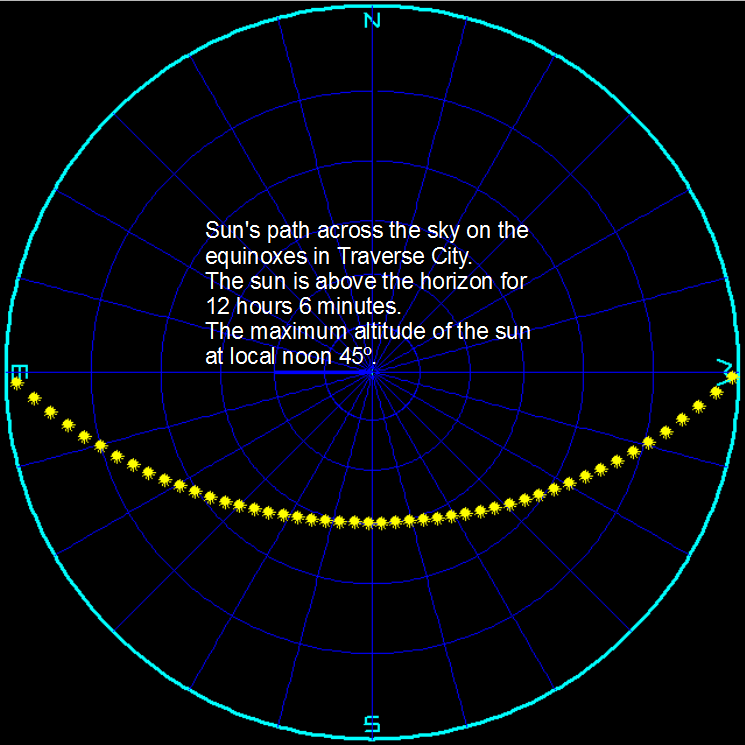
The sun’s daily path through the sky from horizon to horizon on an equinox the first day of spring or autumn. Credit My LookingUp program.
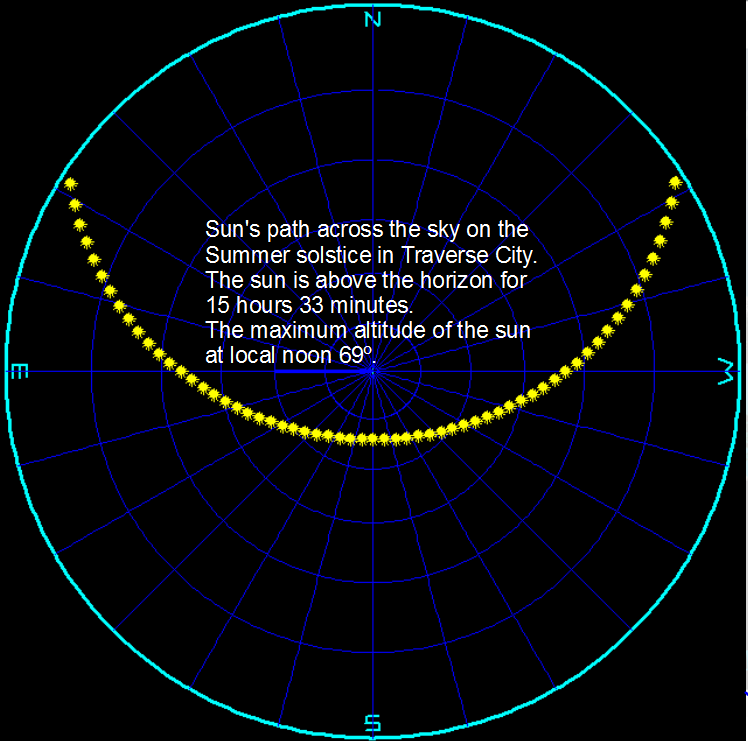
The sun’s daily path through the sky from horizon to horizon on the first day of summer, the summer solstice. Credit My LookingUp program.
03/20/2014 – Ephemeris – Spring is a few hours away
Ephemeris for Thursday, March 20th. The sun will rise at 7:45. It’ll be up for 12 hours and 9 minutes, setting at 7:54. The moon, 3 days before last quarter, will rise at 12:24 tomorrow morning.
Just hang on for a few more hours and winter will be over. At 12:57 p.m. this afternoon (16:57 UT, March 20, 2014) the sun will appear to cross the earth’s celestial equator heading northward signaling the start of spring in the northern hemisphere. Unfortunately our weather won’t change that instantaneously. The word equinox means equal night, meaning at day and night are of equal length. However due to how astronomers actually define the instant of sunrise and sunset we are already above 12 hours daylight, and increasing by 3 minutes a day. The southern hemisphere of the earth will see the start of autumn as we see spring. The sun will rise due east today and set due west, which may mean hazardous visibility on east west roads with the low sun for a few days.
Times are for the Traverse City/Interlochen area of Michigan. They may be different for your location.
Addendum
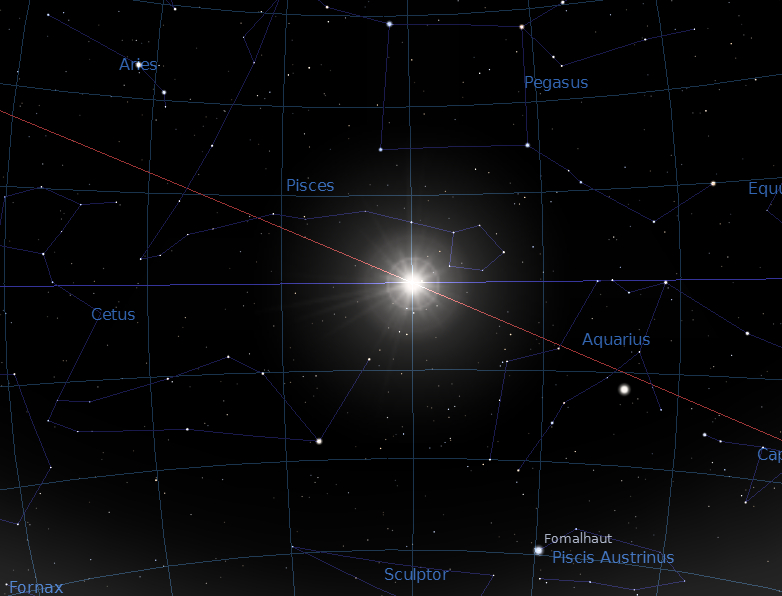
The sun at the vernal equinox point in the sky. The horizontal line the sun is crossing is the celestial equator. The red line is the sun’s path, the ecliptic. The sun is heading to the upper left. Created using Stellarium.
03/20/2013 – Ephemeris – When does spring start, and where is Comet PanSTARRS and the bright planets this week?
Ephemeris for Wednesday, March 20th. The sun will rise at 7:45. It’ll be up for 12 hours and 10 minutes, setting at 7:55. The moon, 1 day past first quarter, will set at 4:17 tomorrow morning.
The sun will cross the earth equator shortly at 7:02 a.m. bringing the season of spring. It’s the vernal equinox. Comet PanSTARRS is in the west northwest low on the horizon. It can best be seen about 9:15 or so. It will set at 9:52 p.m. Jupiter is located in the constellation of Taurus and is in the high southwest during the evening. It will set at 2:00 a.m. Jupiter is a wonderful sight in telescopes with its cloud bands and its moons which change positions each night. The other bright planet Saturn will rise at 11:12 p.m. in the east southeast. It’s located in eastern Virgo. Saturn will pass due south at 4:24 a.m. Saturn is the most beautiful of planets when seen in telescopes. It will be in the southwest for early risers.
Times are for the Traverse City/Interlochen area of Michigan. They may be different for your location.
Addendum
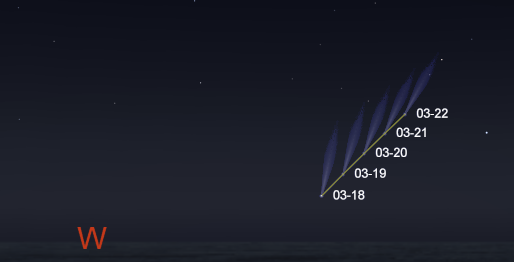
Comet PanSTARRS in the next 5 days at 9:15 p.m. Created using Stellarium and Cartes du Ciel.
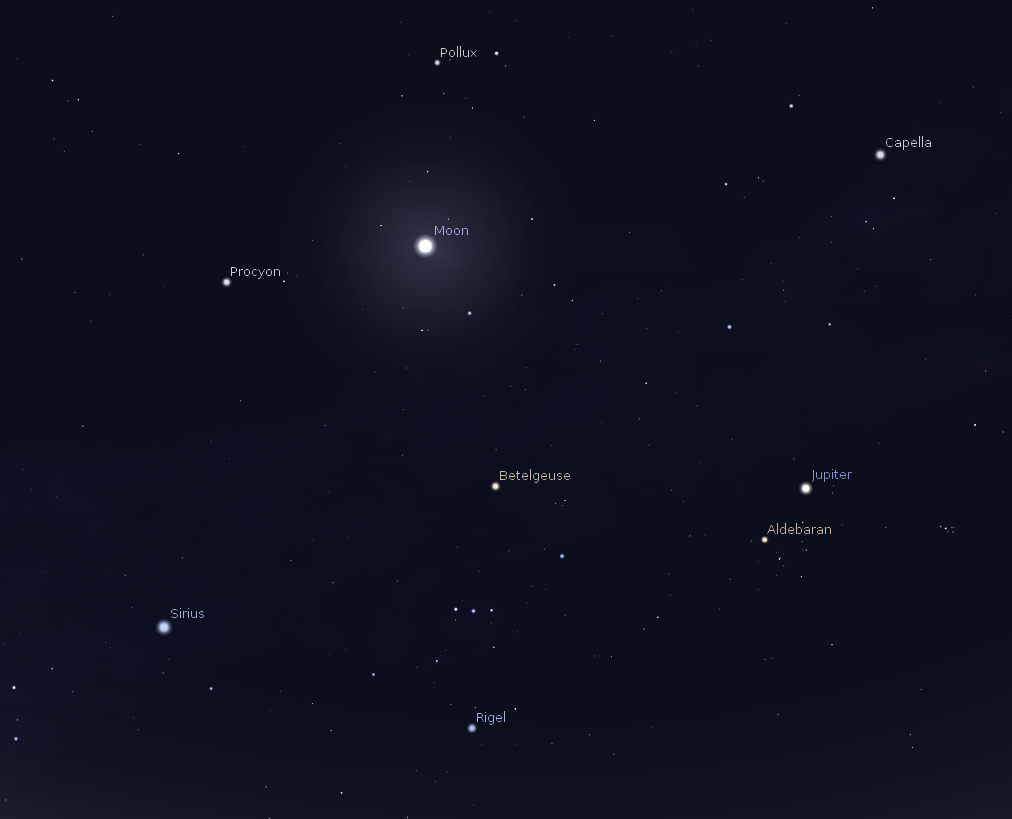
Jupiter, the moon and winter stars at 10 p.m. on March 20, 2013. Created using Stellarium.
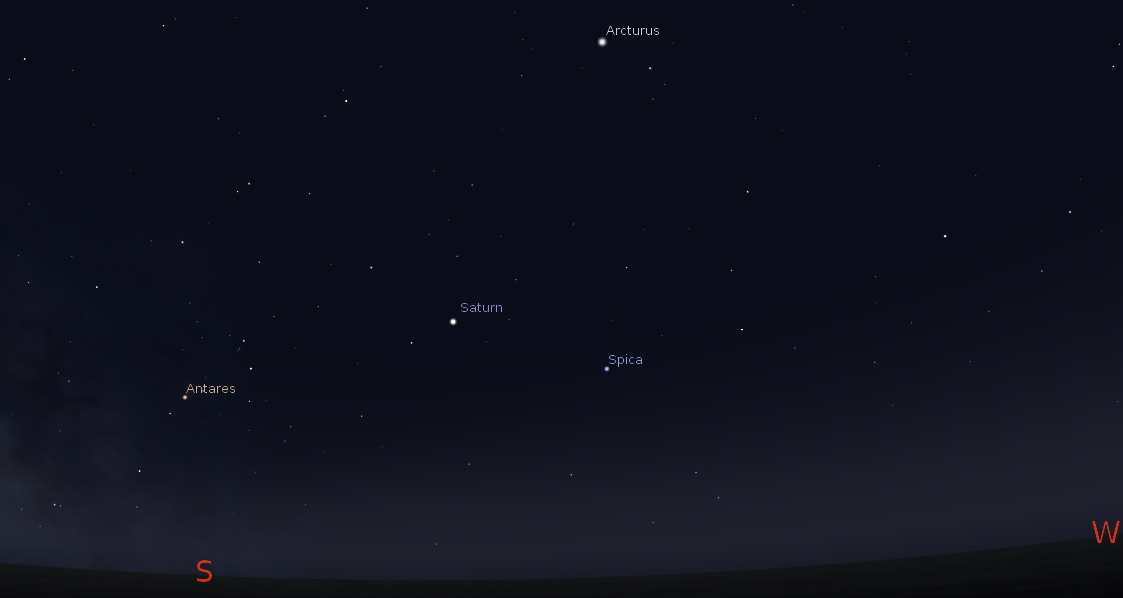
Saturn and the morning stars at 6 a.m. on March 21, 2013. Created using Stellarium.
03/19/2013 – Ephemeris – PanSTARRS, of course, plus a spring preview
Ephemeris for Tuesday, March 19th. The sun will rise at 7:47. It’ll be up for 12 hours and 6 minutes, setting at 7:53. The moon, at first quarter today, will set at 3:38 tomorrow morning.
Comet PanSTARRS continues to be seen low in evening twilight. It is moving now into the west northwest. When it becomes dark enough it will display a fan shaped tail in binoculars. It is moving away from both the sun and the earth. Tomorrow will see our own milestone as the earth moves into a position where the sun appears over the earth’s equator, and the sun sets at the south pole of the earth and rises at the north pole. It will be the vernal or spring equinox. Australians and other folks south of the equator may prefer to call it the March equinox, because for them autumn starts. The exact time the sun will appear to cross the equator heading northward will be 7:02 tomorrow morning. The sun will keep heading northward until June 21st.
Times are for the Traverse City/Interlochen area of Michigan. They may be different for your location.
Addendum
Comet PanSTARRS for this week’s weekdays at 9:15 p.m. Created using Stellarium and Cartes du Ciel.

The earth as seen from the sun near the vernal equinox. See the earth from north pole to south pole. Created using Celestia.
03/20/2012 – Ephemeris – First day of spring
Ephemeris for Tuesday, March 20th. The sun will rise at 7:44. It’ll be up for 12 hours and 10 minutes, setting at 7:55. The moon, 2 days before new, will rise at 6:54 tomorrow morning.
At 1:14 this morning the season of spring started. The sun crossed the celestial equator heading northward. On the day of the equinox, either today’s vernal equinox or September’s autumnal equinox the sun rises due east and sets due west. From today until that September date the sun will rise and set north of those points. The sun will also rise higher in the sky until the summer solstice. The combination of longer daylight hours and it rising higher in the sky will mean more solar heat falling on the northern hemisphere of the earth and less falling on the southern. This will give us spring and summer, and the southern hemisphere autumn and winter. After a really screwy winter I wonder what spring and summer will bring.
* Times are for the Traverse City/Interlochen area of Michigan. They may be different for your location.
Heading to work the morning before the equinox
Turning onto M72 east in Acme I was presented with the sun half risen on top of the hill. This was taken a minute or so later.

03/19/2012 – Ephemeris – The last day of winter
Ephemeris for Monday, March 19th. The sun will rise at 7:46. It’ll be up for 12 hours and 7 minutes, setting at 7:54. The moon, 3 days before new, will rise at 6:30 tomorrow morning.
This is the last full day of winter. And a strange winter it is, ending today with record high temperatures. Tomorrow at 1:14 a.m. spring will officially start. At that time the earth will move to a point in its orbit where the sun will appear to cross the equator in the sky, and will appear to pass directly overhead if you lived on the equator. The event of the crossing and the point on the celestial sphere that the sun crosses the equator is called the vernal equinox. It’s the Greenwich of the heavens. All measurements east and west in the sky are measured from this point. And its position in relation to the prime meridian on the earth at Greenwich, near London is the fundamental measure of the earth’s rotational position.
* Times are for the Traverse City/Interlochen area of Michigan. They may be different for your location.
Addendum
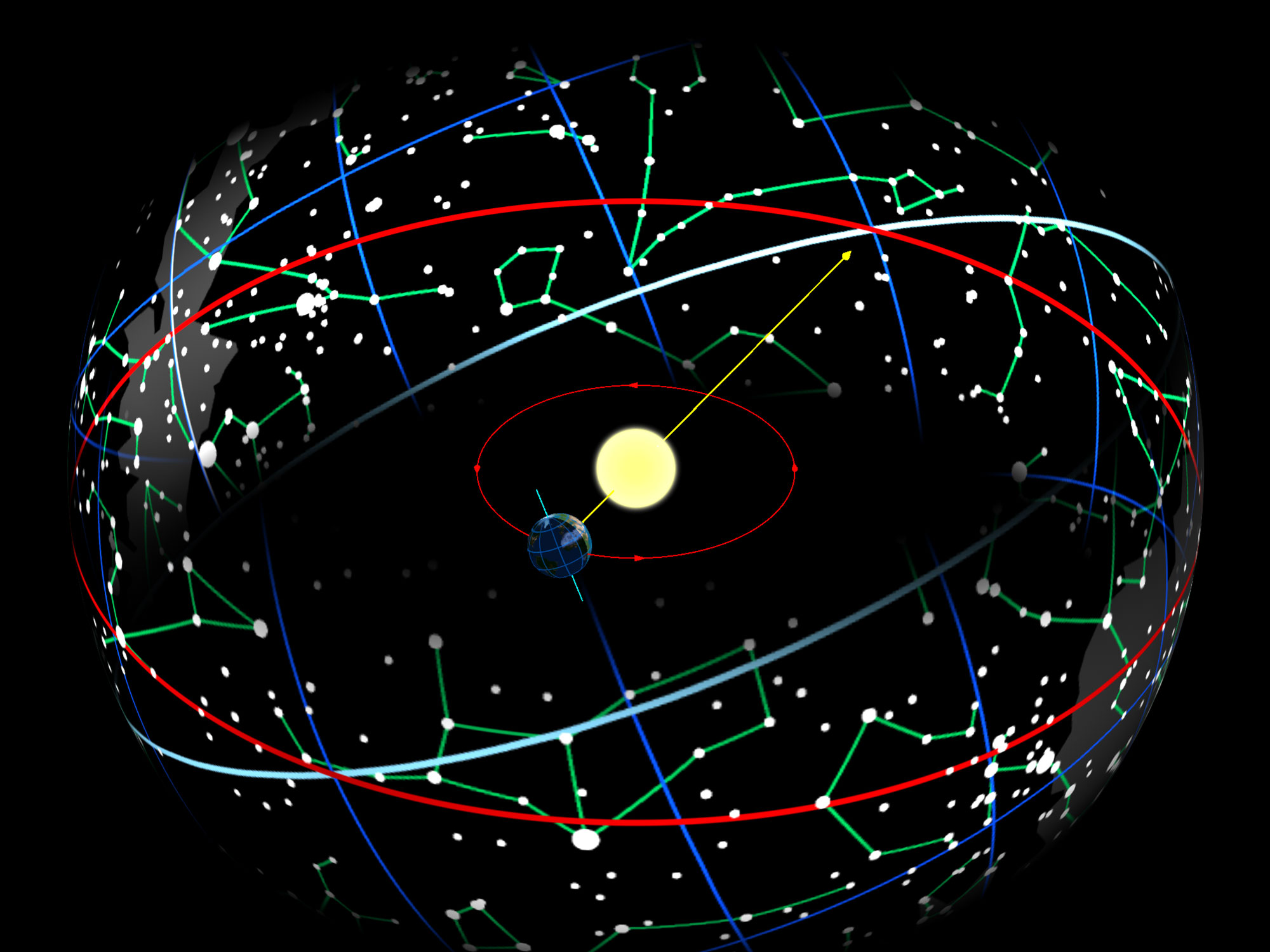
The sun at the vernal equinox. Diagram by Wikipedia contributor Tauʻolunga GNU Free Document License
Click on image to enlarge.
03/18/11 – Ephemeris – Spring is almost here
Ephemeris for Friday, March 18th. The sun will rise at 7:49. It’ll be up for 12 hours and 2 minutes, setting at 7:52. The moon, 1 day before full, will set at 7:16 tomorrow morning.
We are now two days and some hours from the beginning of spring. Spring will arrive at 7:21 p.m. Sunday evening. At that instant the sun will appear to cross the celestial equator, the projection of the earth’s equator on the sky, heading northward. This will give us six months of over 12 hours daylight, culminating on June 21st with over 15 and a half hours of daylight for our listening area. This is the spring or vernal equinox, or to be hemisphericaly correct, the March equinox, because those folks south of the equator will begin autumn. Earth’s seasons are due to the tilt of its axis by 23 and a half degrees. The earth’s axis is nearly fixed in space, but changes its orientation with respect to the sun during our yearly orbit.
* Times are for the Traverse City/Interlochen area of Michigan. They may be different for your location.
 Bob Moler's Ephemeris Blog