Archive
Ephemeris: 12/25/2025 – Christmas night stars
Merry Christmas! This is Ephemeris for Christmas Day, Thursday, December 25th. Today the Sun will be up for 8 hours and 48 minutes, setting at 5:07, and it will rise tomorrow at 8:19. The Moon, 2 days before first quarter, will set at 11:01 this evening.
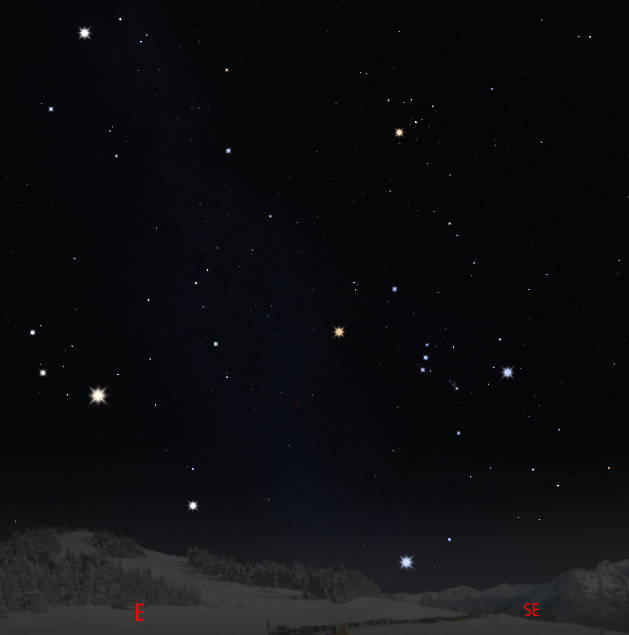
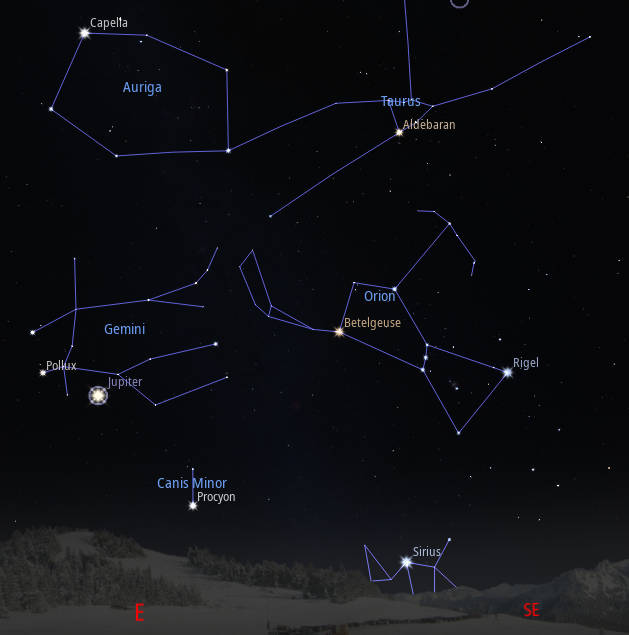
The real star of Bethlehem is probably not what is popularly depicted as a bright star in the sky, rather it was something subtle, only noticed by some astrologers. However, gracing our skies tonight we do have, in the evening, a brilliant star-like object, and our usual winter sprinkling of bright real stars in the southeastern sky. I call the one star-like because it’s a planet, Jupiter to be specific. The term “planet” we get from the Greeks, meaning wanderer. Planets don’t actually wander. Their paths can be determined, and are affected by the Sun, mainly and the other planet’s gravitational attraction. Perhaps the Magi, thought the cause was by divine action, to set them on their journey. Again have a Merry Christmas!
The astronomical event times given in this blog are for the Traverse City/Interlochen area of Michigan (Lat 44.7° N, Long 85.7° W; EST, UT – 5 hours) unless stated otherwise. Times will be different for other locations.
Addendum
Ephemeris: 12/04/2025 – Orion survives a full moon
This is Ephemeris for Thursday, December 4th. Today the Sun will be up for 8 hours and 59 minutes, setting at 5:02, and it will rise tomorrow at 8:04. The Moon, at full today, will rise at 4:24 this evening.
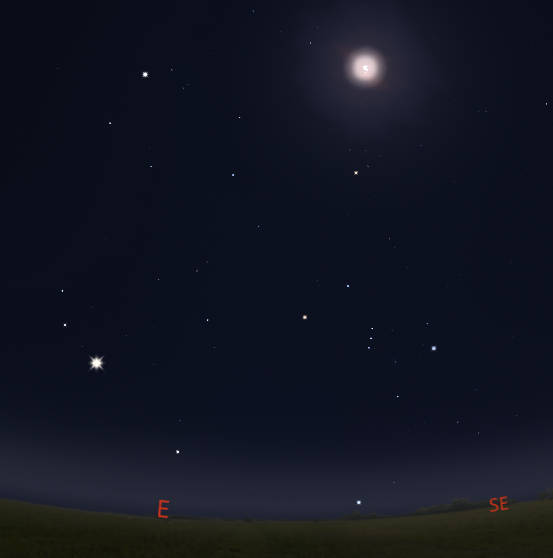
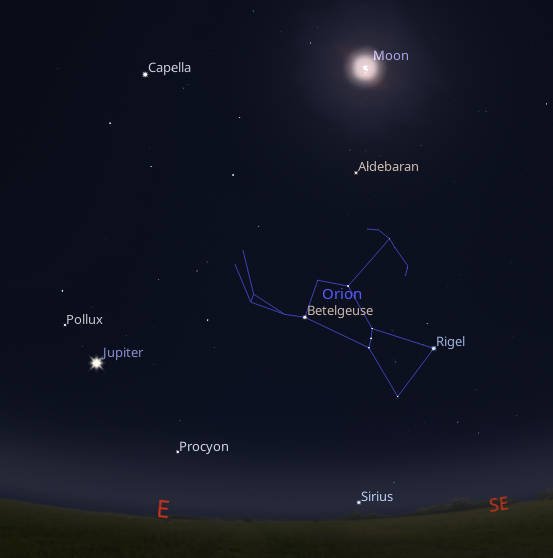
While the full moon overpowers most stars, the bright stars of winter persist. This is even true with tonight’s supermoon, a bit larger and brighter than average. Nowhere in the sky is there a concentration of bright stars as there is in the winter sky. I know it’s not winter yet, but if you stay up late enough, say 10 PM, all the winter stars will be in the sky. Last to rise is the brightest star of all, Sirius. And by 10 o’clock will be low in the southeast. Jupiter has joined the winter stars this year, outshining them all. As a constellation the mighty hunter Orion is easiest to spot on a full moon night, containing seven very bright stars, with three bright stars in a straight line as his belt, which most folks find as his most distinctive feature.
The astronomical event times given in this blog are for the Traverse City/Interlochen area of Michigan (Lat 44.7° N, Long 85.7° W; EDT, UT – 4 hours) unless stated otherwise. Times will be different for other locations.
Addendum
 Bob Moler's Ephemeris Blog