Archive
11/12/10 – Ephemeris – Viewing Night tomorrow
Friday, November 12th.* The sun will rise at 7:35. It’ll be up for 9 hours and 42 minutes, setting at 5:17. The moon, 1 day before first quarter, will set at 11:26 this evening.
Tomorrow night the Grand Traverse Astronomical Society and NMC Astronomy Club will host a public viewing night at Northwestern Michigan College’s Rogers Observatory starting at 9 p.m. On tap, if it’s clear, will be the moon, and the planets Jupiter and possibly Uranus which will appear near Jupiter. There are also some interesting binary stars and star clusters visible including the famous Double Cluster, and using binoculars or telescope finder scopes, the even more famous Pleiades or Seven Sisters may be seen. The NMC Astronomy Club has hand on activities for visitors, especially the kids, in case of cloudy skies. The observatory is located south of Traverse City, on Birmley Road between Garfield and Keystone roads.
* Times, as always are for the Traverse City/Interlochen area of Michigan.
11/11/10 – Ephemeris – The Greeks measured the moon and the earth
Veteran’s Day, Thursday, November 11th. The sun will rise at 7:33. It’ll be up for 9 hours and 45 minutes, setting at 5:18. The moon, 2 days before first quarter, will set at 10:22 this evening.
Check out the moon tonight. The Greeks were able to use it to make two great discoveries. First they knew that lunar eclipses were caused by the moon entering the earth’s shadow. That wasn’t the discovery, the discovery was that the edge of the earth’s shadow was always circular. The only object that casts a circular shadow no matter what its orientation is a sphere. So the Greeks knew the earth was round long before the birth of Christ. They were also able to determine the distance of the moon via eclipses as 60 earth radii, which is within the moon’s actual distance range. It was in the 3rd century B.C. that Eratosthenes determined the circumference of the earth to provide an actual distance scale to the moon.
* Times, as always are for the Traverse City/Interlochen area of Michigan.
11/10/10 – Ephemeris – The bright planets this week
Wednesday, November 10th.* The sun will rise at 7:32. It’ll be up for 9 hours and 47 minutes, setting at 5:19. The moon, 3 days before first quarter, will set at 9:18 this evening.
Lets take a look at the bright planets for this week. Mars is very low and lost in the evening twilight. The planet Jupiter is up at sunset appearing in the southeastern sky in the early evening. It will move due south at 9:01 p.m.. It is the brightest starlight object in the sky. It’s located in Pisces this year and will set at 2:47 a.m. The ringed planet Saturn will rise at 4:20 a.m. in the east southeast. It’s located in the constellation Virgo this year. It’s rings are opening nicely for telescopic observers. Venus is in the morning sky and will rise at 5:56 a.m. in the east southeast but may be hard to spot in the twilight. Mercury is also too close to the sun to be seen. It’s near where Mars is this year, in the evening sky.
* Times, as always are for the Traverse City/Interlochen area of Michigan.
11/09/10 – Ephemeris – The constellations Triangulum and Aries
Ephemeris for Tuesday, November 9th.* The sun will rise at 7:31. It’ll be up for 9 hours and 50 minutes, setting at 5:21. The moon, half way from new to first quarter, will set at 8:13 this evening.
High in the south at 9 p.m. can be seen the Great Square of Pegasus. From the top left star of the square diverge two curved lines of stars that is Andromeda the chained princess. Just below and left of Andromeda is a slender triangle of stars, none particularly bright. It has a name you can easily see in the stars, Triangulum, the triangle. Early Christians saw it as the Mitre of Saint Peter or the Trinity. Another small constellation seen below Triangulum is the much better known constellation Aries the ram, a small hockey stick constellation, not that hard to spot. It is the first constellation of the Zodiac, where the sun is supposed to enter on the first day of spring. Due to the wobble of the earth’s axis, that honor is now given to Pisces.
* Times, as always are for the Traverse City/Interlochen area of Michigan.
11/08/10 – Ephemeris – The constellation Pisces
Monday, November 8th. The sun will rise at 7:29. It’ll be up for 9 hours and 52 minutes, setting at 5:22. The moon, 3 days past new, will set at 7:11 this evening.
High in the south at 9 p.m. are the four bright stars of the Great Square of Pegasus, the upside down flying horse. Lying along the left and bottom sides of that square is the constellation of Pisces the fish, one of the 12 constellations of the Zodiac that lie along the path of the sun, moon and planets. Even though the constellation is called the fish, the fish themselves are not represented in the stars. What can be traced in the stars is the rope, that’s tied to their tails, anchored at the extreme southeastern part of the constellation. The right or western end of the Pisces is the asterism, or informal constellation, of the Circlet. It’s the loop of 5 stars, the rope around the tail of one of the two fish. And this year the planet Jupiter is right below it.
* Times, as always are for the Traverse City/Interlochen area of Michigan.
The biggest dog bone I’ve ever seen.
On November 4th the Deep Impact spacecraft passed inside of 500 miles from the nucleus of Comet Hartley 2. The image below is the first of 5 images released by NASA after the close pass. There are more images to come including some high resolution images. Thanks to Arecibo radio telescope radar images last week we knew this comet had a nucleus with an odd shape. That wasn’t the half of it.
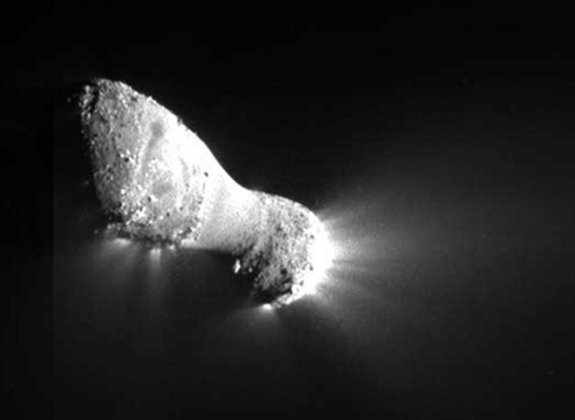
Comet Hartley 2 Medium resolution image. Image credit: NASA/JPL-Caltech/UMD
Emily Lakdawalla of the Planetary Society Blog has some more images and some thoughts on the origin of this celestial “dog bone” Here, here and here.
11/05/10 -Ephemeris – GTAS Meeting
Ephemeris for Friday, November 5th.* The sun will rise at 8:25. It’ll be up for 10 hours and 0 minutes, setting at 6:26. The moon, 1 day before new, will rise at 9:09 tomorrow morning.
A star Bowl quiz will be held this evening between the NMC astronomy club and the Grand Traverse Astronomical Society at this evening’s meeting of the society at 8 p.m. at Northwestern Michigan College’s Rogers Observatory. This will be an attempt to avenge the loss suffered by the GTAS to the college kids in June. The form of the quiz last time was like the Jeopardy game show. The quiz master was NMC astronomy professor Jerry Dobek, who soon found that the number of questions were too few and the quiz went very fast. I expect that this time there will be more questions, or is that answers. Just a heads up: This is the weekend of the time change. Before you go to bed Saturday night set your clock back one hour.
* Times, as always are for the Traverse City/Interlochen area of Michigan.
11/04/10 – Ephemeris – Comet Hartley Intercept
Thursday, November 4th.* The sun will rise at 8:24. It’ll be up for 10 hours and 3 minutes, setting at 6:27. The moon, 2 days before new, will rise at 7:52 tomorrow morning.
The Deep Impact spacecraft, which witnessed the impact of its Impactor into Comet Tempel 1 in 2005 has been redirected to Comet Hartley 2. At 10:01 this morning it will pass its closest to that comet at 434 miles. This is the EPOXI mission, the retargeting of the spacecraft to a new comet. The Arecibo radio telescope on Puerto Rico has already reached out and touched the Nucleus of Comet Hartley 2 and has released its images, showing the nucleus to be a skinny bowling pin shape a bit less than a mile and a half long and tumbling slowly at a rate of 13 to 18 hours. The spacecraft will be positioned to protect itself from the escaping particles of the comet and to photograph the comet, so will not have its antenna pointed to the earth until after the encounter.
Times, as always are for the Traverse City/Interlochen area of Michigan.
 Bob Moler's Ephemeris Blog