Archive
01/31/11 – Ephemeris – February preview
Monday, January 31st. The sun will rise at 8:02. It’ll be up for 9 hours and 46 minutes, setting at 5:49. The moon, 2 days before new, will rise at 7:01 tomorrow morning.
Let’s preview February the shortest month. Through out the month the daylight hours will be getting longer at an increasing pace. Daylight hours will increase from 9 hours and 51 minutes tomorrow to 11 hours and 6 minutes on the 28th. The sunrise time will decrease from 8:02 tomorrow to 7:21 at month’s end. The sunset times will increase from 5:51 on the 1st to 6:29 on the 28th. Along with that the altitude of the sun at noon will increase from 28 degrees to nearly 38 degrees during the month. Local noon, by the way for Interlochen and Traverse City is about 12:55 p.m, which is mainly due to the fact that our standard time meridian happens to run through Philadelphia. The Stardust spacecraft will swing past comet Tempel 1 on the 14th.
* Times are for the Traverse City/Interlochen area of Michigan. They may be different for your location.
01/28/11 – Ephemeris – The constellation Gemini
Friday, January 28th. The sun will rise at 8:05. It’ll be up for 9 hours and 39 minutes, setting at 5:45. The moon, 2 days past last quarter, will rise at 4:48 tomorrow morning.
The constellation Gemini, the Twins is visible high in the southeast at 9 p.m. The namesake stars of the two lads, will be on the left edge of the constellation, vertically aligned. Castor is on the top, while Pollux, a slightly brighter star is below. Lines of stars from Castor and Pollux to the right delineate the lads. In Greek mythology Castor and Pollux were twins, and half brothers, Castor was fathered by a mere mortal, while Pollux was fathered by Zeus in the famous Leda and the swan affair. The brothers, however were inseparable, and when Castor was killed during the quest for the Golden Fleece, Pollux pleaded with Zeus to let him die also. Zeus granted his wish, so both appear in the sky together forever.
* Times are for the Traverse City/Interlochen area of Michigan. They may be different for your location.
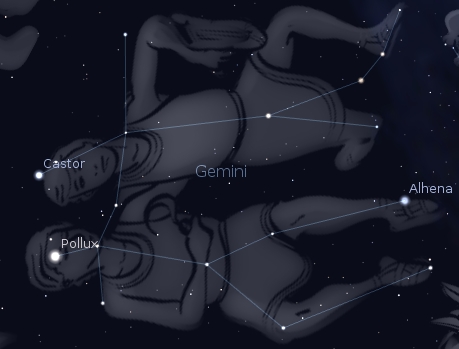
Gemini with Castor and Pollux. Created with Stellarium.
01/27/11 – Ephemeris – Mars at superior conjunction
Thursday, January 27th. The sun will rise at 8:06. It’ll be up for 9 hours and 37 minutes, setting at 5:44. The moon, 1 day past last quarter, will rise at 3:46 tomorrow morning.
Starting today the planet Mars will be too close to the direction of the sun to send commands from the earth to Opportunity rover and satellites orbiting it.. The sun is noisy in the radio spectrum. This is seen in the spring and fall when geosynchronous satellite signals are lost when the satellite passes in front of the sun. This blackout isn’t total. The Mars Odyssey orbiter will be receiving data from te rover daily and relaying it back to the earth but at a very slow bit rate. The disruption of communications will last two weeks centered on February 4th when Mars will seem pass two sun diameters south of the sun. In reality it will be 129 million miles behind the sun. and 221 million miles from the earth.
* Times are for the Traverse City/Interlochen area of Michigan. They may be different for your location.
01/26/11 – Ephemeris – The bright planets this week
Wednesday, January 26th. The sun will rise at 8:07. It’ll be up for 9 hours and 34 minutes, setting at 5:42. The moon, at last quarter today, will rise at 2:37 tomorrow morning.
Lets take a look at the bright planets for this week. Mars is very near the direction of the sun and I’ll have more about it tomorrow. The planet Jupiter is up in the southwestern sky in the early evening. It is a spectacular sight in a telescope with its four satellites, shifting their positions from night to night, and the cloud bands running in the directions of the satellites. Jupiter is the brightest star-like object in the evening. It’s located left the Circlet in Pisces now and will set at 10:23 p.m. The ringed planet Saturn will rise at 11:40 p.m. in the east southeast and will move due south at 5:25 a.m. Venus is brilliant in the morning sky and will rise at 5:02 a.m. in the east southeast. Mercury is now too close to the direction of the sun to be seen.
* Times are for the Traverse City/Interlochen area of Michigan. They may be different for your location.
01/25/11 – Ephemeris – The constellation Lepus the hare
Tuesday, January 25th. The sun will rise at 8:08. It’ll be up for 9 hours and 32 minutes, setting at 5:41. The moon, 1 day before last quarter, will rise at 1:25 tomorrow morning.
Orion, the central winter constellation is seen in the south southeast at 9 p.m. He is a hunter, but is preoccupied in defending himself from the charge of Taurus the bull to the upper right. At Orion’s feet, and unnoticed by him is the small constellation of Lepus the hare. It’s very hard to see a whole rabbit in its eight dim stars: however, I do see a rabbit’s head, ears and shoulders. A misshapen box is the head and face of this critter facing to the left. His ears extend upwards from the upper right star of the box, and the bend forward a bit. Two stars to the right of the box and a bit farther apart show the front part of the body. The free computer program Stellarium shows a different orientation to the hare. You might check it out at Stellarium.org.
* Times are for the Traverse City/Interlochen area of Michigan. They may be different for your location.
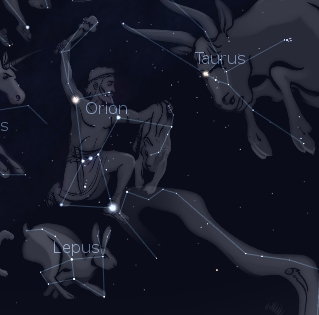
Lepus and a preoccupied Orion. Image from Stellarium.
01/24/11 – Ephemeris – Orion’s dark cloud
Monday, January 24th. The sun will rise at 8:09. It’ll be up for 9 hours and 30 minutes, setting at 5:39. The moon, 2 days before last quarter, will rise at 12:10 tomorrow morning.
Orion is the great constellation in the south tonight at 9 p.m. The three stars in a straight line are his belt which is framed by a large upright rectangle of bright stars. From his belt are three stars visible to the naked eye. More stars are seen here in binoculars or a telescope plus the glow of the Great Orion Nebula. A great part of the constellation is backed up by a huge dark molecular cloud of dust and gas. It is nearly invisible except in the areas of star formation like the Great Orion Nebula and in the infrared. Molecular clouds contain molecular Hydrogen, along with carbon monoxide, oxygen and other molecules, some of which are complex organic compounds. Long exposure photographs also show a large arc of gas called Barnard’s loop off the left side of the Orion rectangle.[, part of a supernova that exploded 2 million years ago.]
* Times are for the Traverse City/Interlochen area of Michigan. They may be different for your location.
01/21/11 – Ephemeris – The Winter Circle
Friday, January 21st. The sun will rise at 8:12. It’ll be up for 9 hours and 23 minutes, setting at 5:35. The moon, 2 days past full, will rise at 8:19 this evening.
The winter skies are blessed with more first magnitude stars than any other season. With the bright moon out these stars will stand out even more, as dimmer stars are suppressed. Six of these stars lie in a large circle centered on the seventh. This circle is up at 9 p.m. Starting high in the east is Capella in Auriga the charioteer. Moving down clockwise is Aldebaran in the face of Taurus the Bull. Then down to Orion’s knee we find Rigel. Down and left is the brightest star of all Sirius the Dog Star in Canis Major, lowest of these stars in the southeast. Moving up and left is Procyon in Canis Minor, Above Procyon is Pollux in Gemini the twins. All these are centered on Betelgeuse the bright red star in Orion’s shoulder.
* Times are for the Traverse City/Interlochen area of Michigan. They may be different for your location.
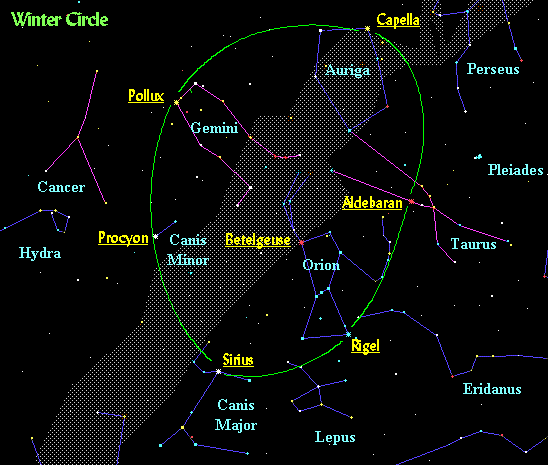
The Winter Circle of 1st magnitude stars
01/20/11 – Ephemeris – The bright star Capella
Thursday, January 20th. The sun will rise at 8:12. It’ll be up for 9 hours and 21 minutes, setting at 5:34. The moon, 1 day past full, will rise at 7:00 this evening.
A bright star called Capella is now nearly overhead in the east. Capella is the highest of winter’s seven brilliant first magnitude stars. Capella never quite sets for anyone north of Ludington. Due to its brightness, and being the closest first magnitude star to the pole, Capella appears to move slowly as the earth rotates, and spends summer and autumn evenings close to the northern horizon, and has in years past elicited a few phone calls and other queries about that ‘bright object in the northeast’. Capella belongs to the pentagonal constellation of Auriga the Charioteer. Capella represents a mother goat he is holding. Three stars in a thin triangle nearby are her kids. The star at the top of the triangle is an eclipsing binary star with a 27 year period.
* Times are for the Traverse City/Interlochen area of Michigan. They may be different for your location.
01/19/11 – Ephemeris – The bright planets for this week
Wednesday, January 19th. The sun will rise at 8:13. It’ll be up for 9 hours and 19 minutes, setting at 5:33. The moon, at full today, will rise at 5:41 this evening.
Lets take a look at the bright planets for this week. Mars is very low and lost in the evening twilight. The planet Jupiter is up in the southwestern sky in the early evening. It is a spectacular sight in a telescope with its four satellites, shifting their positions from night to night, and the cloud bands running in the directions of the satellites. Jupiter is the brightest starlight object in the evening. It’s located below left the Circlet in Pisces now and will set at 10:49 p.m. The ringed planet Saturn will rise at 12:08 a.m. in the east southeast. Venus is brilliant in the morning sky and will rise at 4:52 a.m. in the east southeast. Mercury will rise at 6:59 in the east southeast. Mercury may be seen by about 7: 30 a.m. low in the east southeast with binoculars.
* Times are for the Traverse City/Interlochen area of Michigan. They may be different for your location.
01/18/11 – Ephemeris – Antimatter from thunderstorms
Tuesday, January 18th. The sun will rise at 8:14. It’ll be up for 9 hours and 17 minutes, setting at 5:31. The moon, 1 day before full, will set at 7:51 tomorrow morning.
The Fermi gamma ray satellite has detected gamma rays from an unusual source. The Earth. Specifically from thunder storms. That isn’t the weird part. The gamma rays produced in the storm interact with electrons in the upper atmosphere producing a positron-electron pair that tangles with the earth’s magnetic field where Fermi detects it. Positrons are anti-electrons which can be produced artificially on the earth, and are used in medical PET scans. While scientists know how lightning is produced in a general way they do not know deep down the exact mechanism that produces lightning. That goes for thunderstorms on the earth and lightning in the atmospheres of the other planets. Lightning is still a mysterious phenomenon.
* Times are for the Traverse City/Interlochen area of Michigan. They may be different for your location.
 Bob Moler's Ephemeris Blog