Archive
01/17/11 – Ephemeris – Professor Kunkle’s “Bombshell”
Martin Luther King Day, Monday, January 17th. The sun will rise at 8:14. It’ll be up for 9 hours and 15 minutes, setting at 5:30. The moon, 2 days before full, will set at 7:09 tomorrow morning.
Minneapolis astronomy professor Parke Kunkle recently gave an interview with a reporter stating that the constellations of the Zodiac no longer match the astrological Zodiacal signs. This caused a great sensation, with people calling up their astrologers wondering what it would do to their horoscopes. Kunkle’s little bombshell is covered in every first year astronomy course in the precession of the equinoxes, shifting the constellations by one in about 2200 years. Kunkle also mentioned a thirteenth constellation of the Zodiac. Scorpius lies mostly below the ecliptic or path of the sun in the sky. The area above the scorpions tail is Ophiuchus the serpent bearer. I am an Ophiuchucan, and we Ophiuchans don’t believe in astrology.
* Times are for the Traverse City/Interlochen area of Michigan. They may be different for your location.
01/14/11 – Ephemeris – Names and meanings of the bright stars in Orion
Friday, January 14th. The sun will rise at 8:16. It’ll be up for 9 hours and 10 minutes, setting at 5:26. The moon, 2 days past first quarter, will set at 4:20 tomorrow morning.
The constellation of Orion the hunter is visible in the southeast at 9 p.m. The stars of Orion are interesting in themselves. I’ve already talked about two of them. Starting at the top left of the seven bright stars of Orion’s torso is Betelgeuse the bright red star, whose name means something like “Armpit of the Giant”. The star in Orion’s other shoulder is Bellatrix the “Amazon Star”. Below are the three stars of Orion’s belt, from left to right; Alnitak, Alnilam and Mintaka. Their names mean “Girdle”, “Belt of Pearls”, and “Belt” respectively. Down to Orion’s knees we look on the left to the star Saiph which means “Sword”, though it is some ways from the stars of Orion’s sword. Finally there’s the bright blue-white star Rigel whose name means ”left Leg of the Giant”.
* Times are for the Traverse City/Interlochen area of Michigan. They may be different for your location.
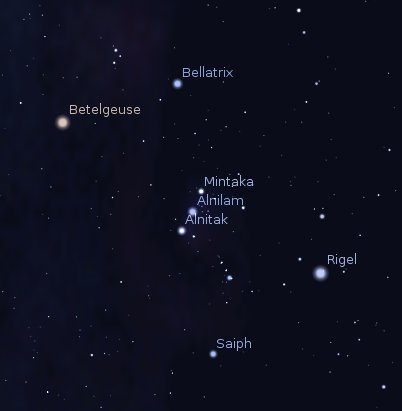
Orion with star names
Update:
I’ve added this image created from the free planetarium program Stellarium showing the stars and their names. Download it from www.stellarium.org.
01/13/11 – Ephemeris – The bright star Rigel
Thursday, January 13th. The sun will rise at 8:16. It’ll be up for 9 hours and 8 minutes, setting at 5:25. The moon, 1 day past first quarter, will set at 3:15 tomorrow morning. | A week ago I talked about the star Betelgeuse the bright red star in the top left of Orion’s upright rectangle. Orion is seen in the southeast at 9 in the evening. The blue-white star in Orion’s opposite corner is usually brighter. It is Rigel whose longer Arabic name of which Rigel is the first part means Left Leg of the Giant. Rigel is a giant itself, actually a super giant star, which is more a measure of its mass than its size, that of 17 solar masses. Its surface temperature is more than twice as hot as the sun. It is 85 thousand times as bright as the sun and 50 times its diameter. Its distance is around 773 light years. Those with telescopes might be able to spot a close companion star to Rigel, just at the edge of the bright arc light image of Rigel itself.
* Times are for the Traverse City/Interlochen area of Michigan. They may be different for your location.
01/12/11 – Ephemeris – The bright planets visible this week
Wednesday, January 12th. The sun will rise at 8:17. It’ll be up for 9 hours and 7 minutes, setting at 5:24. The moon, at first quarter today, will set at 2:11 tomorrow morning.
Lets take a look at the bright planets for this week. Mars is very low and lost in the evening twilight. The planet Jupiter is up in the southwestern sky in the early evening. It is a spectacular sight in a telescope with its four satellites, shifting their positions from night to night, and the cloud bands running in the directions of the satellites. Jupiter is the brightest starlight object in the evening. It’s located below left the Circlet in Pisces now and will set at 11:05 p.m. The ringed planet Saturn will rise at 12:35 a.m. in the east southeast. Venus is brilliant in the morning sky and will rise at 4:43 a.m. in the east southeast. Mercury will rise at 6:44 in the east southeast. Mercury may be seen by about 7: 30 a.m.
* Times are for the Traverse City/Interlochen area of Michigan. They may be different for your location.
01/11/11 – Ephemeris – Stardust spacecraft flyby of Comet Tempel 1 in 34 days
Tuesday, January 11th. The sun will rise at 8:17. It’ll be up for 9 hours and 5 minutes, setting at 5:23. The moon, 1 day before first quarter, will set at 1:08 tomorrow morning.
The Stardust spacecraft is 34 days from its flyby of the comet Tempel 1 on Valentine’s day. This is the comet visited and impacted by the spacecraft Deep Impact five and a half years ago, on the 4th of July 2005. The purpose of this flyby is to study the impact crater created by Deep Impact, and the changes in the comet’s nucleus since the last encounter. Comet’s undergo wear and tear as they approach the sun sublimating their ices and liberating dust that forms their head and tail. The Stardust spacecraft is having some problems. It hasn’t imaged the comet for fine guidance yet, and apparently it has less maneuvering fuel than initially thought. In order to image the impact crater the rotation period of the comet must be known to a great precision. I’m not sure they do.
* Times are for the Traverse City/Interlochen area of Michigan. They may be different for your location.
01/10/11 – Ephemeris – Venus and Mercury at greatest western elongation
Monday, January 10th. The sun will rise at 8:18. It’ll be up for 9 hours and 3 minutes, setting at 5:22. The moon, 2 days before first quarter, will set at 12:07 tomorrow morning.
Over the weekend Venus and Mercury both reached their greatest western elongation from the sun, That is their greatest separation from the sun, Venus at 47 degrees, and Mercury at 23 degrees. Venus is easy to spot in the southeast in the morning now. Mercury rises this morning at 6:40. By possibly 7:30 there will be a time between the growing twilight and the rising of Mercury to be high enough to be spotted. Mercury will be close to the horizon off to the lower left of Venus. Don’t be confused with the star below Venus, that is the red giant star Antares. Binoculars are a great help is spotting Mercury low in the brightening twilight. The visibility of Mercury will continue for the rest of the week.
* Times are for the Traverse City/Interlochen area of Michigan. They may be different for your location.
Extra
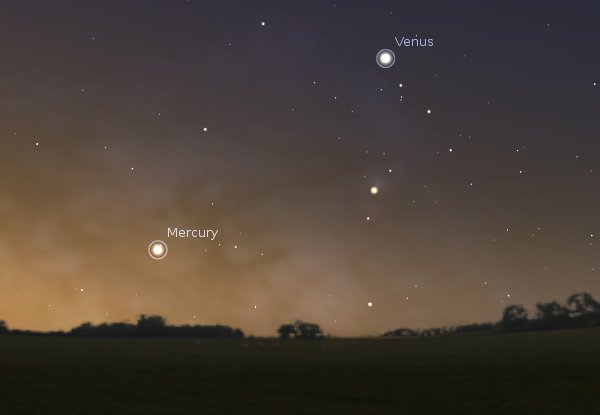
Venus and Mercury at 7:30 a.m. the week of January 10, 2011
This illustration is created using Stellarium. The sky will be brighter and Mercury fainter than shown here.
01/07/11 – Ephemeris – Local astronomical events this weekend
Friday, January 7th. The sun will rise at 8:18. It’ll be up for 8 hours and 59 minutes, setting at 5:18. The moon, 3 days past new, will set at 9:03 this evening.
Previewing astronomy and space events for 2011 will be the topic at this evening’s meeting of the Grand Traverse Astronomical Society at Northwestern Michigan College’s Rogers Observatory starting at 8 p.m. Yours truly will be giving the presentation highlighting the events of the new year which encompass a cometary flyby, and the orbiting of the planet Mercury and the asteroid Vesta. Plus viewing opportunities for us on the ground. Also tomorrow even there will be a viewing night at the observatory featuring the moon, Jupiter and the Great Orion Nebula. That also starts at 8 p.m. If it’s cloudy there will be some hands on activities lead by the NMC Astronomy Club. The observatory’s located south of Traverse City on Birmley Road.
* Times are for the Traverse City/Interlochen area of Michigan. They may be different for your location.
01/06/11 – Ephemeris – The bright star Betelgeuse
Thursday, January 6th. The sun will rise at 8:19. It’ll be up for 8 hours and 58 minutes, setting at 5:17. The moon, 2 days past new, will set at 8:00 this evening.
The bright red star in constellation Orion’s shoulder is Betelgeuse, and its now thought to be about 640 light years away. Betelgeuse is a shortened form of an Arabic phrase that means “Armpit of the central one”. Orion is seen in the southeast at 9 in the evening. Even at Betelgeuse’ great distance it’s the star whose surface is easiest seen, after the sun of course. That’s because it’s so big. As large around as the half the size of the orbit of Jupiter. Betelgeuse is losing mass in a huge cloud around it. It is a massive star in the late stages of its life. Some astronomers speculate that it will explode in a massive supernova within the next million years. [Astronomers also speculate that Betelgeuse may have originated from the area of Orion’s belt twice a far away from us.]
*Text in brackets was omitted due to time constraints
* Times are for the Traverse City/Interlochen area of Michigan. They may be different for your location.
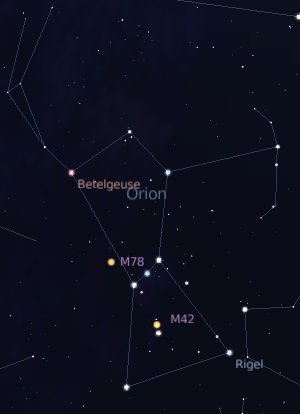
Orion via Stellarium.org
01/05/11 – Ephemeris – The bright planets this week
Wednesday, January 5th. The sun will rise at 8:19. It’ll be up for 8 hours and 57 minutes, setting at 5:16. The moon, 1 day past new, will set at 6:55 this evening.
Lets take a look at the bright planets for the first time in 2011. Mars is very low and lost in the evening twilight. The planet Jupiter is up in the south southwestern sky in the early evening. It is a spectacular sight in a telescope with its four satellites, shifting their positions from night to night, and the cloud bands running in the directions of the satellites. Jupiter is the brightest starlight object in the evening. It’s located below the Circlet in Pisces now and will set at 11:27 p.m. The ringed planet Saturn will rise at 1:01 a.m. in the east southeast. It’s located in the constellation Virgo this year. It’s rings are opening nicely for telescopic observers. Venus is brilliant in the morning sky and will rise at 4:34 a.m. in the east southeast.
* Times are for the Traverse City/Interlochen area of Michigan. They may be different for your location.
 Bob Moler's Ephemeris Blog