Archive
11/16/11 – Ephemeris – Where are the bright planets this week?
Wednesday, November 16th. The sun will rise at 7:40. It’ll be up for 9 hours and 33 minutes, setting at 5:13. The moon, 2 days before last quarter, will rise at 10:29 this evening.
It’s Wednesday and time again to take a look at the whereabouts of the bright planets. The planet Venus is still rather close to the sun in the evening setting at 6:28, and should be visible by 5:45. Jupiter is now the prominent planet of the evening sky located in the east and southeast and is seen against the stars of the constellation Aries. It will pass due south at 11:03 p.m. In a telescope it will be accompanied by its 4 brightest moons. The moons and planetary features change from night to night and sometimes while you watch. Jupiter will set at 5:50 a.m.. Mars will rise at 12:28 a.m in the east northeast and will be left of the star Regulus in the constellation Leo tomorrow morning.. [It is 134 million miles away and closing.]
* Times, as always are for the Traverse City/Interlochen area of Michigan. Bracketed passage was omitted from the audio program due to time constraints.
Scott Anttila got a great shot of the lunar crater Theophilus
This is cool. My Monday post on the moon talked about the crater Theophilus. My old astronomy friend Scott Anttila was able to get a great image of this crater. It compare’s favorably with the Virtual Moon Atlas image. First, here’s his image:
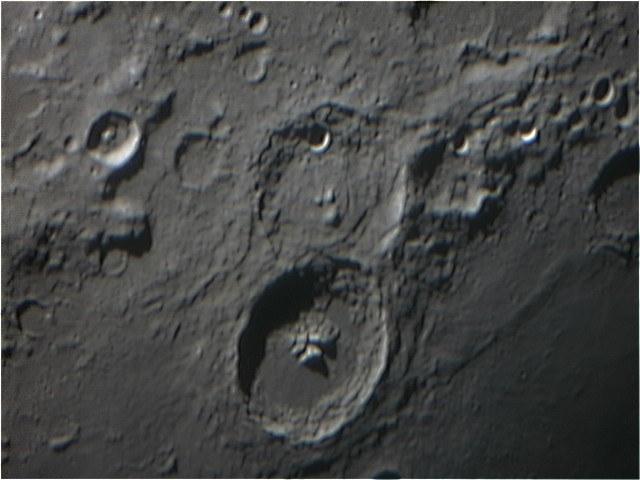
The Crater Theophilus. Credit: Scott Anttila.
I had to flip the image to match the map below.
Here’s my Virtual Moon Atlas Image from Monday:
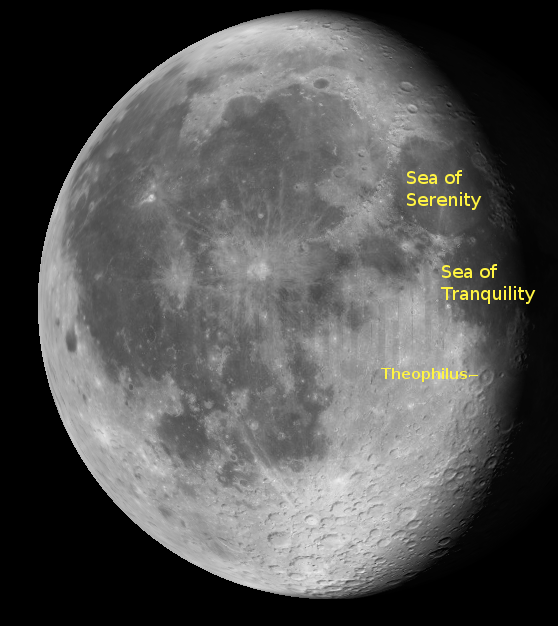
Waning Gibbous Moon 11/14/11 9 p.m. Created with Virtial Moon Atlas.
Thanks Scott!
See why I love that crater?
11/15/11 – Ephemeris – Prospects for the Leonid meteor shower
Tuesday, November 15th. The sun will rise at 7:38. It’ll be up for 9 hours and 36 minutes, setting at 5:14. The moon, 3 days before last quarter, will rise at 9:22 this evening.
This is an off peak year for the Leonid meteor shower but astronomers are finding more and more Leonid dust streams. These dust streams are created when the comet, in this case Tempel-Tuttle passes its closest to the sun. They end up preceding or following the comet near its orbit but are affected by the tiny force of sunlight and end up diverging more and more from the comet itself. Three dust streams are expect to be encountered by the earth this year. The stream from the1800 passage of the comet is expected to pass the earth tomorrow afternoon to be picked up as radio echos only. Also Thursday and Friday afternoon there are also expected peaks. All invisible from here, but possibly visible from Asia.
* Times, as always are for the Traverse City/Interlochen area of Michigan.
Information gleaned from the International Meteor Organization Meteor Shower Calendar 2011: http://imo.net/calendar/2011.
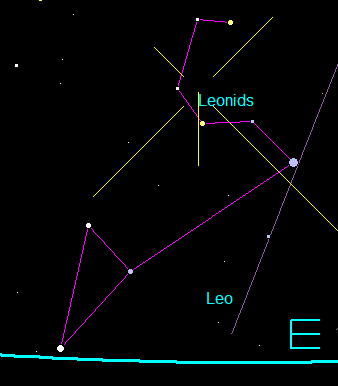
Leonid meteor radiant
11/14/11 – Ephemeris – The moon tonight
Monday, November 14th. The sun will rise at 7:37. It’ll be up for 9 hours and 38 minutes, setting at 5:15. The moon, half way from full to last quarter, will rise at 8:19 this evening.
The moon will be a waning gibbous phase tonight. The terminator is now the sunset line sweeping slowly across the moon. To the unaided eye or binoculars darkness will be falling across the Sea of Tranquility on the moon’s equator and will start to cross the Sea of Serenity above it. Below Tranquility is of my favorite craters Theophilus with its central peak will again stand out in shadows. It won’t be very close to the terminator tonight, but by tomorrow night it will be in the moon’s night and gone from our sight. The moon’s days and nights last nearly 15 days each. We are lucky to have a large satellite orbiting the earth. We may never know how important the role it had to play in establishing life on the earth.
* Times, as always are for the Traverse City/Interlochen area of Michigan.
Addendum
Waning Gibbous Moon 11/14/11 9 p.m. Created with Virtial Moon Atlas.
11/11/11 – Ephemeris – More on Jupiter
Veteran’s Day, Friday, November 11th. The sun will rise at 7:33. It’ll be up for 9 hours and 45 minutes, setting at 5:19. The moon, 1 day past full, will rise at 5:43 this evening.
Lets check out again the giant planet Jupiter, visible in the southeastern sky in the evening. Jupiter is more massive than all the other planets, moons, and asteroids twice over. [In fact the famous science and science fiction writer Isaac Asimov once stated that the solar system consists of the sun, Jupiter and debris.] Jupiter is huge, 11 times the earth’s diameter, and 13 hundred times its volume. It is mostly made of hydrogen with methane and ammonia clouds. In the deeper parts of Jupiter the temperature rises as the pressure increases, compressing the hydrogen into a hot sea. Thee is nowhere on Jupiter to land. Below that it turns into a liquid metallic hydrogen, and Jupiter’s rapid 10 hour spin creates a huge magnetic field and radiation bands.
* Times are for the Traverse City/Interlochen area of Michigan. They may be different for your location. Text in brackets omitted from program due to time constraints.
11/10/11 – Ephemeris – The planet Venus
Thursday, November 10th. The sun will rise at 7:32. It’ll be up for 9 hours and 48 minutes, setting at 5:20. The moon, at full today, will rise at 5:05 this evening.
The planet Venus is about to become visible low in the southwest after sunset. It might be visible a half hour after sunset. Venus is way beyond the sun now and coming around toward the earth. It will take some months to move around the sun toward the earth. As it does it will grow in size and its phase will wane. In white light Venus appears as a featureless cloud covered ball. It is illuminated by the sun, and so its appearance will change as it moves around the sun. And when it passes between the earth and the sun on June 6th next year, it will do so in grand style by passing in front of the sun as a transit of Venus which will not reoccur for 105 years. From our location, we will be able to see he start of that transit in the late afternoon.
* Times are for the Traverse City/Interlochen area of Michigan. They may be different for your location.
11/09/11 – Ephemeris – Where are the bright planets this week?
Wednesday, November 9th. The sun will rise at 7:30. It’ll be up for 9 hours and 50 minutes, setting at 5:21. The moon, 1 day before full, will set at 7:25 tomorrow morning.
It’s Wednesday and time again to take a look at the whereabouts of the bright planets. The planet Venus is still rather close to the sun in the evening setting at 6:25, 64 minutes after the sun and not really visible. Jupiter is now the prominent planet of the evening sky located in the east and southeast and is seen against the stars of the constellation Aries, and to the right of the moon tonight. It will pass due south at 11:30 p.m. In a telescope it will be accompanied by its 4 brightest moons. The moons and planetary features change from night to night and sometimes while you watch. Mars will rise at 12:38 a.m also in the east northeast and is moving between the constellations of Cancer and Leo. Mars is 139 million miles away and closing.
* Times are for the Traverse City/Interlochen area of Michigan. They may be different for your location.
11/08/11 – Ephemeris – Asteroid 2005 YU55 will pass the earth tonight
Election Day, Tuesday, November 8th. The sun will rise at 7:29. It’ll be up for 9 hours and 53 minutes, setting at 5:22. The moon, 2 days before full, will set at 6:25 tomorrow morning.
Tonight a small asteroid will sail past the earth. It may be small as asteroids go, but it’s a quarter mile in diameter. The asteroid’s designation is 2005 YU55, and it will pass is within the orbit of the moon at 198,000 miles. The moon’s average distance is 240,000 miles. This is the kind of asteroid that is too small to be picked up by current searches in any great percentages. Back in 2005 it was found after it passed the earth, not quite early detection. The folks who track these things think that we’re safe from this one for the next 200 years or so. If 2005 YU55 were to hit it would unleash the power of a hydrogen bomb of thousands of megatons of TNT. [It would be devastating, but no radiation. The dinosaur killer was tens of thousands of times larger.]
* Times are for the Traverse City/Interlochen area of Michigan. They may be different for your location. Text in brackets omitted from program due to time constraints.
11/07/11 – Ephemeris – A closer look at Jupiter
Monday, November 7th. The sun will rise at 7:27. It’ll be up for 9 hours and 55 minutes, setting at 5:23. The moon, 3 days before full, will set at 5:24 tomorrow morning.
Jupiter is the planet to spot in the evening sky. It’s in the east in the early evening. I’ve talked to some folks who thought it was Venus. Jupiter is second only to Venus in brightness, but where it is now, opposite the sun in the sky, is a place Venus never can be because its orbit is closer to the sun than the earth. Jupiter is bright because it is big. It’s 5 times earth’s distance from the sun, so sunlight is diluted by a factor of 25 by the inverse square law. It’s 11 times the earth’s diameter. Square that, and its surface area is roughly 120 times that of the earth, so it reflects more light totally than Venus but appears somewhat fainter because it’s much farther than Venus. Volume wise Jupiter is 1,300 times the volume of the earth, but is only 318 times as massive as the earth.
* Times are for the Traverse City/Interlochen area of Michigan. They may be different for your location.
11/04/11 – Ephemeris – GTAS activities this weekend plus fall back
Friday, November 4th. The sun will rise at 8:23. It’ll be up for 10 hours and 3 minutes, setting at 6:27. The moon, 2 days past first quarter, will set at 3:23 tomorrow morning.
This evening the Grand Traverse Astronomical Society will be holding its monthly meeting at Northwestern Michigan College’s Rogers Observatory at 8 p.m. This evening we will have a special program by the student astronomers of NMC. And tomorrow night there will be a public viewing night from 8 to 10 p.m. with Jupiter and the moon as the featured targets if it will be clear. You can never tell if it’s going to be clear or cloudy until its time to observe, especially this year. The observatory is located south of Traverse City on Birmley Road between Garfield and Keystone Roads. Tomorrow night also we fall back by turning our clocks back one hour as standard time resumes. It’s going to be a lot darker in the evenings now.
* Times are for the Traverse City/Interlochen area of Michigan. They may be different for your location.
 Bob Moler's Ephemeris Blog