01/13/2012 – Ephemeris – The moon passes Mars tonight
Friday, January 13th. The sun will rise at 8:17. It’ll be up for 9 hours and 8 minutes, setting at 5:25. The moon, 3 days before last quarter, will rise at 10:52 this evening.
This evening the moon will pass below the planet Mars after the moon rises near 11 p.m. Mars is rather distant now, and it won’t be really near in its next close approach to us on March 5th when it will be slightly under 63 million miles away. In telescopes Mars is and will remain a tiny disk with a hint of a white polar cap on one end. Photographers with large telescopes and CCD cameras can capture Mars even better and show some surface detail. We have even closer views of Mars. Of course there is an operating rover called Opportunity still active on the planet and the Curiosity rover on its way plus three orbiting satellites, two US and one European. The satellites will be cruising overhead as Curiosity lands August 5th.
* Times, as always are for the Traverse City/Interlochen area of Michigan.
Addendum
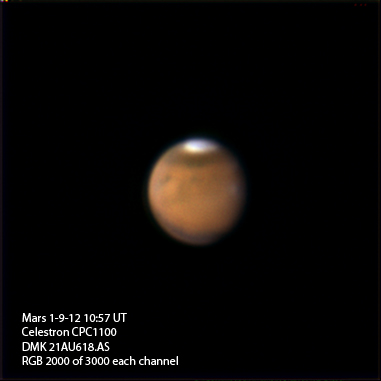
Mars on the morning of January 9, 2012. By Scott Anttila
Here’s Scott Anttila’a image of Mars from Monday morning, the 9th. Note Mar’s gibbous phase. Mars will become full when it’s at opposition from the sun March 3rd. It is only 9.7 seconds of arc in diameter. Also note, beside the northern polar cap that’s quite obvious, there is a hazy patch near the right edge of Mars. It is what telescopic astronomers of a hundred years ago called Nix Olympica, the Snows of Olympus. When the Mariner 9 spacecraft reached Mars in 1971 it found that there was a real mountain there. So the feature was renamed Olympus Mons or Mount Olympus. The white haze isn’t snow but water ice clouds that condense over the mountain peak. Mount Olympus is 14 miles high, three times taller than Mt Everest. The closest earth analog to it is the volcanic peak Mauna Kea on the island of Hawaii. Actually you’d have to throw in the entire island of Hawaii itself from the sea floor on up.
 Bob Moler's Ephemeris Blog
Great picture
Hey, thanks for the blog! I’ve been reading your weblog for 2 or 3 days now and i’m definitely having fun with it. I actually had a couple of questions regarding your article though. Ya think it will be achievable for me to get in touch with you further to debate it? Perhaps set up a chat on email or an instant messanging program? In any other case, thanks anyway and I’ll continue to read and comment.
I don’t IM. However my email is bob(at)bjmoler.org.
What was needed now were craft that could find those lifeforms, a task that has proved awkward and elusive but which may soon be resolved, say scientists. The first stab at following Mariner 9 was made when the US embarked on the Viking missions of 1976. These involved two craft being carried to Mars and landed with precision on its surface. Soil was scooped from the surface and analysed in tiny robot laboratories for evidence of biological activity. “It was an incredibly expensive undertaking,” says Taylor. “And it was a great success – except that there didn’t appear to be any life. People were very disappointed. They wanted to find life but they didn’t.” After that, Nasa gave up on Mars for 20 years. Martian studies reached an all-time low until, in 1996, Nasa scientists, led by David McKay, announced they had found possible signs of life on a Martian meteorite called ALH84001.