07/19/2012 – Ephemeris – The constellation Cygnus the swan
Ephemeris for Thursday, July 19th. Today the sun will be up for 15 hours and 5 minutes, setting at 9:21. The moon is new today, and won’t be visible. | Tomorrow the sun will rise at 6:16.
High in the east northeast as it gets dark flies the constellation of Cygnus the swan. This constellation is also known as the Northern Cross. The cross is seen lying on its side with the bright star Deneb at the head of the cross to the left. The rest of the cross is delineated in the stars to the right. As a swan, Deneb is the tail, the stars of the crosspiece of the cross are the leading edges of wings as Cygnus flies south through the Milky Way. There are faint stars that also define the tips and trailing edges of its wings. It is a very good portrayal of a flying swan, like the mute swans we see on the wing. In Greek mythology this was the disguise of the god Zeus who seduced the young lady Leda and fathered the immortal of the Gemini twins Pollux.
Times are for the Traverse City/Interlochen area of Michigan. They may be different for your location.
Addendum
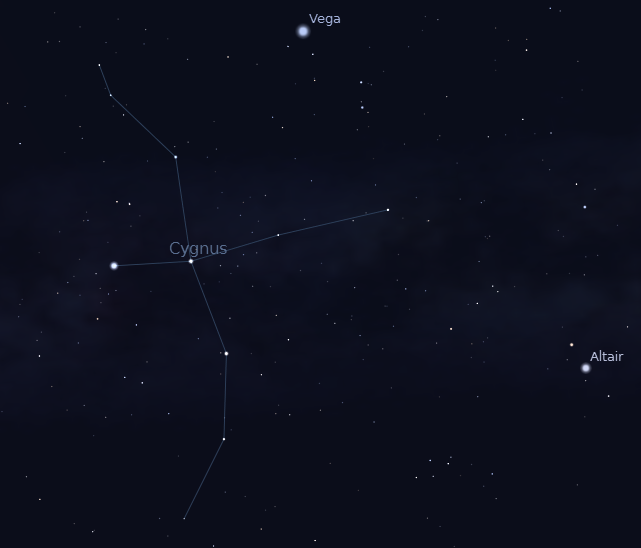
Cygnus and the stars of the Summer Triangle at 11 p.m. on July 19th. Created using Stellarium.
 Bob Moler's Ephemeris Blog
New horizons:
A couple of nights ago I woke up around 4 am as I often do. This time though instead of going back to sleep I went outside and lay down on my patio to look at the sky. I was stunned by the brilliance of the stars. At that time in the morning there is virtually no light pollution from the nearby town which made a huge difference. Perseus was overhead and was absolutely spectacular. Also Cassiopeia. Look forward to more early AM adventures.
You’ll be getting a preview of the winter stars soon. My usual first glimpse of Orion usually happens on the morning of the Perseid meteor watch. That’s August 12th this year. Orion is rising as the morning twilight begins to grow. It’s a good year for the Perseids with only a waning crescent moon. The Perseid radiant is circumpolar here so we get to see Perseids all night. When the radiant is low (where they seem to come from in Perseus) their numbers are reduced but the trail of a bright one can span the sky.