Archive
Curiosity has Landed!
Congratulations to JPL and NASA!
08/03/2012 – Ephemeris – Weekend events here and on Mars.
Ephemeris for Friday, August 3rd. The sun rises at 6:31. It’ll be up for 14 hours and 32 minutes, setting at 9:04. The moon, 2 days past full, will rise at 9:34 this evening.
The Northwestern Michigan College’s Rogers observatory will be open this evening starting at 9 p.m. For views of the heavens including the planet Saturn and the moon. There’s some bright deep sky objects also visible. Mars though up is a very tiny planet and is quite distant. What can’t be seen in a telescope will be visible shortly. Monday at 1:31 a.m. The Curiosity Mars Science Laboratory will land in Gale Crater. If the landing is successful the new rover will be bringing a new arsenal of scientific instruments to probe the martian past. From our vantage point on the earth Mars looks like a tiny yellowish orange disk. We will be back to two operational rovers joining the three operational satellites now orbiting Mars.
Times are for the Traverse City/Interlochen area of Michigan. They may be different for your location.
Addendum
Here’s a movie from the Jet Propulsion Laboratory (JPL) of Curiosity’s entry descent and landing called Seven Minutes of Terror: http://youtu.be/ISmWAyQxqqs
08/02/2012 – Ephemeris – The sun’s kicking up again this week
Thursday, August 2nd. The sun rises at 6:30. It’ll be up for 14 hours and 35 minutes, setting at 9:05. The moon, 1 day past full, will rise at 9:05 this evening.
With the sun really being active, there’s a good chance we’ll see several displays of the northern lights of aurora borealis. Those south of the equator will see the southern equivalent, the aurora australis. There’s an active group of sunspots rotating onto the earth-side face of the sun that should give us a chance to see the aurora in the next week or so. Sunspots are caused by tremendous magnetic fields generated below the bright photosphere we rather improperly call the sun’s surface. The sun has no solid surface, it’s all gas. The magnetic fields cool the gas, making it darker. The spots are maybe at a temperature 2,000 degrees cooler than the rest of the photosphere which is about 10,000 degrees Fahrenheit. In complex sunspot groups there is a potential for huge explosions.
Times are for the Traverse City/Interlochen area of Michigan. They may be different for your location.
Addendum
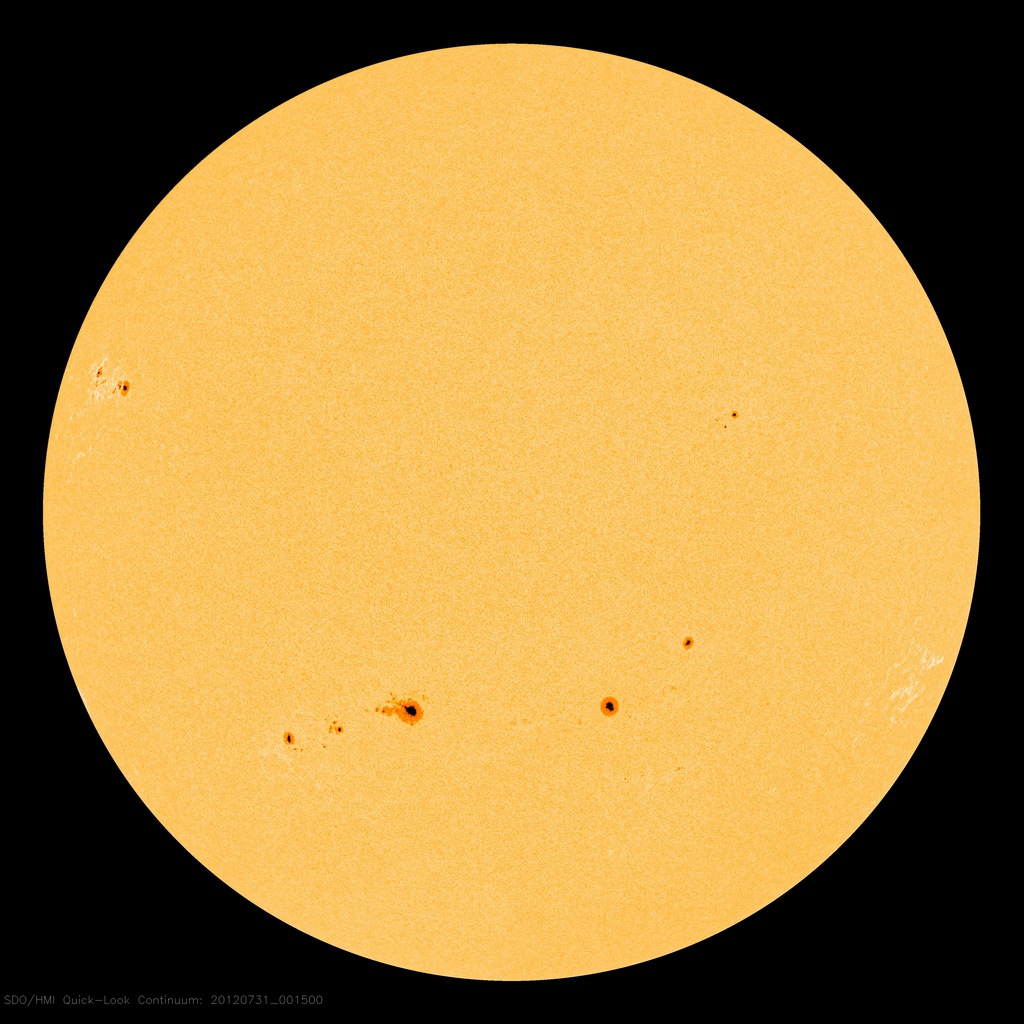
Solar Dynamics Observatory white light image of the sun from Monday. Credits NASA / SDO. Click on image to enlarge.
08/01/2012 – Ephemeris – Where are the bright planets this week?
Ephemeris for Wednesday, August 1st. The sun rises at 6:29. It’ll be up for 14 hours and 37 minutes, setting at 9:07. The moon, at full today, will rise at 8:33 this evening.
Let’s see what’s happening with the bright planets for this week. Mars Saturn and the star Spica make a bright triangle in the west southwest after sunset. Mars is on the right and Saturn is the topmost of the three. They are located in the constellation Virgo the virgin. Mars will be setting in the west at 11:38 p.m. Saturn will set at 12:05 a.m. At mid-month Mars will pass between Saturn and Spica. The morning sky features the two brightest planets: Jupiter, which will rise at 1:59 in the east northeast and Venus, which will rise at 3:13 also in the east northeast. The bright star Aldebaran in Taurus the bull will appear just to the right of Jupiter tomorrow morning, but Venus will have dropped farther below Jupiter, as it stays by the sun.
Times are for the Traverse City/Interlochen area of Michigan. They may be different for your location.
Addendum
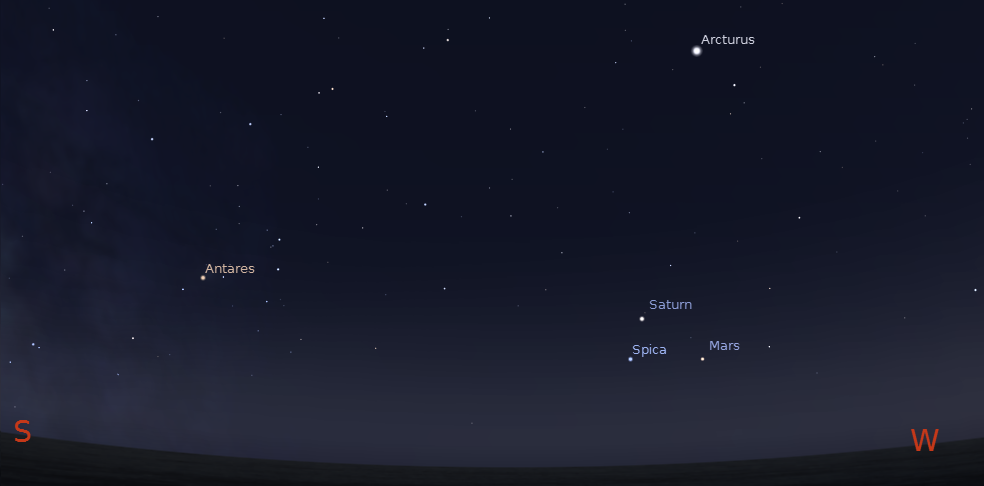
Looking southwest at 10:30 p.m. on August 1, 2012. Created using Stellarium. Click on the image to enlarge.
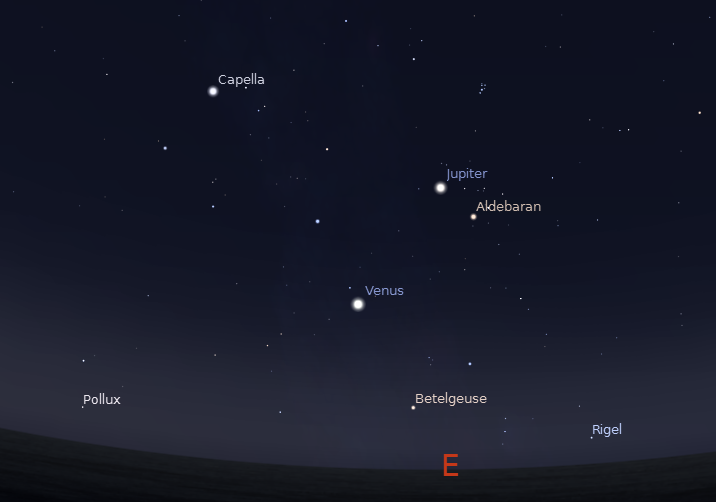
Looking east at 5 a.m. August 2, 2012. That’s Orion rising below Jupiter and Venus. Created using Stellarium. Click on the image to enlarge.
 Bob Moler's Ephemeris Blog