Archive
04/30/2013 – Ephemeris – Previewing May sunshine
Ephemeris for Tuesday, April 30th. The sun rises at 6:33. It’ll be up for 14 hours and 12 minutes, setting at 8:46. The moon, 2 days before last quarter, will rise at 1:57 tomorrow morning.
Tomorrow we’ll start the month of May when the promise of spring is finally fulfilled. Daylight hours in the Interlochen/Traverse City area will increase from 14 hours and 15 minutes tomorrow to 15 hours 19 minutes on May 31st. The altitude, or angle, of the sun above the southern horizon at local noon will ascend from 60 degrees now to 67 degrees at month’s end. The altitude of the sun in the Straits area will be a degree lower than that but your daylight will be a few minutes longer. Local apparent noon this month, when the sun passes due south, will be about 1:38 p.m. This is the month of the Eta Aquarid meteor shower which will reach its peak next Monday morning. They will be best seen around 5 a.m.
Times are for the Traverse City/Interlochen area of Michigan. They may be different for your location.
Addendum
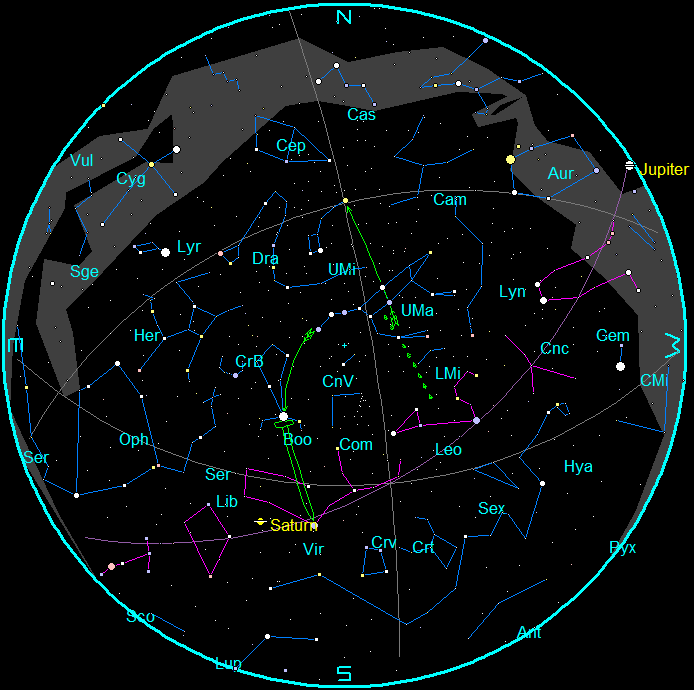
May Stars, centered at 11 p.m. on the 15th. Created using my program Looking Up for Windows.
04/29/2013 – Ephemeris – Saturn at opposition from the sun
Ephemeris for Monday, April 29th. The sun rises at 6:35. It’ll be up for 14 hours and 9 minutes, setting at 8:45. The moon, 3 days before last quarter, will rise at 1:11 tomorrow morning.
This past weekend Saturn was in opposition to the sun. That simply means the earth was more or less directly between the sun and Saturn. That means Saturn’s at its closest to us at 821 million miles. The Cassini spacecraft that’s still orbiting Saturn, when it sends pictures and data back to earth still takes about an hour and a quarter for the signals to get here. Shadows of the rings on the planet and planet on the rings are minimal. Saturn and the earth have some coincidental properties as seen from the sun. Saturn is 9.5 times the earth’s distance from the sun. And Saturn is about 9.5 times the diameter as the earth, so from the sun both the earth and Saturn would appear to be the same apparent size. Cool huh?
Times are for the Traverse City/Interlochen area of Michigan. They may be different for your location.
Addendum
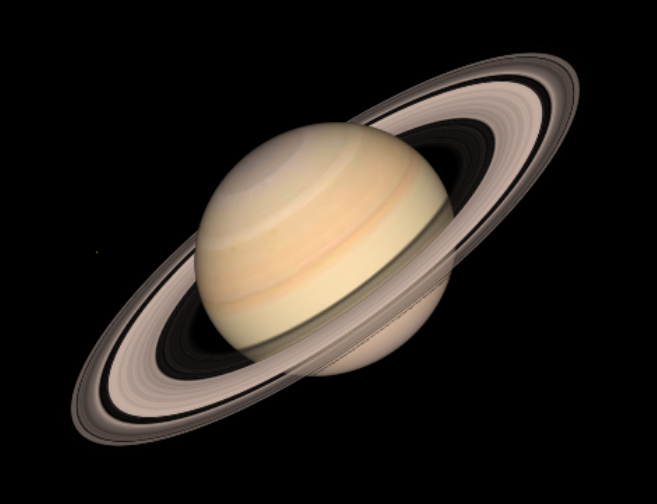
Saturn rising in the evening in May, 2013 as rendered by Cartes du Ciel (Sky Charts)
04/26/2013 – Ephemeris – First star party of the year at Sleeping Bear Dunes tomorrow night.
Ephemeris for Arbor Day, Friday, April 26th. The sun rises at 6:39. It’ll be up for 14 hours and 1 minute, setting at 8:41. The moon, 1 day past full, will rise at 10:06 this evening.
Tomorrow the Grand Traverse Astronomical Society will hold a star party at the Sleeping Bear Dunes National Lakeshore. It will be held at Platte River Point, west of Honor starting at about 8:30 p.m. The point is located at the end of Lake Michigan Road, off M22, less than a mile south of where Deadstream road meets M22. This is a very dark location and we have a little time near 11 p.m. When it will be quite dark before moonrise. The sequester has affected the park, but hasn’t so far affected our schedule. We have monthly star parties from now until October at various locations in the park. Next month the star we’ll be observing will be the sun, which we’ll do from the grounds of park headquarters in Empire. So come on out.
Times are for the Traverse City/Interlochen area of Michigan. They may be different for your location.
04/25/2013 – Ephemeris – Two new exoplanets in the same star’s habitable zone discovered
Ephemeris for Thursday, April 25th. The sun rises at 6:41. It’ll be up for 13 hours and 58 minutes, setting at 8:40. The moon, at full today, will rise at 8:52 this evening.
Last week came the announcement that an international team, analyzing data from the Kepler satellite had found a star system with two near earth sized planets in the habitable zone for that star. The two planets around the star Kepler-62 The planets e and f are in the habitable zone for the star and are in the class called super earths 1.6 and 1.4 time the diameter of the earth. They will require more study to determine their densities, and the composition of their atmospheres. Exoplanet discoveries continue to mount up, but so far a planet the size of the earth, in the habitable zone of its star has eluded astronomers. Closer to home, but visible on the other side of the earth there will be a slight partial eclipse of the moon this afternoon our time.
Times are for the Traverse City/Interlochen area of Michigan. They may be different for your location.
Addendum
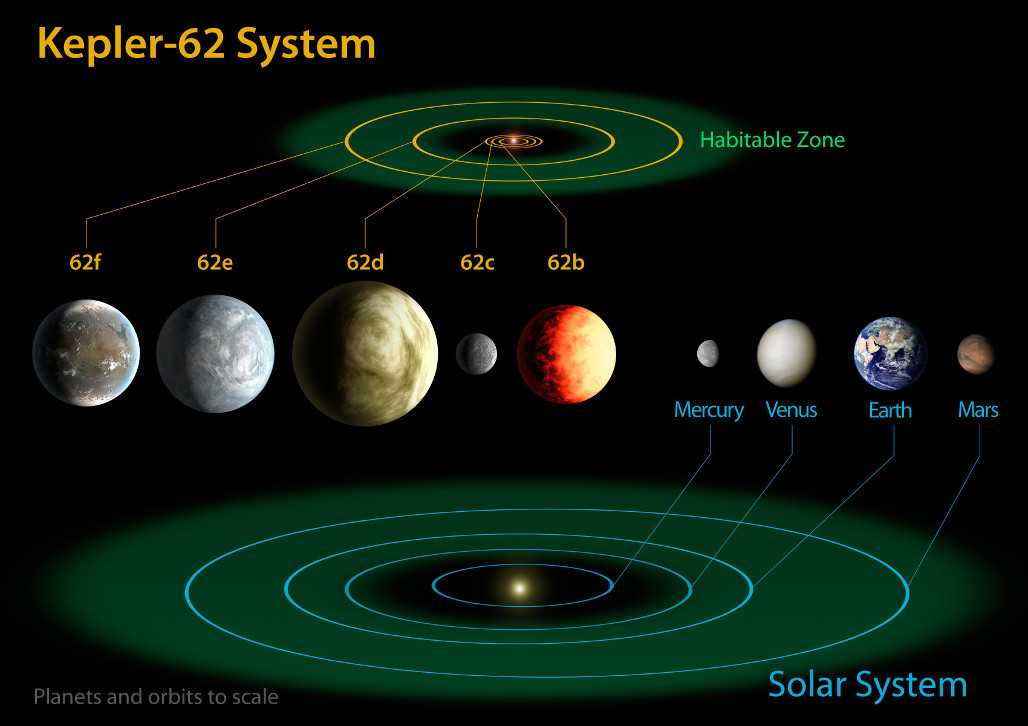
The Kepler-62 stellar system. Credit: JPL/NASA.
04/24/2013 – Ephemeris – Where are the two bright planets this week?
Ephemeris for Wednesday, April 24th. The sun rises at 6:43. It’ll be up for 13 hours and 55 minutes, setting at 8:38. The moon, 1 day before full, will set at 6:24 tomorrow morning.
It’s time to check out the two remaining bright planets for this week. Jupiter is located in the constellation of Taurus, above the V shape of stars, the face of the bull and is in the west during the evening. It will set at 12:10 a.m. In the west northwest. Jupiter is still high enough as it gets dark to get a very good view of its cloud bands and satellites. The four moons that Galileo found are easy targets for small telescopes or even sharp-eyed binocular observers. The other bright planet Saturn will rise at 8:43 p.m. in the east southeast. It’s located in eastern Virgo, but us moving back a bit toward the bright star Spica to its right. Tonight the bright moon will be near Spica, so it may make both Saturn and Spica hard to spot.
Times are for the Traverse City/Interlochen area of Michigan. They may be different for your location.
Addendum
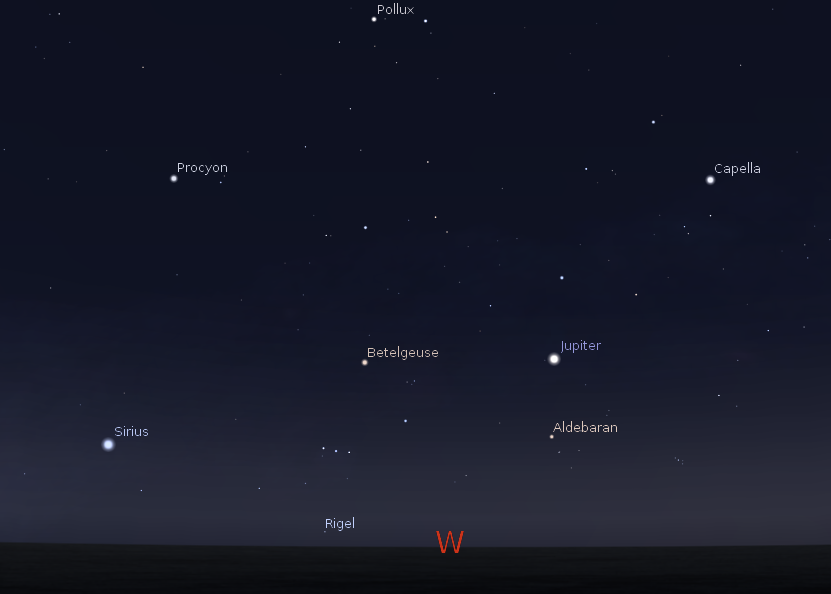
Jupiter and the fleeing stars of winter at 10 p.m. on April 24, 2013. Created using Stellarium.
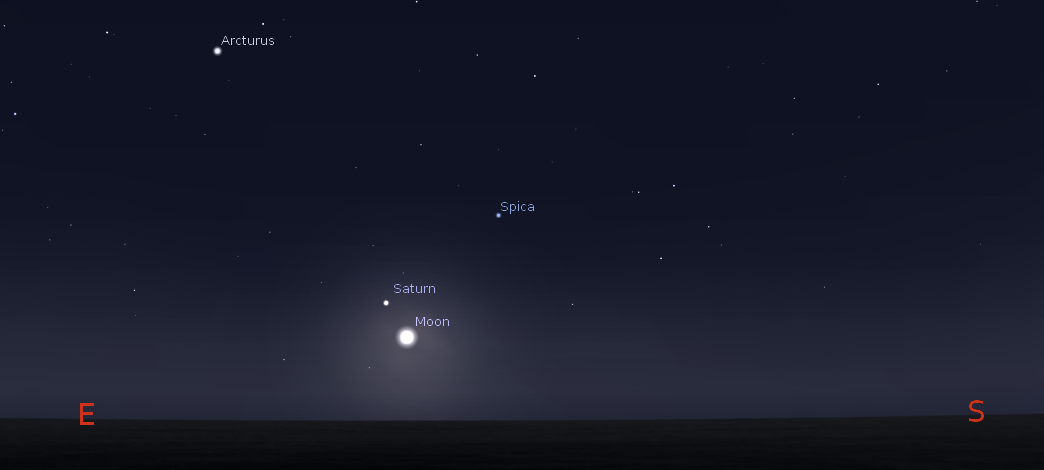
Saturn and the moon at 10 p.m. on April 24, 2013. Created using Stellarium.
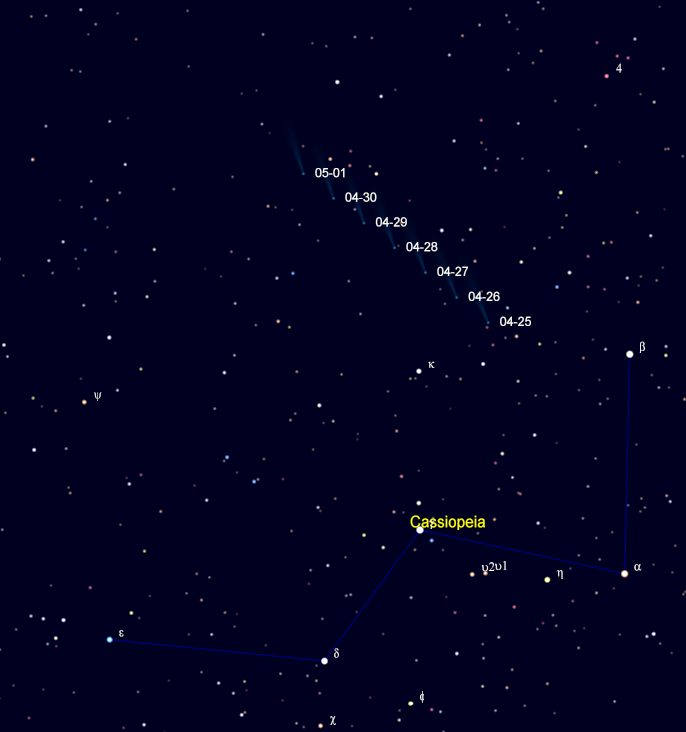
Our last look at Comet PanSTARRS at 5 a.m. on April 25 to May 1, 2013. Created using Cartes du Ciel (Sky Charts).
04/23/2013 – Ephemeris – Orbital Sciences enters the race to supply the International Space Station
Ephemeris for Tuesday, April 23rd. The sun rises at 6:44. It’ll be up for 13 hours and 52 minutes, setting at 8:37. The moon, 2 days before full, will set at 5:49 tomorrow morning.
Sunday afternoon the second winner in the Commercial Orbital Transportation Services or COTS competition held by NASA flew its first test flight. Orbital Sciences Corporation, which has been in business since 1982 developed a new rocket for COTS, the Antares, named after the brightest red star in the constellation Scorpius. It flew flawlessly launching a dummy payload into low earth orbit along with some cube-sats. At least one of these tiny satellites is controlled, not by a specially built computer, but by an Android smart phone. Smart phones are incredibly versatile, but can they stand the rigors and radiation of space? And can they phone home? Orbital will have another test launch later this year with test cargo to the International Space Station.
Times are for the Traverse City/Interlochen area of Michigan. They may be different for your location.
Addendum
Orbital has been in the rocket and satellite business for just over 30 years. As far as rockets go, their expertise was in solid fueled rockets. The Antares is their first liquid fueled rocket first stage. The first stage engines are re-manufactured Russian engines that were destined for the ill-fated Soviet N1 moon rocket engines. The original engines were so unreliable that they couldn’t be tested and mounted on the rocket. The tolerances of the pumps were so bad that they couldn’t be run again. The design bureau for the N1 would order engines six at a time. If two of the tested OK, they would use the other 4. If one of the test engines failed, all the engines in that batch would be rejected.
The Russians marveled at the F-1 engines in the first stage of the Saturn V, which would be tested three times, including a full duration test before installed in the Saturn V first stage. Still the same Russian engines were perfected to become an extremely reliable engine that Orbital is using on their Antares rockets. United Launch Alliance also uses the same engines on their Atlas 5 rockets. It’s rather ironic that the latest members of the Atlas family, that was first built as a weapon against the Soviets are using Russian engines.
Source for the Russian engines: Rockets and People Volume 4, TheMoon Race by Boris Chertok, an ebook downloadable from NASA.
04/22/2013 – Ephemeris – Spaceship Earth
Ephemeris for Earth Day, Monday, April 22nd. The sun rises at 6:46. It’ll be up for 13 hours and 50 minutes, setting at 8:36. The moon, 3 days before full, will set at 5:17 tomorrow morning.
The earth is unique in the solar system. Actually every planet is unique, as we’ve found out with our spacecraft that have at least flown by every planet of the solar system, and we’re two years from flying by the dwarf planet Pluto and its so far discovered 5 moons. But the earth uniquely supports life as we know it. It is the only one. While it is imperative that we colonize the moon, Mars and asteroids and live off the land so no single disaster can wipe us out, we need to take care of the earth, to understand and get a grip on what we’re doing to earth’s climate. We must think of the earth as a spaceship with both renewable resources and limited ones. Our journey is long, the supplies will have to last.
Times are for the Traverse City/Interlochen area of Michigan. They may be different for your location.
Addendum

Our home. Credit NASA.
04/19/2013 – Ephemeris Plus* – Astronomy Day and the Lyrid meteor shower
Ephemeris Plus for Friday, April 19th. The sun rises at 6:51. It’ll be up for 13 hours and 41 minutes, setting at 8:32. The moon, 1 day past first quarter, will set at 3:51 tomorrow morning.
Tomorrow is Astronomy Day 2013. Astronomy Day is generally held on the Saturday closest to the first quarter moon in late April or early May. The Grand Traverse Astronomical Society will celebrate with a star party at Northwestern Michigan College. Tomorrow April 20th, from 9 p.m. to 11 p.m. There will also be activities inside the observatory, so clear or cloudy there will be something to see or do for all ages.
The Lyrid Meteor Shower will be active this weekend and reach a peak Monday morning. The meteors from this shower will seem to come from near the constellation of Lyra the harp, a northern summer constellation, with the bright star Vega with a small and narrow parallelogram of stars near it. We do have a moon problem this year, so it just might be caught by early risers in the next couple of mornings. It is not a super active shower, and has a peak rate of only 18 and hour when Vega is overhead, which it will be at 5 in the morning. With the experience of the bright meteor that broke windows in Russia, be comforted to know that meteor showers members are created with very small grains, not big boulders.
Times are for the Traverse City/Interlochen area of Michigan. They may be different for your location.
*Ephemeris Plus contains more information in the post’s body that could not fit into the time constraints of the Ephemeris program.
Addendum
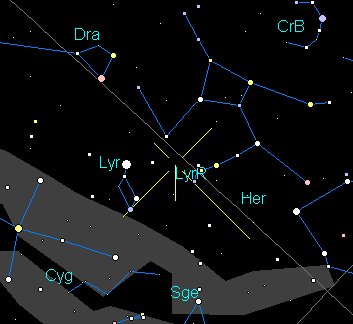
Lyrid meteor radiant. The bright star is Vega
04/18/2013 – Ephemeris – The moon at first quarter
Ephemeris for Thursday, April 18th. The sun rises at 6:52. It’ll be up for 13 hours and 38 minutes, setting at 8:31. The moon, at first quarter today, will set at 3:21 tomorrow morning.
Lets take a look at the moon tonight. It’ll be about 6 hours after first quarter and we’ll see features at the terminator, the sunrise line that cuts the moon in half. In small telescopes, at the north or top end of the moon, the wide flat crater Plato is just entering sunlight. Long shadows from its crater walls will retreat across its flat floor over the evening. If you look closely you’ll notice that the floor of Plato is slightly convex to conform with the curvature of the moon itself. Nearby is the straight gash in the Alps Mountains, called the Alpine Valley. Supposedly the crater Plato formed shortly after Mare Imbrium formed throwing up the Alps and the Apennine mountains to the south. The Straight wall, can be seen on the south end of the moon.
Times are for the Traverse City/Interlochen area of Michigan. They may be different for your location.
Addendum
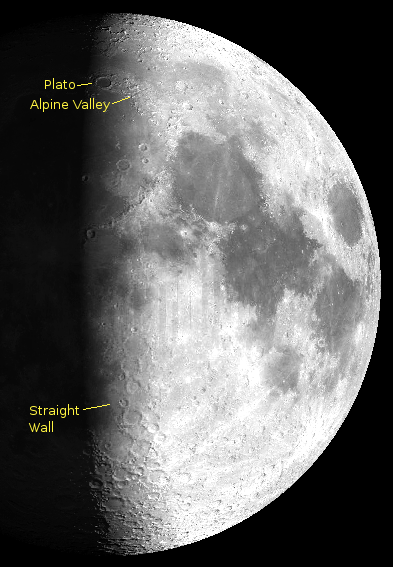
First quarter moon April 18, 2013 Created using Virtual Moon Atlas
04/17/2013 – Ephemeris – Where are the bright planets this week?
Ephemeris for Wednesday, April 17th. The sun rises at 6:54. It’ll be up for 13 hours and 35 minutes, setting at 8:30. The moon, 1 day before first quarter, will set at 2:49 tomorrow morning.
It’s time to check out the two remaining bright planets for this week. I’m no longer going to cover Comet PanSTARRS here, since it has dropped below naked eye visibility, but I will provide finder charts in the Ephemeris blog at bobmoler.wordpress.com for the next few weeks. Jupiter is located in the constellation of Taurus, above the V shape of stars, the face of the bull and is in the west during the evening. It will set at 12:27 a.m. The other bright planet Saturn will rise at 9:13 p.m. in the east southeast. It’s located in eastern Virgo. It will pass due south at 2:27 a.m. Both planets are wonderful sights in telescopes. Jupiter with its cloud bands and moons, Saturn with those fantastic rings.
Times are for the Traverse City/Interlochen area of Michigan. They may be different for your location.
Addendum
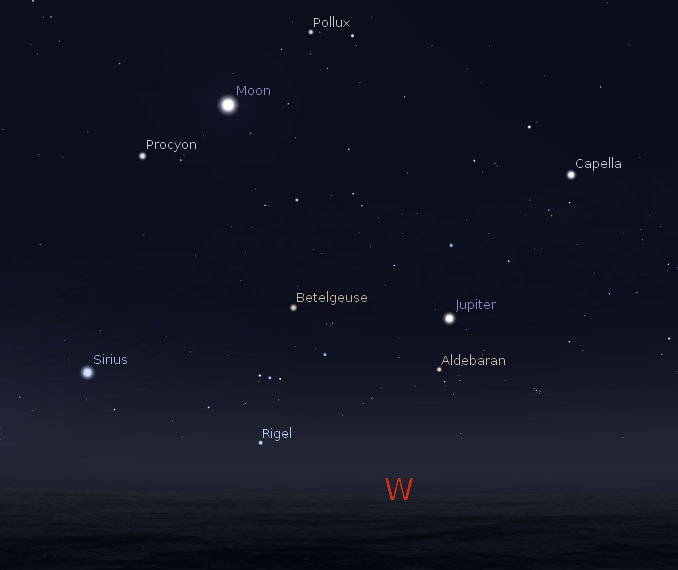
Jupiter and the setting stars of winter at 10 p.m., April 17, 2013. Created using Stellarium.
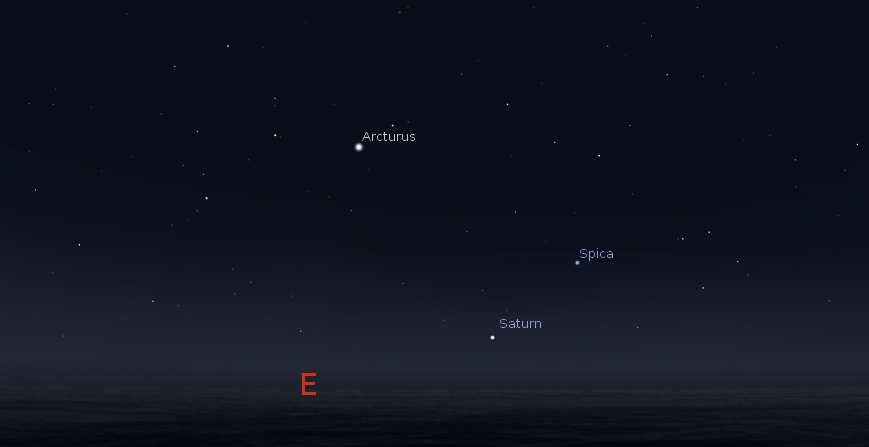
Saturn rising with the bright stars of late spring at 10 p.m., April 17, 2013. Created using Stellarium.
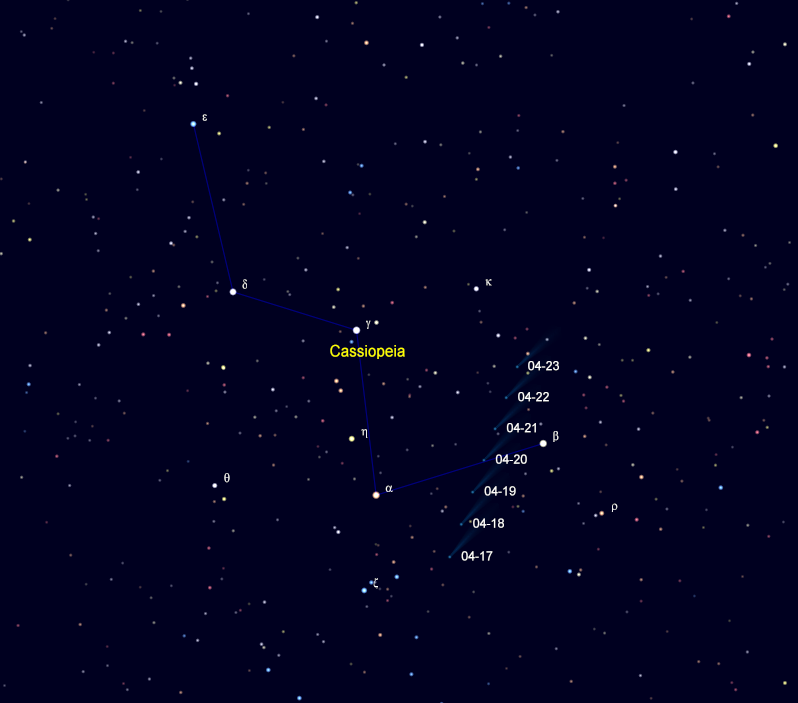
Comet PanSTARRS is moving through Cassiopeia from 04/17/13 to 4/23/13 at 11 p.m. low in the north north-east. Created using Cartes du Ciel (Sky Charts). It requires binoculars or telescope to spot.
 Bob Moler's Ephemeris Blog