Archive
03/07/2017 – Ephemeris – The Moon tonight – the crater Copernicus
Ephemeris for Tuesday, March 7th. The Sun will rise at 7:08. It’ll be up for 11 hours and 29 minutes, setting at 6:38. The Moon, 2 days past first quarter, will set at 4:39 tomorrow morning.
Looking at the Moon tonight the brightest feature on the left side of the moon is the big splash mark left by the impact that created the crater Copernicus. The proper term is ejecta blanket that can be noticed by the naked eye or binoculars. Although it is most visible during full moon, because it is really made of small craters that are most visible when we see them from the direction of the Sun, so they are not shadow filled and brighter than normal. Copernicus is on the south edge of a great lava plain called Mare Imbrium, the Sea of Showers. There’s a large crater on the north edge named after the Greek philosopher Plato. At the upper left edge is the Laplace promontory the point of the Bay of Rainbows to be revealed tomorrow night.
Times are for the Traverse City/Interlochen area of Michigan. They may be different for your location.
Addendum
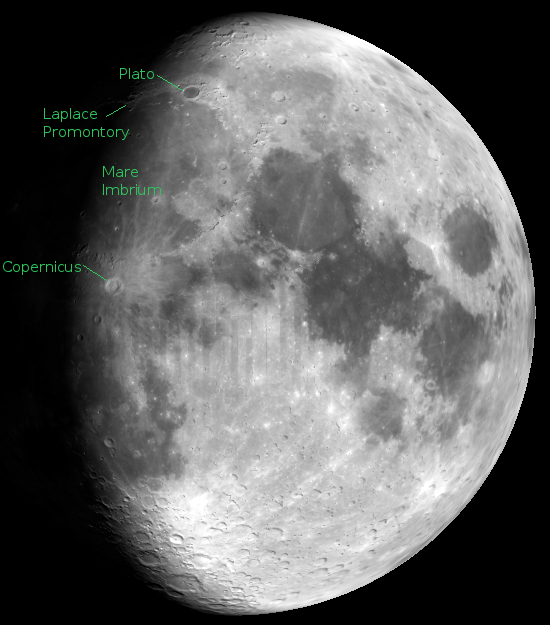
The Moon featuring Copernicus, Plato, Laplace Promontory and Mare Imbrium at 9 p.m., March 7, 2017. Created using Virtual Moon Atlas.
03/06/2017 – Ephemeris – TRAPPIST-1 The star with seven earth-sized planets
Ephemeris for Monday, March 6th. The Sun will rise at 7:10. It’ll be up for 11 hours and 26 minutes, setting at 6:37. The Moon, 1 day past first quarter, will set at 3:47 tomorrow morning.
The big astronomical news of two weeks ago was the announcement of a star system that had at least 7 earth-sized planets. And that three of them were in the habitable zone of their dim red dwarf star. The designation of the star is TRAPPIST-1, a Belgian telescope in South America that has nothing to do with monks. TRAPPIST is the acronym for the telescope’s rather long name. Confirmation of all the planets, their sizes and mass was carried out by NASA’s Spitzer Infrared Telescope trailing the Earth in solar orbit. Needless to say this star system will be the object of intense study as larger and more sophisticated ground and space based telescopes come on line in the next few years.
Times are for the Traverse City/Interlochen area of Michigan. They may be different for your location.
Addendum
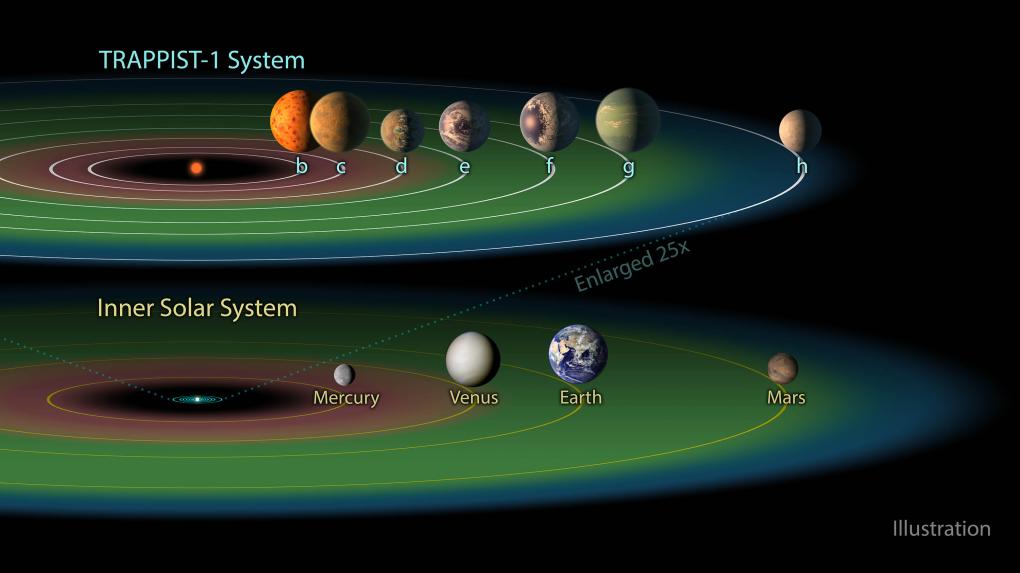
Comparison of the TRAPPIST-1 planetary system with our own inner solar system. The green zone is the habitable or Goldilocks zone Credit: NASA/JPL-Caltech/R. Hurt, T. Pyle (IPAC)
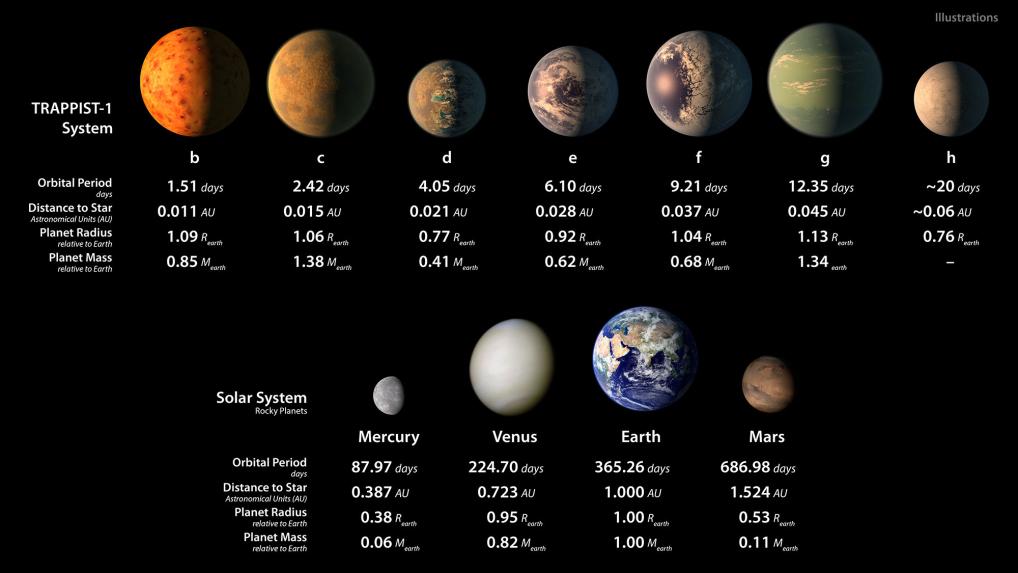
What is currently known about the TRAPPIST-1 Planets. Comparison of the TRAPPIST-1 planetary system with our own inner solar system. Credit: NASA/JPL-Caltech/R. Hurt, T. Pyle (IPAC)
Note that the surface features of these planets are in the eye of the illustrator. They are currently black shadows seen on the face of the star that they cross.
Planet g looks closest to the Earth’s density of the habitable zone planets. The problem I’d have is if I lived there at 12.35 days per year I’d be 2220 years old.
Entice your great-great-great-great grandkids with this travel poster:
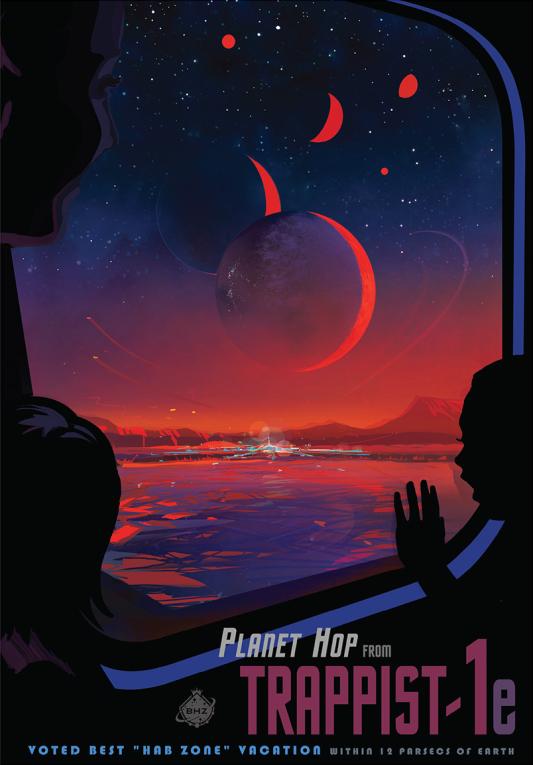
Planet Hop from TRAPPIST-1e. Maybe not next door like Proxima b, but just down the block. only 39 light years away.
For more information:
On the Spitzer site you can find:
Images
Videos (b-roll and annotated/narrated)
Planet surface maps and starfield backdrop image
http://www.spitzer.caltech.edu/trappist-1
On the JPL site you can also find:
Exoplanet Travel Poster
VR tour of TRAPPIST-1d surface
Additional videos
https://exoplanets.nasa.gov/trappist1/
On the ESO site you can also find:
Even more videos and graphics
http://www.eso.org/public/news/eso1706
Play around with the TRAPPIST-1 and other extra solar planetary systems with NASA’s Eyes: https://eyes.nasa.gov/eyes-on-exoplanets.htm.
Replay the news conference announcing the TRAPPIST-1 discovery from February 22, 2017:
http://www.ustream.tv/recorded/100200725.
03/02/2017 – Ephemeris – Saturday night’s occultation of the bright star Aldebaran
Note: this program is for a very specific location in the northern lower peninsula of Michigan. The occultation of Aldebaran is visible from most of the United States except Alaska and Central America. For predictions for your locations you can use a planetarium type program like Stellarium, Cartes du Ciel (Sky Charts), which can be downloaded free from the right column on this blog page, or the commercial planetarium program of your choice. Make sure the program is zoomed in so the Moon is actual size, and set for your location, and play around with the time.
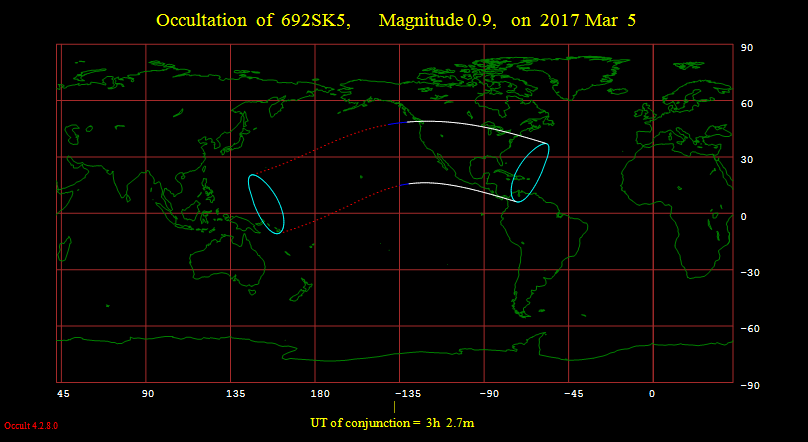
Path of the occultation of Aldebaran for March 4-5, 2017. Note where the top edge of the path goes. Right through northern Michigan.
On to the program:
Ephemeris for Thursday, March 2nd. The Sun will rise at 7:17. It’ll be up for 11 hours and 14 minutes, setting at 6:32. The Moon, 3 days before first quarter, will set at 11:26 this evening.
Saturday night just after 11 p.m. the upper right edge of the Moon will just cover the bright star Aldebaran, the angry red eye of Taurus the bull. That is for some of us. For those of us south of a line from Leland to just south of Mancelona and off across the state the Moon will occult or hide the star. For those north of that line Aldebaran will just miss the Moon. Start looking at 11 p.m. or so. The center of the occultation as it I called is about 11:13 p.m. The farther south of that line you are the longer the occultation will last. At 11 p.m. the star will be just off the upper right edge of the Moon.
Times are for the Traverse City/Interlochen area of Michigan. They may be different for your location.
Addenda
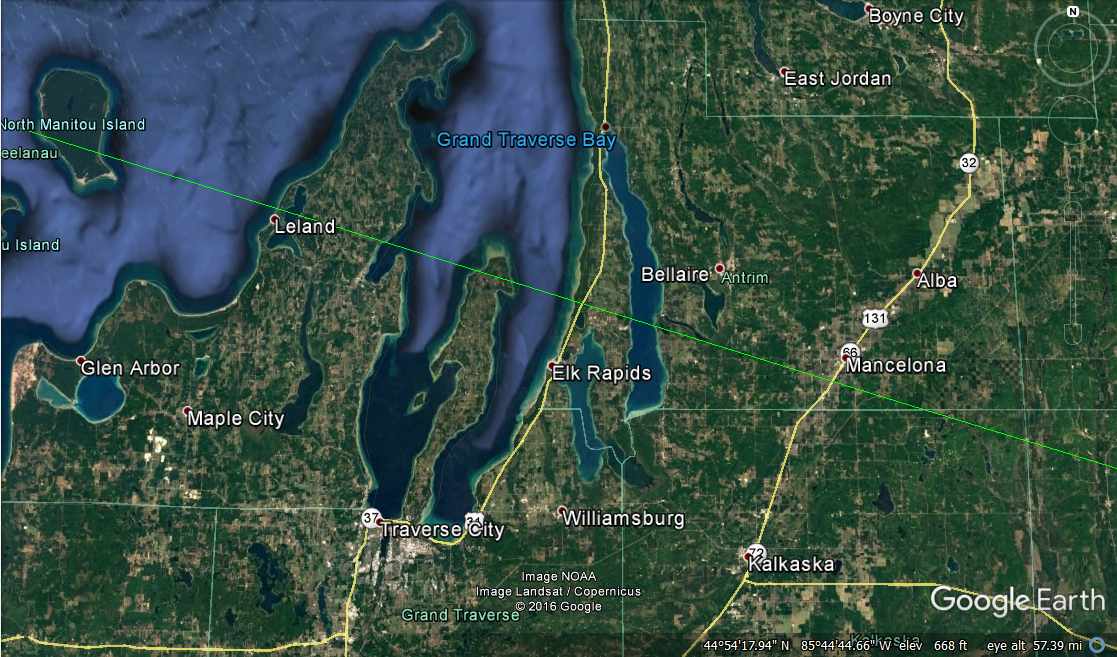
The north limit of the occultation zone as it passes through the Grand Traverse Region. Locations north of the green line will not see an occultation, Locations south of that line will see the occultation. Map credit Google Earth.
The file to load for this occultation map overlay is: http://ephemeris.bjmoler.org/ZC692-2017-Mar-5.kmz.
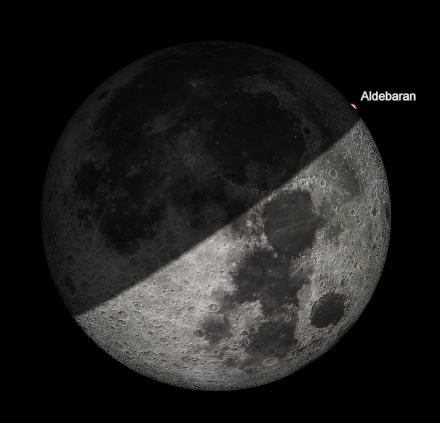
The point of the mid occultation from the NMC Observatory. Note that in reality Aldebaran would be completely covered by the Moon. This is the Moon and Aldebaran as they would be seen in the west at that time. Created using Cartes du Ciel (Sky Charts).
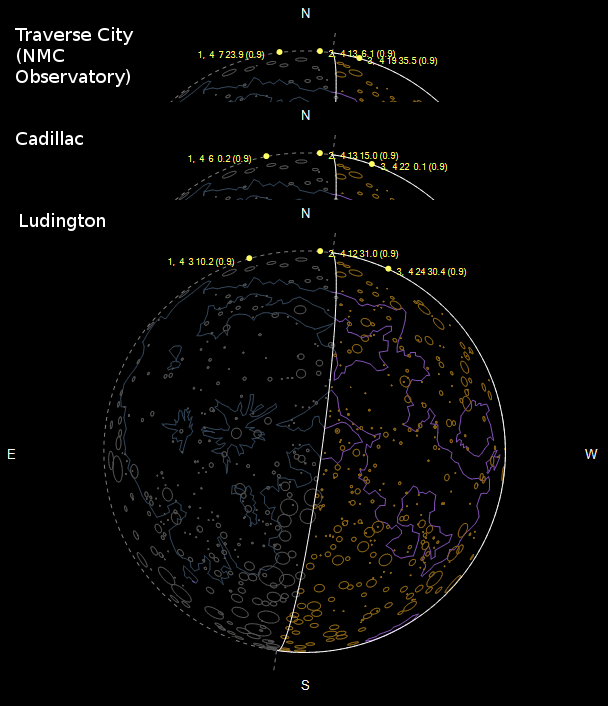
The occultation of Aldebaran as seen from three sample locations in the IPR listening area. Credit IOTA’s Occult4 program. The Moon is shown in equatorial orientation.
Here’s the legend for the labels:
# H M S (Mag)
#: 1 First contact, Aldebaran disappears
2 Middle of the occultation
3 Last contact, Aldebaran reappears
H: hour UT, 4 = 11 p.m. EST
M: Minute
S: Second
Mag: Magnitude of the star, 0.9 (First magnitude star)
An article I wrote about this occultation in the March 2017 issue of the Grand Traverse Astronomical Society newsletter The Stellar Sentinel:
The Grazing Occultation of Aldebaran, March 4th
Late Saturday night March 4th the Moon will pass in front of, or not the bright star Aldebaran. The “or not” depends on where you are.
The event is called an occultation. The word comes from occult, which, despite its baggage, simply means hidden. When one celestial body moves in front of another and completely covers it an occultation occurs. In actuality a total solar eclipse is an occultation. However a lunar eclipse is still an eclipse as we see it, but an occultation as the Sun sees it.
Above there’s a map of the Leelanau and Old Mission peninsulas and a bit of the Lower Peninsula of Michigan with a line drawn across it from north of Leland to just south of Mancelona. That is the calculated northern limit of the occultation. Observers within a mile of so of that line could see Aldebaran winking in and out as it’s light encounters mountains and passes through valleys at the northern limb of the Moon.
Even though we’ve landed humans on the Moon and have mapping satellites orbiting it, there is still a need to add more data to the accumulated knowledge we have of the surface and position of the Moon. Observers in a coordinated effort can be set up perpendicular to the graze line and using coordinated time signals produce a map of the edge of the Moon.
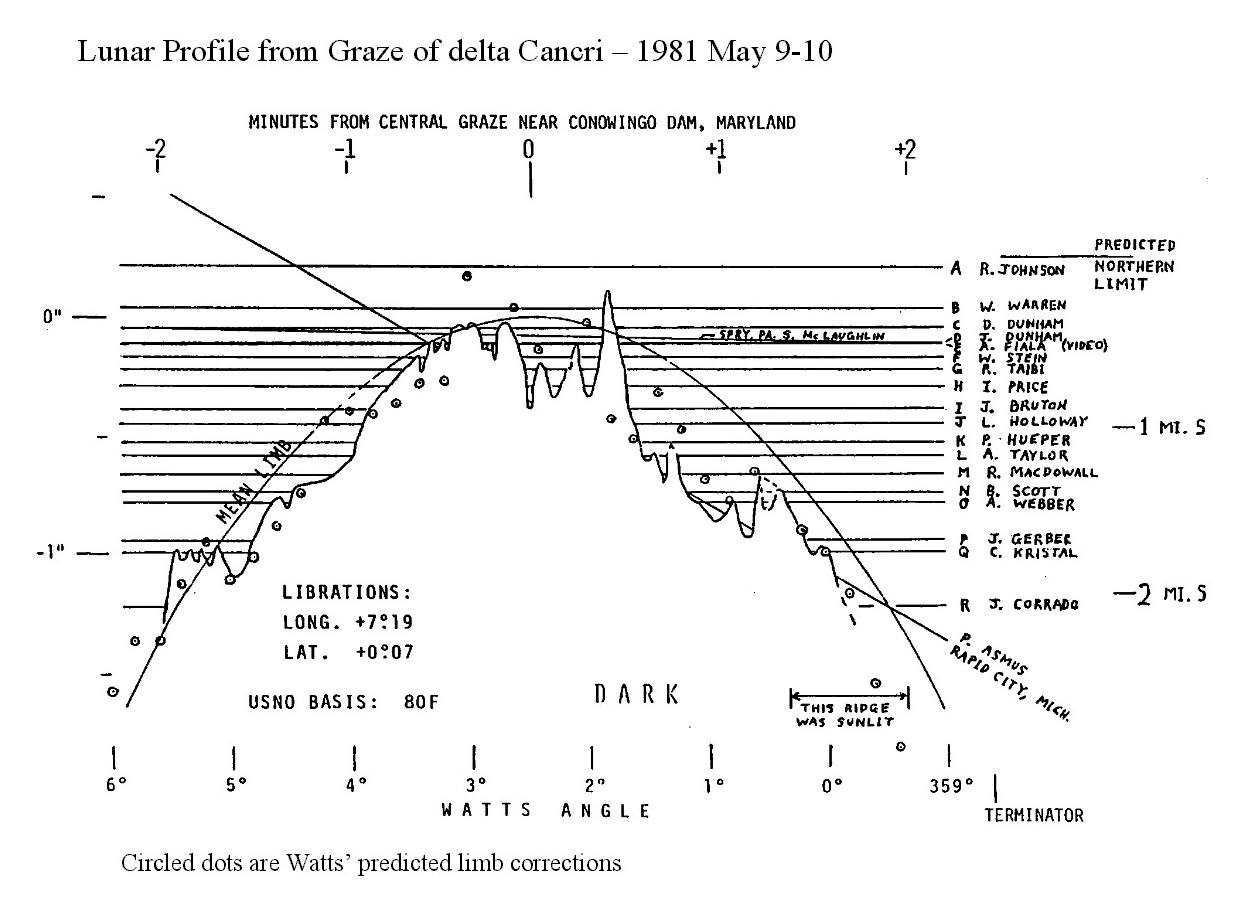
Plot of the results of a grazing occultation of Delta Cancri on May 9-10, 1981. Each horizontal line is one observer’s timings. From “An Introduction to Grazing Occultations” at http://www.lunar-occultations.com/iota/Graze.htm.
03/01/2017 – Ephemeris – It’s Bright Planet Wednesday!
Ephemeris for Ash Wednesday, Wednesday, March 1st. The Sun will rise at 7:19. It’ll be up for 11 hours and 11 minutes, setting at 6:30. The Moon, 3 days past new, will set at 10:14 this evening.
Let’s check out the bright planets for this week. Saturn can be glimpsed this and tomorrow mornings in the southeast before 6:30 a.m. It will rise tomorrow at 3:19 a.m. in the east-southeast. Jupiter can be seen in the southwest these mornings above the star Spica, and later tonight. The giant planet will rise in the east at 9:52 p.m. Venus and Mars are in the evening sky. At 7:30 p.m. these planets will be seen in the western sky. Venus is unmistakable as the brilliant evening star, Mars will be left and above it and much dimmer. The Moon will be left of it tonight.. Venus will set at 9:26 p.m. while Mars will set at 10:13. Venus exhibits a dazzling crescent in small telescopes and binoculars now.
Times are for the Traverse City/Interlochen area of Michigan. They may be different for your location.
Addendum
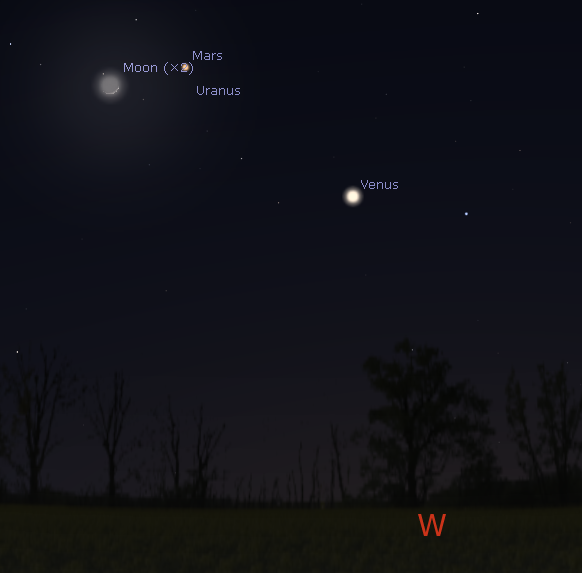
Venus. Mars and the Moon in the west at 7:30 p.m. March 1, 2017. The Moon is twice its actual size for clarity. Created using Stellarium.
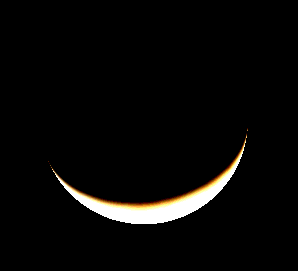
Venus as it might appear in a telescope tonight March 1, 2017. I processed the image to overexpose it as it would appear in a telescope. Created using Stellarium.
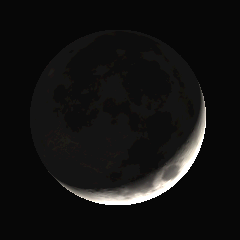
The crescent Moon with earth shine as it might look in binoculars. 7:30 p.m. March 1, 2017. Created using Stellarium.
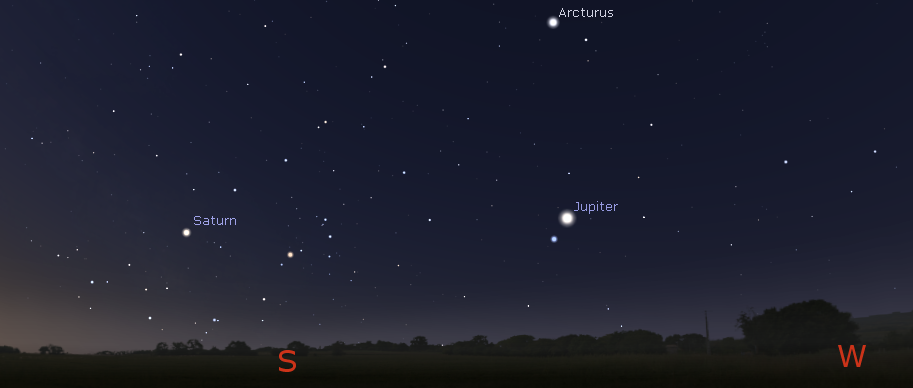
Jupiter in the southwest above the star Spica with Saturn in the south at 6:30 a.m. tomorrow morning, Match 2, 2017. Created using Stellarium.
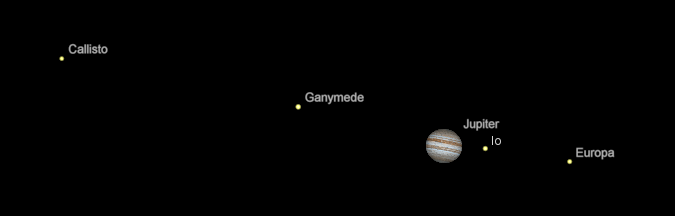
Jupiter and its moons as they might appear in telescopes tomorrow morning at 6:30 a.m. March 2, 2017. Created using Cartes du Ciel (Sky Charts).
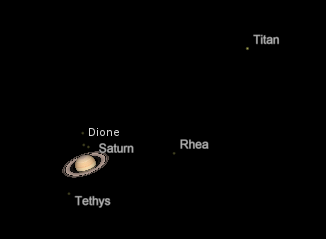
Saturn and its brightest moons as they might appear in telescopes tomorrow morning at 6:30 a.m. March 2, 2017. Created using Cartes du Ciel (Sky Charts).
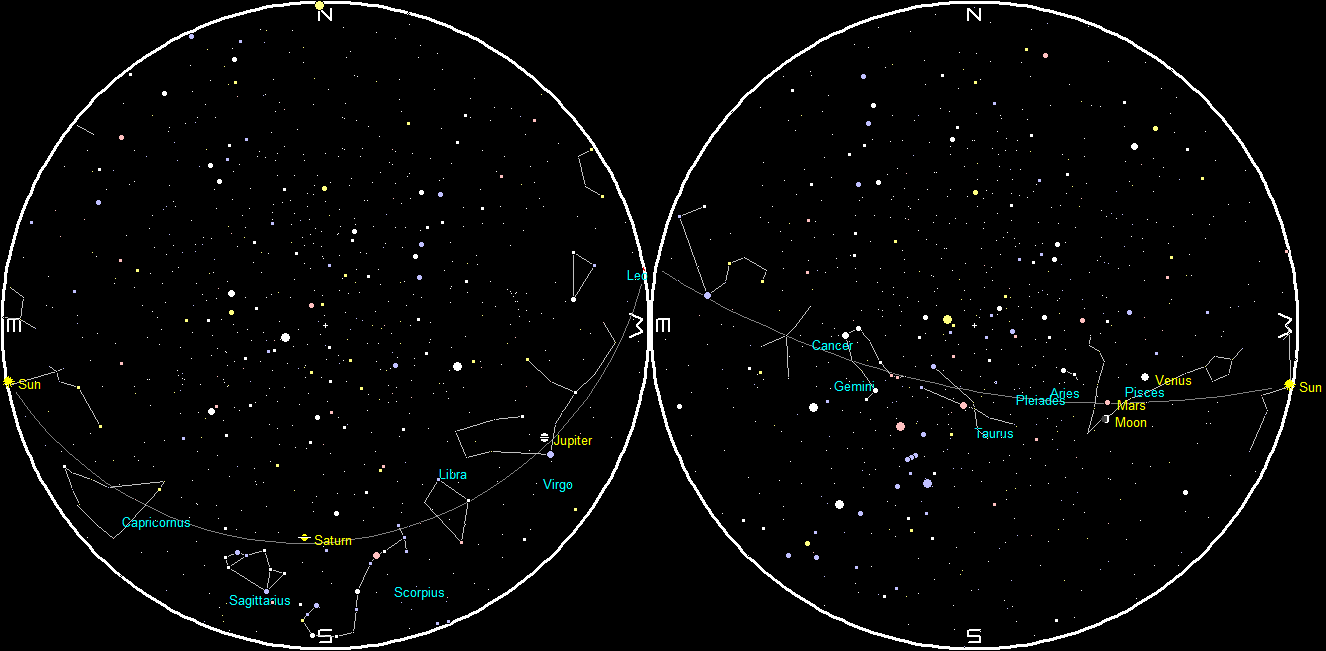
Planets and Moon at sunset and sunrise of a single night starting with sunset on the right on March 1, 2017. The night ends on the left with sunrise on March 2. Click on image to enlarge. Created using my LookingUp program.
 Bob Moler's Ephemeris Blog