12/15/2017 – Ephemeris – Taurus, Bullish on Winter
Note: The title of this post I’ve taken from an article I wrote for the December 1999 issue of the Stellar Sentinel, the monthly newsletter of the Grand Traverse Astronomical Society, which I will reprint with some tweaks, as the addendum to this post. Winter will arrive in six days, though I’m not particularly bullish on it, but it fits the constellation I’m talking about today.
Ephemeris for Friday, December 15th. The Sun will rise at 8:12. It’ll be up for 8 hours and 50 minutes, setting at 5:02. The Moon, 3 days before new, will rise at 6:25 tomorrow morning.
Low in the east-southeast at 9 p.m. is the constellation of Orion the giant hunter. Above him is Taurus the bull. His face is a letter V shape of stars lying on its side with the bright orange-red star Aldebaran at the bottom tip of the V as its angry blood-shot eye. Orion is depicted in the sky facing him with club in one hand and a shield in the other the approaching and in some depictions charging Taurus. The V of stars is a star cluster called the Hyades. The Pleiades are in his shoulder above. Taurus, in Greek mythology, was the guise the god Zeus when he carried off the maiden Europa. Europa’s still with him, sort of, as the intriguing satellite with a buried ocean orbiting Zeus’ Roman equivalent the planet Jupiter.
The times given are for the Traverse City/Interlochen area of Michigan. They may be different for your location.
Addendum
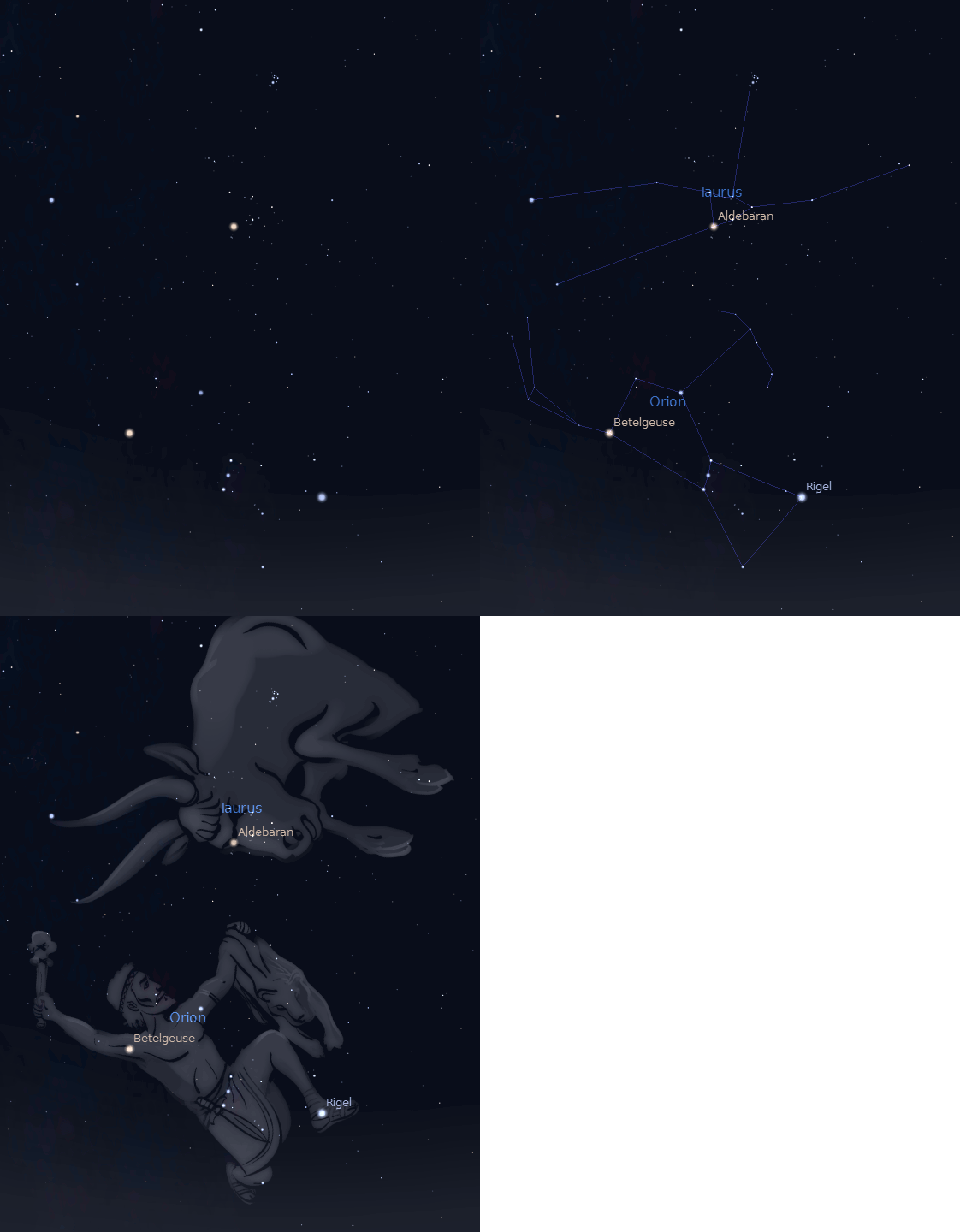
Three views of Taurus the bull and Orion the hunter for about p.m. in December.
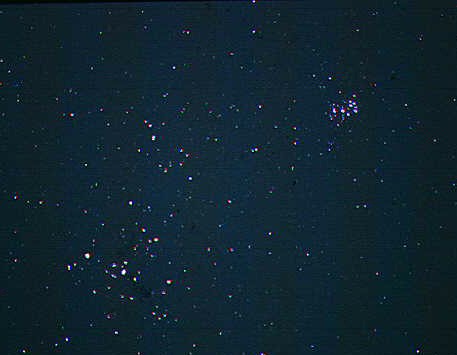
The Hyades (lower left) and the Pleiades (upper right). My photograph from many years ago BD (Before Digital).
The first constellation of winter to appear is probably a toss-up between Auriga the charioteer and Taurus the Bull. Auriga never quite disappears, or at least Capella its brightest star is circumpolar and never quite sets here in Northern Michigan. But Auriga sneaks up slowly in the northeast. Taurus on the other hand makes a grand entrance on autumn evenings preceded by the Pleiades, the Seven Sisters star cluster.
Taurus’ brightest star is Aldebaran, the bull’s angry bloodshot eye. It is at the left tip of a letter V of stars that is the bull’s face. Above the V are single stars that form the tips of its very long horns. Other stars below form the front legs of this beast. That’s it. Only the front part of the bull appears in the sky. In its shoulder are the Pleiades.
According to Greek mythology Taurus represents the god Zeus, the Roman Jupiter, who, in the disguise of a bull abducted the beautiful maiden Europa. This isn’t the only celestial disguise of Zeus. Cygnus is the disguise of Zeus in the famous Leda and the swan affair.
The Pleiades and the Hyades, the V-shaped star cluster of Taurus’ head also have their places in Greek Mythology. The Hyades and Pleiades are half sisters of each other who share Atlas as their father. But it is the Pleiades which are more prominent and have more stories about them. It is the Pleiades that are pursued by Orion the hunter, the central constellation of winter. And since the Pleiades are west of Orion it does appear that Orion continues to chase them around and around the sky daily. To the Kiowa Indians the Pleiades were also young maidens. As the story goes they were being chased by a large bear. The Great Spirit placed them on what we know today as Devil’s Tower in Wyoming to keep them out of reach of the bear. It is said that even today the sides of this tower show the scars of the bear’s claws. Devil’s Tower was the prominent landmark in the movie Close Encounters of the Third Kind. To the Anishinaabek native peoples around here the Pleiades is the “Hole in the Sky” or the seven sweating stones that are heated for the sweat lodge ceremony.
What do we know about Taurus today? Aldebaran is an orangish giant star which lies at a distance of 65 light years. It doesn’t belong to the Hyades, which is about 151 light years away. Aldebaran’s diameter is 40 times the Sun’s, about the diameter as the orbit of Mercury. It’s only 1.7 times tha mass of the Sun. Aldebaran shines at 153 times the Sun’s output.
Aldebaran appears to be part of the Hyades cluster, but it is less than half the distance to this most important star cluster. Though less prominent as the Pleiades, the Hyades is the most important star cluster in the heavens. The reason is because the Hyades was until recently the only star cluster close enough to get an accurate distance measurement by direct means. That direct means is parallax, measuring the shift of the star’s position in the sky due to the earth’s changing position in orbit of the Sun. The Hipparcos satellite has been refining these parallaxes over the past few years. Its measurement of the distance of the Hyades cluster is 151 light years give or take a bit less than a light year. The Hyades distance is the basis for all more distant measurements to the ends of the known universe.
The Hyades is a good binocular object with over 100 stars visible. The cluster actually overflows the binocular’s field of view. This cluster is also known as the Taurus Moving Cluster because its stars are receding towards a point northeast of Orion’s Betelgeuse.
Of course the splashiest part of Taurus is the Pleiades. For people with good vision 6 or more stars can be seen. I can see 4 or 5 stars and fuzz, which are unresolved stars. Many, who see the Pleiades for the first time, think the tiny pattern of stars is the Little Dipper. The stars do indeed look like a tiny dipper, with a nice bowl and a sawed off handle. And that’s what I call it: the Tiny Dipper. The big surprise of the Hipparcos distance measurements is the distance of the Pleiades. The generally accepted distance was about 410 light years. Hipparcos measured 375 light years. This means that the stars of the Pleiades are somewhat dimmer than believed before. Pleiades prior measurement was based on photometric or brightness measurements with the stars of the Hyades and other stars of the same type and known brightness and distance. So it turns out in the case of the Pleiades that the former measurements weren’t as accurate as thought, and means we have more to understand about stellar evolution as it relates to star brightness. Or perhaps Hipparcos is wrong. And interesting debate and more measurements are sure to follow.
The age of the Pleiades is thought to be around 100 million years, young compared to the Sun’s 4.6 billion years. Long exposure photographs and some telescopes can still spot the remaining wisp’s of the nebulae they were born from. The material is probably dust simply reflecting the light of the stars in the cluster.
Taurus is a great constellation to scan with a pair of binoculars.
-
December 15, 2017 at 12:59 am12/15/20187 – Ephemeris – Taurus, Bullish on Winter – MeasurementDataBases for Industry & Science
 Bob Moler's Ephemeris Blog