07/16/2018 – Ephemeris – Lyra the harp, Hermes’ invention
Ephemeris for Monday, July 16th. Today the Sun will be up for 15 hours and 12 minutes, setting at 9:24, and it will rise tomorrow at 6:13. The Moon, 3 days before first quarter, will set at 12:02 tomorrow morning.
Very high up in the eastern sky at 11 p.m. can be found a bright star just north of a small, narrow, but very distinctive parallelogram of stars. They are the stars of the constellation Lyra the harp. The bright star is Vega, one of the twenty one brightest first magnitude stars. Vega is actually the 5th brightest night-time star. The harp, according to Greek mythology, was invented by the god Hermes. The form of the harp in the sky, is as he had invented it: by stretching strings across a tortoise shell. Hermes gave it to his half-brother Apollo, who in turn gave it to the great musician Orpheus. The Sun has a motion with respect to most stars around it. Its direction is towards the vicinity of Lyra.
The times given are for the Traverse City/Interlochen area of Michigan. They may be different for your location.
Addenda
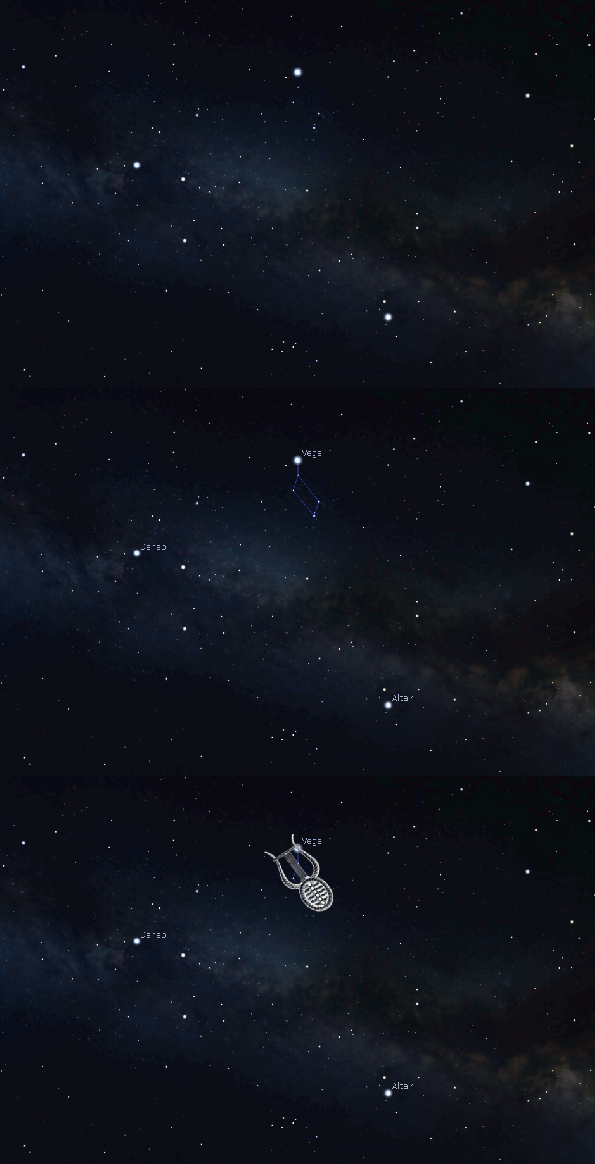
Animated Lyra finder chart. with Vega and the other named stars of the Summer Triangle. The lyre image not supplied by Stellarium but is from The World’s Earliest Music by Hermann Smith, Figure 60, A Project Gutenberg Ebook, and captioned “The Chelys or Greek Tortoiseshell Lyre”. Click on the image to enlarge Created using Stellarium and GIMP.
Last Saturday night’s wild Sun ‘n Star Party
Last Saturday night the Grand Traverse Astronomical Society, myself included, and the rangers and volunteers of the Sleeping Bear Dunes National Lakeshore held our Sun ‘n Star Party at the Dune Climb. I live 20 miles southeast of the Dune Climb, and about half way between Traverse City and Interlochen. It’s also the location for which the Ephemeris sunrise and sunset times are calculated for. We rely on the GOES East satellite imagery to show us the cloud patterns and movement. Saturday morning was pretty overcast and hot. GOES East showed that a big clearing was heading for us. At 1 p.m. I emailed our members that the event was a GO, and began to pack up the car with my two telescopes, and assorted items. Meanwhile some raindrops were showing up on the windshield. A check with weather radar on my phone confirmed that some rainstorms were popping up between my location and Lake Michigan. This is rather normal when it’s hot and humid in the afternoon, and wouldn’t affect the Dune area close to the lake. In driving to the Dune Climb I drove through some rain showers, but the skies cleared by the time I got within 5 miles from the lake.
The solar observing from 4 to 6 p.m.was great, except for no sunspots. We had 2 solar telescopes that did reveal some prominences. The sky was clear. The storm clouds were receding to the east. Of course we couldn’t see much to the west because the dune was in the way. Its angular altitude averaged 12 degrees. Some of us stayed there and ate our dinner. By 7:30 the wind came up from the southwest. A check of the GOES East satellite showed us a large, roughly square cloud the width of the lake slowly moving northward that was just south of us. Just after 8 p.m. we noticed clouds looming from the south, then fog was overtaking the tops of the dunes to the southwest. Shortly thereafter we were socked in. At a little after 9 p.m. Marie Scott the ranger in charge of this event gave introductions, and handed the microphone to me, who introduced our members and went over what we were supposed to see that night. We couldn’t track this cloud anymore by satellite because it was between the daytime color imagery and the nighttime infrared imagery. However around 10 p.m. someone spotted Vega, nearly overhead. And while I was swinging my 11″ Dobsonian towards it, someone else called out Jupiter. Looking around the fog was lifting. The night was salvaged. We stayed over an hour after the official 11 p.m. to watch Mars rise near the end of the star party, and finally view some of the wonders of the dark summer sky.
This was the fourth of seven monthly star parties scheduled at the Dunes this year. It was the first we didn’t cancel due to weather. We generally cancel one or two of then a year, but to start the year with three was depressing.
 Bob Moler's Ephemeris Blog