Archive
11/05/2018 – Ephemeris – Cassiopeia the Queen
Ephemeris for Monday, November 5th. The Sun will rise at 7:26. It’ll be up for 9 hours and 59 minutes, setting at 5:26. The Moon, 2 days before new, will rise at 6:00 tomorrow morning.
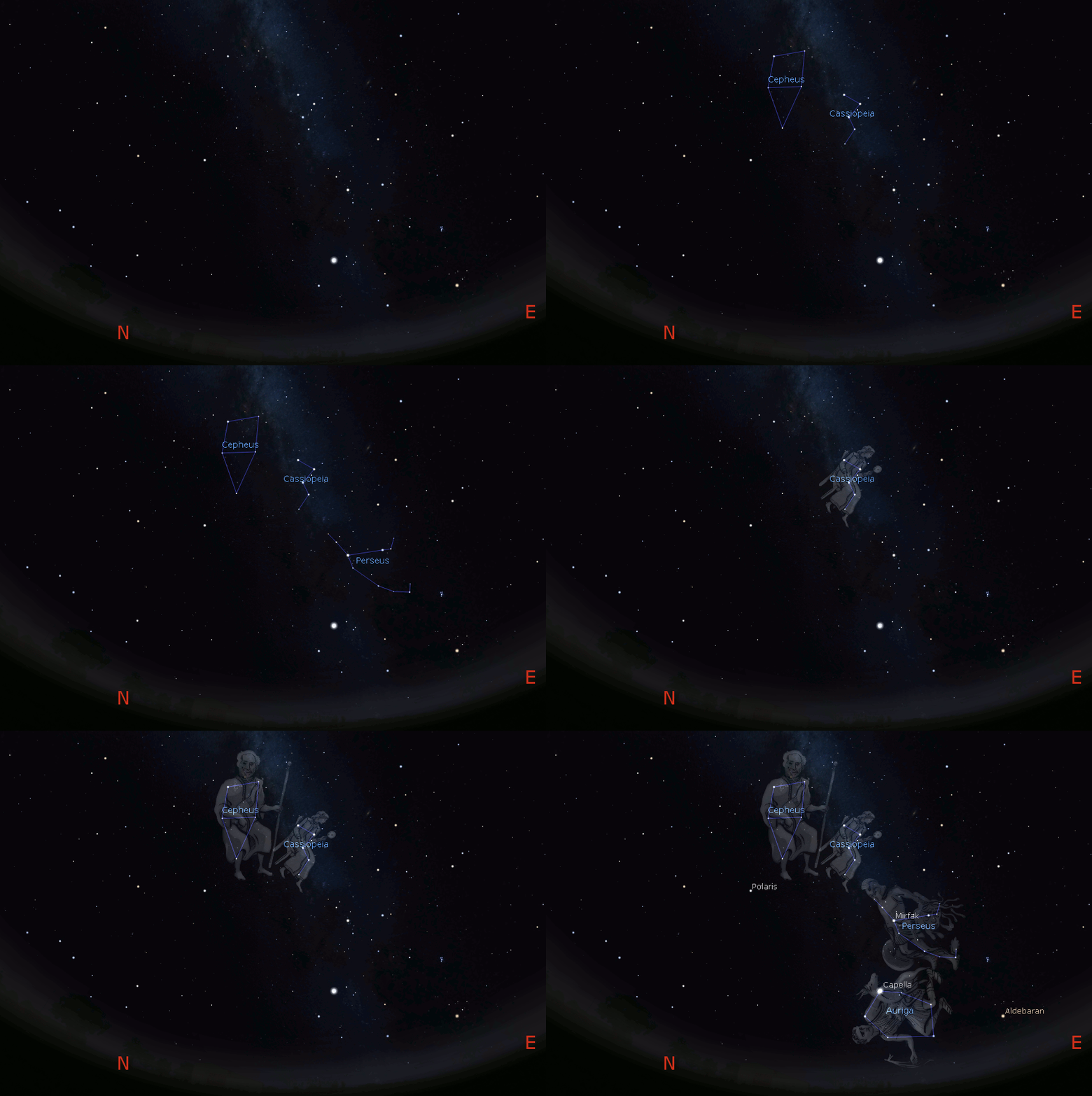
The stars of the autumn skies are replacing the summer stars from the east. Look in the northeastern sky by 7 p.m. and you can find the W shaped constellation of Cassiopeia the queen. Cassiopeia is so far north that it never sets for us in Michigan. It is opposite the pole star Polaris from the Big Dipper. There’s a dim star that appears above the middle star of the W which turns it into a very crooked backed chair, Cassiopeia’s throne. Above and left of Cassiopeia is a dim upside down church steeple shaped constellation of Cepheus the king, her husband. The Milky Way flows through Cassiopeia toward the northeastern horizon and through the constellation of Perseus the hero, which kind of looks, to me anyway, like the cartoon roadrunner.
The times given are for the Traverse City/Interlochen area of Michigan. They may be different for your location.
Addendum
11/04/2018 – Ephemeris Extra – Wintermaker rising
A chill is in the air, The Fisher, Ojiig’s bloody tail has swooped low in the north at midnight to paint the trees with their fall colors, and the leaves have fallen to the ground. Haven’t heard of the Fisher? I mention it from time to time here on my Ephemeris program on Interlochen Public Radio. It’s a constellation of the Anishinaabe peoples indigenous to this area of Michigan, of which the Chippewa, Ottawa, and Ojibwe are a part.
The Fisher occupies the stars which we know as the Big Dipper and the Great Bear, Ursa Major. And unlike the bear, a fisher really does have a long tail. The fisher is a real weasel-like animal whose diet apparently does not include fish. It is found across southern Canada and in the American West. I’ve related the story of the Fisher, and how he brought summer to the Earth, in these pages in the August 2012 issue and on my blog bobmoler.wordpress.com. Search for fisher. Like most legends, there are different versions of that story and others about the Fisher.
Fisher or not, summer is gone and the world seems darker and colder. Over in the east these evenings great winter constellation of Orion is rising. It brings to mind the Robert Frost poem Star-Splitter, and our star chart this month from the November 1st post:
“You know Orion always comes up sideways.

Throwing a leg up over our fence of mountains,

And rising on his hands, he looks in on me

Busy outdoors by lantern-light with something

I should have done by daylight, and indeed,

After the ground is frozen, I should have done

Before it froze, and a gust flings a handful

Of waste leaves at my smoky lantern chimney

To make fun of my way of doing things,

Or else fun of Orion's having caught me.

Has a man, I should like to ask, no rights

These forces are obliged to pay respect to?"
The rest of the poem is available on the Poetry Foundation website: https://www.poetryfoundation.org/poems/44273/the-star-splitter. The poem is about one Brad McLaughlin and his telescope. While I don’t approve of how he financed his telescope, I do share his enthusiasm.
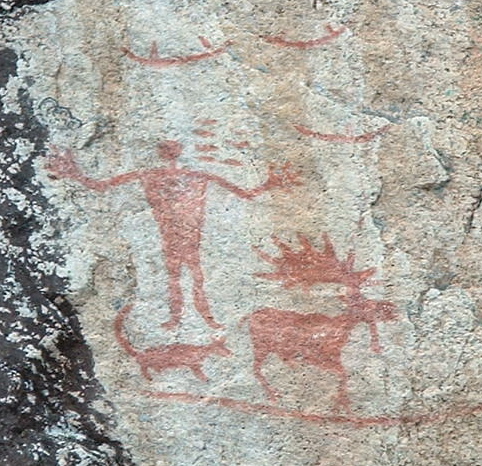
The Wintermaker, Biboonikeonini’s, name literally means North Wind. While his torso is the same as Orion’s his arms stretch from Aldebaran in Taurus to Procyon in Canis Minor, just about spanning the entire winter sky. The pictographs, seen above of the Wintermaker, Curly Tail and Moose can only be seen from a canoe in the cliff face on one side of the narrows between North Hegman and Trease lakes, 15 miles north of Ely, Minnesota
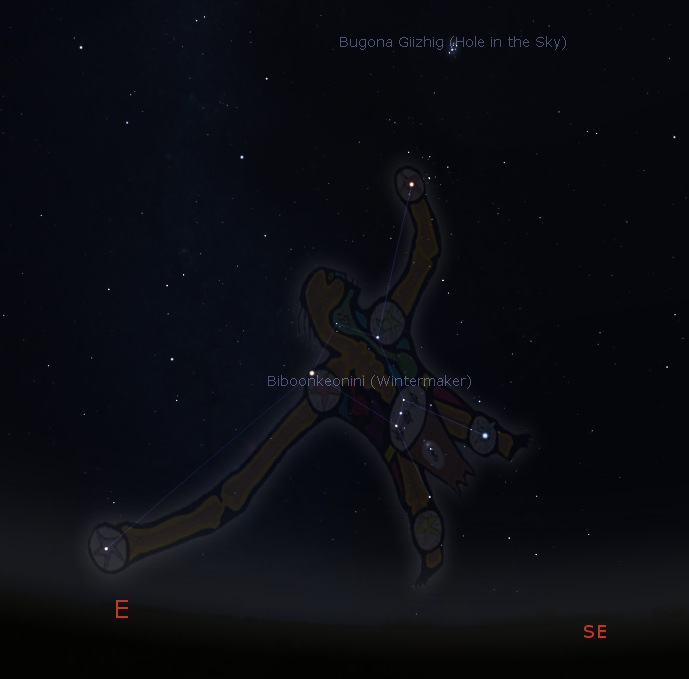
In late winter as Ojiig is rising in the northeast signaling the maple sugaring season, the Wintermaker is moving lower in the southwest. Some Ojibwe parents make bows for their children to shoot arrows at the Wintermaker to convince him to flee the skies so spring can begin as a way to teach them the old legends of their culture.
The Pleiades is an important group of stars for the Anishinaabe in several ways. It is the Hole-In-The-Sky, Bagone’giizhig, through which the Sky Woman fell and to give birth to the first humans on the Earth.
The Pleiades also represent the seven poles of the Shaking Tent Ceremony, and the seven sacred stones that are heated for the sweat lodge, which is also seen in the stars in the spring as Corona Borealis.

They are also the Seven Daughters of the Moon and Sun. They loved to dance and play, and when their father, the Moon was low in the sky, would descend to the Earth in a basket to do their thing. On one of their trips to the earth, one of them was captured by a human and she ended up falling in love with him, and married him. When father Moon found out he permanently dimmed her star, so now most people now only can spot 6 of the stars. This last bit seems to parallel the Greek story of the lost Pleiad.
Note: This is published as an article in the Grand Traverse Astronomical Society’s November 2018 newsletter Stellar Sentinel.
11/02/2018 – Ephemeris – Back to basics tonight at the GTAS meeting
Ephemeris for Friday, November 2nd. The Sun will rise at 8:22. It’ll be up for 10 hours and 7 minutes, setting at 6:30. The Moon, 2 days past last quarter, will rise at 3:27 tomorrow morning.
Tonight at this month’s meeting of the Grand Traverse Astronomical Society at 8 p.m. at Northwestern Michigan College’s Rogers observatory we will get back to basics for anyone wondering about the skies visible from one’s backyard. Learn the constellations by building your own star finder that shows where the stars are any night of the year. We’ll also show you how to use it. We will let you experiment with moon-balls, that will show the light and shadow of the Moon’s phases. Afterward, if it’s clear you’ll have a chance to use those star finders during the observation period starting around 9 p.m. The observatory is south of Traverse City, on Birmley Road, between Garfield and Keystone roads.
The times given are for the Traverse City/Interlochen area of Michigan. They may be different for your location.
11/01/2018 – Ephemeris – November preview
Ephemeris for Thursday, November 1st. The Sun will rise at 8:20. It’ll be up for 10 hours and 10 minutes, setting at 6:31. The Moon, 1 day past last quarter, will rise at 2:14 tomorrow morning.
Let’s look ahead at the skies for the month of November. The Sun is still moving south rapidly. Daylight hours in the Interlochen/Traverse City area and will drop from 10 hours and 10 minutes today to 9 hours 5 minutes on the 30th. The altitude, or angle, of the Sun above the southern horizon at local noon will be at 30 degrees today and will descend to 23 and a half degrees on the 30th. The altitude of the Sun in the Straits area will be a degree lower. Local noon, this month, will be about 12:30 p.m. once we’re on standard time. The Leonid meteor shower will reach multiple peaks from the 16th through the 21st and is expected to be lackluster and may only produce 10 to 15 meteors per hour. But the Leonids can be surprising.
The times given are for the Traverse City/Interlochen area of Michigan. They may be different for your location.
Addendum
November Evening Star Chart
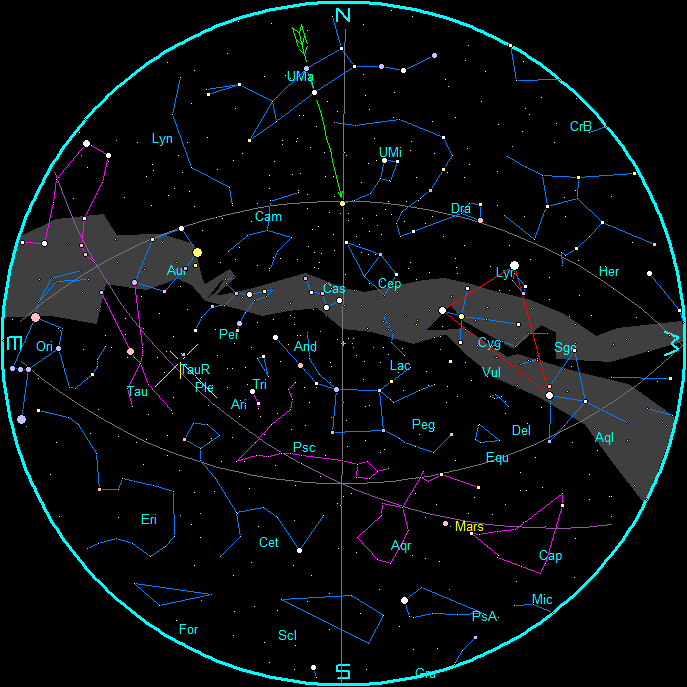
The planets and stars are plotted for the 15th at 9 p.m. EST in the evening and 6 a.m. for the morning chart. These are the chart times. Note that Traverse City is located approximately 45 minutes behind our time meridian. (An hour 45 minutes behind our daylight saving time meridian during EDT). To duplicate the star positions on a planisphere you may have to set it to 1 hour 45 minutes earlier than the current time.
Note the chart times of 9 p.m. and 6 a.m. are for the 15th. For each week before the 15th add ½ hour (28 minutes if you’re picky). For each week after the 15th subtract ½ hour. The planet positions are updated each Wednesday on this blog. For planet positions on dates other than the 15th, check the Wednesday planet posts on this blog.
November Morning Star Chart
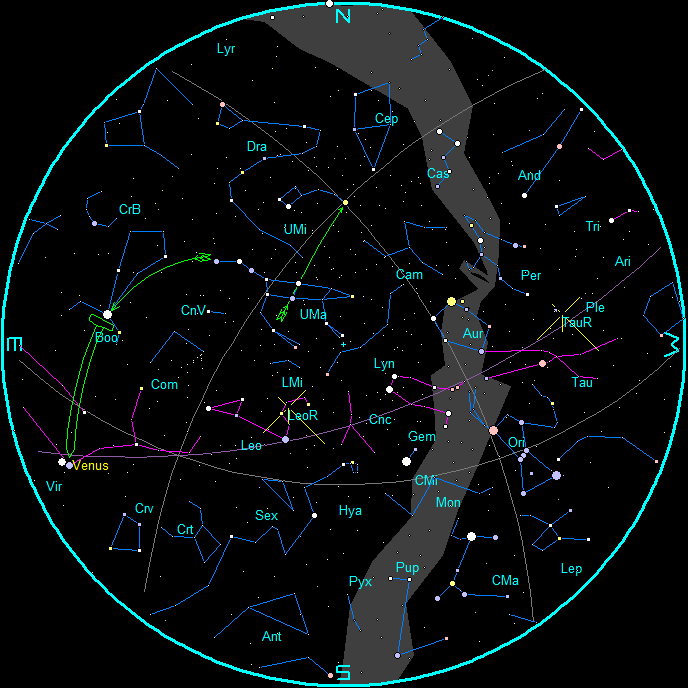
Star Chart for November moprnings 2018 (6 a.m. EST November 15, 2018). Created using my LookingUp program. Click on image to enlarge. The original morning chart uploaded November 1st was outdated. This corrected chart was uploaded November 6th.
For a list of constellation names to go with the abbreviations click here.
- Pointer stars at the front of the bowl of the Big Dipper point to Polaris the North Star.
- Follow the arc of the handle of the Big Dipper to the star Arcturus
- The Summer Triangle is in red.
- TauR on the evening star chart can be used as the radiant for the North and South Taurid meteor showers.
- LeoR on the morning star chart is the radiant of the Leonid meteor shower which peaks between the 16th to 21st.
Twilight
| Time zone=EDT | |||||||
| Morning twilight | Evening twilight | Dark night | Moon | ||||
| Date | Astronomical | Nautical | Nautical | Astronomical | Start | End | Illum. |
| 2018-11-01 | 6h47m | 7h21m | 19h39m | 20h13m | 20h13m | 1h02m | 0.41 |
| 2018-11-02 | 6h48m | 7h22m | 19h38m | 20h12m | 20h12m | 2h14m | 0.29 |
| 2018-11-03 | 6h49m | 7h23m | 19h37m | 20h11m | 20h11m | 3h27m | 0.19 |
| 2018-11-04 | 5h50m | 6h24m | 18h36m | 19h10m | 19h10m | 3h39m | 0.11 |
| 2018-11-05 | 5h52m | 6h26m | 18h34m | 19h08m | 19h08m | 4h50m | 0.05 |
| 2018-11-06 | 5h53m | 6h27m | 18h33m | 19h07m | 19h07m | 5h53m | 0.01 |
| 2018-11-07 | 5h54m | 6h28m | 18h32m | 19h06m | 19h06m | 5h54m | 0.00 |
| 2018-11-08 | 5h55m | 6h29m | 18h31m | 19h05m | 19h05m | 5h55m | 0.01 |
| 2018-11-09 | 5h56m | 6h30m | 18h30m | 19h04m | 19h04m | 5h56m | 0.05 |
| 2018-11-10 | 5h57m | 6h32m | 18h29m | 19h03m | 19h46m | 5h57m | 0.10 |
| 2018-11-11 | 5h59m | 6h33m | 18h28m | 19h02m | 20h33m | 5h59m | 0.17 |
| 2018-11-12 | 6h00m | 6h34m | 18h27m | 19h01m | 21h25m | 6h00m | 0.26 |
| 2018-11-13 | 6h01m | 6h35m | 18h26m | 19h00m | 22h20m | 6h01m | 0.35 |
| 2018-11-14 | 6h02m | 6h36m | 18h25m | 19h00m | 23h18m | 6h02m | 0.44 |
| 2018-11-15 | 6h03m | 6h38m | 18h24m | 18h59m | – | 6h03m | 0.54 |
| 2018-11-16 | 6h04m | 6h39m | 18h24m | 18h58m | 0h18m | 6h04m | 0.63 |
| 2018-11-17 | 6h05m | 6h40m | 18h23m | 18h57m | 1h19m | 6h05m | 0.73 |
| 2018-11-18 | 6h07m | 6h41m | 18h22m | 18h57m | 2h21m | 6h07m | 0.81 |
| 2018-11-19 | 6h08m | 6h42m | 18h21m | 18h56m | 3h24m | 6h08m | 0.89 |
| 2018-11-20 | 6h09m | 6h43m | 18h21m | 18h55m | 4h30m | 6h09m | 0.95 |
| 2018-11-21 | 6h10m | 6h45m | 18h20m | 18h55m | 5h38m | 6h10m | 0.99 |
| 2018-11-22 | 6h11m | 6h46m | 18h19m | 18h54m | – | – | 0.99 |
| 2018-11-23 | 6h12m | 6h47m | 18h19m | 18h54m | – | – | 1.00 |
| 2018-11-24 | 6h13m | 6h48m | 18h18m | 18h53m | – | – | 0.99 |
| 2018-11-25 | 6h14m | 6h49m | 18h18m | 18h53m | 18h53m | 19h38m | 0.94 |
| 2018-11-26 | 6h15m | 6h50m | 18h17m | 18h52m | 18h52m | 20h43m | 0.88 |
| 2018-11-27 | 6h16m | 6h51m | 18h17m | 18h52m | 18h52m | 21h52m | 0.79 |
| 2018-11-28 | 6h17m | 6h52m | 18h16m | 18h51m | 18h51m | 23h05m | 0.68 |
| 2018-11-29 | 6h18m | 6h53m | 18h16m | 18h51m | 18h51m | – | 0.56 |
| 2018-11-30 | 6h19m | 6h54m | 18h16m | 18h51m | 18h51m | 0h17m | 0.44 |
| 2018-10-31 | 6h45m | 7h19m | 19h40m | 20h14m | 20h14m | – | 0.53 |
Twilight calendar was generated using Cartes du Ciel (Sky Charts).
See my blog post: Twilight Zone for the definitions of the different periods of twilight here: https://bobmoler.wordpress.com/2018/09/27/
NASA Calendar of Planetary Events
| Time | ||||
| Nov | 1 | Th | Venus: 10.6° W | |
| 1 | Th | 11:16:00 PM | Moon-Regulus: 2.1° S | |
| 5 | Mo | 12:31:00 PM | South Taurid Shower: ZHR = 10 | |
| 6 | Tu | 09:59:00 AM | Mercury Elongation: 23.3° E | |
| 7 | We | 11:02:00 AM | New Moon | |
| 8 | Th | 11:56:00 PM | Mercury-Antares: 1.8° N | |
| 11 | Su | 10:46:00 AM | Moon-Saturn: 1.6° S | |
| 11 | Su | 09:21:00 PM | Moon South Dec.: 21.4° S | |
| 12 | Mo | 11:48:00 AM | North Taurid Shower: ZHR = 15 | |
| 13 | Tu | 09:04:00 AM | Moon Descending Node | |
| 14 | We | 10:57:00 AM | Moon Apogee: 404300 km | |
| 14 | We | 06:23:00 PM | Venus-Spica: 1.5° S | |
| 15 | Th | 09:54:00 AM | First Quarter | |
| 15 | Th | 11:16:00 PM | Moon-Mars: 1.1° N | |
| 17 | Sa | 06:05:00 PM | Leonid Shower: ZHR = 15 | |
| 23 | Fr | 12:39:00 AM | Full Moon | |
| 23 | Fr | 04:11:00 PM | Moon-Aldebaran: 1.7° S | |
| 25 | Su | 08:48:00 PM | Moon North Dec.: 21.5° N | |
| 26 | Mo | 01:25:00 AM | Jupiter Conjunction | |
| 26 | Mo | 07:10:00 AM | Moon Perigee: 366600 km | |
| 27 | Tu | 12:18:00 AM | Moon Ascending Node | |
| 27 | Tu | 04:10:00 AM | Mercury Inferior Conj. | |
| 27 | Tu | 03:57:00 PM | Moon-Beehive: 0.8° N | |
| 29 | Th | 04:27:00 AM | Moon-Regulus: 2.4° S | |
| 29 | Th | 07:19:00 PM | Last Quarter | |
| All event times are given for UTC-5:00: Eastern Standard or Daylight Time | ||||
Sky Events Calendar by Fred Espenak and Sumit Dutta (NASA’s GSFC),
http://eclipse.gsfc.nasa.gov/SKYCAL/SKYCAL.html
If you go to the above site you can print out a list like the above for the entire year
or calendar pages for your time zone.
Sun and Moon Rising and Setting Events
| Ephemeris of Sky Events for Interlochen/TC | ||||||||||
| November 2018 – Local time zone: EDT/EST | ||||||||||
| Date | Sun | Twilight* | Moon | Illum | ||||||
| Rise | Set | Hours | End | Start | Phase | R/S** | Time | Fract | ||
| Thu | 1 | 08:20a | 06:31p | 10:11 | 07:36p | 07:15a | Rise | 02:14a | 35 | |
| Fri | 2 | 08:21a | 06:29p | 10:08 | 07:34p | 07:16a | Rise | 03:27a | 25 | |
| Sat | 3 | 08:22a | 06:28p | 10:05 | 07:33p | 07:17a | Rise | 04:39a | 16 | |
| *** Time Change – EST – Time Change *** | ||||||||||
| Sun | 4 | 07:24a | 05:27p | 10:02 | 06:32p | 06:19a | Rise | 04:50a | 9 | |
| Mon | 5 | 07:25a | 05:25p | 10:00 | 06:31p | 06:20a | Rise | 06:00a | 3 | |
| Tue | 6 | 07:27a | 05:24p | 09:57 | 06:30p | 06:21a | Rise | 07:09a | 1 | |
| Wed | 7 | 07:28a | 05:23p | 09:55 | 06:29p | 06:22a | New | Set | 05:52p | 0 |
| Thu | 8 | 07:29a | 05:22p | 09:52 | 06:28p | 06:23a | Set | 06:26p | 2 | |
| Fri | 9 | 07:31a | 05:21p | 09:49 | 06:26p | 06:25a | Set | 07:03p | 6 | |
| Sat | 10 | 07:32a | 05:19p | 09:47 | 06:25p | 06:26a | Set | 07:46p | 11 | |
| Sun | 11 | 07:33a | 05:18p | 09:44 | 06:25p | 06:27a | Set | 08:33p | 18 | |
| Mon | 12 | 07:35a | 05:17p | 09:42 | 06:24p | 06:28a | Set | 09:25p | 26 | |
| Tue | 13 | 07:36a | 05:16p | 09:40 | 06:23p | 06:29a | Set | 10:20p | 35 | |
| Wed | 14 | 07:37a | 05:15p | 09:37 | 06:22p | 06:31a | Set | 11:18p | 44 | |
| Thu | 15 | 07:39a | 05:14p | 09:35 | 06:21p | 06:32a | F Qtr | Set | 12:18a | 54 |
| Fri | 16 | 07:40a | 05:13p | 09:33 | 06:20p | 06:33a | Set | 01:18a | 63 | |
| Sat | 17 | 07:41a | 05:12p | 09:30 | 06:19p | 06:34a | Set | 02:20a | 72 | |
| Sun | 18 | 07:43a | 05:11p | 09:28 | 06:19p | 06:35a | Set | 03:24a | 80 | |
| Mon | 19 | 07:44a | 05:10p | 09:26 | 06:18p | 06:36a | Set | 04:29a | 88 | |
| Tue | 20 | 07:45a | 05:10p | 09:24 | 06:17p | 06:38a | Set | 05:37a | 94 | |
| Wed | 21 | 07:47a | 05:09p | 09:22 | 06:17p | 06:39a | Set | 06:47a | 98 | |
| Thu | 22 | 07:48a | 05:08p | 09:20 | 06:16p | 06:40a | Set | 07:58a | 100 | |
| Fri | 23 | 07:49a | 05:07p | 09:18 | 06:15p | 06:41a | Full | Rise | 05:55p | 99 |
| Sat | 24 | 07:50a | 05:07p | 09:16 | 06:15p | 06:42a | Rise | 06:42p | 96 | |
| Sun | 25 | 07:52a | 05:06p | 09:14 | 06:14p | 06:43a | Rise | 07:39p | 90 | |
| Mon | 26 | 07:53a | 05:06p | 09:12 | 06:14p | 06:44a | Rise | 08:43p | 82 | |
| Tue | 27 | 07:54a | 05:05p | 09:10 | 06:14p | 06:45a | Rise | 09:52p | 72 | |
| Wed | 28 | 07:55a | 05:04p | 09:09 | 06:13p | 06:46a | Rise | 11:05p | 61 | |
| Thu | 29 | 07:56a | 05:04p | 09:07 | 06:13p | 06:47a | L Qtr | Rise | 12:17a | 50 |
| Fri | 30 | 07:58a | 05:04p | 09:06 | 06:13p | 06:48a | Rise | 01:28a | 39 | |
| * Nautical Twilight | ||||||||||
| ** Rise or set whichever occurs between sunset and sunrise | ||||||||||
 Bob Moler's Ephemeris Blog