Archive
03/03/2020 – Ephemeris – Betelgeuse, apparently, has stopped dimming and may be brightening
Ephemeris for Tuesday, March 3rd. Today the Sun will be up for 11 hours and 18 minutes, setting at 6:33, and it will rise tomorrow at 7:14. The Moon, 1 day past first quarter, will set at 3:41 tomorrow morning.
Betelgeuse the red giant star in the constellation Orion’s shoulder has apparently stopped dimming and may be brightening again. The process of recovery is slow. It may recover its former brightness. We’ll know this later in summer when Betelgeuse and the rest of Orion moves from behind the Sun and enters the morning sky. Betelgeuse is known to be irregular in brightness, but has never been recorded as being this dim, dropping it from being a first magnitude star. Betelgeuse is no longer dimming. There is lots of speculation as to why it’s now brightening. One is the thought that there are several periodic cycles that govern Betelgeuse’s variability. That the troughs of these cycles happen to coincide is one explanation.
The times given are for the Traverse City/Interlochen area of Michigan. They may be different for your location.
Addendum
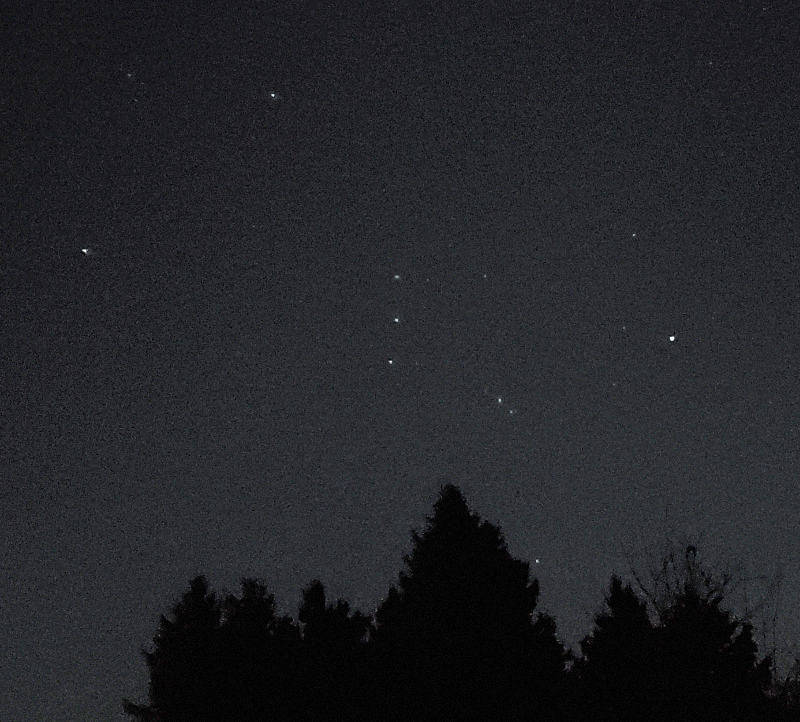
Betelgeuse in Orion (the bright star on the left) at 7:07 p.m. January 6, 2020. Taken with my Samsung Galaxy S10+ in the moonlight. Compare the brightness of Betelgeuse with Rigel, Bellatrix and the belt stars.
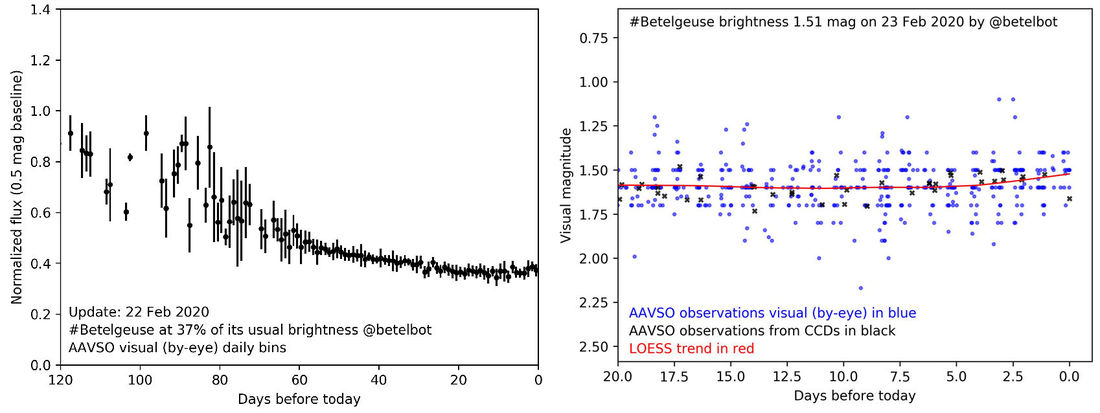
The brightness of Betelgeuse from late November 2019 to 23 Feb. 2020 shows it dimming dramatically (the y-axis is in magnitudes, where a bigger number is fainter). A close-up on just the past 20 days (right) shows it starting to rise again around 18 Feb. Blue dots are estimates by eye, black using digital cameras, and the red line is a smooth fit to the data. Credit: Betelbot on Twitter, run by Michael Hipke via Dr. Phil Plait’s Bad Astronomy post https://www.syfy.com/syfywire/no-supernova-for-you-betelgeuse-is-brightening-again-right-on-schedule
03/02/2020 – Ephemeris – Greek use of the first quarter Moon
Ephemeris for Monday, March 2nd. Today the Sun will be up for 11 hours and 14 minutes, setting at 6:32, and it will rise tomorrow at 7:15. The Moon, at first quarter today, will set at 2:39 tomorrow morning.
The Moon is at first quarter at 2:57 this afternoon. The ancient Greek philosopher/astronomer Aristarchus* tried to determine the distance to the Sun by observing the Moon at exactly first quarter and measuring the angle between it and the Sun. If we see the Moon at exactly first quarter when the sunrise line called the terminator cuts the Moon exactly in half then the angle at the Moon between the Sun and the Earth is a right or 90 degree angle. If we, on the Earth at that same instant were able to measure the angular distance between the Moon and the Sun. we could theoretically calculate the distance to the Sun. He was correct about the Moon’s distance, but calculated the Sun was at only about 10% of its actual distance.
The times given are for the Traverse City/Interlochen area of Michigan. They may be different for your location.
* In the actual broadcast program I erroneously credited the later Greek astronomer Hipparchus.
Addendum
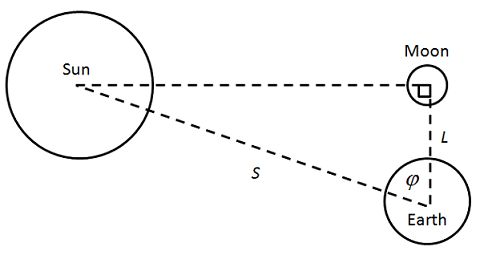
Quarter Moon method of determining the Sun’s distance by Aristarchus. Credit: andonee
 Bob Moler's Ephemeris Blog