Archive
07/29/2020 – Ephemeris – Let’s look at a the naked-eye planets and not so naked-eye comets for this week
This is Bob Moler with Ephemeris for Wednesday, July 29th. Today the Sun will be up for 14 hours and 45 minutes, setting at 9:11, and it will rise tomorrow at 6:27. The Moon, 2 days past first quarter, will set at 2:27 tomorrow morning.
Let’s look at a the naked-eye planets for this week. Jupiter and Saturn are both low in the southeastern sky in the evening. Jupiter is the very bright one. To the left of it will be Saturn. Both planets will be up most of the night with Jupiter setting first at 5:05 am tomorrow morning and Saturn following at 5:44 am. Comet NEOWISE is in the evening sky fading to below naked-eye visibility and also it is hampered by the bright moon. It was a great sight in this bleak year of 2020. The next planet visible will be Mars which will rise at 12:03 am. Its now down to 60.6 million miles (97.5 million km) away, as the Earth slowly overtakes it at the rate of about 3.6 million miles (5.7 million km) a week. Venus will rise at 3:14 am in the east-northeast as our Morning Star. Finally Mercury will rise at 4:59 am.
The event times given are for the Traverse City/Interlochen area of Michigan. They may be different for your location.
Addendum
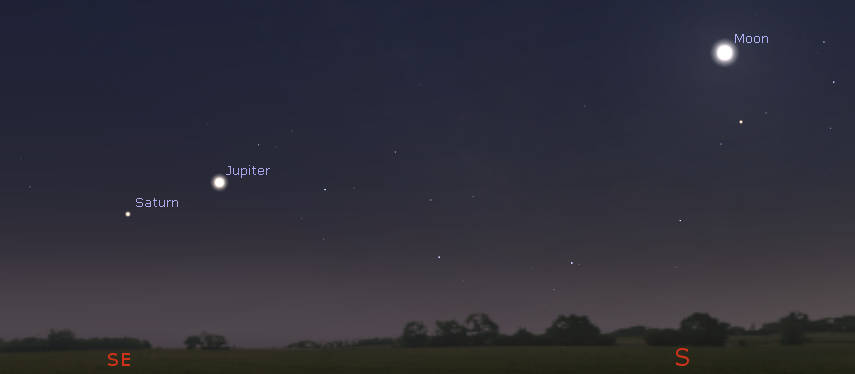
Evening planets Jupiter and Saturn seen in the southeast at 10 pm, about 45 minutes after sunset July 29, 2020. Click on the image to enlarge. Created using Stellarium.
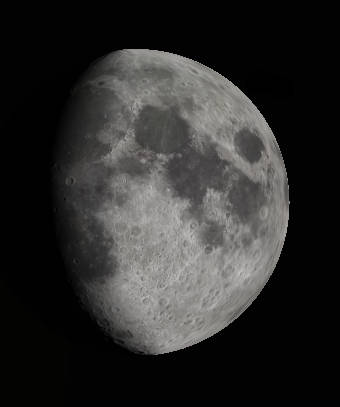
The gibbous Moon as it might be seen tonight at 10 pm July 29, 2020. Created using Stellarium.
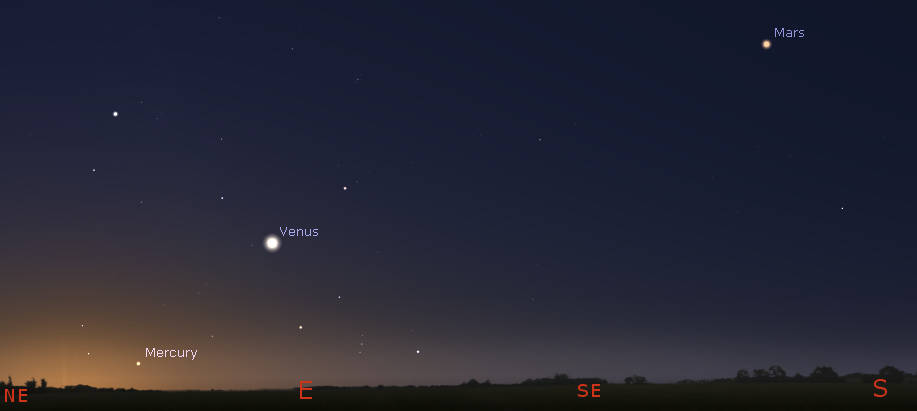
The morning planets as seen at 5:30 am or about an hour before sunrise July 30,2020. Mercury is showing up, rising at 4:56 amClick on the image to enlarge. Created using Stellarium.
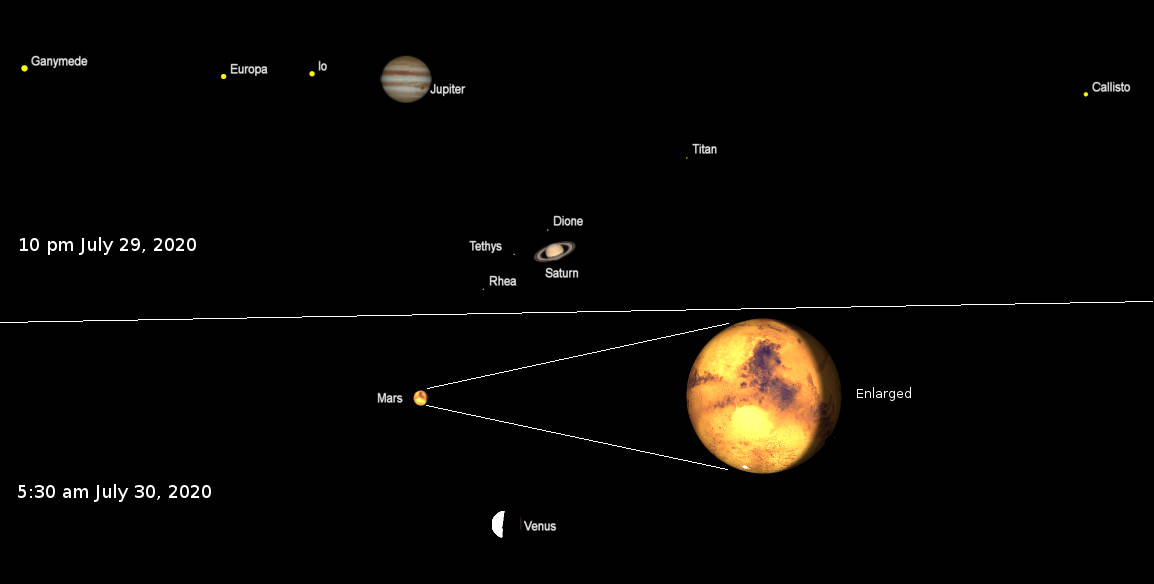
The planets as seen in a telescope (north up) with the same magnification tonight and tomorrow July 29/30, 2020. Apparent diameters: Jupiter, 47.26″; Saturn, 18.45″, rings, 42.98″ at 10 pm. Mars, 14.40″, and Venus 27.78″ at 5:30 am. Mars also displays an enlargement showing surface detail. The ” symbol means seconds of arc (1/3600th of a degree.) Click on the image to enlarge. Created using Cartes du Ciel (Sky Charts).
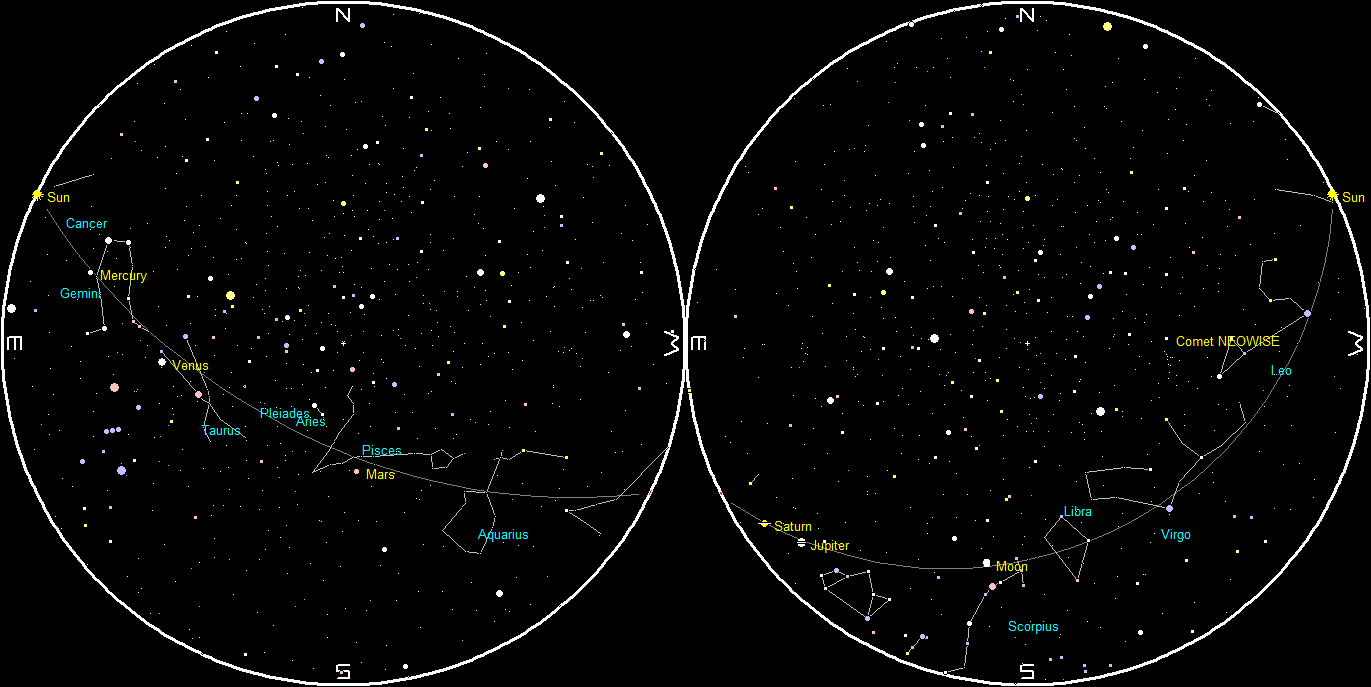
Planets and the Moon at sunset and sunrise of a single night starting with sunset on the right on July 29, 2020. The night ends on the left with sunrise on the 30th. Click on the image to enlarge. Created using my LookingUp program.
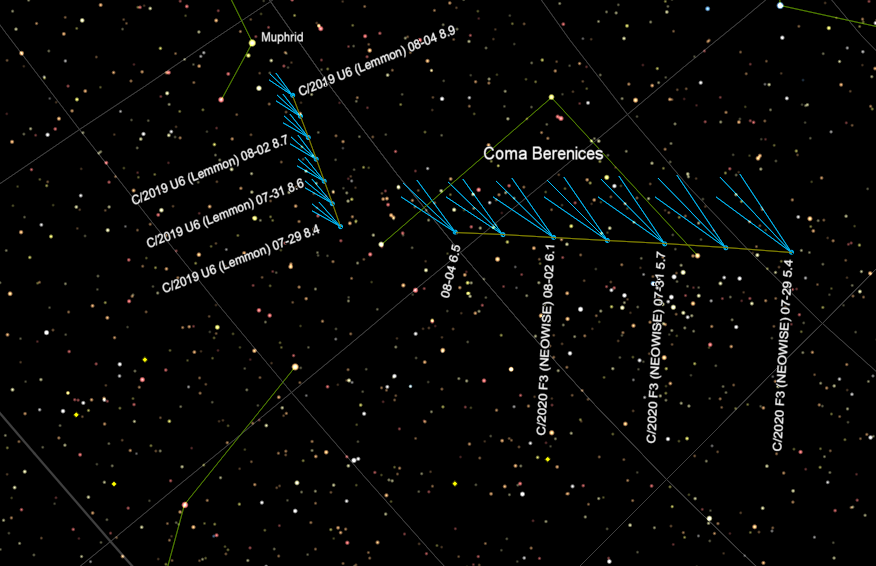
Finder chart for Comets NEOWISE and Lemmon at 11 pm for the week of 07/29/20 to 08/04/20. NEOWISE will be a visible in binoculars. Lemmon will require a telescope. Labels give name, month/day and predicted magnitude. Click on the chart to enlarge. Created using Cartes du Ciel (Sky Charts).
 Bob Moler's Ephemeris Blog