Archive
07/03/2020 – Ephemeris – Grand Traverse Astronomical Society virtual meeting tonight
This is Bob Moler with Ephemeris for Friday, July 3rd. Today the Sun will be up for 15 hours and 28 minutes, setting at 9:31, and it will rise tomorrow at 6:03. The Moon, 2 days before full, will set at 5:18 tomorrow morning.
The Grand Traverse Astronomical Society will host a virtual meeting tonight at 8 pm. It is via the Zoom app for the smart phone, tablet or going to zoom.us with a browser on your computer. Instructions and a link can be found on the society’s website gtastro.org. With the Sun out so long now, I will be giving the presentation: The Sun and the Earth, about the relationship between the two bodies. I’ll talk about all the energy the Sun puts out and how the atmosphere protects us from some of it. We’ll look at the cause of the seasons, and why, in early July as summer is getting going the Earth is at its farthest from the Sun, and what effect that has on the our summers. And lots more.
07/02/2020 – Ephemeris – The star Deneb in Cygnus the swan
This is Ephemeris for Thursday, July 2nd. Today the Sun will be up for 15 hours and 29 minutes, setting at 9:31, and it will rise tomorrow at 6:02. The Moon, 3 days before full, will set at 4:29 tomorrow morning.
This evening when it gets dark enough the bright star Deneb in Cygnus the swan will be high in the east-northeast. Deneb is the dimmest star of the summer triangle. Of the other stars of the triangle, Vega is higher in the east, while Altair is lower in the southeast. Deneb’s apparent magnitude, or brightness as seen from Earth, makes it the dimmest of the three bright stars. Its vast distance of possibly 2,600 light years is over 100 times the distance of Vega. If brought as close as Vega, Deneb would be as bright at least as the quarter moon. It is possibly as bright as 200 thousand Suns; and a huge star, possibly as large in diameter as the orbit of the Earth. For all this it is only 19 or so times the mass of the Sun.
The event times given are for the Traverse City/Interlochen area of Michigan. They may be different for your location.
Addendum
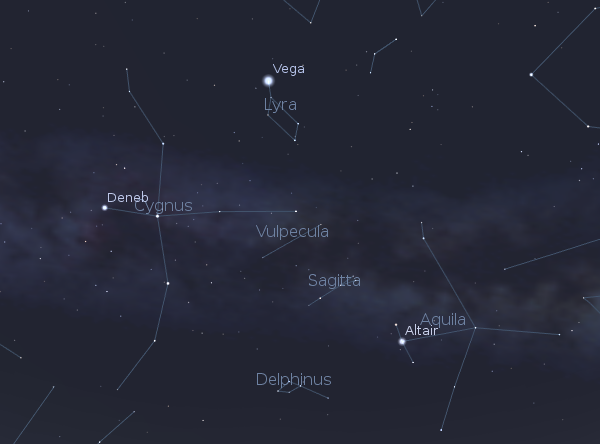
Deneb with the other stars and constellations in the Summer Triangle. Created using Stellarium.
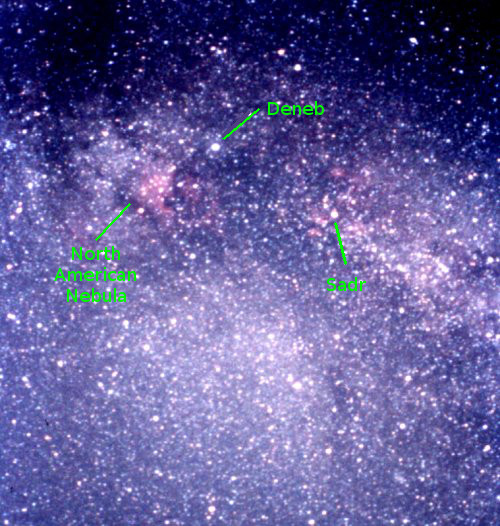
One of my old photographs of Deneb and the North American Nebula digitized from a slide.
07/01/2020 – Ephemeris – Let’s look at the naked-eye planets for this week
This is Ephemeris for Wednesday, July 1st. Today the Sun will be up for 15 hours and 30 minutes, setting at 9:31, and it will rise tomorrow at 6:01. The Moon, 3 days past first quarter, will set at 3:49 tomorrow morning.
Let’s look at the naked-eye planets for this week. Jupiter now rises in the evening, tonight it’s at 10:08 pm in the east-southeast. Saturn will rise 19 minutes later at 10:27 pm right behind Jupiter. Mars, is stretching its lead left of Saturn and will rise at 1:18 am in the east. Its now down to 75.4 million miles (121.5 million km) away, as the Earth slowly overtakes it at the rate of about 4 million miles (6.4 million km) a week. Jupiter and Saturn will be hanging out between Sagittarius and Capricornus this year while Mars is slowing its rapid eastward motion now two constellations over in Pisces. Finally, Venus will rise at 4:05 am in the east-northeast in the twilight as our Morning Star.
The event times given are for the Traverse City/Interlochen area of Michigan. They may be different for your location.
Addendum
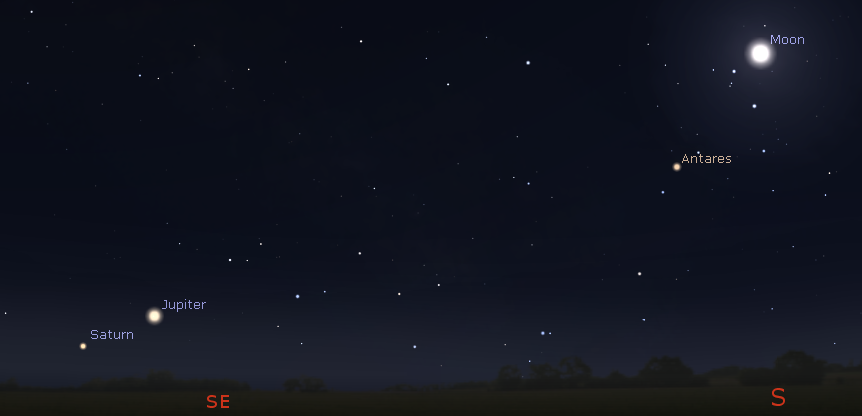
Almost evening planets Jupiter and Saturn, and the Moon at 11 pm on July 1st, 2020. Both Jupiter and Saturn are still officially morning planets since they rise after sunset. Click on the image to enlarge. Created using Stellarium.
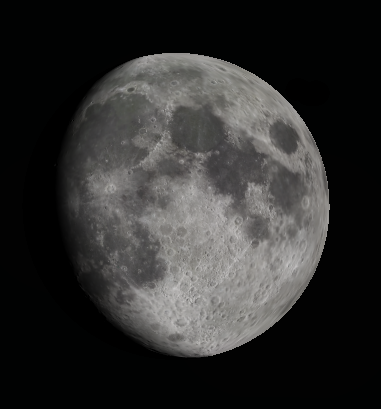
The gibbous Moon as it might appear this evening, July 1st, 2020, in a pair of binoculars or small telescope. Created using Stellarium.
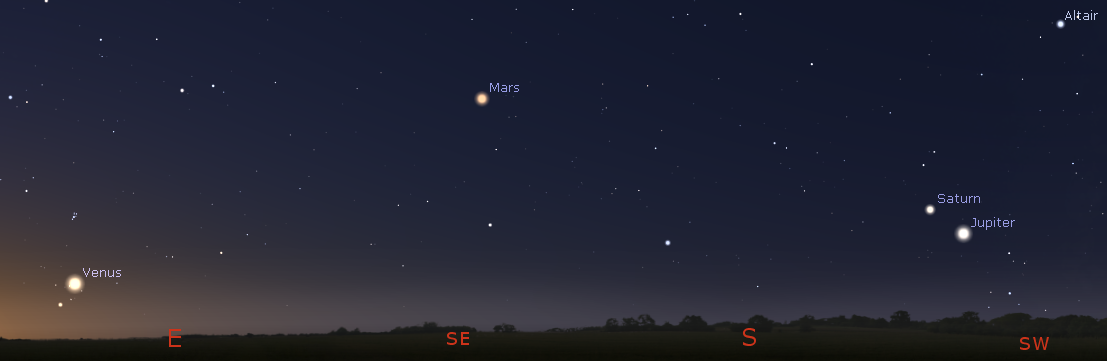
The morning planets, including Jupiter and Saturn which are also visible in the late evening. Click on the image to enlarge. Created using Stellarium.
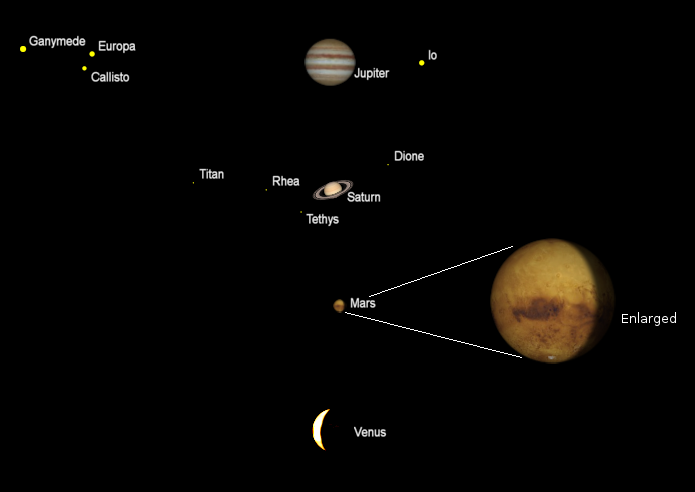
The planets as seen in a telescope (north up) with the same magnification tomorrow morning July 2, 2020. Apparent diameters: Jupiter, 47.34″; Saturn, 18.37″, rings, 42.79″, Mars, 11.57″, and Venus 42.15″. Mars also displays an enlargement showing surface detail. The ” symbol means seconds of arc (1/3600th of a degree.) Created using Cartes du Ciel (Sky Charts).
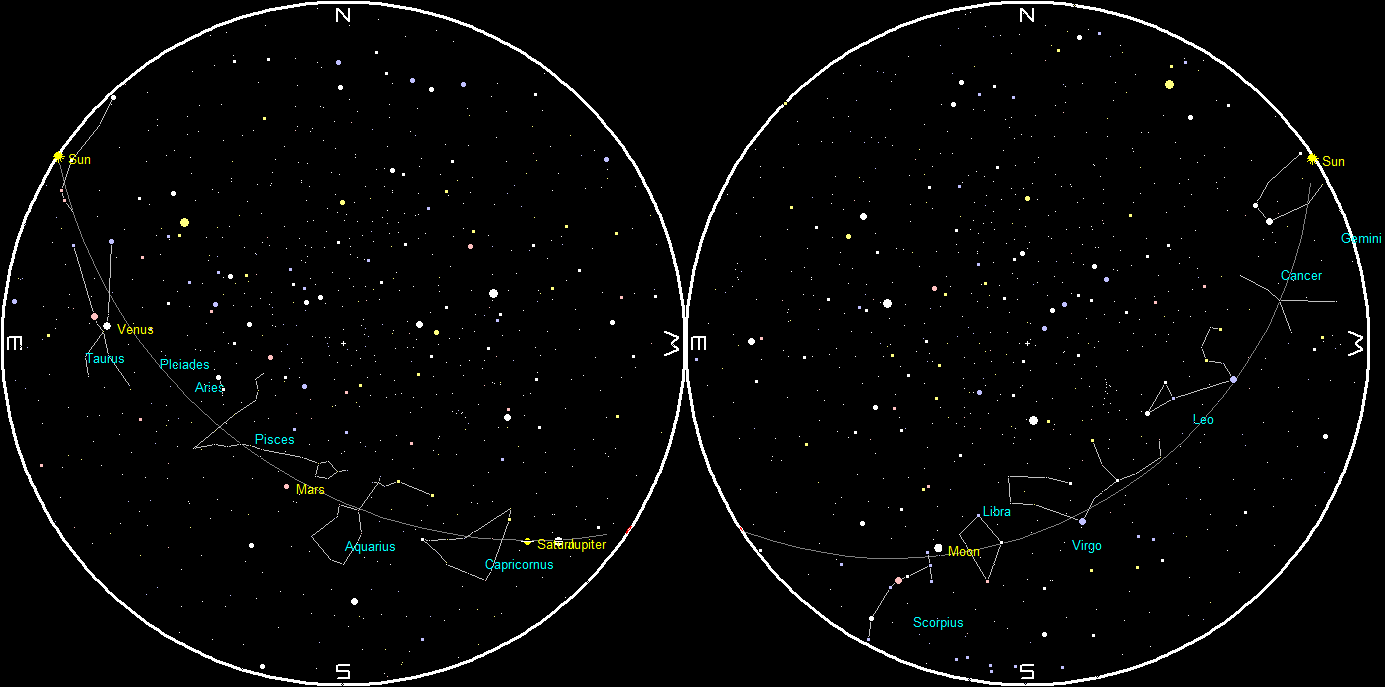
Planets and the Moon at sunset and sunrise of a single night starting with sunset on the right on July 1, 2020. The night ends on the left with sunrise on the 2nd. The closeness of Jupiter and Saturn in the morning sky unfortunately overlays planets and labels. Click on the image to enlarge. Created using my LookingUp program.
 Bob Moler's Ephemeris Blog