02/02/2022 – Ephemeris – Let’s search for the naked-eye planets for this week
This is Bob Moler with Ephemeris for Ground Hog Day, Wednesday, February 2nd. Today the Sun will be up for 9 hours and 52 minutes, setting at 5:52, and it will rise tomorrow at 7:59. The Moon, 1 day past new, will set at 7:42 this evening.
Let’s search for the naked-eye planets for this week. There is just one planet left in the evening sky now. Jupiter will be visible in the west-southwest by 6:30 pm. The thin crescent Moon will appear below and left of it tonight. It’s kind of hard to tell which will be brighter. Jupiter will set at 7:54 pm. Saturn is too close to the Sun to be seen, and will cross behind the Sun on Friday, and will then enter the morning sky, where we will lose it for a month or so. Speaking of the morning sky, Venus, our brilliant morning star, will be in the southeast by 7 o’clock with the much dimmer Mars to the right and below it. Venus will rise at 5:40, with Mars following at 5:59. Antares is Mars’ rival in color and brightness, the red giant star Antares will be in the south-southeast at 7. Mars is speeding away from it.
The astronomical event times given are for the Traverse City/Interlochen area of Michigan (EST, UT – 5 hours). They may be different for your location.
Addendum
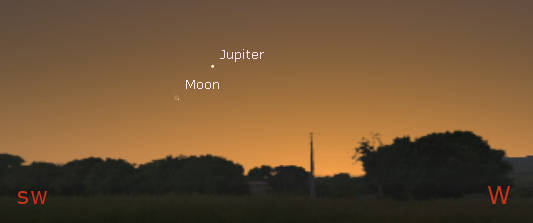
Jupiter and the Moon in twilight at 6:30 pm tonight, February 2, 2022. Created using Stellarium.
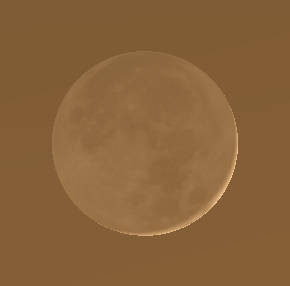
This is what tonight’s one-day old Moon might look like in a pair of binoculars at 6:30 pm, February 2, 2022. The image shows earth shine, the reflected light of a nearly full Earth on The Moon’s night side. Created using Stellarium.
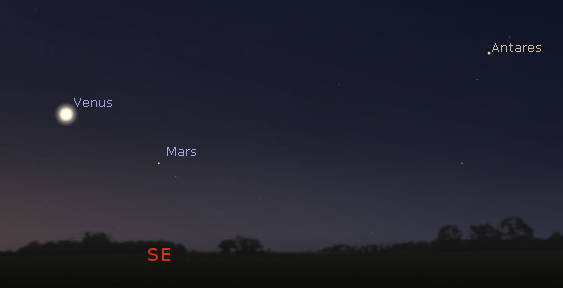
Venus and Mars in the morning at 7:00 tomorrow morning, February 2, 2022. Created using Stellarium.
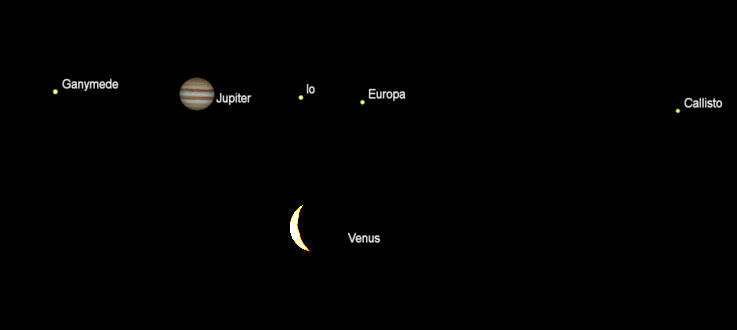
Telescopic views of the bright planets and their brighter moons (north up) as they would be seen in a small telescope, with the same magnification, overnight, February 2/3, 2022. I do not show planets less than 10 seconds of arc in diameter. Apparent diameters: Jupiter, 33.56″ at 7 pm. Mars is not shown, its apparent diameter is 4.35″. Venus has an apparent diameter of 47.25″ and is 17.5% illuminated at 7 am. The ” symbol means seconds of arc (1/3600th of a degree.) Created using Cartes du Ciel (Sky Charts).
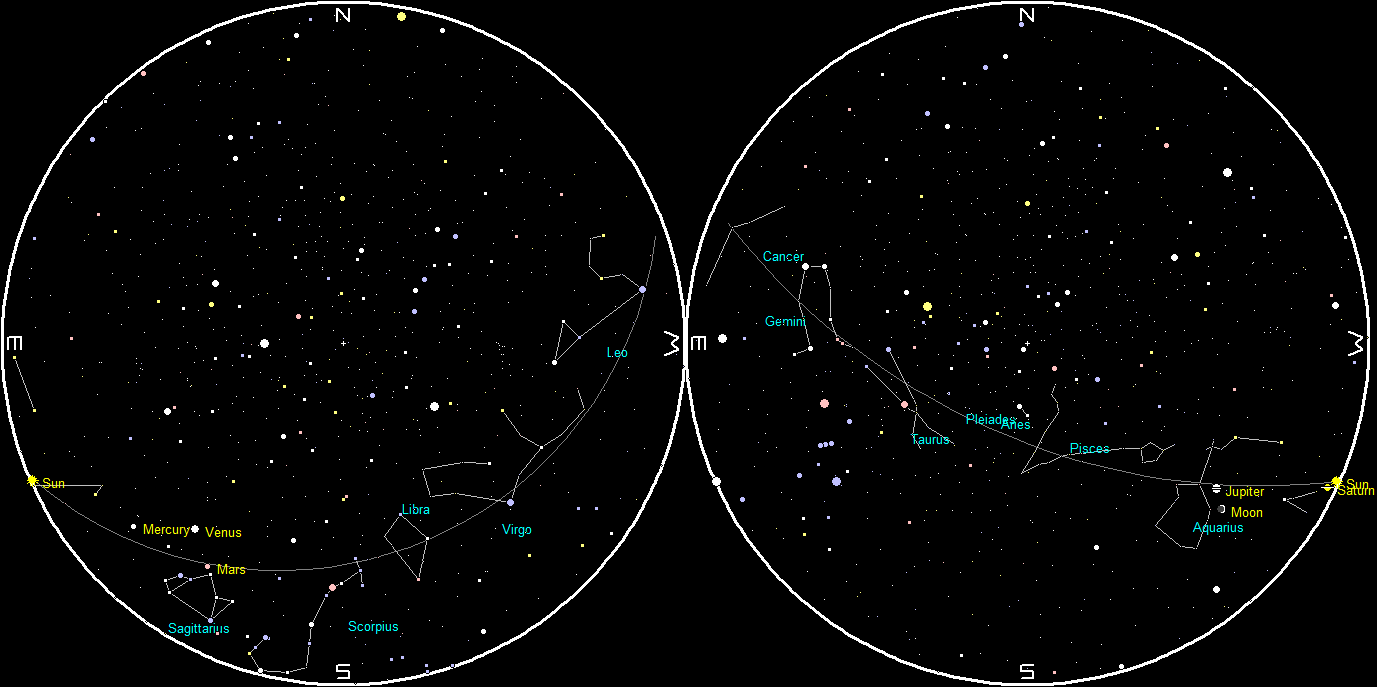
The naked-eye planets and the Moon at sunset and sunrise on a single night, starting with sunset on the right on February 2, 2022. The night ends on the left with sunrise on the 3rd. Click on the image to enlarge it. Created using my LookingUp program.

