Archive
03/16/2022 – Ephemeris – Let’s search for the naked-eye planets for this week
This is Ephemeris for Wednesday, March 16th. Today the Sun will be up for 11 hours and 57 minutes, setting at 7:50, and it will rise tomorrow at 7:51. The Moon, 2 days before full, will set at 7:59 tomorrow morning.
Let’s search for the naked-eye planets for this week. There are no bright planets in the evening sky. Jupiter, the last to leave, will stay too close to the direction of the Sun to be visible in the morning sky for at least a month. So that’s where the action shifts to. Jupiter joins Mercury, Saturn, Venus and Mars. Late winter and early spring mornings aren’t the best for spotting planets close to the Sun, since they tend to lie low in the southeastern sky. Venus will rise at 5:51 tomorrow morning and Mars will rise at 6:04. Saturn will rise at 6:40. By 7:15, they will be low in the southeast with much dimmer Mars at the 5 o’clock position below Venus, with Saturn much lower at the 8 o’clock position.
The astronomical event times given are for the Traverse City/Interlochen area of Michigan (EDT, UT – 4 hours). They may be different for your location.
Addendum
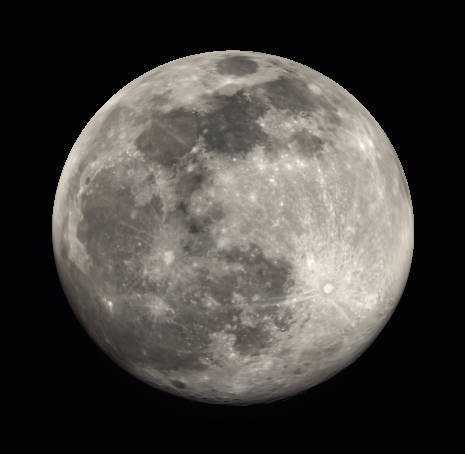
The Moon 2 days before full as it might appear in binoculars or small telescope, tonight, at 9 pm, March 16, 2022. Created using Stellarium.
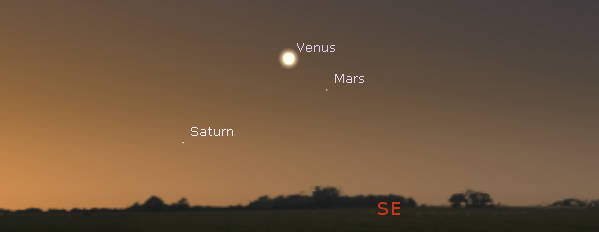
Morning planets Venus, Saturn and Mars at 7:15 am, or about 36 minutes before sunrise tomorrow, March 17, 2022. Binoculars may help in spotting Mars and Saturn. Over the week, these planets will continue to move away from the rising Sun. Well, all except Venus which will reach its greatest elongation, meaning separation from the Sun on Sunday, before beginning to slip back toward the Sun. Created using Stellarium.
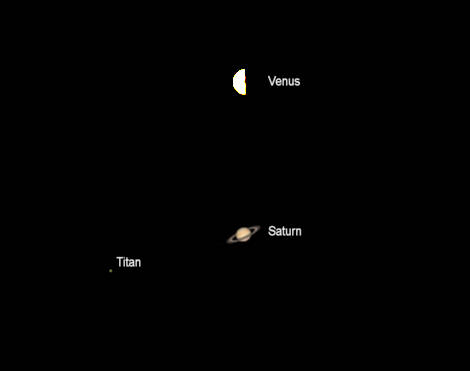
Telescopic views of the Venus and Saturn (north up) as they would be seen in a small telescope, with the same magnification, tomorrow morning at 7 15 am, March 17, 2022. I do not show planets less than 10 seconds of arc in diameter. Apparent diameters: Venus 25.49″, 48.0% illuminated; Saturn 15.55″, its rings 36.22″. Mars is not shown, its apparent diameter is 4.94″ and is 92.8% illuminated. The ” symbol means seconds of arc (1/3600th of a degree.) Created using Cartes du Ciel (Sky Charts).
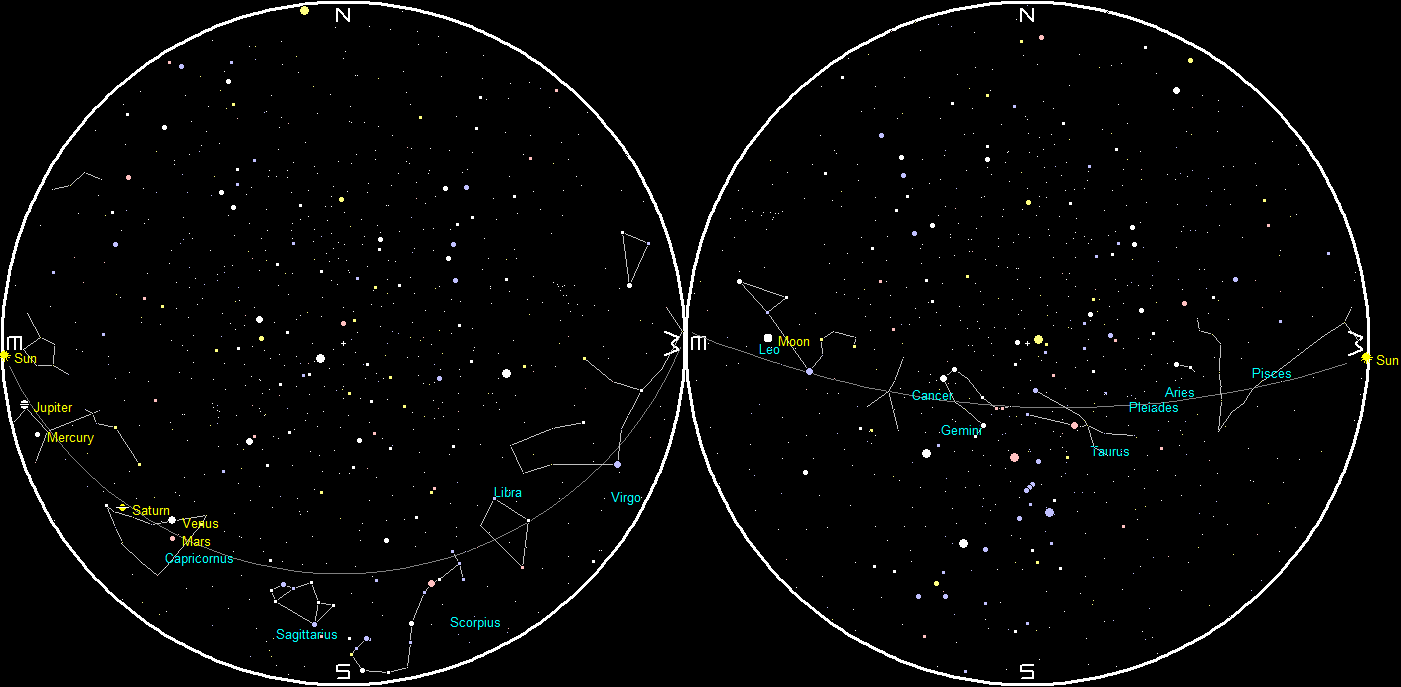
The naked-eye planets and the Moon at sunset and sunrise on a single night, starting with sunset on the right on March 16, 2022. The night ends on the left with sunrise on the 17th. Notice that all the naked-eye planets are in the morning sky now, with the Moon still hanging out in the evening sky. Click on the image to enlarge it. Created using my LookingUp program.
 Bob Moler's Ephemeris Blog