Archive
06/02/2022 – Ephemeris – What’s an ephemeris?
This is Ephemeris for Thursday, June 2nd. Today the Sun will be up for 15 hours and 22 minutes, setting at 9:22, and it will rise tomorrow at 5:59. The Moon, 3 days past new, will set at 12:34 tomorrow morning.
Yesterday, I was too busy on this program to mention that that program was the 47th anniversary of the Ephemeris program and was embarking on its 48th orbit of the Sun. At this juncture, you might be wondering: What’s an ephemeris? According to Wikipedia: Quote “In astronomy and celestial navigation, an ephemeris (plural: ephemerides; from Latin ephemeris, meaning ‘diary’, from the Greek, … meaning ‘diary, or journal’) gives the positions of… astronomical objects… at a given time or times. Historically, positions were given as printed tables of values, given at regular intervals of date and time.” enquote. My tables are now databases which I generate for the year during the prior December from published algorithms. I will show all on my blog today: (You are already here). I used to have to interpolate values from printed ephemerides for the first 5 or so years of the program.
The astronomical event times given are for the Traverse City/Interlochen area of Michigan (EDT, UT – 4 hours). They may be different for your location.
Addendum
An Ephemeris Example – Comet 73P-B/Schwassmann-Wachmann 3 nuclear fragment B
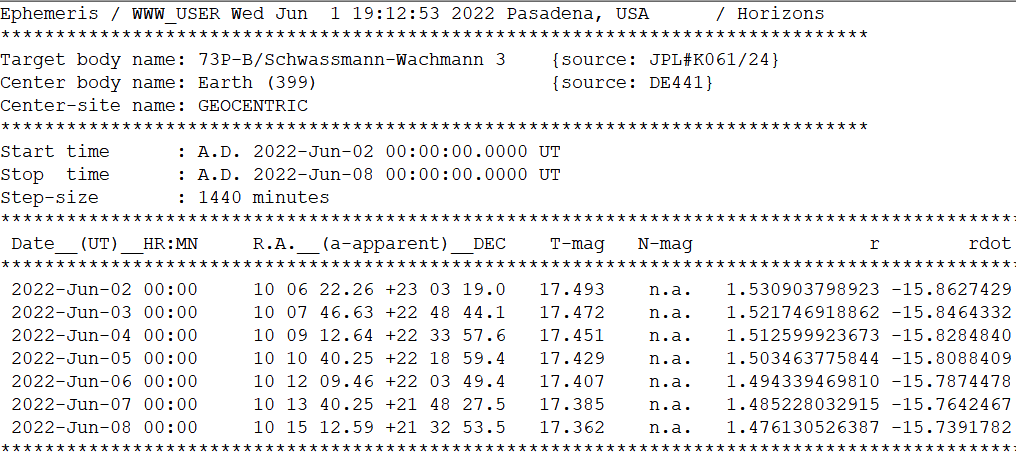
Here’s an ephemeris for Comet Schwassmann-Wachmann 3 nuclear fragment B from the Jet Propulsion Laboratory’s (JPL) Horizons system. The listing has been truncated for width. Click on it to enlarge it.
R.A. is right ascension – East-west position in the sky, like longitude on the Earth, only it’s in hours, minutes and seconds. One hour = 15 degrees.
DEC is declination – North-south position, in the sky, exactly like latitude on the Earth in degrees, minutes and seconds.
(a-apparent) means that the above coordinates are based on where the vernal equinox point in the sky is at that date and time, and for the observer’s location. Since I didn’t specify one, it’s the center of the Earth.
T-mag – Predicted total magnitude of the comet. Magnitudes are like golf scores. The higher magnitude, the dimmer the object. It’s really, really dim.
N-mag – Predicted magnitude of the nucleus. No estimate is made here.
r – Distance from the Sun in terms of Astronomical Units (AU). 1 AU is Earth’s mean distance from the Sun.
rdot – The change in r. It’s in kilometers per second. If negative, it’s moving toward the Sun.
For more information on how I produce ephemerides for this program, go here: https://bobmoler.wordpress.com/2019/01/22/
06/01/2022 – Ephemeris – Let’s search for the naked-eye planets for this week
This is Ephemeris for Wednesday, June 1st. Today the Sun will be up for 15 hours and 21 minutes, setting at 9:21, and it will rise tomorrow at 5:59. The Moon, 2 days past new, will set at 11:49 this evening.
Let’s search for the naked-eye planets for this week. All the naked-eye planets are in the morning sky, although Mercury is too close to the Sun to be seen, and might just be visible low in the east-northeast after 5 am around mid-month. That’s at least for those as far north as we are. At 5 am tomorrow the planets will be spread out from brilliant Venus low in the east to Saturn higher in the south-southeast. To the right of Venus, tomorrow morning, in the east-southeast are Mars and Jupiter. Mars is quite a bit dimmer than Jupiter. All will be in line sloping to the upper right with Saturn all by its lonesome in the south-southeast. Though Mercury will enter the evening sky first, it won’t have great visibility. Saturn will enter the evening sky August 14th.
The astronomical event times given are for the Traverse City/Interlochen area of Michigan (EDT, UT – 4 hours). They may be different for your location.
Addendum
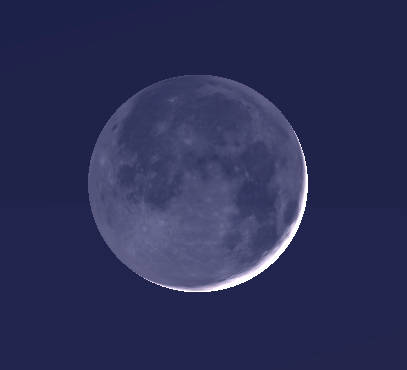
The two-day-old Moon as it might be seen in binoculars tonight, June 1, 2022. Earth shine might illuminate the Moon’s night side. Created using Stellarium and GIMP.
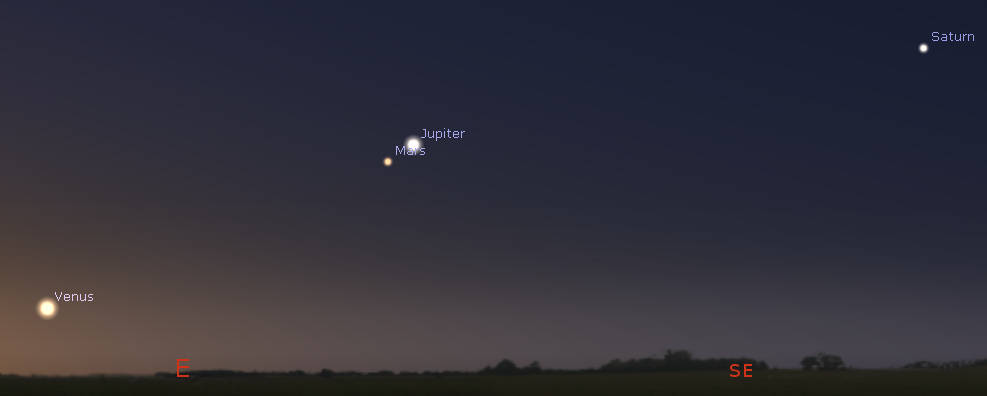
Morning planets at 5 am tomorrow morning, June 2, 2022. Click on the image to enlarge it. The span of the planets from Venus to Saturn is 70 degrees. Click on the image to enlarge it. Created using Stellarium.
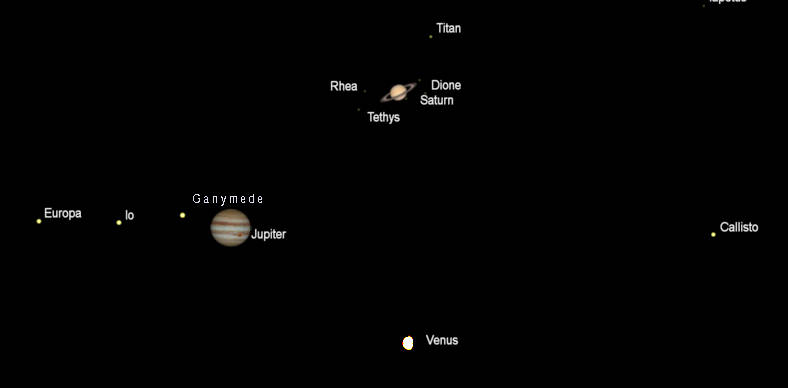
Views of Venus, Jupiter, and Saturn (north up) as they would be seen in a small telescope, with the same magnification, tomorrow morning at 5:00 am, June 2, 2022. I do not show planets less than 10 seconds of arc in diameter. Apparent diameters: Venus 13.58″, 78.3% illuminated; Saturn 17.40″, its rings 40.54″; Jupiter 37.49″. Mars is not shown, its apparent diameter is 6.46″ and is 87.2% illuminated. The ” symbol means seconds of arc (1/3600th of a degree.) Created using Cartes du Ciel (Sky Charts), planet information from Stellarium.
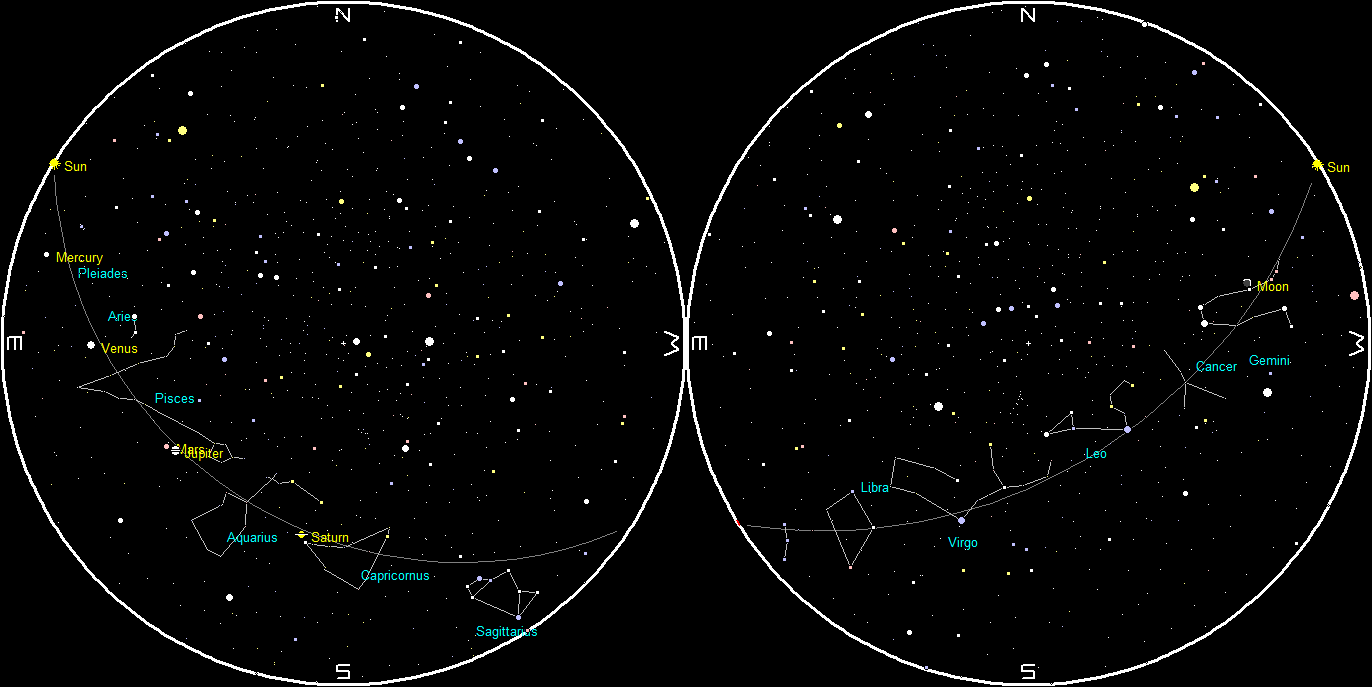
The naked-eye planets and the Moon at sunset and sunrise on a single night, starting with sunset on the right on June 1, 2022. The night ends on the left with sunrise on the 2nd. Notice that all the naked-eye planets are in the morning sky now. Click on the image to enlarge it. Created using my LookingUp program.
Update on the Tau Herculid meteor shower of May 31st.
The meteor shower was rather weak. I saw one during an hour and a half of observing, slowly moving over the Big Dipper. The sky was “clear”, but there was a haze to it. It definitely wasn’t crystal clear. I’ve heard from others who had a bit more success.
 Bob Moler's Ephemeris Blog