Archive
07/06/2022 – Ephemeris – Let’s search for the naked-eye planets for this week
This is Bob Moler with Ephemeris for Wednesday, July 6th. Today the Sun will be up for 15 hours and 26 minutes, setting at 9:30, and it will rise tomorrow at 6:04. The Moon, at first quarter today, will set at 1:32 tomorrow morning.
Let’s search for the naked-eye planets for this week. All the naked-eye planets are in the morning sky, although Mercury is too close to the Sun to be seen. On the 16th, it will leave the morning sky, crossing over to the evening sky. At 5 am tomorrow, the planets will be spread out from brilliant Venus low in the east-northeast to Saturn higher in the south. To the right and above of Venus, in the east-southeast, will be the Mars. Jupiter is a bit higher in the southeast. Mars is dimmer than Jupiter, but is slowly getting brighter as the Earth creeps up on it. Saturn ends the line of planets in the south. Tonight, Saturn will rise about 11:30 pm. It won’t be an official evening planet until it rises before sunset. That won’t happen until mid-August.
The astronomical event times given are for the Traverse City/Interlochen area of Michigan (EDT, UT – 4 hours). They may be different for your location.
Addendum
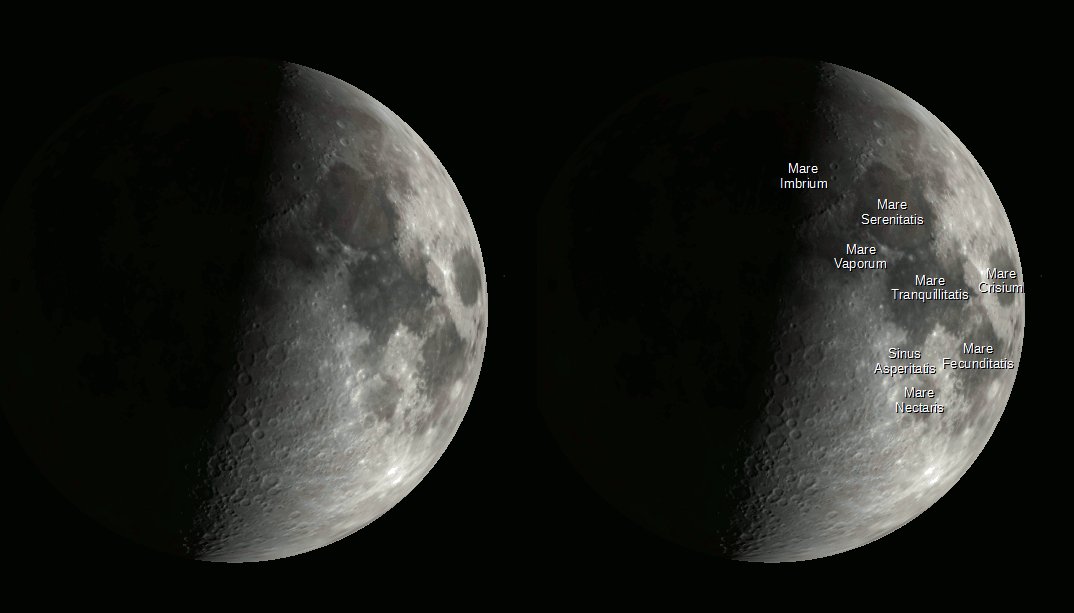
First quarter Moon tonight with prominent features labeled. Created using Stellarium, GIMP and LibreOffice.
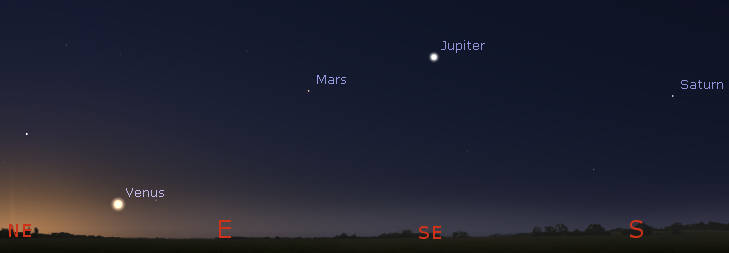
The morning planets at 5 am tomorrow morning, July 7, 2022. The planets actually appear in a straight line in the sky, being placed along the ecliptic, or path of the Sun in the sky. The ecliptic is a great circle on the celestial sphere. Click on the image to enlarge it. The span of the planets from Venus to Saturn is 113 degrees. Click on the image to enlarge it. Created using Stellarium.
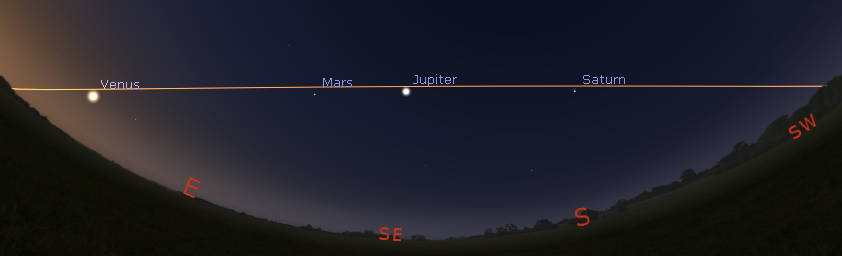
Distortions of rendering a spherical sky on a flat plane. The morning planets as seen in a stereographic view where great circles, like the ecliptic and horizon, are either circles or straight lines. In this image, the ecliptic, orange line, runs through the center of the plot, so it appears straight. In the real sky, both the planets and the horizon appear to be in straight lines. This assumes that your horizon is flat. Click on the image to enlarge it. Created using Stellarium.
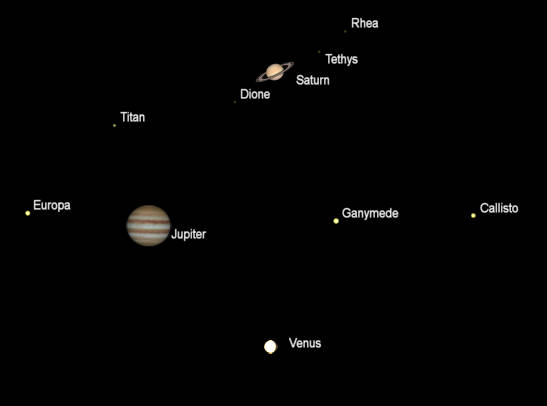
Views of Saturn, Jupiter, and Venus (north up) as they would be seen in a small telescope, with the same magnification, tomorrow morning at 5:00 am, July 7, 2022. I do not show planets less than 10 seconds of arc in diameter. Apparent diameters: Saturn 18.32″, its rings 42.68″; Jupiter 41.68″. Mars is not shown, its apparent diameter is 7.41″ and is 85.4% illuminated; Venus 11.60″, 87.5% illuminated. Jupiter’s 4th Galilean moon, Io, is missing because it is in Jupiter’s shadow. The ” symbol means seconds of arc (1/3600th of a degree.) Created using Cartes du Ciel (Sky Charts).
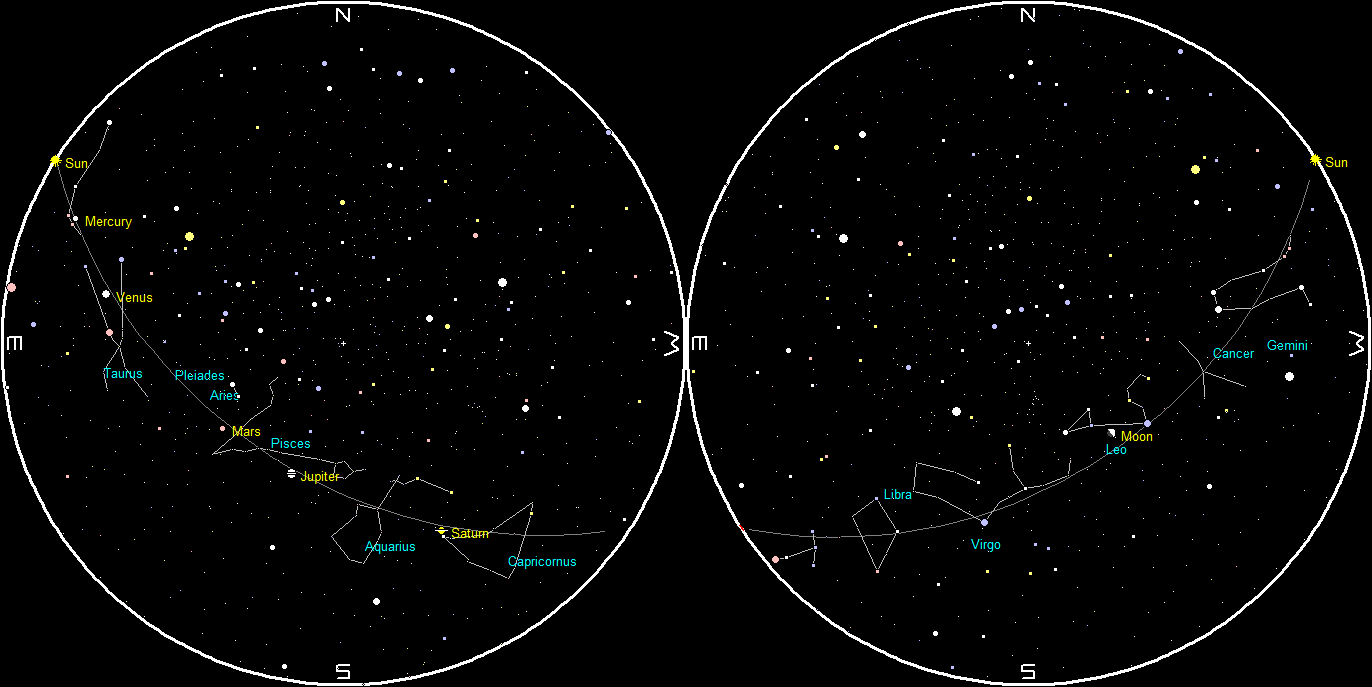
The naked-eye planets and the Moon at sunset and sunrise on a single night, starting with sunset on the right on July 6, 2022. The night ends on the left with sunrise on the 7th. Notice that all the naked-eye planets are in the morning sky now. Click on the image to enlarge it. Created using my LookingUp program.
 Bob Moler's Ephemeris Blog