Archive
09/28/2022 – Ephemeris – Searching for the naked-eye planets for this week
This is Bob Moler with Ephemeris for Wednesday, September 28th. Today the Sun will be up for 11 hours and 51 minutes, setting at 7:28, and it will rise tomorrow at 7:38. The Moon, 3 days past new, will set at 8:51 this evening.
Let’s search for the naked-eye planets for this week. The thin sliver of a waxing crescent Moon may be visible very low in the southwest at 8 pm. We’re back to two naked-eye planets in the evening sky. Jupiter was in opposition from the Sun on Monday, and closest to the Earth. As it gets darker, Jupiter will be seen first low in the east. At that time, Saturn can be seen in the southeast. Jupiter is seen against the stars of Pisces the fish, while Saturn is spotted in the eastern end of Capricornus the sea goat. At 6:45 tomorrow morning, Mars will be high in the south, above the winter constellation of Orion, and Jupiter will be very low in the west. Venus will rise in the east at 7:02 into bright twilight.
The astronomical event times given are for the Traverse City/Interlochen area of Michigan (EDT, UT – 4 hours). They may be different for your location.
Addendum
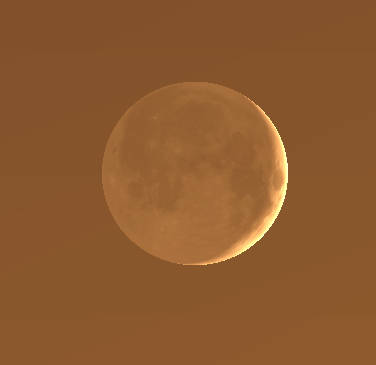
What the three-day-old Moon might look like in binoculars in twilight at 8 pm tonight, September 28, 2022. Illumination of the night part of the Moon will be provided by the bright gibbous Earth in its sky. The phenomenon is called earth shine. Created using Stellarium.
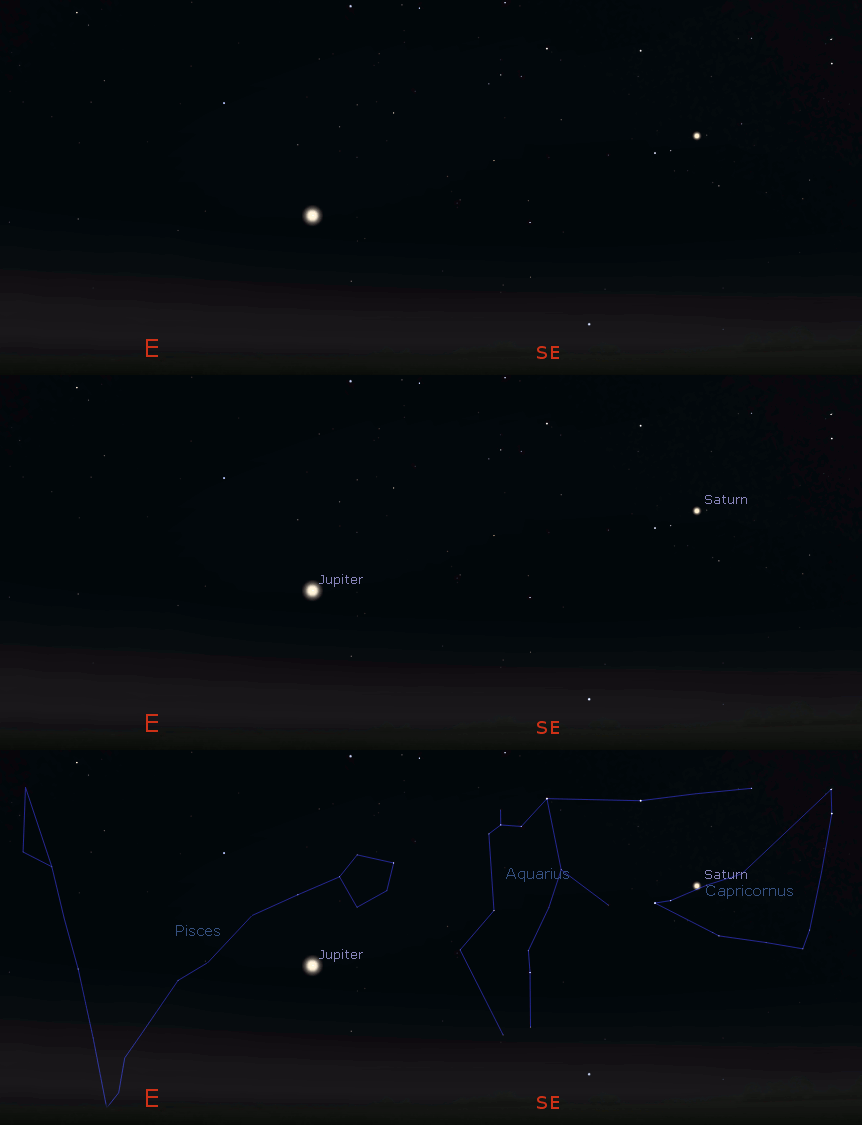
Evening planet finder animation by showing Jupiter and Saturn with and without the constellation lines. For 9 pm this evening, September 28, 2022. Click on the image to enlarge it. Created using Stellarium and GIMP.
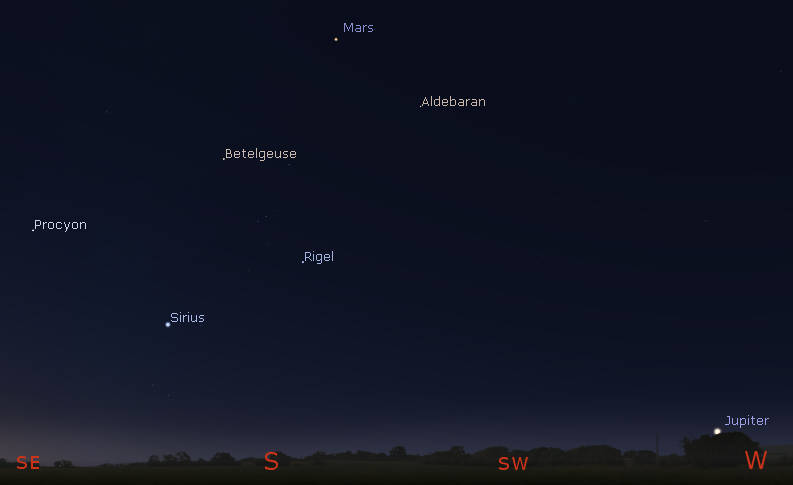
Morning planet Mars with the last gasp of the new evening planet Jupiter and bright winter stars at 6:45 tomorrow morning, September 29, 2022. Click on the image to enlarge it. Created using Stellarium.
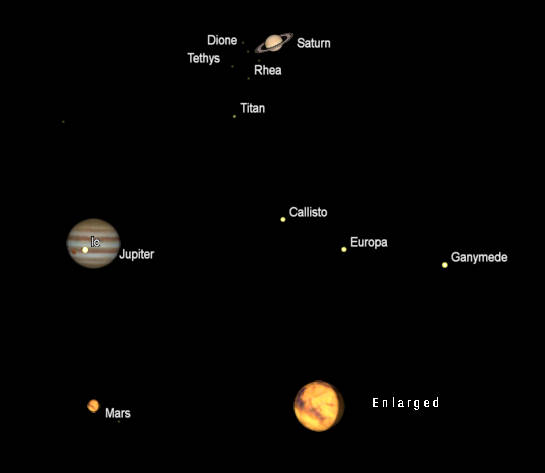
Telescopic views of Saturn, Jupiter and Mars (north up) as they would be seen in a small telescope, with the same magnification. The image doesn’t show it, but the white north polar cap will appear at the top or north limb of Mars. Saturn and Jupiter are shown at 10 pm, Mars at 6 am. Apparent diameters: Saturn 18.17″, its rings 42.33″; Jupiter 49.86″. Mars 11.01″. Mars’ distance is 73.8 million miles (118.7 million kilometers). The ” symbol means seconds of arc (1/3600th of a degree.) Created using Cartes du Ciel (Sky Charts).
One surprising thing about Mars in a telescope is how bright it is. That’s because it’s much closer to the Sun than Jupiter or Saturn, even thought it has a lower albedo (reflectance) than those planets.
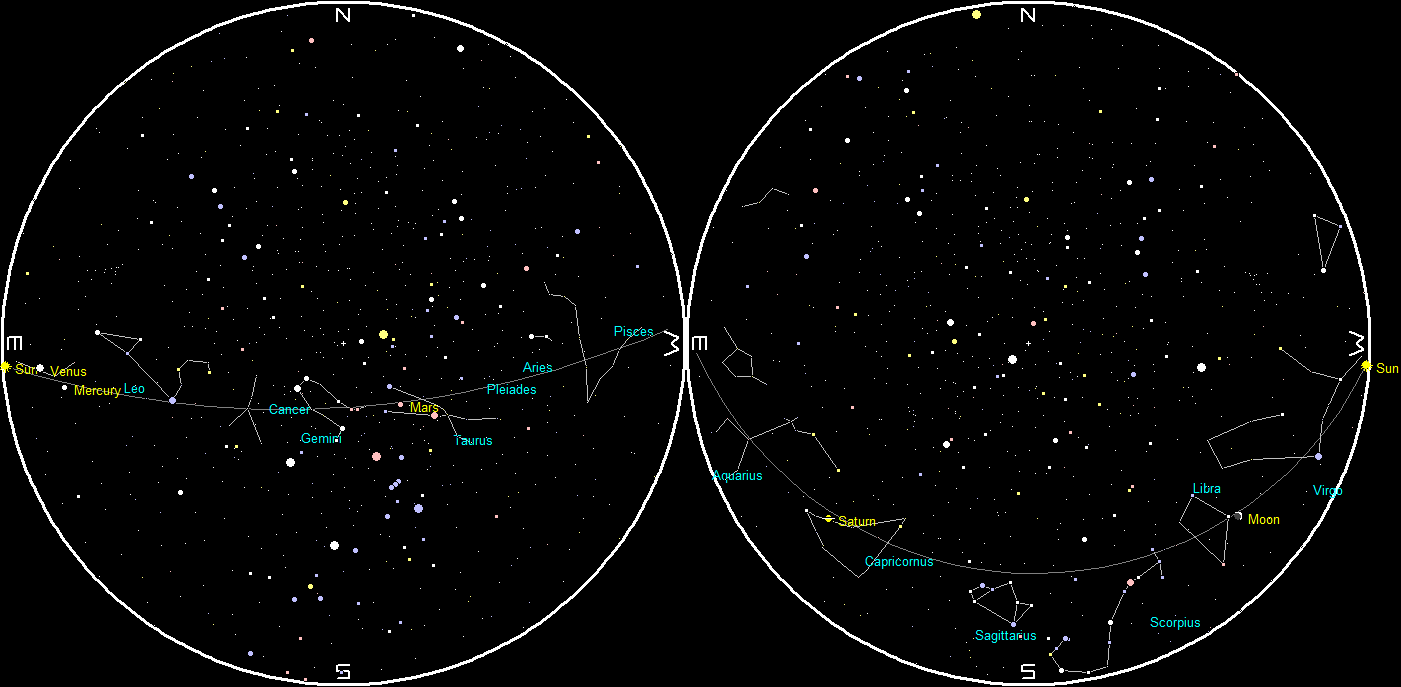
The naked-eye planets and the Moon at sunset and sunrise on a single night, starting with sunset on the right on September 28, 2022. The night ends on the left with sunrise on the 29th. Click on the image to enlarge it. Created using my LookingUp program and GIMP.
 Bob Moler's Ephemeris Blog