Archive
Ephemeris: 07/21/2023 – Antares just looks weird
This is Ephemeris for Friday, July 21st. Today the Sun will be up for 15 hours and 3 minutes, setting at 9:20, and it will rise tomorrow at 6:18. The Moon, halfway from new to first quarter, will set at 11:34 this evening.
We’ve had our Fourth of July fireworks over two weeks ago, but there’s one star still celebrating as a sparkler. That’s Antares in Scorpius the scorpion low in the south tonight. We in Michigan always see Antares low in the south. It’s a bright red giant star which twinkles mightily, and since it’s low in the sky, it spits and sputters all kinds of colors due to our atmosphere’s turbulence, and the fact that we’re looking through so much of it at Antares. At it’s highest, due south, we are seeing it though 3 times more atmosphere than we would be if it was overhead. The more magnification one uses with binoculars or a telescope, the greater the sparkler effect. It is even called in sometimes as a UFO.
The astronomical event times given are for the Traverse City/Interlochen area of Michigan (EDT, UT –4 hours). They may be different for your location.
Addendum
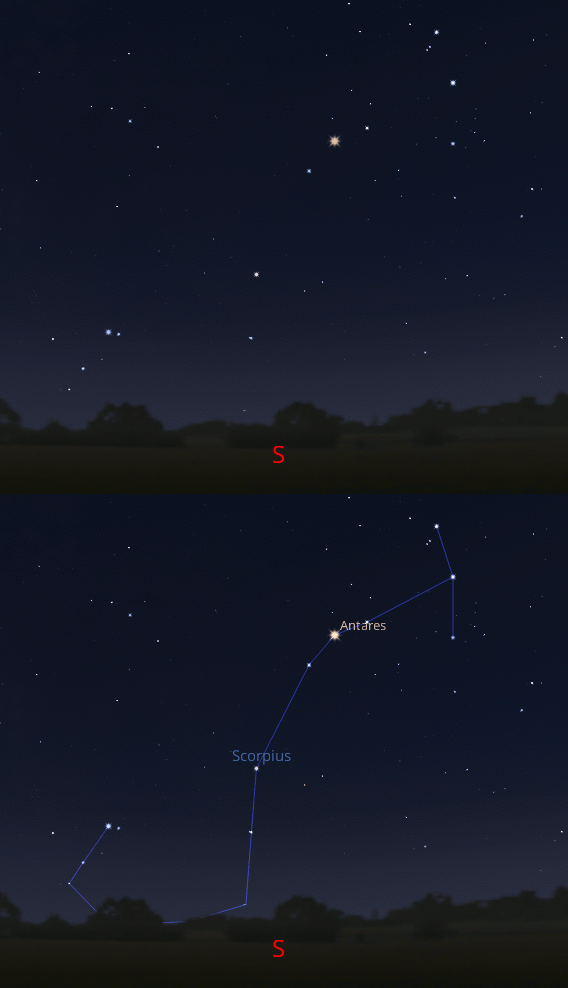
The name of the star Antares means “Rival of Mars”. “Ant” meaning anti, “Ares”, the Greek equivalent to the Roman god Mars. The reason is their similar reddish color. Antares is red because it is a cool star, a red giant. Mars is red due to its red dust, colored by iron rust. The planet passes Antares about every 23 1/2 months. Mars will next pass Antares on December 8th, 2023. However, the event will not be visible, because both the star and the planet will be too close to the Sun in the morning sky then. Their next meeting, or conjunction, after that, on November 17th, 2025 will be in the evening sky, but still too close to the Sun to be spotted. The conjunction after that will be in the evening sky, again rather close to the Sun, on October 28, 2027. For these three encounters, Mars will be north or above Antares, and dimmer than the star.
 Bob Moler's Ephemeris Blog