This is Ephemeris for Wednesday, September 20th. Today the Sun will be up for 12 hours and 17 minutes, setting at 7:44, and it will rise tomorrow at 7:28. The Moon, 2 days before first quarter, will set at 10:10 this evening.
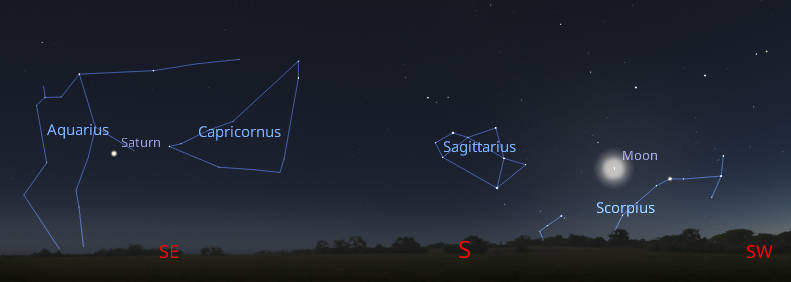
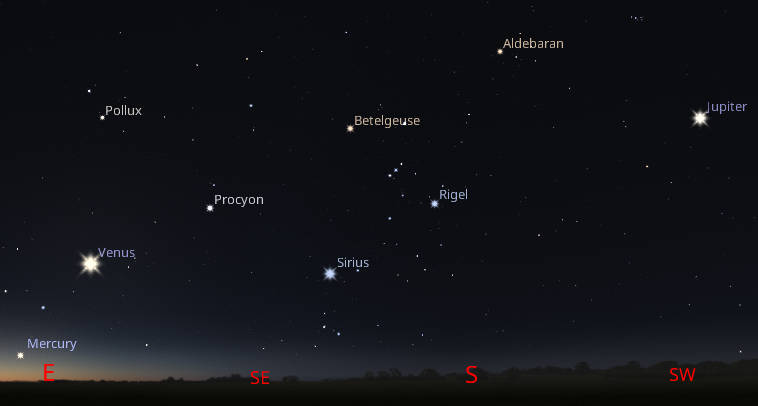
Let’s find out where the naked-eye planets have wandered off to. Four of those five planets are now visible, but Mars is too close to the Sun to be seen. Saturn is the sole evening planet visible. It can be spotted in the southeast in the evening. And it will still be visible throughout the morning hours until it sets at 5:15 am. Saturn is in retrograde or westward motion now, against the stars of Aquarius. Jupiter, Venus and Mercury are the morning planets. Jupiter will rise at 9:35 pm. It is a week into its retrograde motion, which will last the rest of this year. Venus is our brilliant morning star, at its brightest, and will rise in the east-northeast at 4:07 am. Tiny Mercury will have risen by 6 am, and be visible in the east by around 6:30.
The astronomical event times given are for the Traverse City/Interlochen area of Michigan (EDT, UT –4 hours). They may be different for your location.
Addendum
Saturn and the Moon with the Zodiac constellations at 8:30 pm tonight, September 20, 2023. Click or tap on the image to enlarge it. Created using Stellarium.
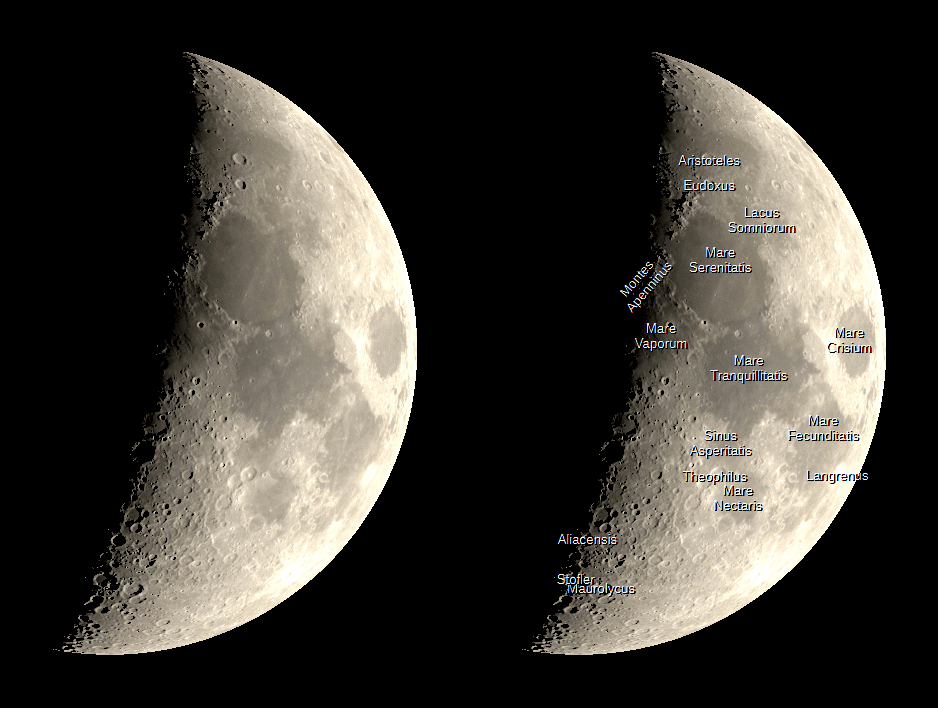
The Moon as it might appear in binoculars or small telescope at 8:30 tonight, September 20, 2023, with selected features labeled. Created using Stellarium, LibreOffice Draw and GIMP.
Morning planets Jupiter, Venus and Mercury with the winter stars at 6:30 am or about an hour before sunrise. Stars and planets appear brighter than they actually be at that hour. Click or tap on the image to enlarge it. Created using Stellarium and GIMP.
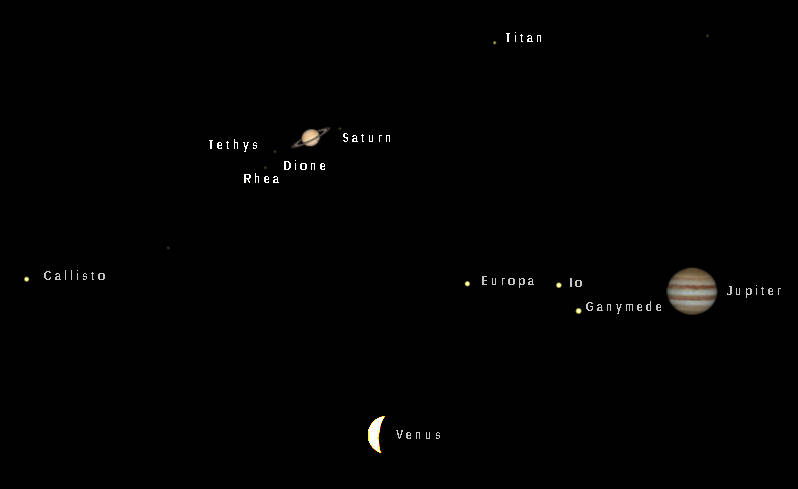
Telescopic Saturn, Jupiter and Venus (north up) as they would be seen in a small telescope, with the same magnification at 8:30 pm September 20, 2023, for Saturn and 6:30 am September 21, 2023, for Jupiter and Venus. Apparent diameters: Saturn 18.76″, its rings 43.70″; Jupiter 46.75″; and Venus 36.11″ and is 29.1% illuminated. Mercury, not shown due to size, 7.34″ and is 43.6% illuminated. The ” symbol means seconds of arc (1/3600th of a degree.) Click or tap on the image to enlarge it. Created using Cartes du Ciel (Sky Charts).
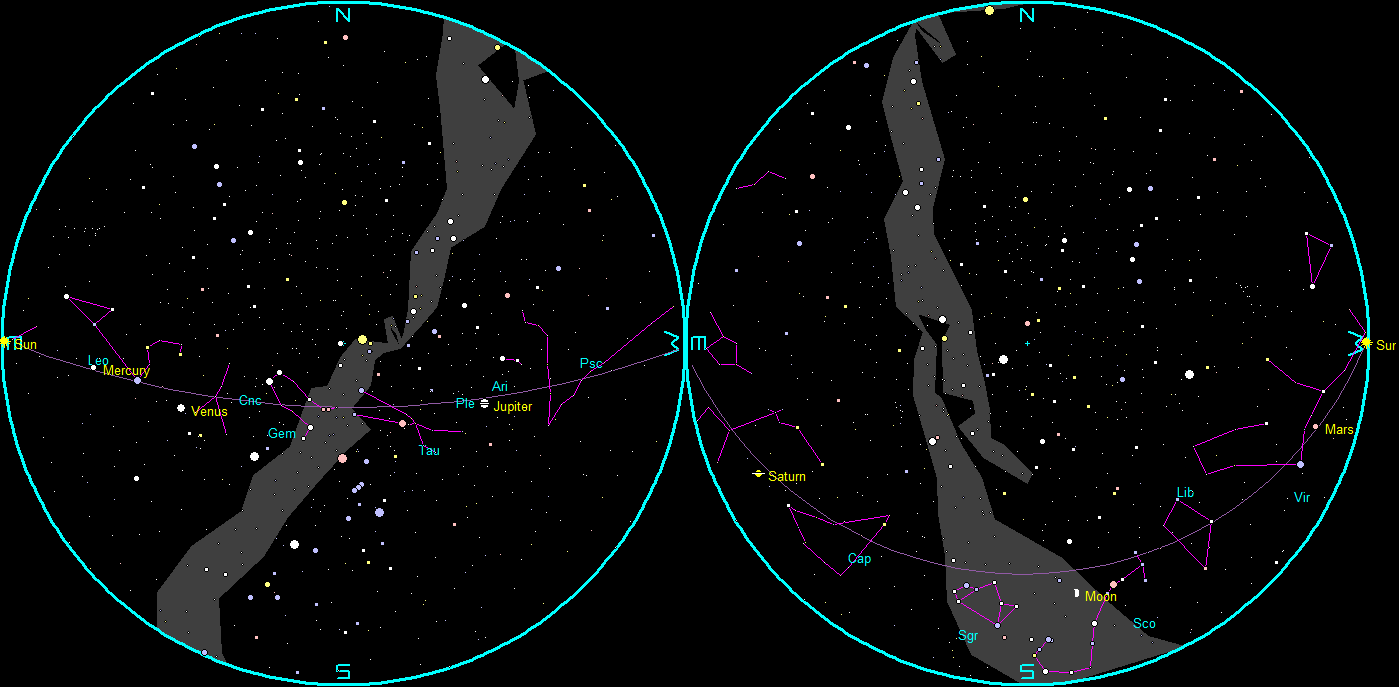
The naked-eye planets and the Moon at sunset and sunrise on a single night, starting with sunset on the right on September 20, 2023. The night ends on the left with sunrise on the 21st. Click or tap on the image to enlarge it. Created using my LookingUp app and GIMP.
 Bob Moler's Ephemeris Blog