Archive

Archive for February 26, 2024

Ephemeris: 02/26/2024 – The angle of the rising and setting planets from the Sun vary with the seasons

February 26, 2024 Comments off

This is Bob Moler with Ephemeris for Monday, February 26th. Today the Sun will be up for 10 hours and 59 minutes, setting at 6:25, and it will rise tomorrow at 7:24. The Moon, 2 days past full, will rise at 8:44 this evening.

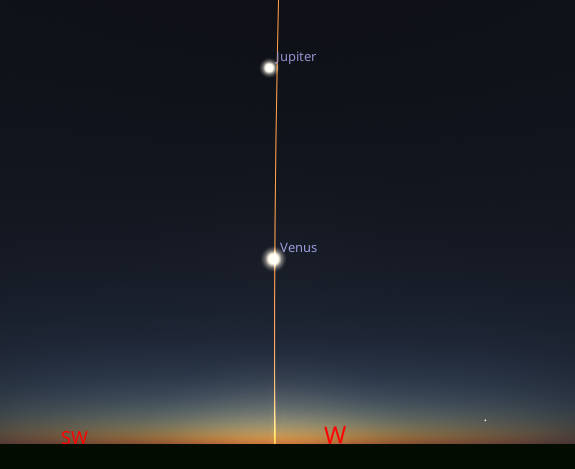
In late winter and early spring dark skies return within a few days after the full Moon. Indeed, this is the first day after the full moon, which was on Saturday morning, that we have dark skies. Well for 40 minutes before the Moon rises. This is because the ecliptic which is the Sun’s path in the sky is as close to vertical as it can get for us. It shows planets near the Sun and the area of the full moon as steeply inclined to the horizon as possible. Twelve years ago this month when my wife and I were on a Hawaiian cruise, I was aboard ship looking at the sky after sunset and was amazed to see Jupiter and Venus* vertically aligned in the west. It was because we were located around the Tropic of Cancer and near the equinox, so the ecliptic was actually vertical after sunset. It was quite a jolt to see that. So this time of year we can see planets close to the sun at sunset and the moon to go away after full rapidly.

The astronomical event times given are for the Traverse City/Interlochen area of Michigan (EST, UT –5 hours). They may be different for your location.

* On the broadcast I said Jupiter and Saturn, relying on my memory. As can be seen below, it was Jupiter and Venus.

Addendum
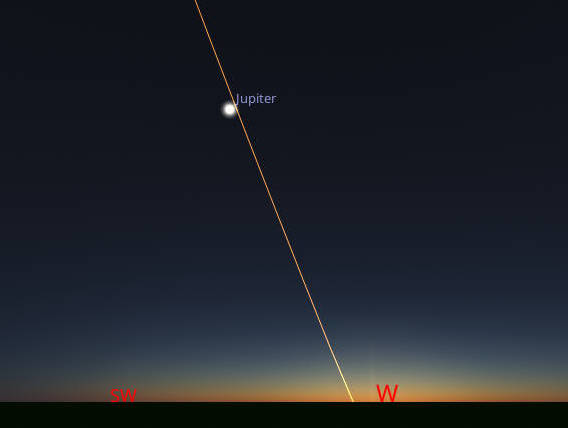
Looking West after sunset
This view is looking West after sunset when the Sun is approximately 10° below the horizon. For us, it’s about 7:17 pm, or about 52 minutes after sunset. The orange line intersecting the horizon near the western compass point is the ecliptic, the apparent path of the Sun in the sky over the year. It is also the plane of the Earth’s orbit. The solar system is essentially flat, so this is also near where all the planets can be found. On late winter and early spring evenings the ecliptic intercepts the western horizon at a very high angle so we can see planets relatively close to the Sun. This evening Jupiter is at an angle of 63° from the Sun. However, the situation is different in the morning. Created using Stellarium.
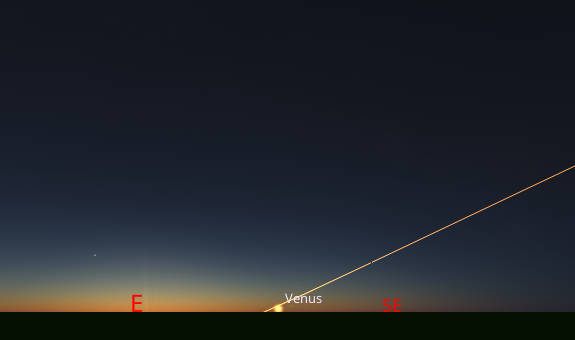
Looking east-southeast before sunrise
Tomorrow morning at 6:32 am, again the Sun is 10° below the horizon at 52 minutes before sunrise. The angle of the ecliptic is much lower to the horizon than it is in the evening. That’s why Venus, whose angular distance from the Sun of 25°, a bit less than half Jupiter’s angular distance from the Sun, is just rising. Created using Stellarium.
Venus and Jupiter arranged vertically after sunset as they were seen in Hawaii back in 2012
Venus and Jupiter arranged vertically after sunset as they were seen in Hawaii back in 2012, 12 years ago this month. Since Jupiter’s orbit of the Sun is around 12 years, Jupiter was in the same position it is now. The vertical arrangement of these planets reminded me of one of the views in 2001 a Space Odyssey where the moons of Jupiter were arranged vertically over the planet. Created using Stellarium.