This is Ephemeris for Monday, February 24th. Today the Sun will be up for 10 hours and 55 minutes, setting at 6:24, and it will rise tomorrow at 7:26. The Moon, 3 days before new, will rise at 6:30 tomorrow morning.
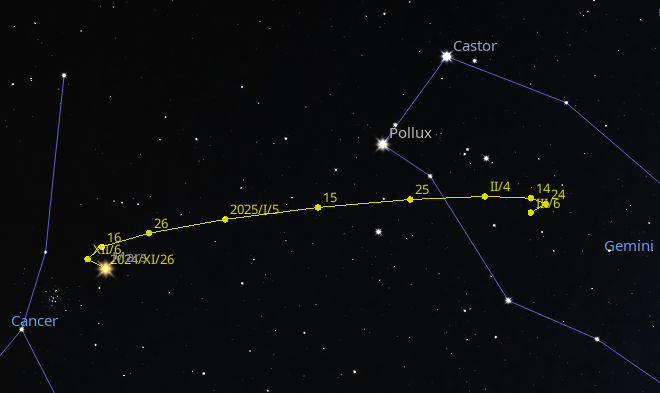
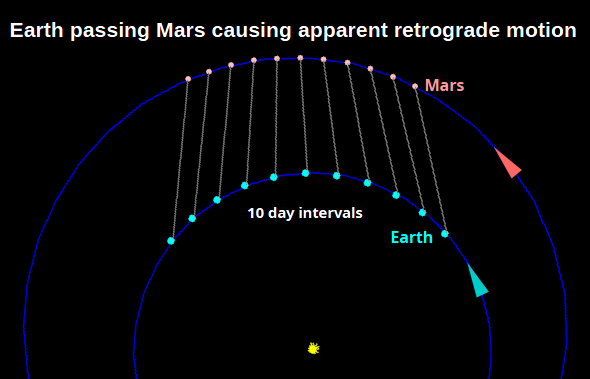
Today the planet Mars is said to be stationary. No, planets do not stop in their orbits of the Sun. It is because we are viewing them from the moving planet Earth. For the last few months Mars has been moving to the west, which is not its normal motion, so we call it retrograde motion. It does that because the Earth, moving faster on an inner orbit, is passing Mars moving slower on an outer orbit. This was a problem for the ancients of the western world because they thought all the moving objects, all seven of them, moved around a stationary Earth. Of those seven, two of them never went backwards, or westward against the stars. They were: the Moon which does orbit the Earth and the Sun which the Earth orbits.
The astronomical event times given are for the Traverse City/Interlochen area of Michigan (EST, UT – 5 hours). Times will be different for other locations.
Addendum
Mars’ track in the sky from November 26th of 2024 until 10 days from now March 6th 2025. The plot started 11 days before Mars was stationary and began its retrograde motion until 10 days after today, another stationary point, where Mars stops moving retrograde and will begin moving in its normal eastward motion. Mars is plotted at 10 days intervals. The labeling is quite minimal: the year and the month is only displayed when they change, and the month is in Roman numerals. The 15 at the center of the plot (January 15, 2025) is the date Mars was in opposition with the Sun or opposite the Sun in the sky, a time when Mars is at or near its closest to the Earth. Created using Stellarium.
The cause of retrograde motion, in the case of Mars, is that the Earth is passing Mars. Both travel in the counterclockwise direction, or if you’re near the plane of the solar system, appear to move eastward. As the Earth passes a planet, it will appear to move westward for a while. This is made up when Mars is behind the Sun in conjunction. It will make up for all the time it’s been dallying around near opposition time. Incidentally, the same is true when an inferior* planet like Venus or Mercury passes between the Earth and the Sun it will for a short period of time also move in a retrograde direction. Again making up for it on the other side of the Sun near superior conjunction. BTW: The positions of the planets coorespond to the positions and dates of the Mars track in the above image. Created using my Looking up app LibreOffice draw for the captions and pointers.
* For non astronomers: Inferior doesn’t refer to quality, but that the planet’s orbit is inside the Earth’s orbit. Superior planets orbit farther out from the Sun than the Earth.
 Bob Moler's Ephemeris Blog