This is Bob Moler with Ephemeris for Wednesday, April 30th. Today the Sun will be up for 14 hours and 13 minutes, setting at 8:46, and it will rise tomorrow at 6:32. The Moon, 3 days past new, will set at 1:08 tomorrow morning.
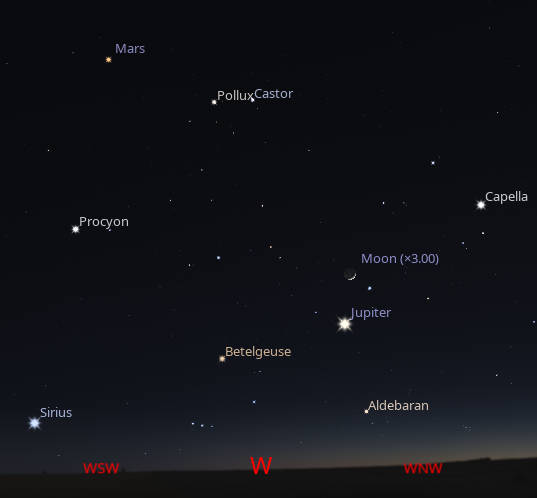
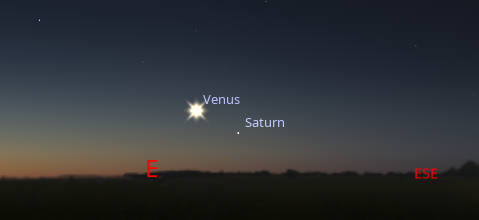
Let’s take our weekly look at the whereabouts of the naked-eye planets. At 9:30 PM this evening two of the five naked eye planets will be out. Jupiter, is now the brightest evening planet, our substitute evening star if you will. It will be in the western sky. Tonight it will be below the crescent Moon. To its lower left, the great constellation of Orion will be beginning to set. The rapidly fading Mars, with its distinctive reddish hue, is high in the southwest, with the stars Castor and Pollux in Gemini to the right of it. By 5:30 AM Venus will be seen very low in the east, as the Morning Star. It will require a low eastern horizon. It should be visible until a bit after 6:30. Saturn is visible close and to its lower right.
The astronomical event times given in this blog are for the Traverse City/Interlochen area of Michigan (Lat 44.7° N, Long 85.7° W; EDT, UT – 4 hours) unless stated otherwise. Times will be different for other locations.
Addendum
The evening planets Jupiter and Mars seen with the Moon (3 times normal size) and fading stars of winter at 10 PM, on April 30th, 2025. Created using Stellarium and GIMP.
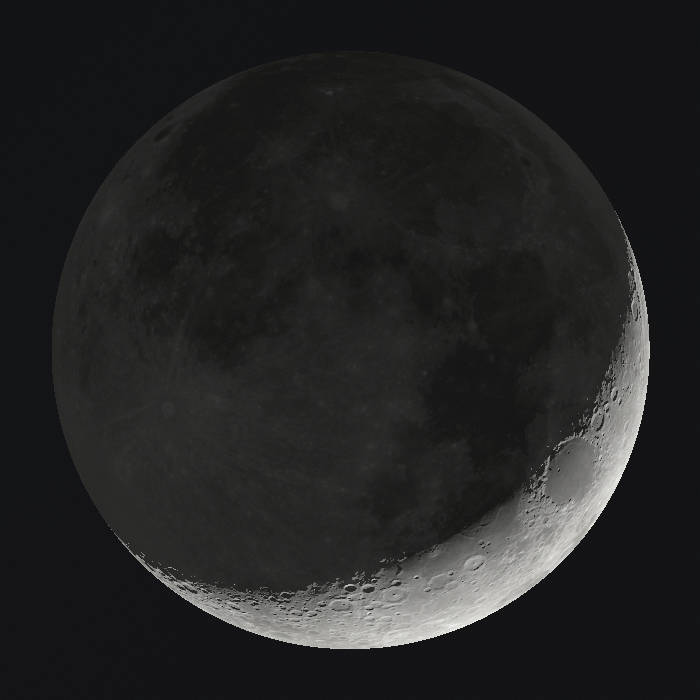
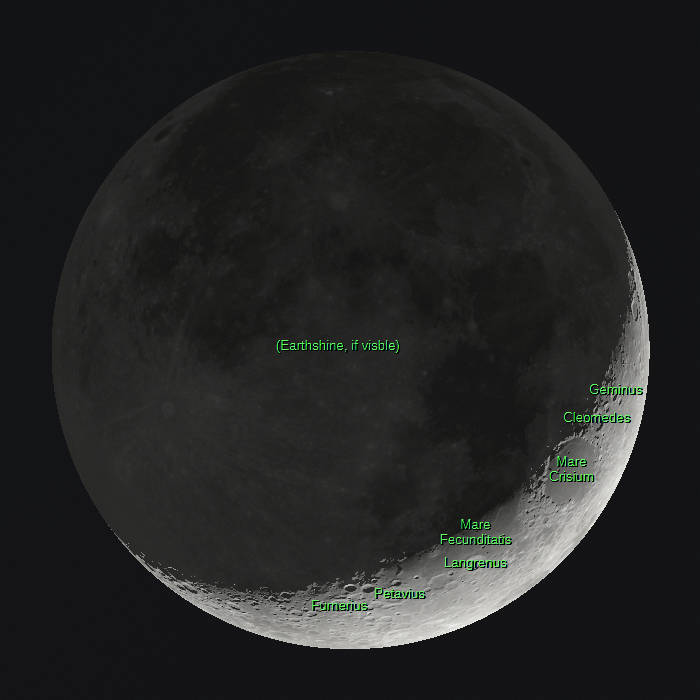
The Moon tonight, April 30, 2025. A view visible in small telescopes showing an image with and without selected features labeled. Created using Stellarium, LibreOffice Draw, and GIMP.
Venus and Saturn at 5:30 AM tomorrow morning, May 1st, 2025, low in the east. Saturn may still be tough to spot at our northerly latitude (45 N). Created using Stellarium.
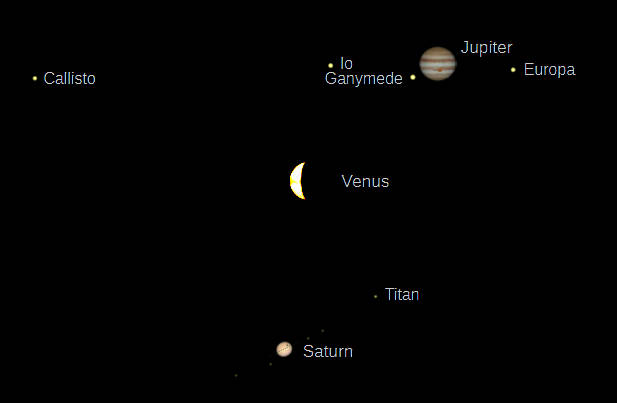
Telescopic Jupiter, Venus and Saturn (north up) as it would be seen in a small telescope with the same magnification. Jupiter is shown for tonight, 10 PM, April 30, 2025. Its apparent diameter is 33.7″. Mars is 6.6″ in diameter, too small to be shown here. My lower size limit is 10″. Venus is shown in the morning of May 1st. Its apparent diameter is 40.6″, and is 23.3% iluminated. Saturn is 16.1″ in diameter, but its rings, being nearly edge on and not illuminated, should not be visible. Planetary surface detail is more subtle than shown here. The ” means seconds of arc, or 1/3600th of a degree. Created using Cartes du Ciel (Sky Charts).
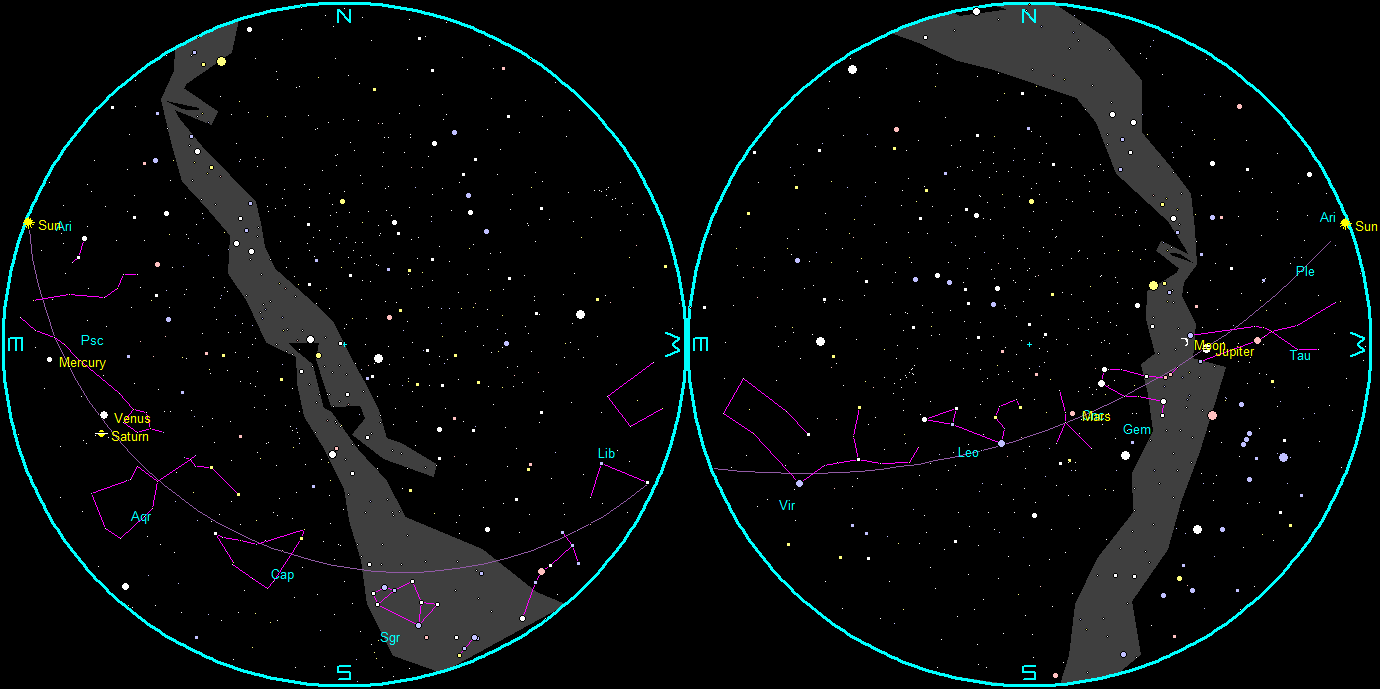
The naked-eye planets and the Moon at sunset and sunrise on a single night, starting with sunset on the right on April 30, 2025. The night ends on the left with sunrise on the May 1st. Click or tap on the image to enlarge it. Created using my LookingUp app and GIMP.
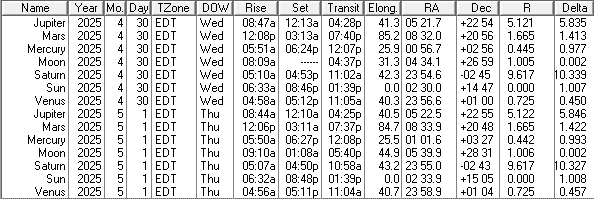
This is a low precision ephemeris of the Sun Moon and naked eye planet positions for today and tomorrow, April 30th and May 1st, 2025. Some of the columns are self-explanatory, others are not. The transit column is the time that the body crosses the meridian and is due south. Elong, for elongation, is the angle between the Sun and that body. RA is right ascension, which is the object’s east-west position on the celestial sphere in hours and minutes. Dec is declination which is the north-south position of the object on the celestial sphere in degrees and minutes. R is the distance of that object from the Sun in astronomical units. An astronomical unit is about 93 million miles or 150 million kilometers. And Delta is the distance of that object from the Earth, also in astronomical units. I omit the ‘m’ in am and pm for compactness. The data was generated using my LookingUp for DOS app and displayed as a table by my Ephemeris Helper app.
 Bob Moler's Ephemeris Blog