Archive
Ephemeris: 09/15/2025 – Last month to view the southern Milky Way from Michigan
This is Bob Moler with Ephemeris for Monday, September 15th. Today the Sun will be up for 12 hours and 30 minutes, setting at 7:52, and it will rise tomorrow at 7:23. The Moon, 1 day past last quarter, will rise at 1:14 tomorrow morning.
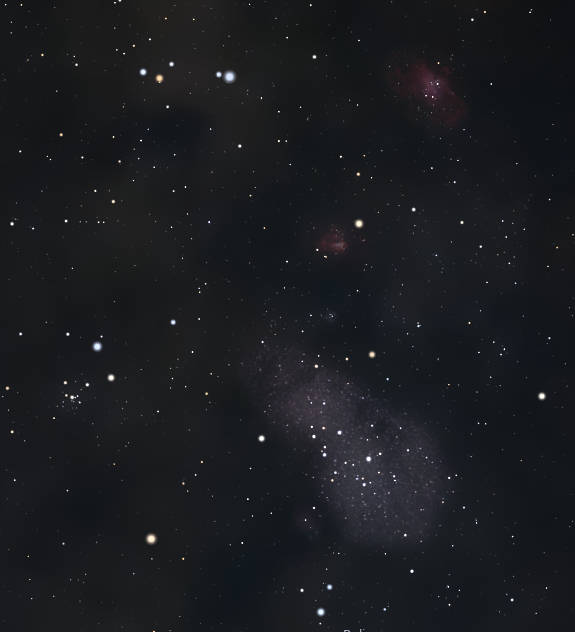
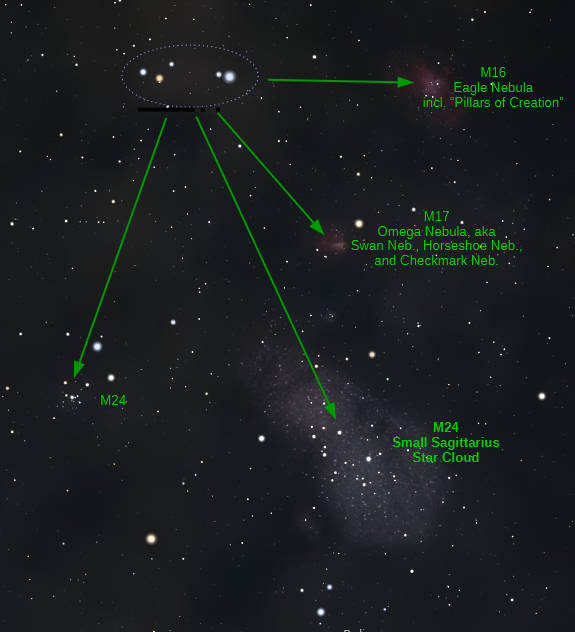
September is the second of the two months we get to see the southern part of the Milky Way in the evening sky. At 10 PM the asterism of the Teapot of the constellation Sagittarius is pouring its tea on the southwestern horizon. It is in that direction that we look to the center of the Milky Way. Unfortunately there are clouds of dust and gas between us and the center, so we cannot see it visually, though it can be seen by radio waves and other means. There are a host of objects visible in binoculars and small telescopes. One does not need a star map to be able to find them, just point a telescope at low power or binoculars in that direction and sweep around slowly. There are treasures of star clusters and nebulae to be found.
The astronomical event times given in this blog are for the Traverse City/Interlochen area of Michigan (Lat 44.7° N, Long 85.7° W; EDT, UT – 4 hours) unless stated otherwise. Times will be different for other locations.
Addendum
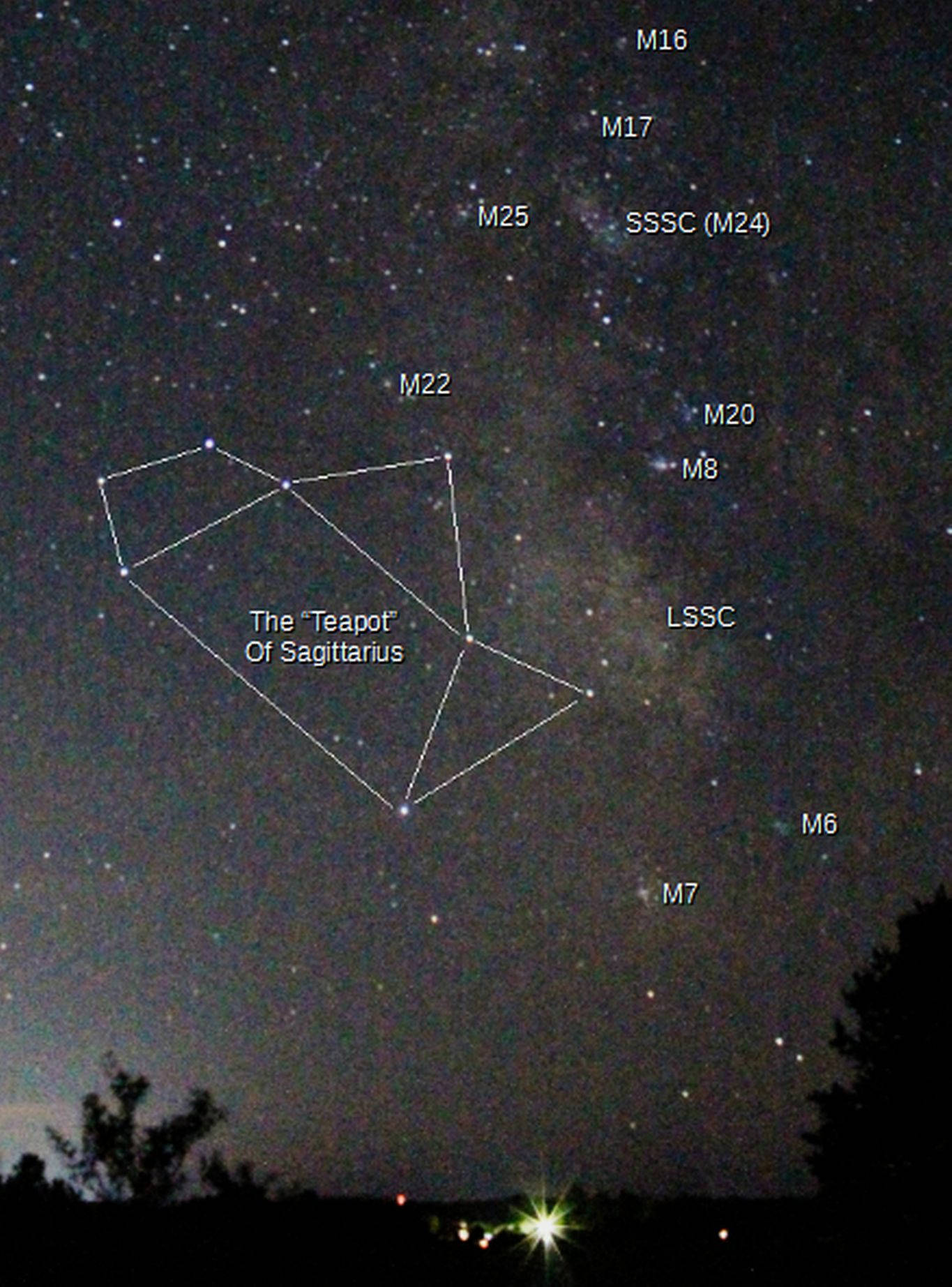
In the image above the amount of detail of the stars is approximately that of a pair of binoculars. The various nebulae and star clusters are denoted with M numbers. These are some of the brightest, what we call deep sky objects, in the catalog by Charles Messier, who is looking for comets. He numbered them as he came across them. The brightest star cluster is M7, which Claudius Ptolemy recorded in the 2nd century CE. The brightest nebula is M8, the Lagoon Nebula out of which a star cluster is being formed. In binoculars, it looks like a short horizontal gash. Next in brightness is M17, a fuzzy spot in binoculars, but appears as a glowing check mark, or swimming swan in a telescope. M20, the Trifid Nebula, is the next brightest nebula in which dark dust lanes divide it into three lobes. M16, the Eagle Nebula is very dim. Most of the time I miss the nebulosity, but its embedded star cluster is quite easily seen. The rest of the Messier objects are star clusters or a star cloud. Of these M22 is a globular star cluster and one of the easiest of these clusters to resolve, though it might take a telescope of 150 mm (6″) diameter to do it.
 Bob Moler's Ephemeris Blog