This is Ephemeris for New Year’s Eve, Wednesday, December 31st. The Sun will rise at 8:20. It’ll be up for 8 hours and 52 minutes, setting at 5:12. The Moon, 3 days before full, will set at 6:49 tomorrow morning.
Let’s take our last weekly look at the whereabouts of the naked-eye planets for 2025. Saturn is the brightest star-like object in the southwestern sky as soon as it gets dark. In a telescope Saturn sports a very thin ring, one degree from being edge on and is slowly opening. Jupiter will rise at 5:54 PM in the east-northeast, below and right of Castor and Pollux, the bright stars of Gemini. The giant planet is slowly moving westward with its retrograde motion. Jupiter’s 4 brightest moons can be seen even in binoculars, and shift position night to night. In the morning sky, only Jupiter can be seen, descending in the western sky. It will leave the morning sky, officially on January 10th, as it reaches opposition with the Sun.
The astronomical event times given in this blog are for the Traverse City/Interlochen area of Michigan (Lat 44.7° N, Long 85.7° W; EST, UT – 5 hours) unless stated otherwise. Times will be different for other locations.
Addendum
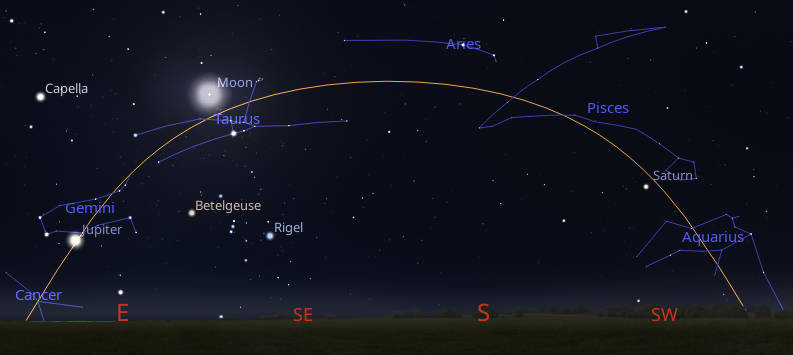
Jupiter, Saturn and the waxing gibbous Moon along with the zodiacal constellations, and the path of the Sun (ecliptic) in orange, in this panorama at 8 PM tonight, December 31, 2025. Created using Stellarium.
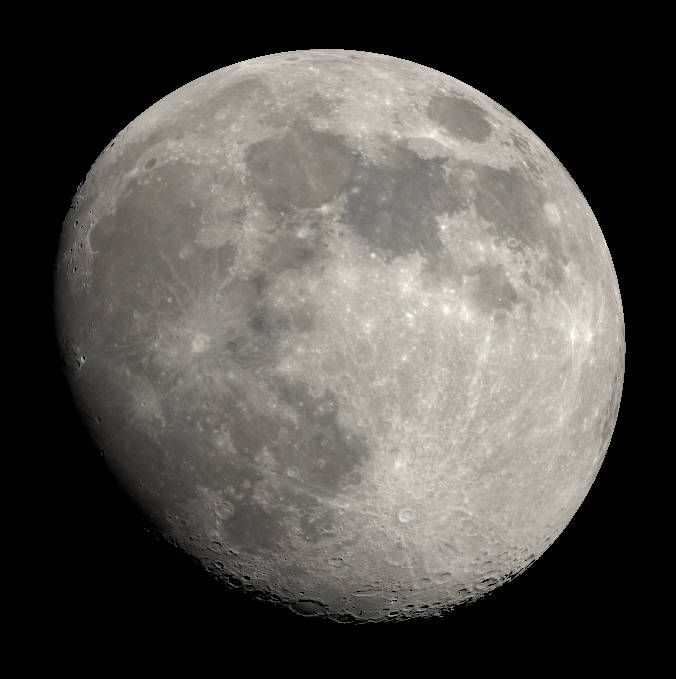
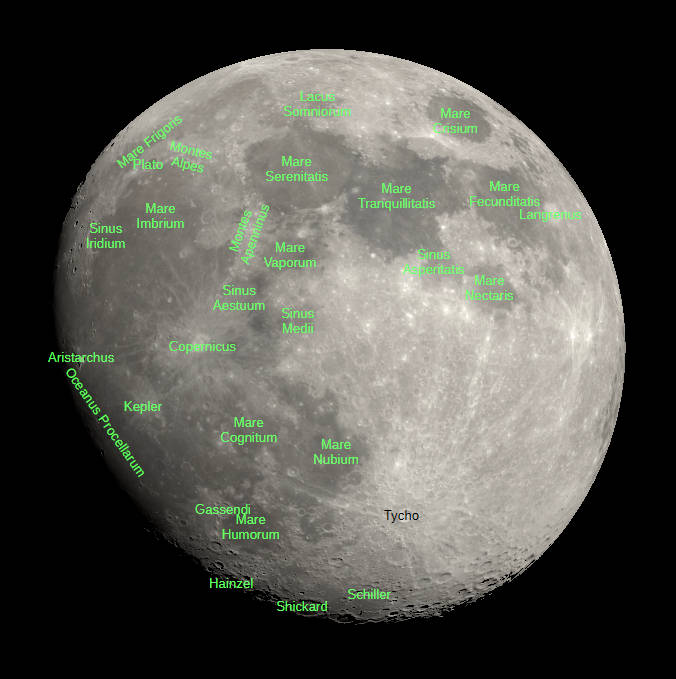
The Moon three days before full as seen in the tonight, December 31, 2025. A view visible in small telescopes showing an image with and without selected features labeled. Created using Stellarium, LibreOffice Draw, and GIMP.
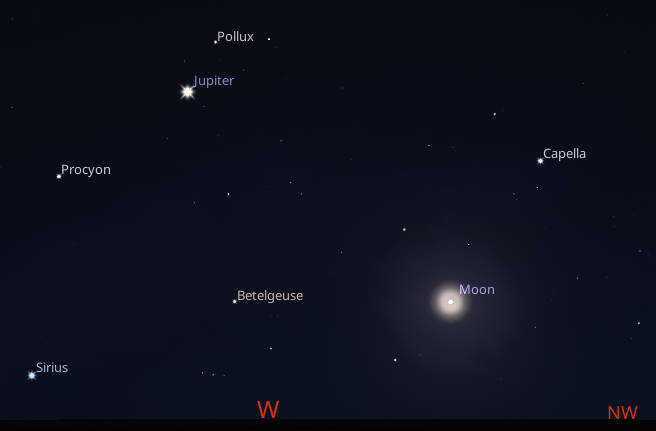
Jupiter is the only visible morning planet, and soon it too will leave, as it is sinking in the west with the few remaining winter stars and the Moon at 7 AM tomorrow, January 1, 2026. Created using Stellarium.
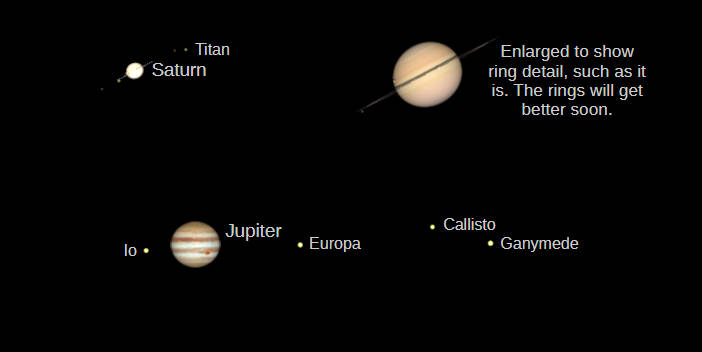
Telescopic Saturn, and Jupiter (north up) as they would be seen in a small telescope with the same magnification at 8 PM tonight, December 31, 2025. Saturn will be 17.1″ in diameter, but its rings, being nearly edge on, may show up brighter than seen here, and extend to 39.9″. They are tilted 1.0° from being edge on. Jupiter will be 46.5″ in diameter. Jupiter’s moon Io and its shadow will transit the planet later in the evening. The (”) symbol means seconds of arc, or 1/3600th of a degree. Created using Cartes du Ciel (Sky Charts), LibreOffice Draw and GIMP.
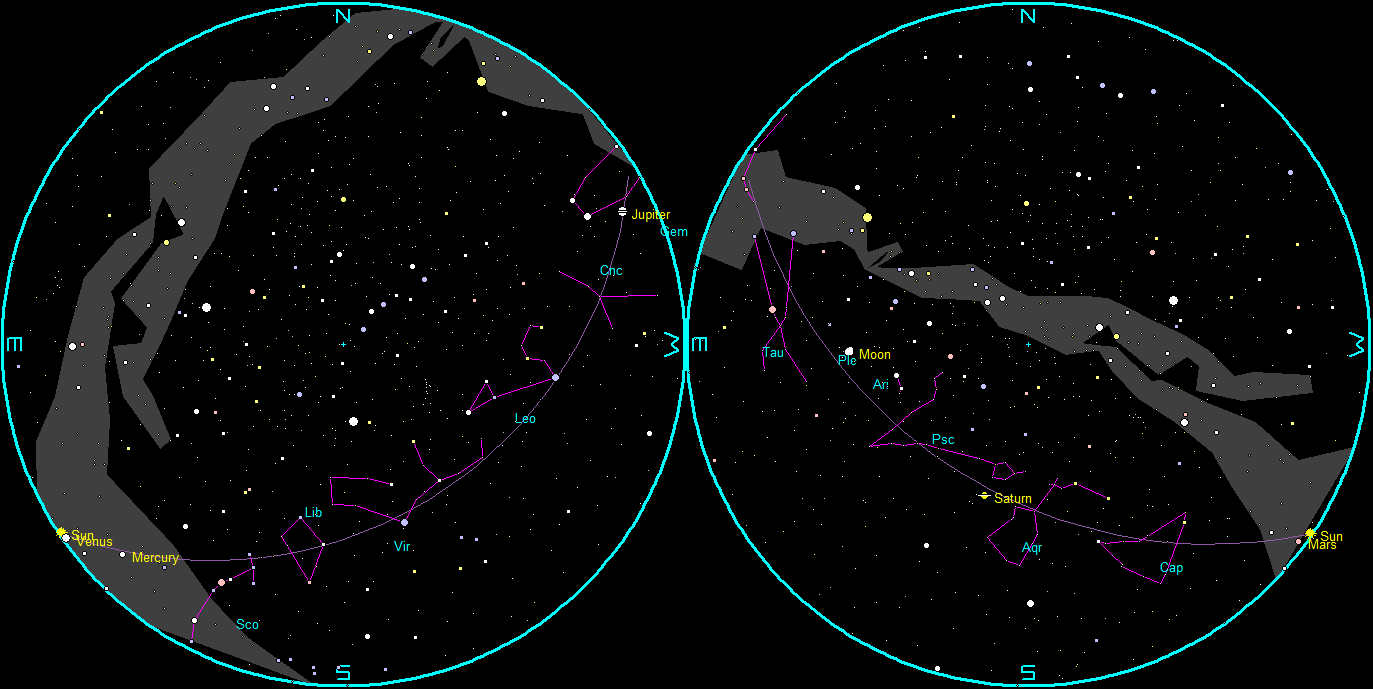
The naked-eye planets and the Moon at sunset and sunrise on a single night, starting with sunset on the right on December 31st, 2025. The night ends on the left with sunrise on the New Year’s morning, 2026. Click or tap on the image to enlarge it. Created using my LookingUp app and GIMP.
 Bob Moler's Ephemeris Blog