Archive
Ephemeris: 04/28/2026 – Stars spend most of their lives fueled by hydrogen
This is Ephemeris for Tuesday, April 28th. Today the Sun will be up for 14 hours and 7 minutes, setting at 8:44, and it will rise tomorrow at 6:35. The Moon, 3 days before full, will set at 5:24 tomorrow morning.
A star is a gaseous ball made mostly of hydrogen, which due to its mass crushes down in its core to create heat in the millions of degrees. Under those temperatures and pressures hydrogen nuclei, stripped of their electrons can collide to convert into helium and in doing so lose a tiny bit of mass that turns into energy which is used to sustain the star’s light and keep it stable. This hydrogen burning, so to speak, takes place during the longest period of a star’s life. And stars have a characteristic color based on their mass. Stars with little mass are cooler and appear a dim red. We call them red dwarfs. The nearest star to our solar system is a red dwarf called Proxima Centauri. It’s so dim that it’d be difficult to find with a pair of binoculars. And it’s only four light years away.
The astronomical event times given in this blog are for the Traverse City/Interlochen area of Michigan (Lat 44.7° N, Long 85.7° W; EDT, UT – 4 hours) unless stated otherwise. Times will be different for other locations.
Addendum
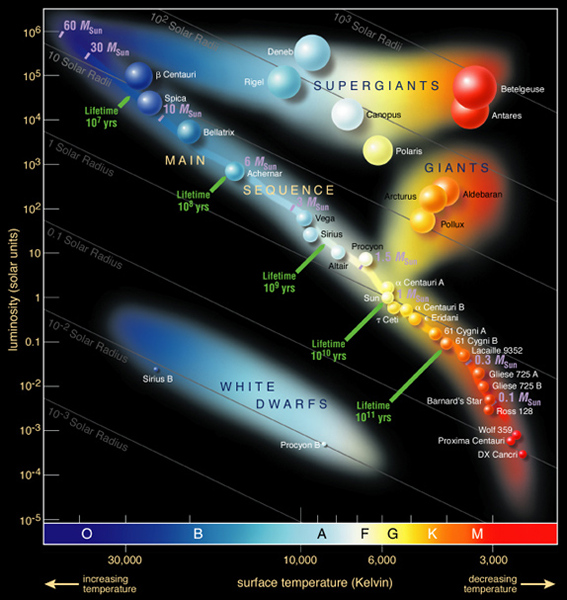
The HR diagram above shows the various types and brightness of stars. The relatively thin line of stars from upper left to lower right, called the main sequence, are stars that are running primarily on hydrogen as a fuel. At the bottom end of the main sequence small stars with a fraction of the sun’s mass. All these stars are near the sun. It doesn’t mean that we live in a bad neighborhood, but that the most numerous stars are red dwarfs, and we just can’t see them when they’re farther away. All the other stars are not using as hydrogen as their main fuel source. Stars the upper right are using heavier elements to produce energy from the fusion products of lighter elements, after having run out of hydrogen in their cores. The white dwarf stars in the lower part of the diagram no longer have active thermonuclear reactions in their cores and are cooling down and collapsing. A star with the mass of the sun, when it becomes a white dwarf, will shrink down to about the size of the earth.

