Ephemeris: 09/21/2026 – What is an ephemeris?
This is Ephemeris for Monday, September 21st. Today the Sun will be up for 12 hours and 13 minutes, setting at 7:41, and it will rise tomorrow at 7:30. The Moon, 3 days past first quarter, will set at 2:49 tomorrow morning.
I’ve given the name of this program as being Ephemeris, which is a rather obscure term. A related word, ephemeral, an adjective, may be more familiar, meaning something that lasts a brief period of time, no more than a day. The word ephemeris itself comes from the Greek, and picked up by the Romans meaning a diary. In astronomy an ephemeris a tabular list of daily positions of astronomical objects, which part of this program really does with the rising and setting times of the sun and moon. The request of the station back in 1975 when I started this, was just to get sunrises and sunsets, I’ve added an astronomical tidbit. Now, of course, you can get sunrises and sunsets for your precise location from your smartphone.
The astronomical event times given in this blog are for the Traverse City/Interlochen area of Michigan (Lat 44.7° N, Long 85.7° W; EDT, UT – 4 hours) unless stated otherwise. Times will be different for other locations.
Addendum
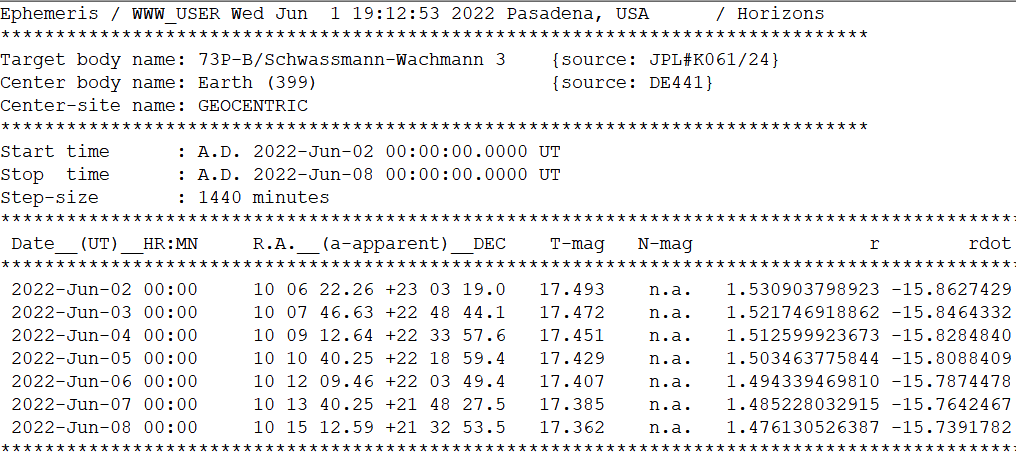
The columns represent, from left to right: The date and time, and then the position R.A. is Right Ascension which is the east-west position of the object in the sky in hours, minutes, and seconds where an hour is 15 degrees. The next three columns are the declination which is the north-south position in degrees, minutes, and seconds. Plus meaning north of the celestial equator T-mag is total magnitude or brightness of the comet, and seventeen is very dim, N-mag is the magnitude of the nucleus which is not applicable here. Small r is the distance from the sun an astronomical units. The Earth’s mean distance from the Sun is 1. I don’t know what rdot is and I wouldn’t need it for finding the comet. The example is truncated in width. Another column, Delta, is the comet’s distance from the earth.
 Bob Moler's Ephemeris Blog