Archive
06/13/2022 – Ephemeris – What’s a near rectilinear halo orbit?
Since I wrote and recorded this program on June 5th, the launch date has been postponed from June 13th. No new launch date has, been selected, though the launch window extends through the 22nd for this month’s attempt.
This is Ephemeris for Monday, June 13th. Today the Sun will be up for 15 hours and 32 minutes, setting at 9:29, and it will rise tomorrow at 5:56. The Moon, 1 day before full, will set at 5:41 tomorrow morning.
Last Friday I talked about the CAPSTONE mission to a near rectilinear halo orbit of the Moon, which, when I recorded this, could launch as soon as today. Anyway, what is a near rectilinear halo orbit? And why is it so special? It is a long looping orbit that comes quite close to the Moon over its North Pole, and very far away over the South Pole of the Moon. Instead of going behind the Moon from the Earth’s perspective, the orbit will always be face-on to the Earth. It will require occasional tweaks to keep it that way, just like the James Webb Space Telescope needs occasional tweaks to keep it in orbit of the Earth-Sun L2 point. That way a lander, or base at the South Pole of the Moon, can keep in communication with the Lunar Gateway for all but a couple of hours each week. Why the South Pole? That’s where the water ice is!
The astronomical event times given are for the Traverse City/Interlochen area of Michigan (EDT, UT – 4 hours). They may be different for your location.
Addendum
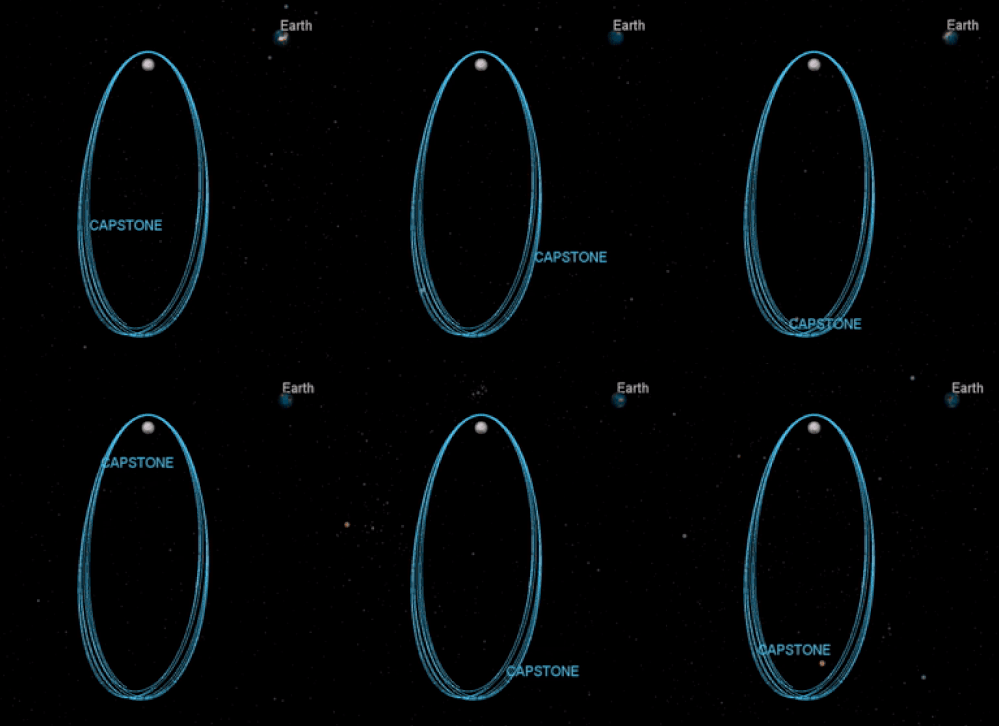
NASA CAPSTONE* pathfinder for gateway orbit is to be launched this year by Rocket Lab to prove out the near rectilinear orbit for the Lunar Gateway.
The orbit will pass 1,900 miles (3,000 km) above the Moon’s North Pole and out to 43,000 miles (70,000 km) above the South Pole. The period of such an orbit is about 6.5 days. Landing attempts at the South Pole of the Moon will begin as the lander departs the Orion spacecraft or the Lunar Gateway space station and begins its descent over the North Pole.
06/10/2022 – Ephemeris – The first Artemis mission: CAPSTONE
This is Bob Moler with Ephemeris for Friday, June 10th. Today the Sun will be up for 15 hours and 30 minutes, setting at 9:27, and it will rise tomorrow at 5:56. The Moon, 3 days past first quarter, will set at 3:52 tomorrow morning.
Launching, perhaps, as soon a Monday is the CAPSTONE Mission, which is part of the Artemis program to send the next man and first woman to the Moon. The Capstone mission is to check out the special near rectilinear halo orbit the Lunar Gateway space station, and the Human Landing Craft will be in when the Orion spacecraft arrives before landing. CAPSTONE is, of course, an acronym that explains its purpose, to achieve and navigate itself into this near rectilinear halo orbit. CAPSTONE is basically a CubeSat made of 12 4 by 4 inch (12 100 mm by 100 mm) cubes. It will be launched by Rocket Lab from New Zealand on their Electron rocket with their Proton upper stage. It will take 3 months to reach the Moon.
The astronomical event times given are for the Traverse City/Interlochen area of Michigan (EDT, UT – 4 hours). They may be different for your location.
Addendum
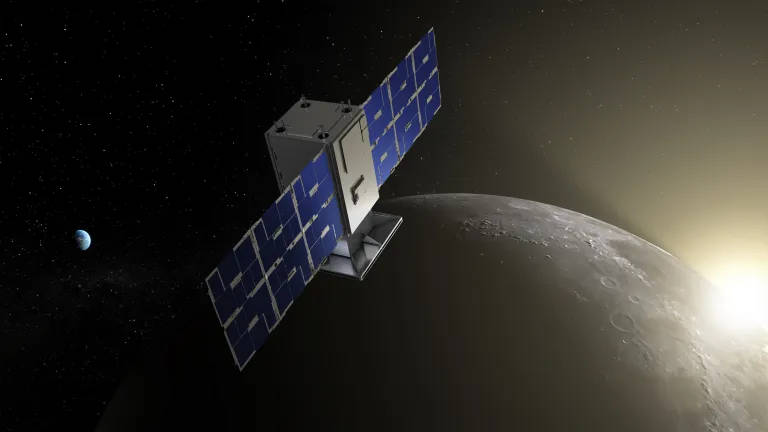
Artist’s impression of the CAPSTONE spacecraft at perilune, the closest point in its orbit, over the north pole of the Moon.
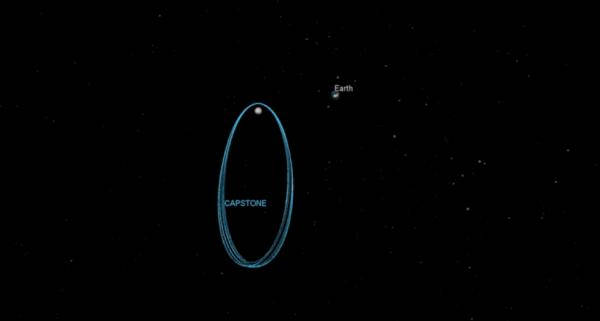
CAPSTONE’s near rectilinear halo orbit of the Moon, which precesses to keep face on to the Earth during the lunar orbit of the Earth.
04/08/2022 – Ephemeris – Landing a spacecraft at the Moon’s South Pole will be a tricky prospect
This is Ephemeris for Friday, April 8th. Today the Sun will be up for 13 hours and 8 minutes, setting at 8:19, and it will rise tomorrow at 7:09. The Moon, 1 day before first quarter, will set at 3:58 tomorrow morning.
The Artemis missions are to land near the South Pole of the Moon. Unlike the Earth’s 23 and a half degree axial tilt the Moon’s is only a degree and a half, so there is little month long variation of the Sun angle, though the Sun’s direction along the horizon revolves 360 degrees over 29 and a half days, the length of its orbit of the Earth. It should make for quite a challenge to land the human lander safely near the lunar South Pole. The lander has to choose a spot in sunlight to land that’s relatively smooth. The reason for the attraction of the lunar South Pole is the presence of water ice in permanently shadowed craters near and at the pole. The Moon’s North Pole isn’t as heavily cratered, with fewer permanently shadowed craters.
The astronomical event times given are for the Traverse City/Interlochen area of Michigan (EDT, UT – 4 hours). They may be different for your location.
Addendum
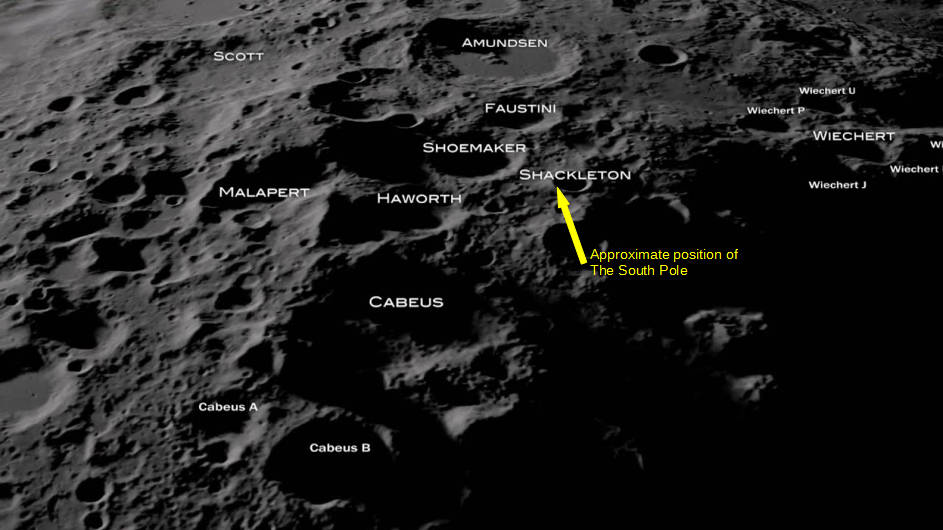
Lunar South Pole Flyover area with approximate South Pole marked based on Virtual Moon Atlas. Did you note a theme in some crater names? Click on the image to enlarge it. Credit: NASA/LRO.
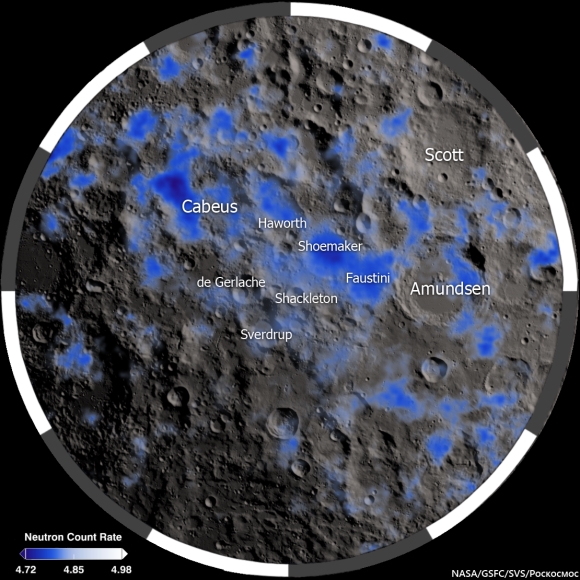
The South Pole of the Moon, where the presence of water ice is detected by the absorption of neutrons by the hydrogen atoms in the ice. Credit NASA/GSFC/SVS/Roscosmos.
04/05/2022 – Ephemeris – The first Axiom Space mission to the ISS amid a busy April
This is Bob Moler with Ephemeris for Tuesday, April 5th. Today the Sun will be up for 12 hours and 59 minutes, setting at 8:15, and it will rise tomorrow at 7:14. The Moon, halfway from new to first quarter, will set at 1:15 tomorrow morning.
One of the commercial entities working to launch their own space station is Axiom Space, founded in 2016. The first Axiom mission is Ax-1, an 8-day mission to the International Space Station that, as of when I am recording this last Sunday night, is scheduled for tomorrow on a SpaceX Falcon 9/Crew Dragon from launch pad 39A at Cape Canaveral. The Artemis-1 wet dress rehearsal was halted earlier Sunday due to a pressurization problem with the mobile launch tower. That’s on pad 39B, a bit over a mile and a half away. I’m assuming that Artemis-1 has priority over the Axiom mission. Plus, there’s the SpaceX Crew-5 launch later this month to the space station, which also has president. It could be an interesting time at the Cape.
The astronomical event times given are for the Traverse City/Interlochen area of Michigan (EDT, UT – 4 hours). They may be different for your location.
Addendum
April 4, 2022: The SpaceX Axiom-1 launch is now scheduled for no earlier than Friday, April 8, for an 8-day mission to the International Space Station (ISS). The SpaceX Crew-4 launch had previously been pushed back to April 20. The Crew-3 return from the ISS was to be 5 days later.
The Artemis-1 Wet Dress Rehearsal was scrubbed April 4th with a malfunctioning vent valve. A successful test will have fuel and oxidizer loaded and all prelaunch functions completed, and counted down to a bit over 9 seconds to launch.
Axiom Space: space station plan
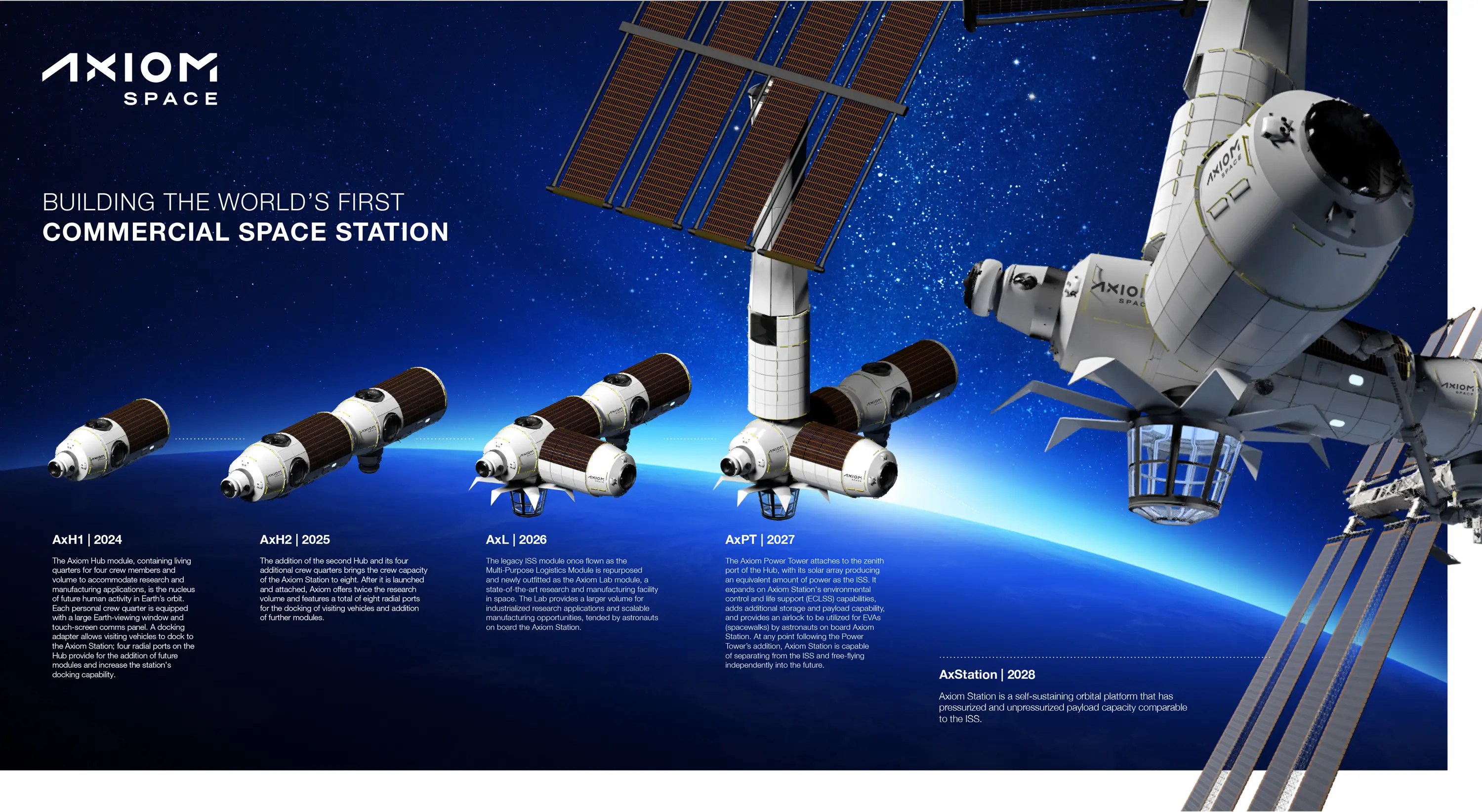
The planned evolution of the Axiom commercial space station. It will start being a module attached to the ISS starting in 2024, according to the current plan. Various modules will be attached. After the power tower containing solar panels is attached, it can be detached from the ISS to fly free. Click on the image to enlarge. Credit: Axiom Space.
02/07/2022 – Ephemeris – The Moon tonight
This is Ephemeris for Monday, February 7th. Today the Sun will be up for 10 hours and 5 minutes, setting at 6:00, and it will rise tomorrow at 7:53. The Moon, 1 day before first quarter, will set at 1:29 tomorrow morning.
Tonight, let’s take a look at the nearly first quarter Moon. The small, nearly circular gray spot is the sea of Crises. A diagonal chain of larger seas run from the terminator, the sunrise line, to below the Sea of Crises. They are, from the terminator, the seas of Serenity, Tranquility and Fertility. NASA is hoping to launch its uncrewed mission to the Moon, Artemis-1, next month with a large block of launch dates. The launch window begins on March 12th and ends on the 27th, with two blackout dates. Two lengths of missions are possible, a long 38 to 42 day mission is possible in the first part of the launch window, and a shorter 26 to 28 day mission is possible in the latter part of the window.
The astronomical event times given are for the Traverse City/Interlochen area of Michigan (EST, UT – 5 hours). They may be different for your location.
Addendum
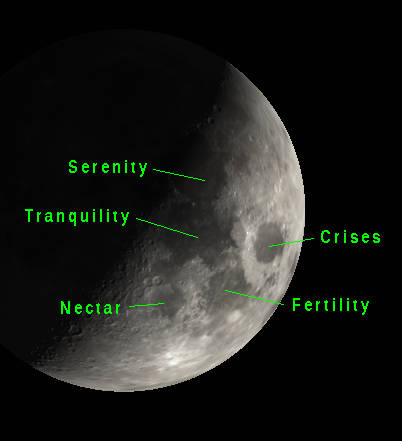
The Moon as it might appear tonight in binoculars or a small telescope at 7 pm tonight, February 7, 2022. I labeled the lunar seas with their English names, translated from the Latin. Also labeled is the Sea of Nectar, which wasn’t mentioned in the program. Moon image created using Stellarium.
12/17/2021 – Ephemeris – Artemis-1 mission may launch in less than 2 months
This is Ephemeris for Friday, December 17th. Today the Sun will be up for 8 hours and 48 minutes, setting at 5:03, and it will rise tomorrow at 8:15. The Moon, 1 day before full, will set at 7:56 tomorrow morning.
In a little less than two months, a fifteen-day launch window opens up to launch Artemis one, the first and hopefully only uncrewed Artemis mission to the Moon in the NASA’s program to land the next man and first woman on the Moon. The uncrewed Orion capsule and the ESA contributed Service Module will orbit the Moon in a very elongated distant orbit of the Moon, retreating out to 38,000 miles (61,000 kilometers) further than the Moon once or twice before heading within 60 miles of the Moon’s surface on its way back to the Earth. The upper stage, that sends Orion on its way to the Moon, will release some CubeSats as it follows Orion to the Moon, where it will whip around the Moon to orbit the Sun.
The astronomical event times given are for the Traverse City/Interlochen area of Michigan (EST, UT – 5 hours). They may be different for your location.
Addendum
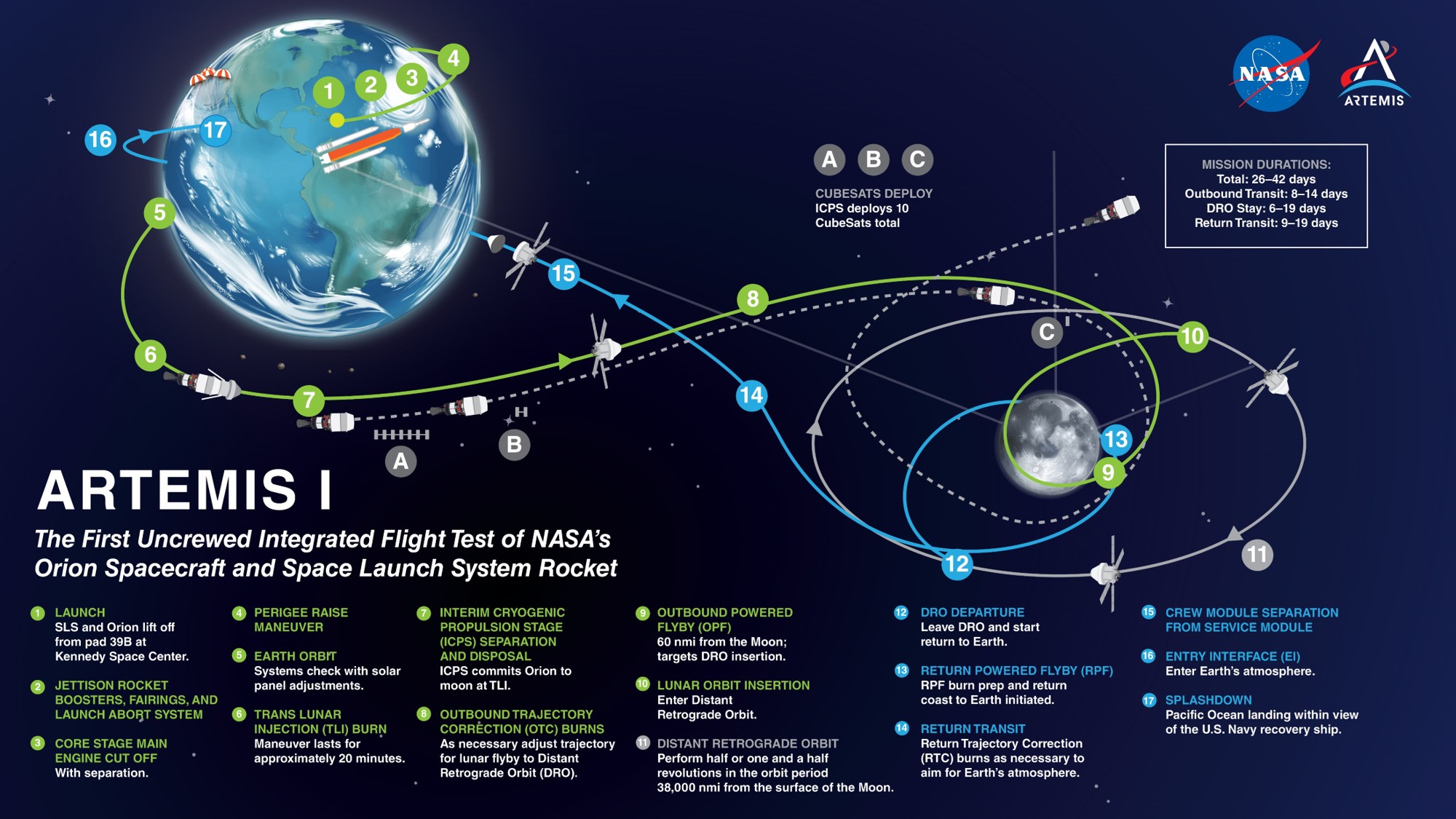
Artemis-1 orbital plan. Click on the image to enlarge it. Credit NASA.

The Earth and Moon to scale. Source Wikipedia.
09/16/2021 – Ephemeris – How safe is the Space Launch System (SLS) compared to the Space Shuttle?
This is Ephemeris for Thursday, September 16th. Today the Sun will be up for 12 hours and 27 minutes, setting at 7:51, and it will rise tomorrow at 7:24. The Moon, 3 days past first quarter, will set at 3:10 tomorrow morning.
Tonight, the planet Saturn will appear above the bright gibbous Moon. It might be a bit hard to spot.
The big NASA moon rocket, the Space Launch System or SLS, borrowed a lot of features from the Space Shuttle. Is it any safer? The answer is yes. The Space Shuttle had no abort system for a catastrophic failure, as we saw with the Challenger accident in 1986. However, even though the SLS uses the same type solid rocket boosters that failed Challenger, the Crew in the Orion capsule is on top of the rocket with an escape system to rocket them away from an exploding core stage. With the Orion capsule, the escape tower will be jettisoned at some point before reaching orbit, possibly making escape impossible in the latter stage of powered flight. Both SpaceX’s Dragon and Boeing’s Starliner have escape rockets built in for the entire flight.
Addendum
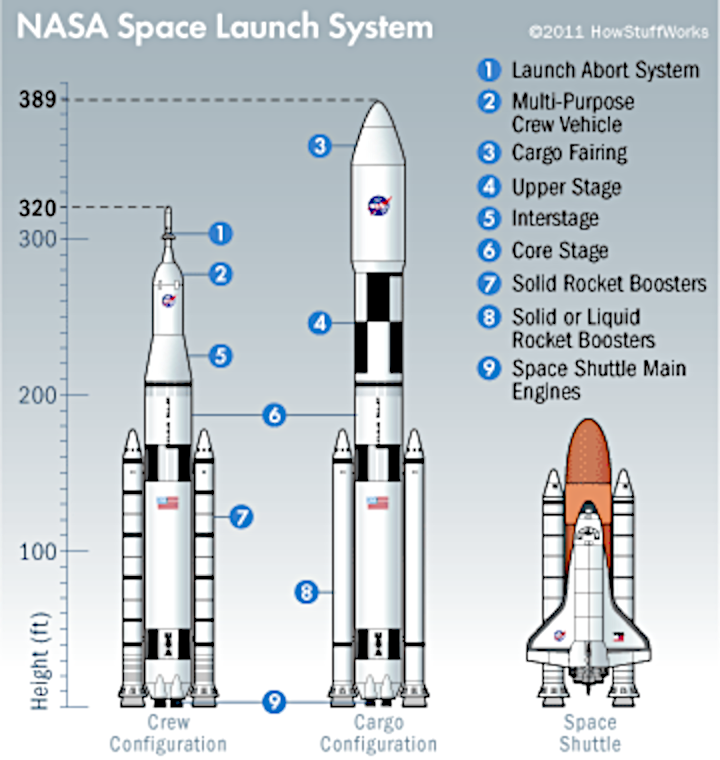
Shuttle-SLS comparisons. Note that this image is 10 years old. The center core stage will, like the external tank on the shuttle, remain unpainted. So far, the cargo version of the is still in the design stage. The Multipurpose Crew Vehicle is now called the Orion Spacecraft. Credit: How Stuff Works.
09/14/2021 – Ephemeris – Lack of spacesuits just one of Artemis problems of getting humans back to the Moon
This is Ephemeris for Tuesday, September 14th. Today the Sun will be up for 12 hours and 33 minutes, setting at 7:54, and it will rise tomorrow at 7:21. The Moon, 1 day past first quarter, will set at 12:53 tomorrow morning.
The bright gibbous Moon is a feast for binoculars or a telescope. However, the speed-up plan to land crews on the Moon in 2024 proposed by the former President is not appearing to pan out. One major item is space suits, which must be more rugged and impervious to the Lunar regolith, or soil, whose grains are tiny, angular and sharp, and get into everything, and can destroy spacesuit joints. NASA has been working on them for 14 years, and by itself could cost a billion dollars. They might be ready by 2025. Besides delays to the SLS rocket, the contract with SpaceX to furnish a lunar lander is now tied up in litigation by one of the contract losers. NASA’s trying to land humans on the Moon on one half of one percent of the Federal budget, plus do everything else it does.
The astronomical event times given are for the Traverse City/Interlochen area of Michigan (EDT, UT – 4 hr). They may be different for your location.
Addendum
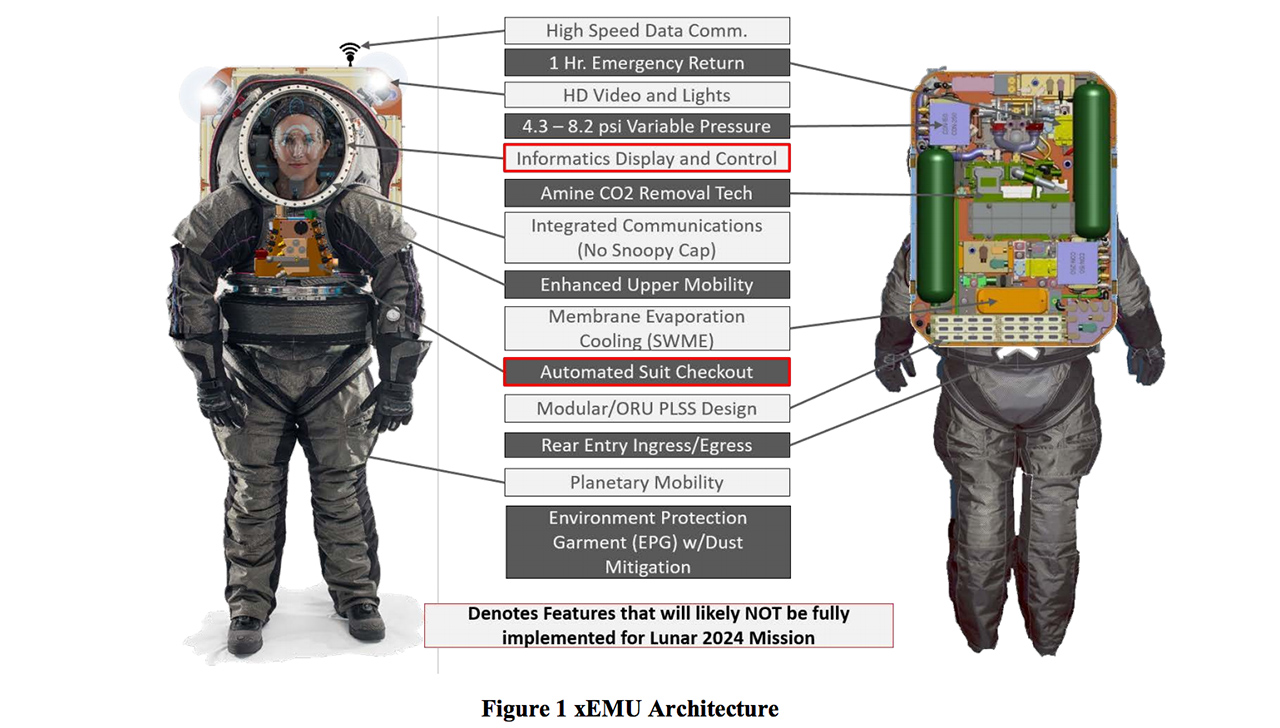
Prototype lunar spacesuit. xEMU stands for Exploration Extravehicular Activity Mobility Unit. Of course. This uncredited image is from slashgear.com in 2019, so I wouldn’t believe the date. These xEMU suits may eventually cost a billion dollars to develop and produce. Click on the image to enlarge it.
08/23/2021 – Ephemeris – Seeking shelter on the Moon
This is Ephemeris for Monday, August 23rd. Today the Sun will be up for 13 hours and 39 minutes, setting at 8:34, and it will rise tomorrow at 6:56. The Moon, 1 day past full, will rise at 9:39 this evening.
The area of interest on the Moon for NASA’s Artemis crewed landing program and the target for Chinese lunar ambitions is the south pole, where signs of water ice have been detected in permanently shadowed craters. That is a valuable resource, if one wants to live off the land on the Moon. There’s another resource that is also valuable in finding: shelter from radiation and the Moon’s extreme temperature swings. Those are lava tubes. They are lava channels in which lava flowed, the top and sides cooled and crusted over. They emptied when the lava ran out, leaving a hollow tube. Sometimes part of the upper crust fails, leaving what is called a skylight. Several of these skylights have been found on the Moon and even Mars.
The astronomical event times given are for the Traverse City/Interlochen area of Michigan (EDT, UT – 4 hr). They may be different for your location.
Addendum
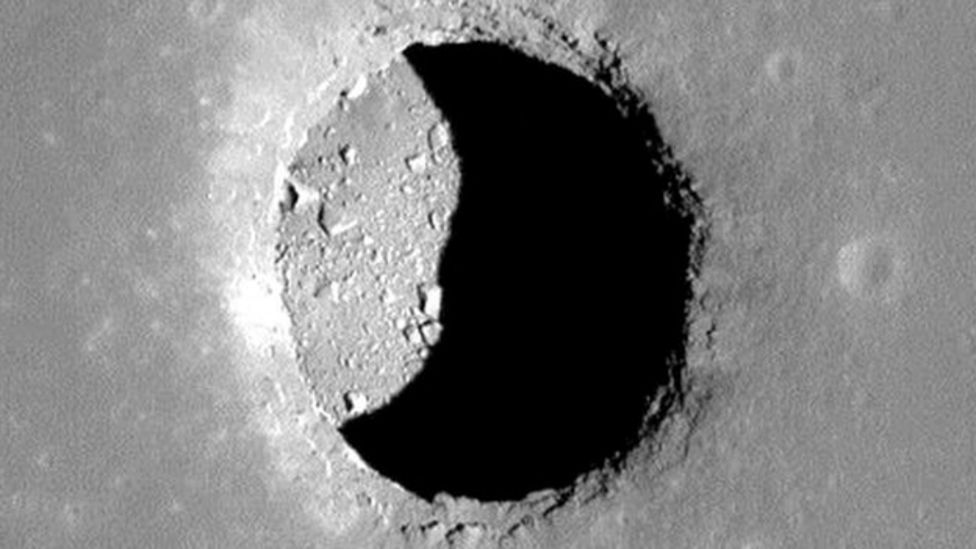
A skylight betrays the presence of a lunar lava tube. Credit NASA/LRO.

Here’s an earthly lava tube on the Island of Hawai’i, I visited in 2012 with my wife. It was on the site of a coffee plantation south of Kona. Credit mine.
08/16/2021 – Ephemeris – The first Artemis mission (maybe) – CAPSTONE
This is Ephemeris for Monday, August 16th. Today the Sun will be up for 13 hours and 59 minutes, setting at 8:46, and it will rise tomorrow at 6:47. The Moon, 1 day past first quarter, will set at 1:13 tomorrow morning.
Tonight’s Moon is a great one to view with a small telescope. Speaking of the Moon, a company called Rocket Lab will be launching the first Artemis program mission, later this year, in preparation to land crews back on the Moon. They are launching a small CubeSat to orbit the Moon in a Near Rectilinear Halo Orbit which always faces the Earth and never goes behind the Moon. To test whether all the mathematical calculations for the orbit actually work in real life. The satellite is called CAPSTONE (another tortured NASA acronym*). It will be launched from New Zealand, Rocket Lab’s main launch site first into a polar orbit before heading to the lunar orbit, taking several months to get there.
The astronomical event times given are for the Traverse City/Interlochen area of Michigan (EDT, UT – 4 hr). They may be different for your location.
* Cislunar Autonomous Positioning System Technology Operations and Navigation Experiment. Told ya. Cislunar space is a spherical volume of space centered on the Earth, whose radius is the Moon’s distance. Beyond that is interplanetary space.
Addendum
Rocket Lab had been planning to launch the CAPSTONE satellite from Wallops Island, Virginia, but approval was taking too long, so they moved the launch to their New Zealand launch site instead.
NASA CAPSTONE* pathfinder for gateway orbit is to be launched late this year by Rocket Lab to prove out the near rectilinear orbit for the Lunar Gateway.
 Bob Moler's Ephemeris Blog