Archive
05/27/2021 – Ephemeris – Miss yesterday’s eclipse? There’s 2 more in the next 12 months.
This is Bob Moler with Ephemeris for Thursday, May 27th. Today the Sun will be up for 15 hours and 13 minutes, setting at 9:17, and it will rise tomorrow at 6:02. The Moon, 1 day past full, will rise at 11:14 this evening.
While yesterday morning’s lunar eclipse may have been disappointing by setting just as it got going. That won’t happen with the next one. The next lunar eclipse visible from Northern Michigan will occur this November 19th, a Friday. It’s another morning eclipse, but doesn’t compete with sunrise or morning twilight. It’s not quite total, but nearly 97.5% of the Moon’s diameter will be covered by the Earth’s inner umbral shadow. The partial eclipse will start at 2:18 am and end at 5:47 am, which in November is nowhere near sunrise. We seem to be coming into a fortuitous period of eclipses in the next few years. Our next lunar eclipse after November will be next May 15th’s lunar eclipse, and it will be total and will conveniently happen in the evening.
The astronomical event times given are for the Traverse City/Interlochen area of Michigan. They may be different for your location.
05/25/2021 – Ephemeris – Viewing the lunar eclipse tomorrow morning
This post is for the appearance of the May 26th lunar eclipse in Michigan.
This is Ephemeris for Tuesday, May 25th. Today the Sun will be up for 15 hours and 10 minutes, setting at 9:15, and it will rise tomorrow at 6:04. The Moon, 1 day before full, will set at 6:09 tomorrow morning.
If we are really lucky tomorrow morning, and it is clear all the way down to the southwestern horizon at dawn we will witness the start of an eclipse of the Moon near sunrise and moonset. The eclipse starts at 4:48 am, but nothing unusual will be visible as the Moon starts to enter Earth’s outer, penumbral shadow. Perhaps by 5:15 the left edge of the Moon might appear dimmer than the right side. The Moon will be getting deeper in that shadow for the next half hour until at 5:45 it begins to enter the Earth’s inner shadow, the umbra. The only light in the umbra is that bent into it by the simultaneous sunrises and sunsets around the Earth. For the next 20 to 25 minutes the shadow will increase until the Sun rises and shortly after that the Moon sets around 6:09.
The astronomical event times given are for the Traverse City/Interlochen area of Michigan. They may be different for your location.
Addendum
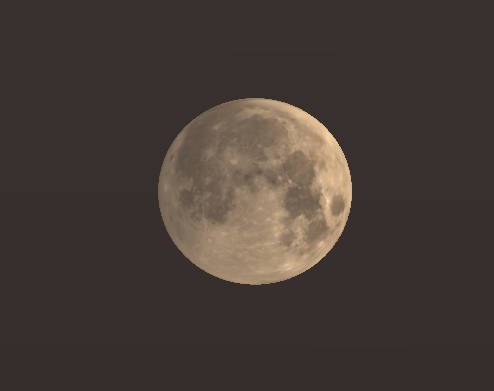
Simulated image of the Moon deep in the penumbra of the lunar eclipse of May 26, 2021 at 5:40 am. Notice that the left side of the Moon is darker than the right side. I find that the effect is more noticeable when wearing sunglasses to cut down the Moon’s bright glare. Created using Stellarium.
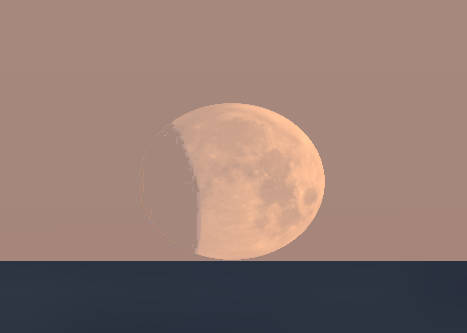
Simulated view of the partially eclipsed Moon of May 26, 2021 setting on a flat horizon. Created using Stellarium and touched up by using GIMP.
| Time | Event |
| 4:47 am | Nautical twilight starts |
| 4:48 am | The Moon enters penumbra (Nothing to see, the dimming on the left side is imperceptible) |
| 5:15 am | The penumbral shadow should become visible at the left edge of the Moon by this time |
| 5:45 am | The Moon enters the umbra (The partial part of the eclipse begins) |
| 6:04 am | Sunrise for Traverse City |
| 6:09 am | Moon sets for Traverse City |
The sunrise and moon set times may vary by more than a few minutes depending on your location.
05/24/2021 – Ephemeris – Get ready for Wednesday morning’s lunar eclipse
This is Bob Moler with Ephemeris for Monday, May 24th. Today the Sun will be up for 15 hours and 8 minutes, setting at 9:14, and it will rise tomorrow at 6:04. The Moon, 2 days before full, will set at 5:33 tomorrow morning.
If we are really lucky Wednesday morning, and it is clear all the way down to the southwestern horizon at dawn, we will witness the start of an eclipse of the Moon as the Sun rises and the Moon sets. The first inkling that something strange is happening to the Moon will come around 5:15 am or so. The Moon will be deep in the Earth’s outer, partial, shadow called the penumbra and the left side of the Moon should appear darker than the rest of it. The brightening of the twilight should enhance the effect. The partial phase of the eclipse will start at 5:45, where the left edge of the Moon will actually begin to disappear into the Earth’s inner shadow, the umbra. Within 20 to 25minutes later the Sun will rise and shortly after the Moon will set.
The astronomical event times given are for the Traverse City/Interlochen area of Michigan. They may be different for your location.
Addendum
Simulated image of the Moon deep in the penumbra of the lunar eclipse of May 26, 2021 at 5:40 am. Notice that the left side of the Moon is darker than the right side. I find that the effect is more noticeable when wearing sunglasses to cut down the Moon’s bright glare. Created using Stellarium.
Simulated view of the partially eclipsed Moon of May 26, 2021 setting on a flat horizon. Created using Stellarium and touched up by using GIMP.
| Time | Event |
| 4:47 am | Nautical twilight starts |
| 4:48 am | The Moon enters penumbra (Nothing to see, the dimming on the left side is imperceptible) |
| 5:15 am | The penumbral shadow should become visible at the left edge of the Moon by this time |
| 5:45 am | The Moon enters the umbra (The partial part of the eclipse begins) |
| 6:04 am | Sunrise for Traverse City |
| 6:09 am | Moon sets for Traverse City |
The sunrise and moon set times may vary by more than a few minutes depending on your location.
05/18/2021 – Ephemeris – Eclipses visible in Northern Michigan this year
This is Ephemeris for Tuesday, May 18th. Today the Sun will be up for 14 hours and 56 minutes, setting at 9:08, and it will rise tomorrow at 6:10. The Moon, 1 day before first quarter, will set at 2:57 tomorrow morning.
This year we will see in part or in full three eclipses from our Northern Michigan location. The first will be the start of a total lunar eclipse next week Wednesday, May 26th. It will start just before sunrise, which for a full moon is around moonset. Our next eclipse will be a solar eclipse that starts, for us, before sunrise on June 10th. In fact, most of the eclipse will occur before sunrise for us in Northern Michigan. The farther north and east of us the more of the eclipse you’ll see. I’ll have more information on the lunar in the next week of programs. And the solar eclipse as we approach that date. We have a final lunar eclipse this year. That will occur in the wee morning hours of November 19th, a partial, but almost total eclipse.
The astronomical event times given are for the Traverse City/Interlochen area of Michigan. They may be different for your location.
Addendum
The four eclipses that occur in 2021
We in Northern Michigan we’ll see part of the first two and all of the third.
May 26, 2021 Total Lunar Eclipse
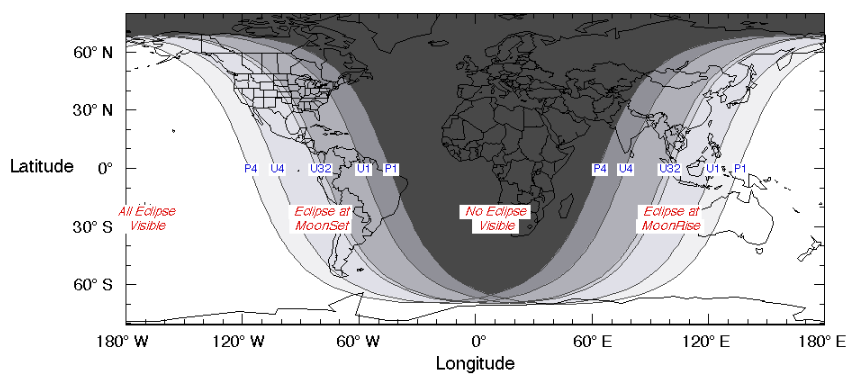
June 10, 2021 Annular Solar Eclipse
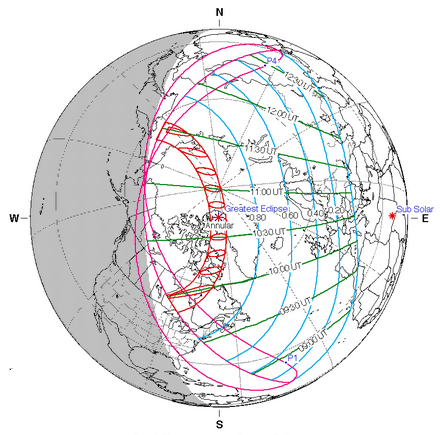
November 19, 2021 Partial Lunar Eclipse
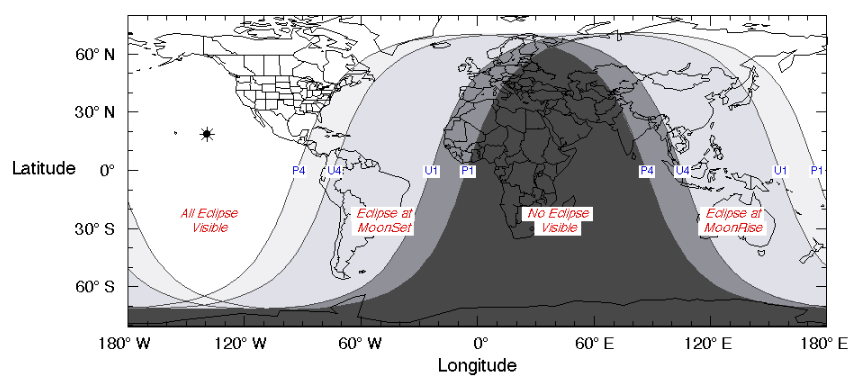
December 4, 2021 Total Solar Eclipse
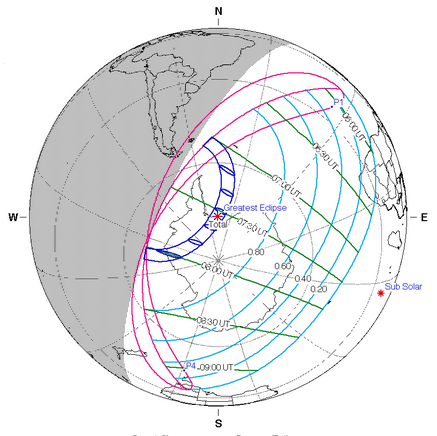
05/14/2021 – Ephemeris – Astronomy Day Star Party this Saturday
This is Bob Moler with Ephemeris for Friday, May 14th. Today the Sun will be up for 14 hours and 48 minutes, setting at 9:03, and it will rise tomorrow at 6:14. The Moon, 3 days past new, will set at 12:07 tomorrow morning.
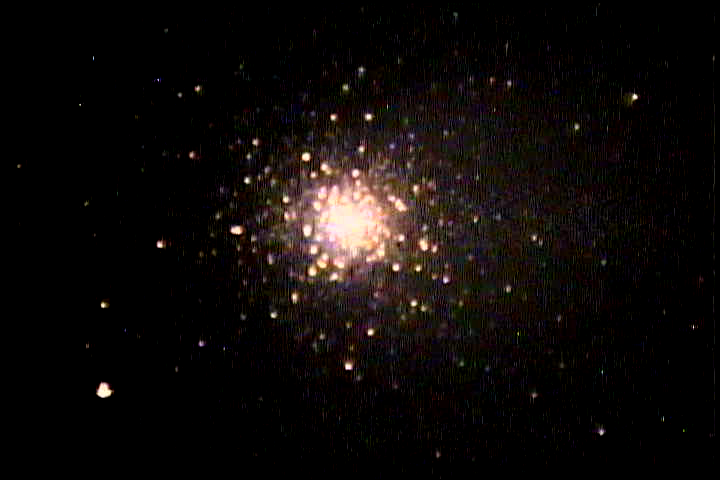
Tomorrow is International Astronomy Day, to celebrate it the Sleeping Bear Dunes National Lakeshore and Grand Traverse Astronomical Society will hold a special virtual star party via the Zoom Internet app. If it’s clear, Northwestern Michigan College’s professor Jerry Dobek will be transmitting live images of celestial objects that will look pretty much like what one sees through the eyepiece of a telescope. Dr. Dobek will be using the Joseph H. Rogers 0.4 meter main telescope and commenting will be members of the Grand Traverse Astronomical Society. Featured objects will be the 4-day-old crescent Moon, the tiny and elusive planet Mercury, star clusters and galaxies. The event starts at 9 pm though best viewing won’t begin until after about 9:30. Go to www.gtastro.org for instructions and a link.
The astronomical event times given are for the Traverse City/Interlochen area of Michigan. They may be different for your location.
Addendum
While attending the virtual star party you can capture the screen imaged with Alt/Print Screen keys. Paste the image into a paint or other program. I use GIMP (Gnu Image Manipulation Program), which fits my budget… It’s free. You can save the image of play with it. What I do with it is to darken the background. It should be black.
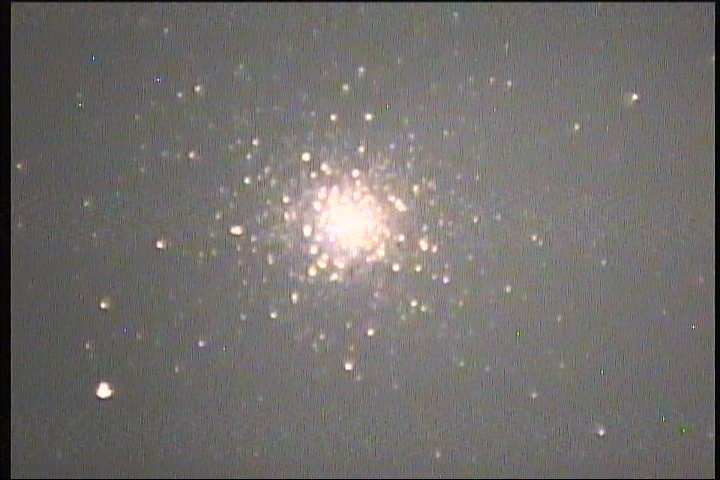
I paste this image into GIMP. I use the Levels control under the Color tab.
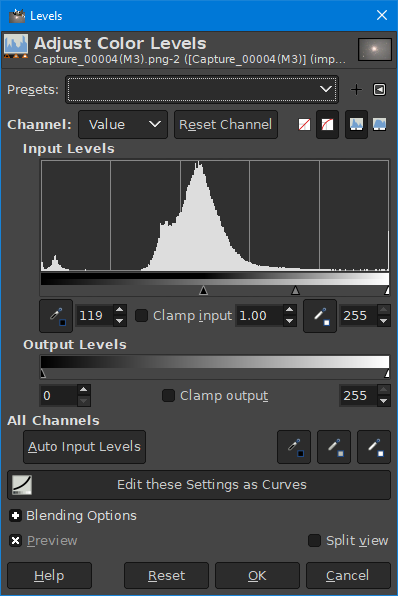
03/19/2021 – Ephemeris – Enjoy this last full day of winter!
This is Ephemeris for Friday, March 19th. Today the Sun will be up for 12 hours and 7 minutes, setting at 7:54, and it will rise tomorrow at 7:45. The Moon, 2 days before first quarter, will set at 2:23 tomorrow morning.
Spring is almost here. It will arrive at 5:37 tomorrow morning, so this is the last full day of winter, such as it was. That point in time and the point in the sky where the Sun crosses the celestial equator, the imaginary line in the sky above the Earth’s equator, heading northward is called the vernal equinox. Vernal means spring and equinox means equal night, meaning that day and night are equal, which they actually were last Tuesday. Since western civilization has spread south of the equator where the seasons are reversed, our Northern Hemisphere spring equinox is the Southern Hemisphere’s autumnal equinox, so to be understandable to both hemispheres we generally say March or September equinox instead.
Addendum
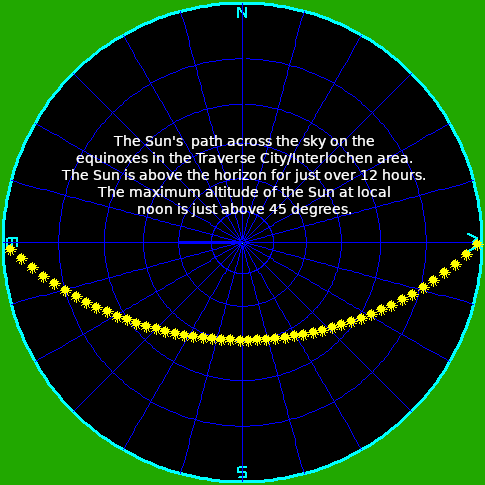
The Sun’s path through the sky on an equinox day from the Traverse City/Interlochen area in Michigan. The Sun is plotted every 15 minutes. This is a stereographic projection which compresses the sky near the zenith and enlarges the sky toward the horizon. Created using my LookingUp program.
12/25/2020 – Ephemeris – Did the “Star” of Bethlehem appear in 3 BC and again in 2 BC?
Merry Christmas, this is Bob Moler with Ephemeris for Christmas Day, Friday, December 25th. Today the Sun will be up for 8 hours and 48 minutes, setting at 5:07, and it will rise tomorrow at 8:19. The Moon, halfway from first quarter to full, will set at 4:53 tomorrow morning.
Many writers of the 2nd and 3rd centuries AD place Jesus’ birth around 2 BC, which had to be before Herod the Great’s death, which I suggest was in 1 BC marked by to a total lunar eclipse. In 3 and again in 2 BC there were star-like conjunctions or apparent joinings of the planets Jupiter and Venus against the backdrop of the constellation of Leo the Lion. A lion is related to Judah, son of Jacob by a blessing the latter gave his 12 sons in Genesis. The first conjunction occurred in August of 3 BC in the morning sky. In June the next year the two planets got together again, this time in the evening sky, just after Jesus would have been born in the lambing season of spring.
The event times given are for the Traverse City/Interlochen area of Michigan. They may be different for your location.
Addendum
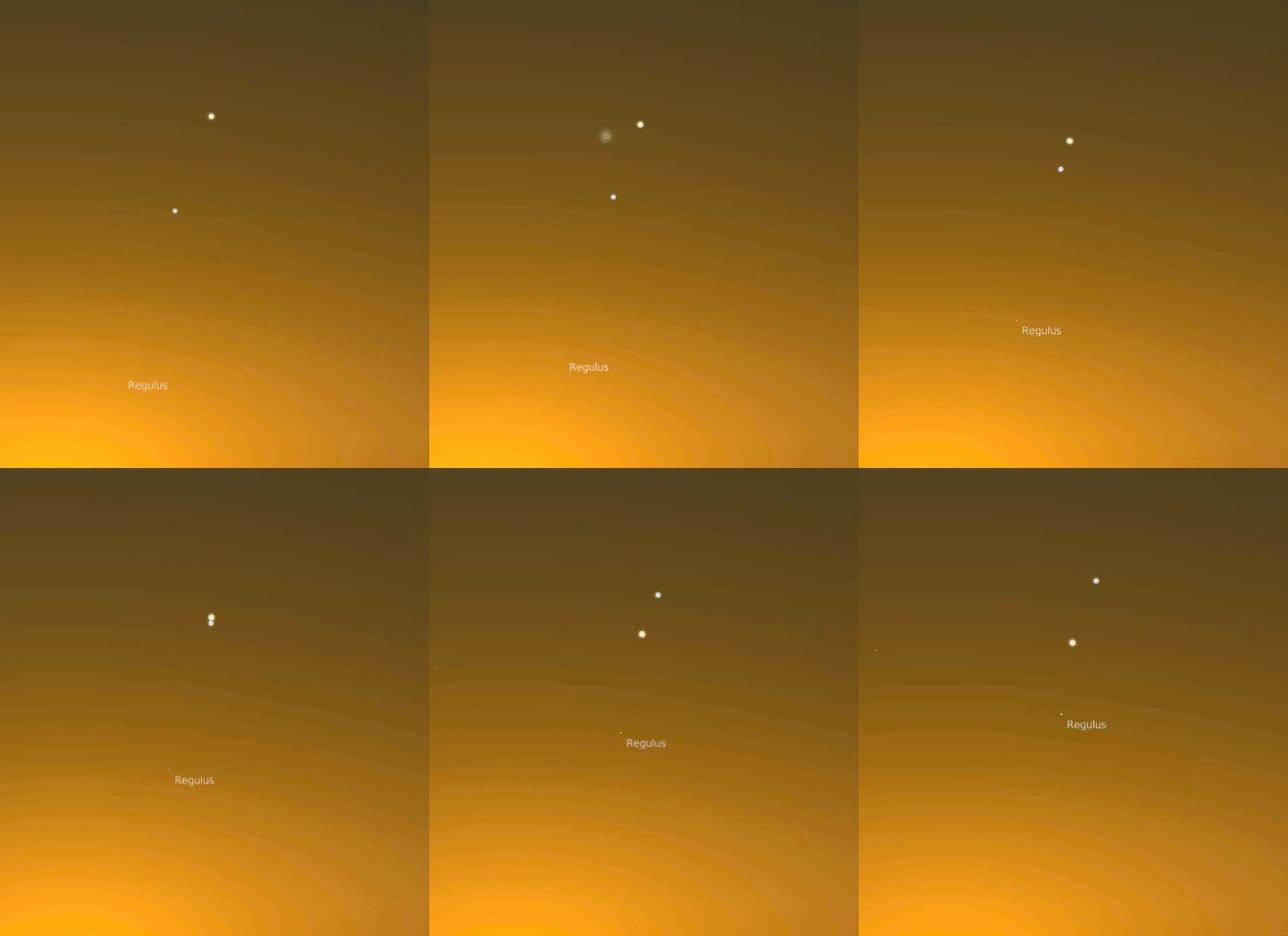
Here is an animation created using Stellarium of Jupiter and Venus, the brighter of the two seeming to coalesce on August 12, 3 BC in the early morning twilight. The ghostly image popping up in the second frame is the thin crescent Moon showing earth shine. Created using Stellarium and GIMP.
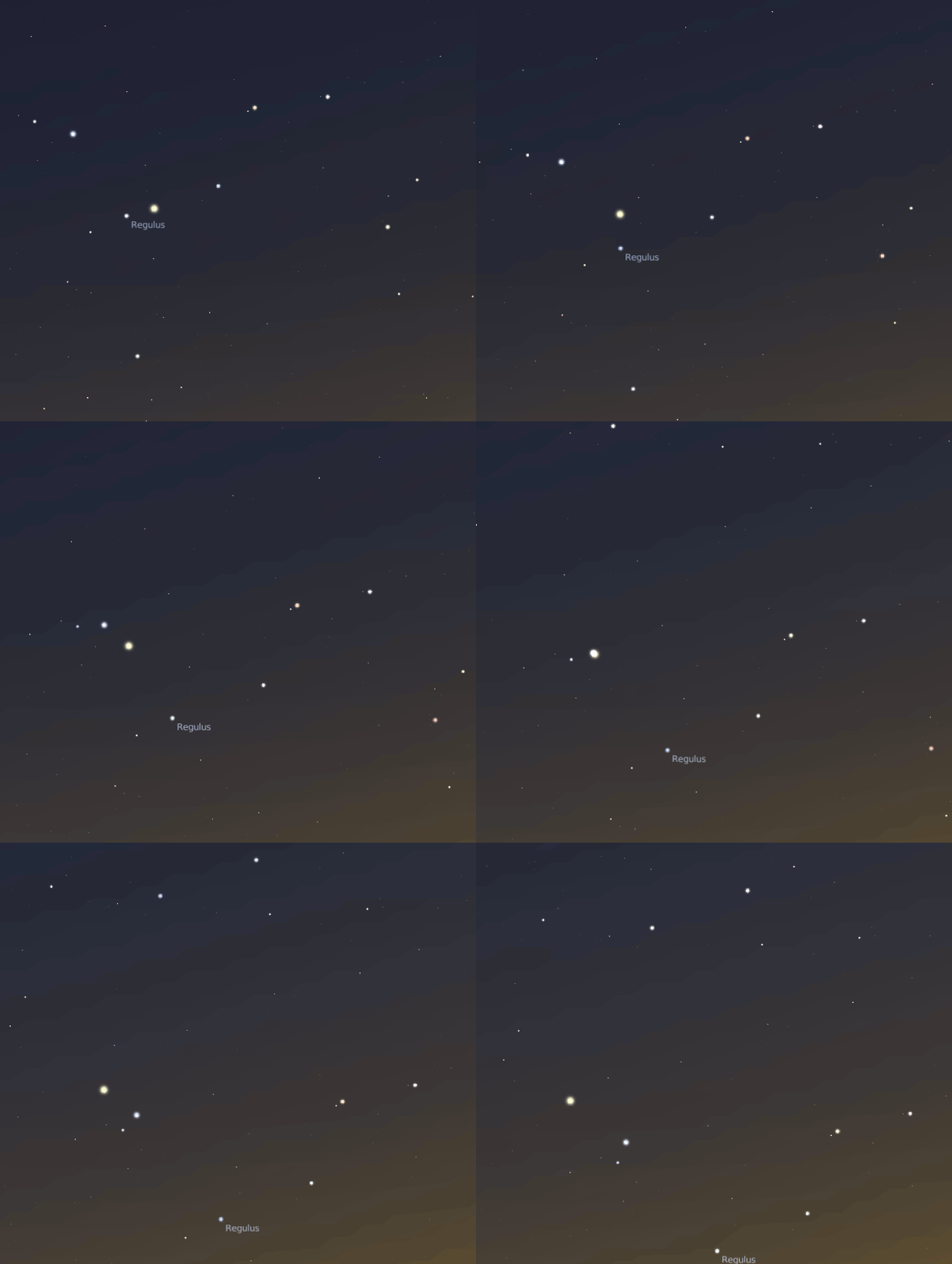
On June 16th 2 BC, this time in the evening, Venus and Jupiter seem to coalesce as one, at least to the naked eye. Regulus (The Little King star) is the brightest star in Leo the lion. To the upper right of it is the Sickle, the front part of the lion and his head and mane. Created using Stellarium and GIMP.
12/14/2020 – Ephemeris – A total solar eclipse will occur today
This is Ephemeris for Monday, December 14th. Today the Sun will be up for 8 hours and 49 minutes, setting at 5:02, and it will rise tomorrow at 8:13. The Moon is new today, and won’t be visible.
Some lucky folks in South America, specifically located in a narrow path crossing Chile and Argentina will see a total eclipse of the Sun in a few hours. For us, the Moon is too far south to cover the Sun. This is the last eclipse of the year. We will get to see part of the next solar eclipse to occur. On the morning of June 10th, next year the Sun will rise as it is partially eclipsed for Michigan, with the Moon already leaving the Sun’s disk. That eclipse will not be total, but an annular eclipse, with the Moon too far away to cover the Sun completely, leaving a bright ring or annulus of the Sun, what some describe as a ring of fire. That effect will be seen in western Ontario, through the arctic, ending in Siberia.
The event times given are for the Traverse City/Interlochen area of Michigan. They may be different for your location.
Addendum
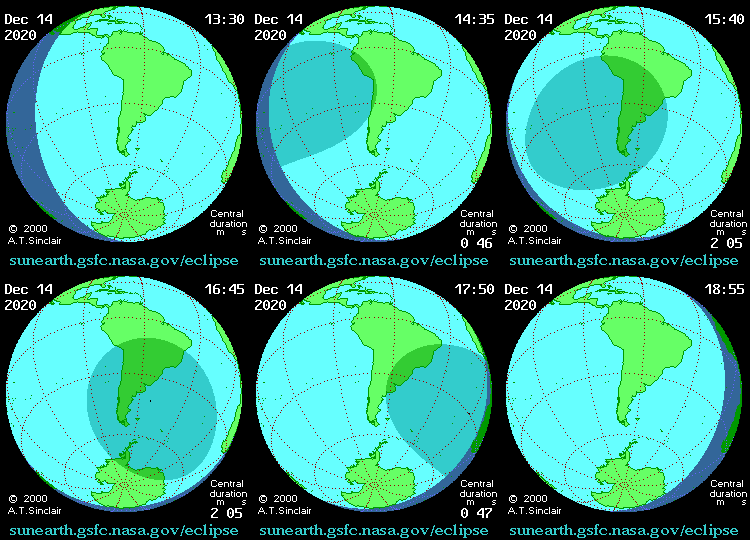
Animation of the path of the December 14, 2020, total solar eclipse. The penumbra of the Moon’s shadow is shown in gray, where the Sun will be partially eclipsed. The black dot near the center of the penumbra is the Moon’s umbra, where the face of the Sun is totally eclipsed. Credit: NASA/Goddard Space Flight Center.
12/10/2020 – Ephemeris – The Geminid meteor shower will reach its peak Sunday evening and Monday Morning December 13/14, 2020
This is Bob Moler with Ephemeris for Thursday, December 10th. Today the Sun will be up for 8 hours and 52 minutes, setting at 5:02 pm which will signal the beginning of the Jewish feast of Chanukah. Sunrise tomorrow will be at 8:10 am. The Moon, 3 days past last quarter, will rise at 4:13 tomorrow morning.
The Geminid meteor shower, the most active meteor shower of the year will be at its most active Sunday night and Monday morning. This year the Moon will be new on Monday and won’t interfere. Our problem is that it’s December, one of the cloudiest months of the year. The Geminid meteors will seem to come from near the star Castor, the second brightest star in Gemini. The actual source of the meteors is the asteroid or rock comet Phaethon. If it is an asteroid it comes closest to the Sun of any asteroid. It has been observed by spacecraft shedding dust when it’s heated near the Sun. It is probably a dead comet.
The event times given are for the Traverse City/Interlochen area of Michigan. They may be different for your location.
Addendum
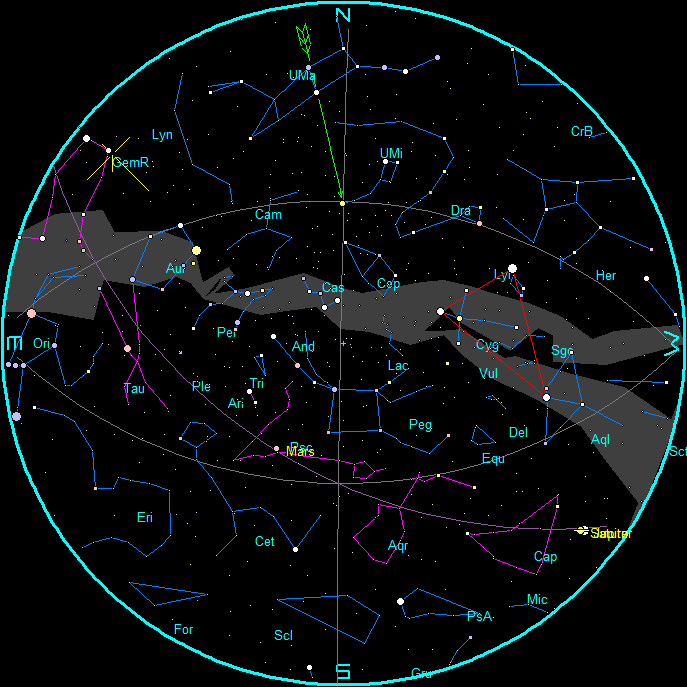
Star Chart for 7 pm, or about 2 hours after sunset. December 13, 2020. Click on image to enlarge. Click on image to enlarge. Created using my LookingUp program.
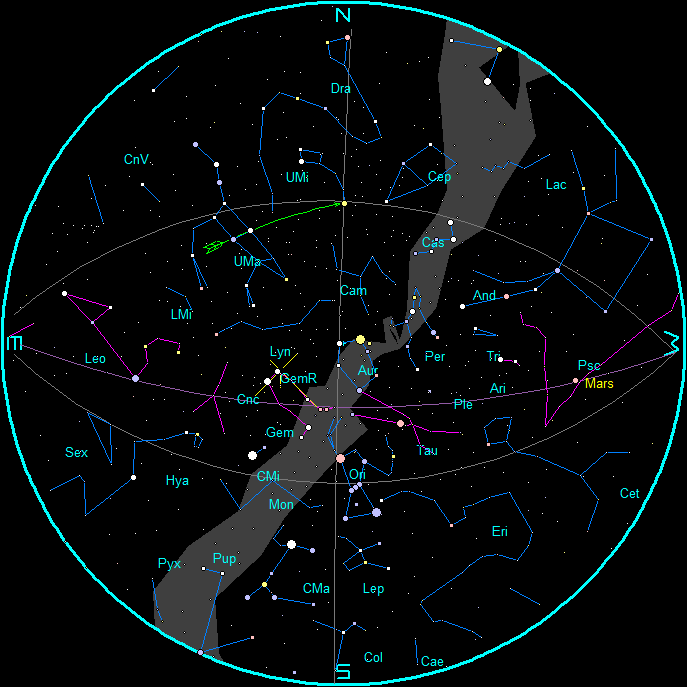
All sky chart of the Geminid Radiant 1 am, or about 7 hours after sunset, Dec 14, 2020. Click on image to enlarge.
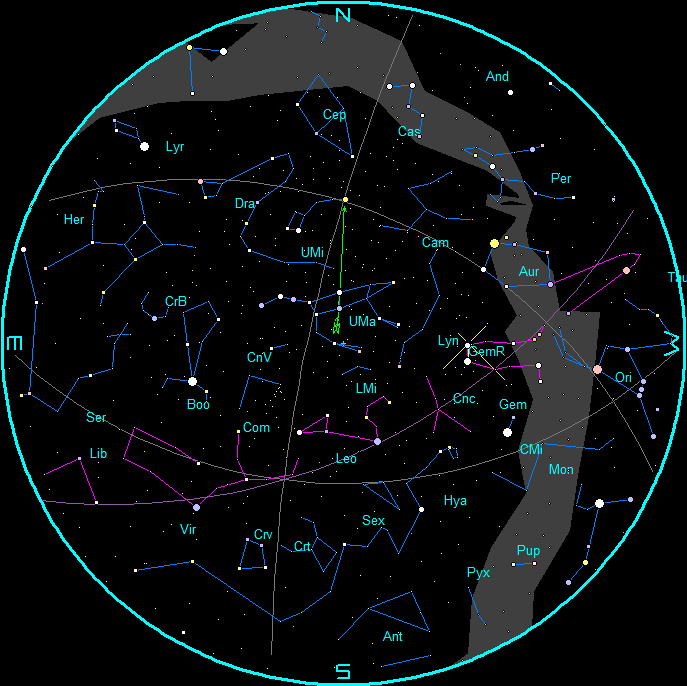
All sky chart of the Geminid Radiant 6 am, or about 2 hours before sunrise, Dec 14, 2020. Click on image to enlarge.
06/15/2020 – Ephemeris – Now is the date of the earliest sunrise and it isn’t even summer yet
This is Ephemeris for Monday, June 15th. Today the Sun will be up for 15 hours and 33 minutes, setting at 9:30, and it will rise tomorrow at 5:56. The Moon, 2 days past last quarter, will rise at 3:30 tomorrow morning.
Today, give or take a day is the date of the earliest sunrise. The latest sunrise was about January 2nd, leaving only about 165 days for the transition of three hours, 24 minutes and since we still have five days to the longest day. The sunset change rate is a lot more leisurely. It has to do with the tilt of Earth’s axis and its slightly elliptical orbit. It’s why sundials don’t keep proper time. Though most sundials appear to be decorative and are not set up correctly anyway. Besides sundials can’t cope with time zones, and daylight time unless they are specially built for a particular location. Anyway the latest sunset will be on the 26th, 200 days since the earliest sunset, on December 9th, last year. The sunset retreat to December 9th will take 165 days, and the sunrise advance will take 200 days until next January 2nd next year.
The event times given are for the Traverse City/Interlochen area of Michigan. They may be different for your location.
 Bob Moler's Ephemeris Blog