Archive
12/31/2016 – Ephemeris year end
No radio program today, being the weekend, so at the end of the calendar page below are the stats for today, the 31st. This is the form of the calendar that I have on my Ephemeris website, which I update monthly. It was created with the same data that the first portion of my program is generated from. I have yearly calendars for 6 communities in the Interlochen Public Radio area in northwestern lower Michigan, and 1 in the U.P. (That’s the Upper Peninsula, if you’re not from around here.)
You will have to hold off your New Years festivities for a bit tonight. Not long, just one second. Today, December 31st, 2016 will be 24 hours and 1 second long. This “leap second” will be added as the 61st second of the minute 6:59 p.m. EST (23:59 UT). The reason is that the Earth’s rotation is slowing down ever so slightly, compared to the atomic clocks at the Bureau of Time. There is some discussion of eliminating this leap second. Most scientists want to use a constant time stream, and don’t give a hang about the rotation of the Earth. The positions of the Earth, Moon and the other planets would be incorrect if we used time strictly based on the Earth’s rotation. Atomic time which is also affected by special and general relativity is used by GPS navigation satellites. A one second jump in time, at our latitude (45° north) is equivalent of the earth’s rotation of about two tenths of a mile. I hope everyone’s coordinated on this.
Ephemeris of Sky Events for Interlochen/TC |
||||||||||
| December, 2016 – Local time zone: EST | ||||||||||
|---|---|---|---|---|---|---|---|---|---|---|
| Date | Sun | Twilight* | Moon | Illum | ||||||
| Rise | Set | Hours | End | Start | Phase | R/S** | Time | Fractn | ||
| Thu | 1 | 08:00a | 05:03p | 09:03 | 06:48p | 06:15a | Set | 07:10p | 6% | |
| Fri | 2 | 08:01a | 05:03p | 09:01 | 06:47p | 06:16a | Set | 08:02p | 11% | |
| Sat | 3 | 08:02a | 05:02p | 09:00 | 06:47p | 06:17a | Set | 08:59p | 18% | |
| Sun | 4 | 08:03a | 05:02p | 08:58 | 06:47p | 06:18a | Set | 09:59p | 26% | |
| Mon | 5 | 08:04a | 05:02p | 08:57 | 06:47p | 06:19a | Set | 11:02p | 36% | |
| Tue | 6 | 08:05a | 05:02p | 08:56 | 06:47p | 06:20a | Set | 12:08a | 46% | |
| Wed | 7 | 08:06a | 05:02p | 08:55 | 06:47p | 06:21a | F Qtr | Set | 01:16a | 57% |
| Thu | 8 | 08:07a | 05:02p | 08:54 | 06:47p | 06:22a | Set | 02:26a | 68% | |
| Fri | 9 | 08:08a | 05:02p | 08:53 | 06:47p | 06:22a | Set | 03:39a | 78% | |
| Sat | 10 | 08:09a | 05:02p | 08:52 | 06:47p | 06:23a | Set | 04:53a | 87% | |
| Sun | 11 | 08:10a | 05:02p | 08:51 | 06:48p | 06:24a | Set | 06:08a | 94% | |
| Mon | 12 | 08:11a | 05:02p | 08:51 | 06:48p | 06:25a | Set | 07:21a | 98% | |
| Tue | 13 | 08:12a | 05:02p | 08:50 | 06:48p | 06:26a | Full | Rise | 05:18p | 100% |
| Wed | 14 | 08:12a | 05:02p | 08:49 | 06:48p | 06:26a | Rise | 06:17p | 98% | |
| Thu | 15 | 08:13a | 05:02p | 08:49 | 06:49p | 06:27a | Rise | 07:21p | 94% | |
| Fri | 16 | 08:14a | 05:03p | 08:48 | 06:49p | 06:28a | Rise | 08:28p | 88% | |
| Sat | 17 | 08:14a | 05:03p | 08:48 | 06:49p | 06:28a | Rise | 09:35p | 80% | |
| Sun | 18 | 08:15a | 05:03p | 08:48 | 06:50p | 06:29a | Rise | 10:41p | 70% | |
| Mon | 19 | 08:16a | 05:04p | 08:48 | 06:50p | 06:29a | Rise | 11:44p | 61% | |
| Tue | 20 | 08:16a | 05:04p | 08:48 | 06:51p | 06:30a | L Qtr | Rise | 12:46a | 51% |
| Wed | 21 | 08:17a | 05:05p | 08:48 | 06:51p | 06:30a | Rise | 01:46a | 41% | |
| Thu | 22 | 08:17a | 05:05p | 08:48 | 06:52p | 06:31a | Rise | 02:45a | 32% | |
| Fri | 23 | 08:18a | 05:06p | 08:48 | 06:52p | 06:31a | Rise | 03:43a | 24% | |
| Sat | 24 | 08:18a | 05:07p | 08:48 | 06:53p | 06:32a | Rise | 04:40a | 16% | |
| Sun | 25 | 08:18a | 05:07p | 08:48 | 06:53p | 06:32a | Rise | 05:37a | 10% | |
| Mon | 26 | 08:19a | 05:08p | 08:49 | 06:54p | 06:32a | Rise | 06:33a | 5% | |
| Tue | 27 | 08:19a | 05:09p | 08:49 | 06:55p | 06:33a | Rise | 07:26a | 2% | |
| Wed | 28 | 08:19a | 05:09p | 08:50 | 06:55p | 06:33a | Rise | 08:16a | 0% | |
| Thu | 29 | 08:19a | 05:10p | 08:50 | 06:56p | 06:33a | New | Set | 05:57p | 1% |
| Fri | 30 | 08:19a | 05:11p | 08:51 | 06:57p | 06:34a | Set | 06:53p | 3% | |
| Sat | 31 | 08:20a | 05:12p | 08:52 | 06:58p | 06:34a | Set | 07:52p | 7% | |
| * Astronomical Twilight | ||||||||||
| ** Moonrise or moonset, whichever occurs between sunset and sunrise | ||||||||||
The far right column of the table, the Moon’s illuminated fraction, may or may not appear in the calendar above depending on you browser or screen size. It is correct on the Ephemeris website.
06/02/2016 – Ephemeris – Saturn at opposition
Ephemeris for Thursday, June 2nd. Today the Sun will be up for 15 hours and 22 minutes, setting at 9:22, and it will rise tomorrow at 5:59. The Moon, 2 days before new, will rise at 5:11 tomorrow morning.
In the wee morning hours tomorrow Saturn will be in opposition from the Sun. It is a time Saturn will rise at sunset and set at sunrise. It is also a time that Saturn is closest to the Earth, so it will appear its largest in our telescopes. Saturn’s variance of apparent size over its appearance in our skies isn’t as dramatic as much closer and smaller Mars. For Saturn which orbits the Sun at nearly 10 times the Earth’s distance from the Sun varies in apparent size plus or minus 10% over it’s synodic period of 12½ months. The synodic period is the interval between oppositions or conjunctions of the Sun. One benefit of being in opposition is that Saturn and its glorious rings will be up all night.
Times are for the Traverse City/Interlochen area of Michigan. They may be different for your location.
Addendum
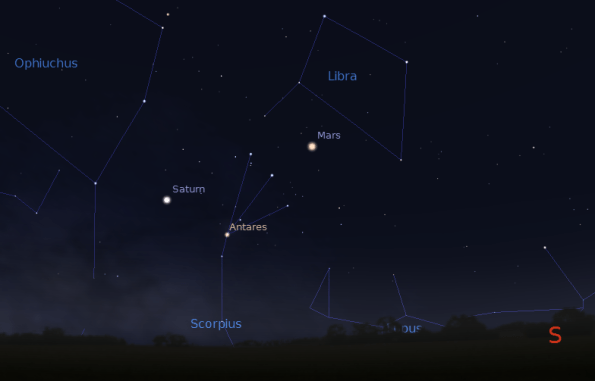
Saturn finder chart. Looking low in the south-southwest at 11 p.m., June 2, 2016. Created using Stellarium.
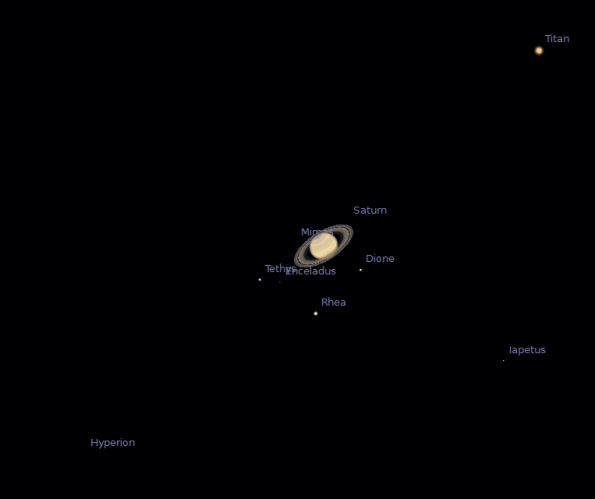
Saturn and some of its 63 moons at 11 p.m., June 2, 2016. Created using Stellarium.
05/05/2016 – Ephemeris – Previewing Monday’s transit of Mercury
Ephemeris for Thursday, May 5th. The Sun rises at 6:26. It’ll be up for 14 hours and 26 minutes, setting at 8:53. The Moon, 1 day before new, will rise at 6:38 tomorrow morning.
Next Monday, the 9th, the tiny planet Mercury will be seen to cross that face of the Sun. Astronomers call such an event a transit. The last time a planet crossed the face of it Sun, it was Venus on June 5th, 2012, almost 4 years ago. Very few, who were alive in 2012 will be around to see the next transit of Venus in 2117. Transits of Mercury are more frequent. Mercury will cross the face of the Sun from 7:12 a.m. to 2:42 p.m. on Monday. Mercury is too small to see with eclipse filters or with the naked eye. The latter could cause blindness. Only telescopes with solar filters that fit over the front of the telescope are safe to use. Mercury will be a tiny black dot, smaller than most sunspots. Tomorrow I’ll have information about where to go to see it.
Times are for the Traverse City/Interlochen area of Michigan. They may be different for your location.
Addendum
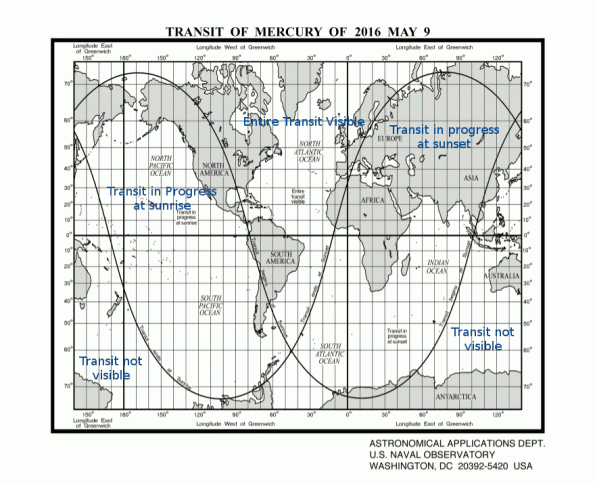
Transit visibility map with added captions to make it more readable. Credit United States Naval Observatory, The Astronomical Almanac Online! 2016
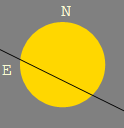
The track of Mercury across the face of the Sun. Mercury will travel from upper left to lower right. Mercury will not be visible until it impinges upon the disk of the Sun. Credit IOTA’s program Occult4.
From IOTA’s Occult4 program
Transit of Mercury on 2016 May 9 (TT)
   {'+' => next day; '-' => previous day }
                                           Overhead at
     Geocentric Event      UTC         P.A.  Long  Lat
                         h  m  s       o      o    o

[1]  Exterior Ingress   11 12 16     83.1     11   17
[2]  Minimum Separation 14 57 38             -45   18
[3]  Exterior Egress    18 42 23    224.4   -102   18

Minimum sepn 318.5";  Radii - Sun 950.4", Mercury 6.0"
delta T =  68.2 secs,  Ephemeris = DE0
Note: These timings are geocentric. Occult4 has timings for various cities of the world. Occult4.0.2 can be downloaded here. They can vary by several minutes for different cities due to parallax.
04/22/2016 – Ephemeris – Hitting on Jupiter
Ephemeris for Earth Day, Friday, April 22nd. The Sun rises at 6:45. It’ll be up for 13 hours and 51 minutes, setting at 8:37. The Moon, at full today, will rise at 9:08 this evening.
The first time anyone had spotted anything hitting Jupiter was in 1994, when over 20 pieces of Comet Shoemaker-Levy 9 hit the planet over an exciting week in July. Jupiter gets hit maybe once a year by a small asteroid making a flash or a scar visible from the Earth. Except for Shoemaker-Levy 9, all the rest of the impacts have been discovered by amateur astronomers who create videos of Jupiter through their modest, by professional standards, telescopes. Generally the reason for the videos is to stack the images to produce super detailed images of the planet, like my friend Scott Anttila, whose images I occasional post with these program transcripts on my blog bobmoler.wordpress.com. Amateurs have even discovered exoplanets.
Times are for the Traverse City/Interlochen area of Michigan. They may be different for your location.
Addendum
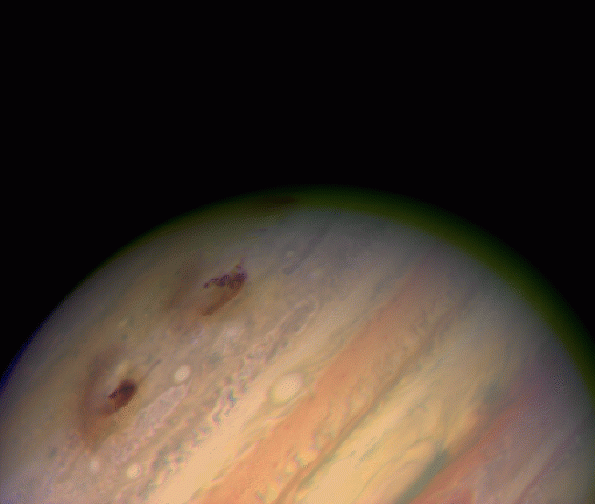
Two of the impact sites of the over 20 bits of Comet Shoemaker-Levy 9 photographed on July 18, 1994. Credit NASA/ESA Hubble Space Telescope.
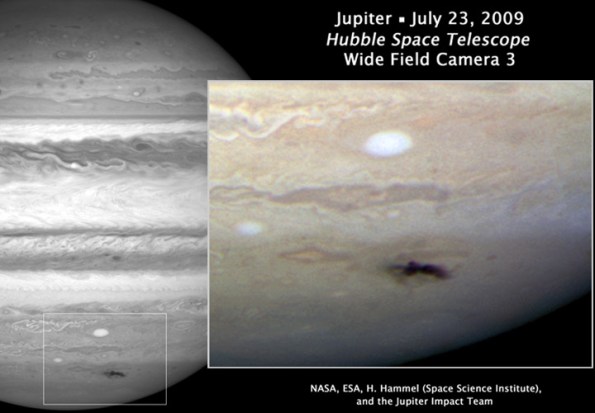
Blemish from an impact discovered by amateur astronomer Anthony Wesley on July 17, 2009. Credit NASA/ESA Hubble Space Telescope.
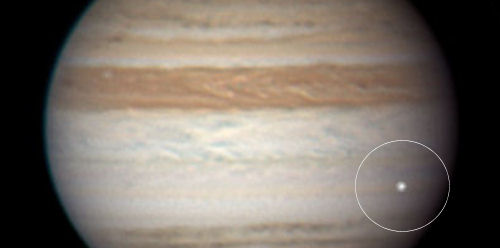
Impact June 3, 2010 photographed by Anthony Wesley. Credit Anthony Wesley.
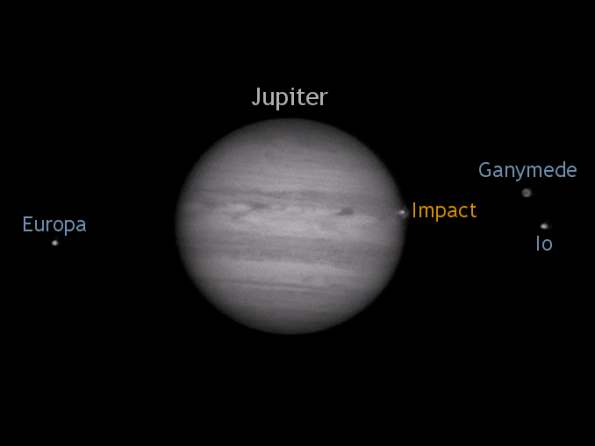
Processed image by John McKeon of the impact of March 17, 2017. The impact was first noticed by Gerrit Kernbauer. Both were amateur astronomers.
Universe Today and more information and videos of the most recent event.
02/22/2016 – Ephemeris – Actual gravitational waves detected!
Ephemeris for Monday, February 22nd. The Sun will rise at 7:32. It’ll be up for 10 hours and 47 minutes, setting at 6:20. The Moon, at full today, will rise at 6:32 this evening.
On February 11th the LIGO team announced the discovery of gravitational waves coming from two black holes merging over a billion light years away. LIGO stands for Laser Interferometry Gravitational-wave Observatory. Two interferometers, one in the state of Washington, and the other in Louisiana detected the same signal milliseconds apart. An interferometer sends a split light beam onto two paths 90 degrees apart to strike mirrors and return to interfere with itself. A minute change in the length either light path will show up as a change in the interference. The maximum change was one-one thousandths of the diameter of the proton subatomic particle. This is a greater discovery than the Higgs Boson of a few years ago.
Times are for the Traverse City/Interlochen area of Michigan. They may be different for your location.
Addendum
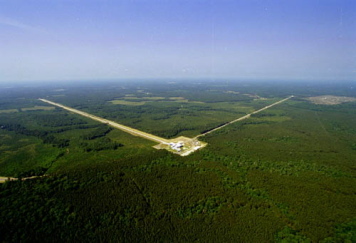
A view of the LIGO detector near Livingston, LA. Credit LIGO.org.
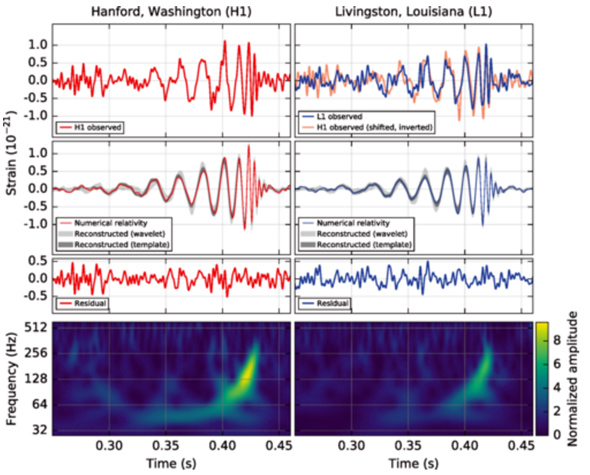
The chirp heard ’round the world and indeed the universe. Credit: LIGO/Abbot et al. 2016. Hat tip: Phil Plait, the Bad Astronomer.
12/31/2015 – Ephemeris – Next year’s big astronomical event
Ephemeris for New Years Eve, Thursday, December 31st. The Sun will rise at 8:20. It’ll be up for 8 hours and 51 minutes, setting at 5:11. The Moon, 2 days before last quarter, will rise at 11:56 this evening.
The big astronomical event of 2016 will be the passage of the planet Mercury across the face of the Sun on May 9th. This type of event is called a transit. Back in 2012 we saw the transit of Venus, an extremely rare event that won’t be repeated for over 100 years. Transits of Mercury are not so rare. The next will be in three years. It also will not be as impressive as a transit of Venus because Mercury is a tiny planet and looks smaller than a small sunspot on the Sun. It cannot be seen without a solar filtered telescope. The actual Transit will last about 7 ½ hours. Should it be clear for all or part of that time members of the Grand Traverse Astronomical Society will be at two locations to show the event.
Times are for the Traverse City/Interlochen area of Michigan. They may be different for your location.
Addendum
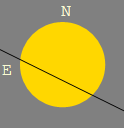
Path of Mercury across the face of the Sun from east to west. Credit IOTA/Occult4
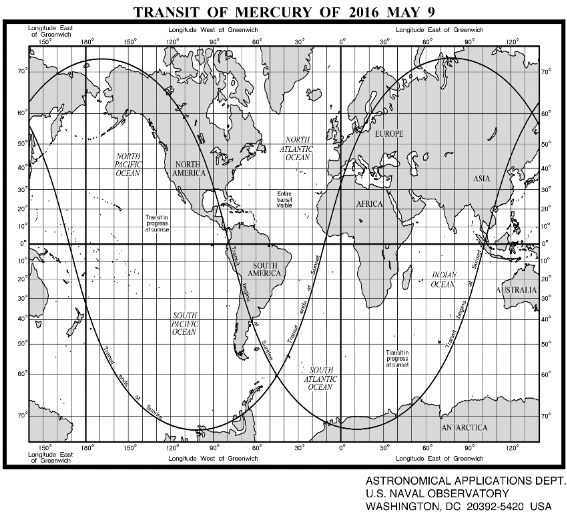
Transit of Mercury visibility map. Click on the Image to view a higher resolution pdf. Credit; Astronomical Almanac Online/USNO
       TRANSIT OF MERCURY GEOCENTRIC PHASES
                                              Position
                                   UT          Angle
                               d  h  m   s        °
Ingress, exterior contact  May 9 11 12 17.6     83.2
Ingress, interior contact      9 11 15 29.5     83.5
Least angular distance         9 14 57 25.3    153.8
Egress, interior contact       9 18 39 12.8    224.1
Egress, exterior contact       9 18 42 24.8    224.4

Least angular distance from the center of the Sun: 5' 18".5
Position angle:  Contact point measured counterclockwise from the north
   point on the face of the Sun.
UT = Universal time A.K.A. Greenwich Mean Time (GMT or Zulu).
   Subtract 4 hours to obtain Eastern Daylight Time (EDT) for
   most of Michigan.  In short the transit will span from
   7:12 a.m. to 2:42 p.m.
Above time-table is from Astronomical phenomena for 2016 Credit: USNO/UKHO
12/07/2015 – Ephemeris – Today the Moon will pass in front of the planet Venus
Ephemeris for Monday, December 7th. The Sun will rise at 8:06. It’ll be up for 8 hours and 56 minutes, setting at 5:02. The Moon, half way from last quarter to new, will rise at 5:04 tomorrow morning.
The Moon will pass in front of Venus between about 12:20 p.m. and 1:27 p.m. for the Interlochen, Traverse City Area. Times will vary as much as 5 minutes over the IPR listening area. Some sort of telescopic aid is needed to see Venus and the crescent Moon in daylight. The crescent Moon is quite faint, though Venus should be easier to spot because it’s brighter. I have a special post on my blog dated Saturday December 5th.. It’s titled Venus Occultation December 7, 2015 from Northern Michigan with all the details. My blog is bobmoler.wordpress.com, or do an Internet search for Bob Moler, That’s Moler spelled M-O-L-E-R, no extra letters. And hope for clear skies.
Times are for the Traverse City/Interlochen area of Michigan. They may be different for your location.
Addendum
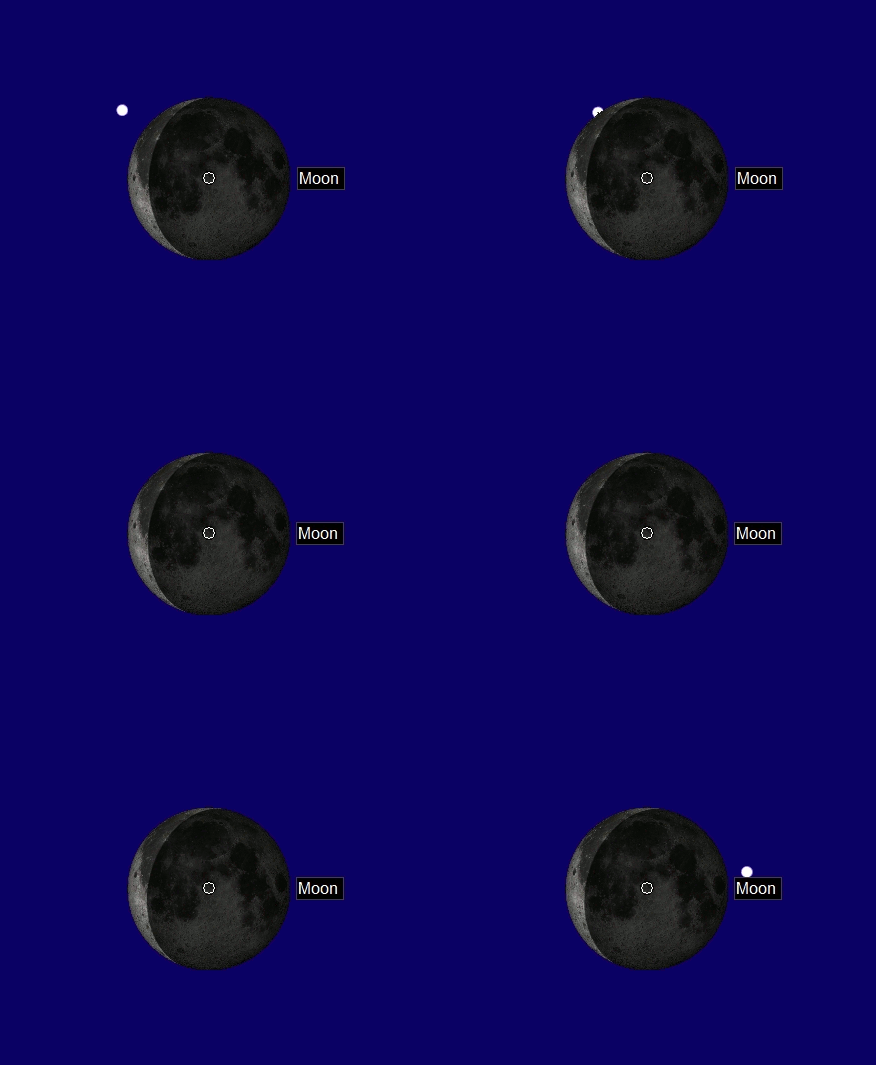
Animation of the occultation. Created using Cartes du Ciel (Sky Charts) and GIMP.
11/23/2015 – Ephemeris – An occultation of Aldebaran by the Moon will be visible to much of the northern US Thursday morning
Ephemeris for Monday, November 23rd. The Sun will rise at 7:49. It’ll be up for 9 hours and 18 minutes, setting at 5:08. The Moon, 2 days before full, will set at 5:58 tomorrow morning.
Thursday morning, Thanksgiving Day here in the US, the Moon will occult or pass in front of the bright star Aldebaran for the northern half of the United States, and Canada. I have a special post on my blog dated yesterday, November 22nd. It’s titled Aldebaran Occultation November 26, 2015 from Northern Michigan (click here) with all the details. My blog is bobmoler.wordpress.com, or do an Internet search for Bob Moler, That’s Moler spelled M-O-L-E-R, no extra letters. Aldebaran is the bright orange star in the face of the constellation Taurus the bull. You will need at least a pair of binoculars to pick out Aldebaran next to the Moon. Aldebaran will disappear at about 5:38 a.m. and reappear about 6:29 a.m. for Interlochen and Traverse City.
Times are for the Traverse City/Interlochen area of Michigan. They may be different for your location. The November 22 post has instructions on how to calculate the occultation times for your location, and has a map to see if you can view the occultation at all.
Addendum
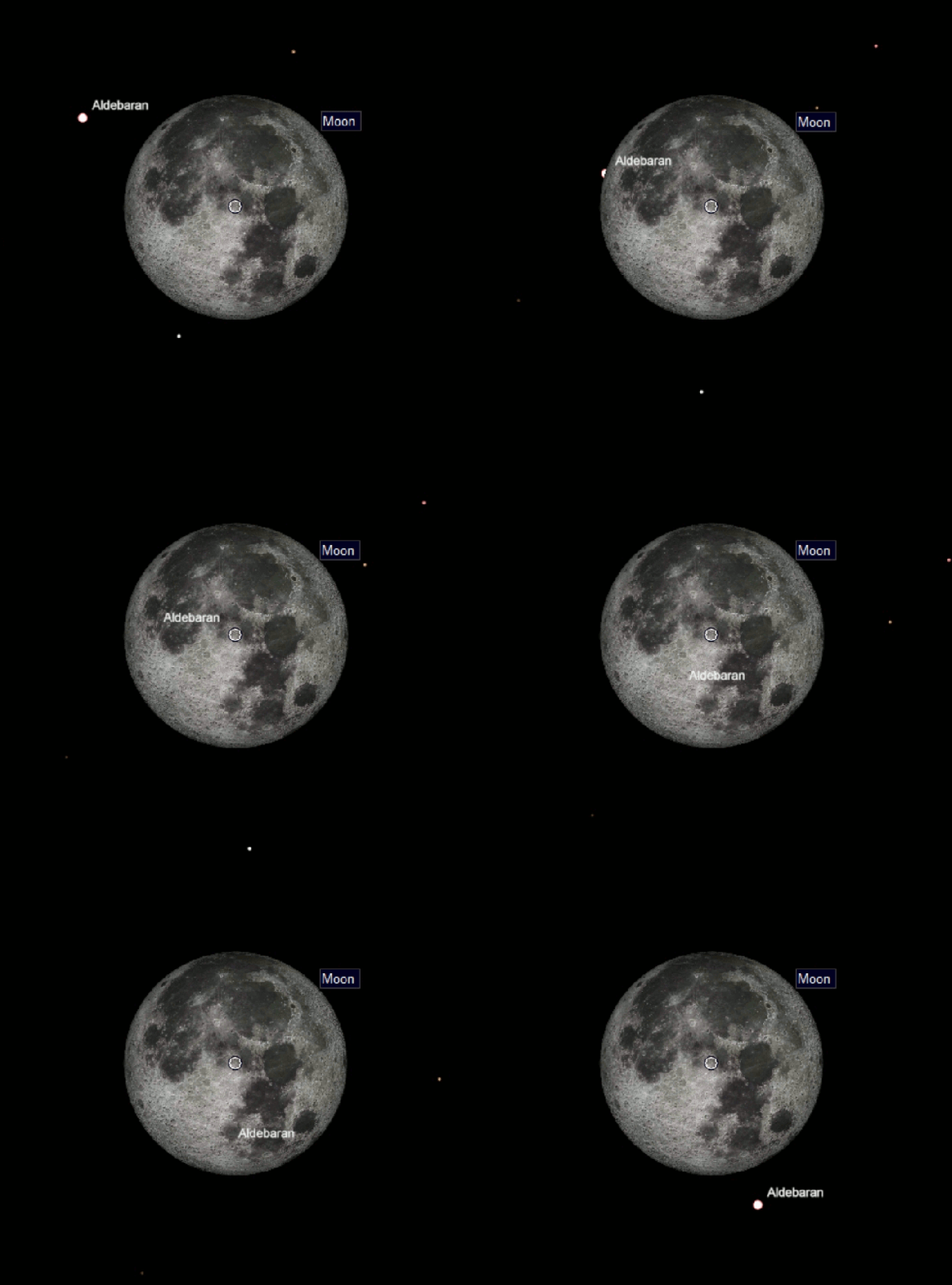
An occultation animation starting at 5:19 a.m. EST showing 10 minute intervals. Not that the computer generated graphics cannot produce a point star. Aldebaran will wink out and back in an instant. Created using Cartes du Ciel (Sky Charts) and GIMP.
 Bob Moler's Ephemeris Blog