Archive
03/24/2016 – Ephemeris – Why is this Sunday Easter?
Ephemeris for Thursday, March 24th. The Sun will rise at 7:37. It’ll be up for 12 hours and 23 minutes, setting at 8:01. The Moon, 1 day past full, will rise at 9:19 this evening.
This Sunday is Easter, only 5 days later than the earliest Easter can ever be. Yesterday’s full moon or the tabular date for it is called the Paschal Full Moon, an attempt for the Christian Church to match the solar Roman calendar to the Jewish lunar calendar in regards to the date of Passover. It doesn’t always work, especially when Easter turns out to be early as it is this year. The simple formula for western churches is the first Sunday after the first full moon after the vernal equinox which is defined as March 21st, no matter the date spring actually started, which was the 20th, this year. All this started to be counted using the Julian Calendar, which is 11 minutes longer than the seasonal or tropical year. We’ll see how that was corrected for tomorrow.
Times are for the Traverse City/Interlochen area of Michigan. They may be different for your location.
Addendum
The Jewish calendar does not have a relationship with the Gregorian Calendar, so Passover will drift later and later into spring over the years. The Jewish calendar does have a relation to the Julian Calendar in that 19 years equals 235 lunar months. This was probably discovered by the Babylonians but was popularized by the Athenian Menton in the 5th century BCE. It’s a way to relate the lunar calendar to the solar or seasonal calendar. We call it the Metonic cycle.
In a lunar calendar the months alternate between 29 and 30 days because the lunar month is 29.53 days. Also a 365.25 day year is 12.37 lunar months. The solution for all this is quite complex, with 12 common or 12 month years and 7 13 month great years to fit the 19 year cycle. It also means that the phases of the moon repeat on or near the same date at 19 year intervals. If you see a quantity called the Golden Number in almanacs, which happens to be 3 this year, that’s where we are (1-19) in the Metonic cycle. The Gregorian Calendar breaks this relationship. We’ll see how tomorrow.
02/29/2016 – Ephemeris – Yea! It’s the Leap Day.
Ephemeris for Monday, February 29th. The Sun will rise at 7:21. It’ll be up for 11 hours and 8 minutes, setting at 6:29. The Moon, 1 day before last quarter, will rise at 1:19 tomorrow morning.
Today is one of those special days that only occur once every 4 years. It’s the intercalary or leap day that compensates for that fact that the earth takes 365 and nearly a quarter day to orbit the sun. That orbit is a year, and those quarter days are accumulated and added as the last day of February on years divisible by 4. The Gregorian reform makes a slight adjustment on most century years, making century years not divisible by 400 ordinary years to keep the calendar in sync with the seasons. The Romans, from who we’ve gotten our calendar considered the month of February as unlucky, and so shortened it. Enjoy your extra day today, too bad it’s a Monday. My bobmoler.wordpress.com blog post from yesterday explains it in more detail.
Times are for the Traverse City/Interlochen area of Michigan. They may be different for your location.
02/28/2016 – Ephemeris Extra – The years of our lives
The continuing story of a small planet revolving around its star
Updated from the originally published in the January 1997 Stellar Sentinel, the monthly newsletter of the Grand Traverse Astronomical Society and republished in the February 2016 edition.
This year, 2016, is a leap year. In leap years we have the US presidential elections, the Summer Olympic Games, and February has 29 days. So what exactly is a leap year, and why am I writing about this earthly phenomenon in an astronomical society newsletter? Well it’s astronomical of course. And if you think a year is a year is a year, well think again.
The calendar we use today is based on the Sun. In ancient times the calendars of the Babylonians, Jews and many other ancient civilizations were based on the Moon, using the lunation, the period of about 29.5 days between new moons, as the basis for the calendar. Lunar calendars tended to have months alternating 29 and 30 days, and years of 12 or 13 months to keep the whole scheme roughly in sync with the seasonal year. There are vestiges of this system today in the various folklore of planting by the Moon.
The ancient Egyptians actually used two calendars. The first was one based close to the sun and had 365 days. It had 12 months of 30 days, each containing three 10 day decans. There were 5 days at the end of the year that were holidays, and belonged to no month. This civil calendar was used for state and accounting purposes. The agricultural calendar was based on the Moon. These two calendars were reconciled every 25 civil years which equaled 209 lunations, divided into 16 ordinary 12 month years, and 9 ‘great’ years of 13 months. Still, since the Egyptian civil year is nearly a quarter of a day a year short, the civil calendar shifted slowly in relation to the seasons. The Egyptian agricultural year started with the flooding of the Nile, which in those days was coincident with the heliacal rising of the brightest night time star Sirius, which they called Sothis. A heliacal rising is when a star or planet is first visible in the morning twilight. This heliacal rising occurs at a mean interval of 365.2507 days. Thus the Egyptian civil calendar would be in sync with the agricultural year every 1460 years, a period called the Sothic Cycle.
The ancient Greek calendars were lunar ones. Early on, each locality had their own calendar. Starting in the 6th century BC the calendar situation got better when a cycle synchronizing lunar calendars with the sun was discovered. It is the Metonic Cycle, probably discovered in Babylon. Here 19 years of 365.25 days equal almost exactly 235 lunations. That’s 12 ordinary 12 month years and 7 ‘great’ years of 13 months. We find remnants of the Metonic Cycle with the Golden Number for the year given in almanacs, a number ranging from 1 to 19. This year’s Golden Number is 3. The year 1 BC was 1. Under the old Julian calendar it was use to help determine the date of Easter.
The Julian Calendar is named for Julius Caesar who instituted it as a part of calendar reform he instituted in 46 BC. The old Roman calendar was a lunar one, but in the earlier years of Julius Caesar’s reign the adjustments, called intercalations, such as 13th months in some years to keep the calendar roughly attuned to the sun, were neglected. To straighten all this our, the year 46 BC was made 445 days long. Starting in 45 BC the new calendar was instituted using the year of length 365.25 days. Each 4 years an intercalary day was added. This was February 29th, giving a 366 day year. This we call a leap year. Year 45 BC was a leap year, but due to some misunderstanding about the calendar reform, the one leap year in every four, was not kept. In fact too many leap years were added, so in Caesar Augustus’ reign leap years from 8 BC to AD 8 were omitted to get back on track.
The western world ended up adopting the Julian calendar, and it was humming along just fine with leap years every 4 years. However the Catholic Church and Pope Gregory XIII became alarmed that Easter was in danger of no longer being a spring feast. The early church, adopted the Julian calendar rather than the Jewish lunar calendar. But the most important feasts, the Crucifixion and Easter were tied to the Jewish feast of Passover, a spring feast starting in the middle of the month at full moon time. Part of the problem was that the Vernal Equinox for ecclesiastical purposes was assumed to fall on March 21st, whether it actually did or not. The first Sunday after the first full moon was Easter.
The problem is that the seasonal or tropical year is 11 minutes and 14 seconds shorter than the Julian year of 365.25 days. In 400 years this amounts to about 3 days error. So the easy correction is to eliminate 3 leap years out of 400 years. The formula is simple. All years divisible by 4 are leap years except century years which are not also divisible by 400. Thus the year 1900 was not a leap year, but 2000 was, and 2100 will not be.
The other part of the reform was harder to swallow. It was the elimination of 10 days because the real Vernal Equinox was by the 16th century falling on March 11th. The Church was able to have this adopted in Catholic countries right away, so in the calendar of 1582 ten days were omitted between October 4th and 15th. Protestant countries generally followed suit later. England and the American Colonies converted to this new Gregorian Calendar in 1752 when by then 11 days were omitted between September 2nd and 14th. The last to convert to the Gregorian Calendar was Greece and Orthodox Christianity who also made further improvements for the future.
I had once investigated how Microsoft Excel spreadsheets store dates. It’s stored as a consecutive date starting with date 1 on January 1, 1900. I had to convert dates downloaded from an IBM AS400 computer into a format compatible with Excel. The dates came one day off. It turns out that Microsoft or whoever devised the Excel dating scheme forgot that the year 1900 was not a leap year in the Gregorian calendar. For my astronomical research I use dates both far in the past I use dating algorithms that use the Julian and Gregorian calendars where appropriate and takes into account the Gregorian discontinuity of 1582 into account. These algorithms convert calendar dates to another type of consecutive day scheme called Julian Day Numbers of Julian dates for short, and back again. In astronomy we see cycles of planetary orbits, variable star periods, etc. They don’t fit into our hodgepodge of different month and year lengths. We just want to know how many days between event A and event B. Julian dates work for us. The Julian dates start on January 1, 4713 of the Julian calendar, which predates any known historical date. Oh by the way: Julian dates start at noon Universal Time (UT) or Greenwich Mean Time (GMT), and fractional days are decimal.
I didn’t even touch when the year begins. In Great Britain when the 1752 reforms took place they also changed the start of the year from March 25th to January 1st.
Bibliography
- The Exact Sciences in Antiquity by O. Neugbauer. Dover Publications
- Explanatory Supplement to the Ephemeris H.M. Nautical Almanac Office
01/22/2016 – Ephemeris – Getting sunrise and sunset times for your location
Ephemeris for Friday, January 22nd. The Sun will rise at 8:12. It’ll be up for 9 hours and 24 minutes, setting at 5:36. The Moon, 1 day before full, will set at 7:31 tomorrow morning.
With the bright moon, blocking all but the brightest stars, it’s a good time to do some housekeeping. When I started this program 40 ½ years ago Interlochen Public Radio (IPR) had only one transmitter and a single antenna pattern. It was simply WIAA then. The sunrise and sunset times worked well for that. However since then with transmitters from Manistee to the Straits I cannot hope to cover it all with a single set of times. The differences in the times also vary with the seasons. To get help on the Internet go to my monthly site ephemeris.bjmoler.org and click on Calendars. There are calendars for Ludington, Cadillac, Interlochen/Traverse City, Petoskey and Mackinaw City. Select a month to view or printout a whole year, or use the email link to request a sunrise, sunset, and Moon calendar for your town. There’s also a link to get sunrise and sunset times for anywhere in the world
Times are for the Traverse City/Interlochen area of Michigan. They may be different for your location.
Addendum
As an aside. I wrote the program to compute the calendars back in the ’80s. It produces calendars in three formats, of which I still use two: comma separated values, and HTML. The HTML output is what is used for the calendar pages. The comma separated value files are input into a database which is used to create for me the first paragraph of the transcript. For the blog posting I omit “This is Bob Moler with…” as redundant. The program also produces database tables of the planets from which I base the Wednesday planet program rise, set and sometimes transit times.
The actual Ephemeris audio programs are also found on the ephemeris.bjmoler.org under the audio link. A whole week of programs are available.
07/31/2015 – Ephemeris – Looking ahead at August in the skies
Ephemeris for Friday, July 31st. The Sun rises at 6:27. It’ll be up for 14 hours and 42 minutes, setting at 9:10. The Moon, at full today, will rise at 9:08 this evening.
Let’s look ahead at the month of August which starts tomorrow. Daylight hours will decrease from 14 hours and 40 minutes tomorrow to 13 hours 18 minutes on the 31st. The altitude of the sun at local noon, that is degrees of angle above the horizon will decrease from 63 degrees tomorrow to just over 53 degrees on the 31st. Straits area listeners can subtract one more degree from those angles. Local noon, when the sun is due south, is about 1:43 p.m. The Perseid meteor shower will reach its peak at about 2 a.m. on the morning of the 13th, and should be spectacular with a nearly new Moon. On the nights between now and then when the moon has set these meteor numbers will be building to the peak. Saturn will be our only easily visible evening planet.
Times are for the Traverse City/Interlochen area of Michigan. They may be different for your location.
Addendum
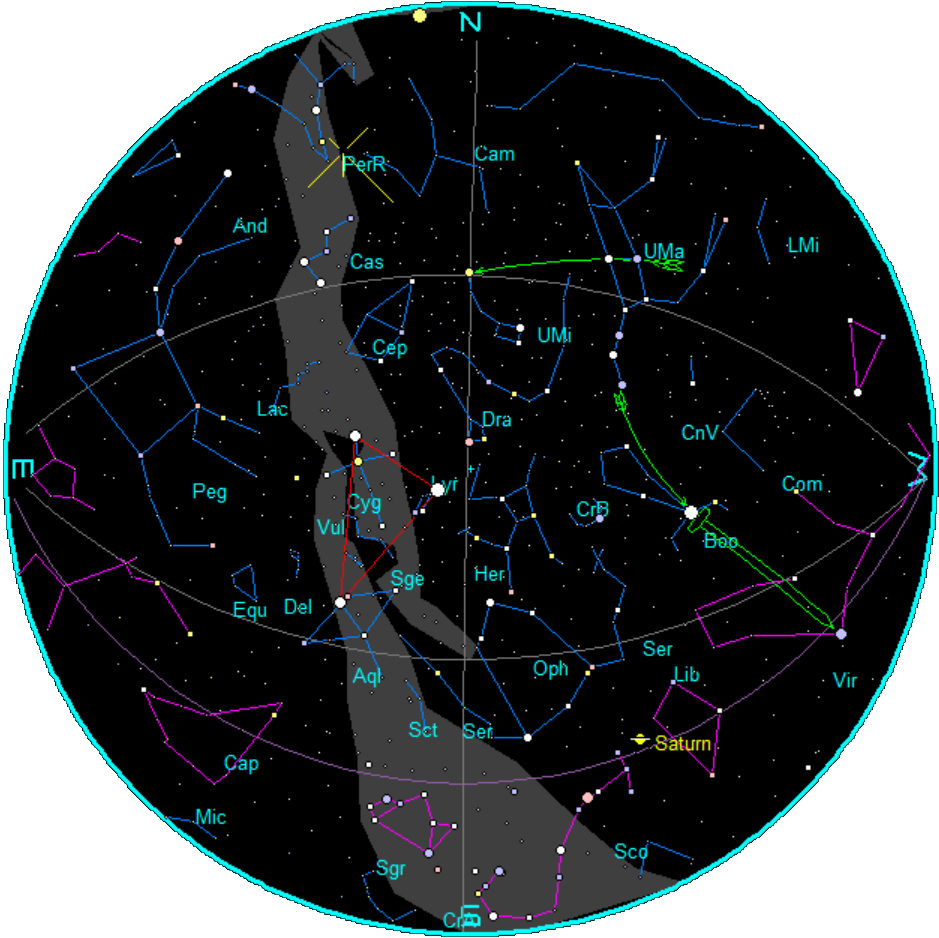
Star Chart for August 2015. Created using my LookingUp program. Click on image to enlarge.The Moon is not plotted.
The planets and stars are plotted for the 15th at 10 p.m. EDT. That is chart time. Note, Traverse City is located 1 hour 45 minutes behind our time meridian. To duplicate the star positions on a planisphere you may have to set it to 1 hour 45 minutes earlier than the current time.
Evening Astronomical twilight ends at 11:12 p.m. EDT on August 1st, decreasing to 10:06 p.m. EDT on the 31st.
Morning astronomical twilight starts at 4:24 a.m. EDT on August 1st, and increasing to 5:18 a.m. EDT on the 31st.
Add a half hour to the chart time every week before the 15th and subtract and hour for every week after the 15th.
For a list of constellation names to go with the abbreviations click here.
The green pointer from the Big Dipper is:
- Pointer stars at the front of the bowl of the Big Dipper point to Polaris the North Star.
- Drill a hole in the bowl of the Big Dipper and the water will drip on the back of Leo the Lion.
- Follow the arc of the Big Dipper’s handle to Arcturus
- Continue with a spike to Spica
- The Summer Triangle is shown in red
- PerR in yellow is the Perseid radiant
Calendar of Planetary Events
Credit: Sky Events Calendar by Fred Espenak and Sumit Dutta (NASA’s GSFC)
To generate your own calendar go to http://eclipse.gsfc.nasa.gov/SKYCAL/SKYCAL.html
Times are Eastern Daylight Time on a 24 hour clock. Some additions made to aid clarity.
Conjunctions like the Mercury-Regulus: 0.9° N means Regulus will appear 0.9° north of Mercury.
| Aug | 01 | Sa | Venus: 21.5° East of the Sun | |
| 02 | Su | 06:11 | Moon Perigee: 362,100 km | |
| 03 | Mo | 22:53 | Moon Descending Node | |
| 06 | Th | 22:03 | Last Quarter | |
| 07 | Fr | 13:25 | Mercury-Regulus: 0.9° N | |
| 08 | Sa | 19:22 | Moon-Aldebaran: 0.7° S | |
| 10 | Mo | 07:11 | Moon North Dec.: 18.3° N | |
| 13 | Th | 02:17 | Perseid Shower: ZHR* = 90 | |
| 14 | Fr | 10:54 | New Moon | |
| 15 | Sa | 15:19 | Venus Inferior Conjunction with the Sun | |
| 16 | Su | 10:34 | Moon-Mercury: 2.2° N | |
| 17 | Mo | 19:05 | Moon Ascending Node | |
| 17 | Mo | 22:33 | Moon Apogee: 405,900 km | |
| 19 | We | 23:35 | Mars-Beehive: 0.5° S | |
| 22 | Sa | 13:21 | Moon-Saturn: 2.8° S | |
| 22 | Sa | 15:31 | First Quarter | |
| 24 | Mo | 23:44 | Moon South Dec.: 18.2° S | |
| 26 | We | 17:04 | Jupiter Conjunction with the Sun | |
| 29 | Sa | 14:35 | Full Moon | |
| 30 | Su | 11:24 | Moon Perigee: 358,300 km | |
| 31 | Mo | 06:16 | Moon Descending Node | |
| 31 | Mo | 22:12 | Neptune Opposition from the Sun | |
| Sep | 01 | Tu | Venus: 25° West of the Sun |
*ZHR – Zenithal Hourly Rate: Approximate number of meteors per hour when the shower radiant is at the zenith. For more information on this and other meteor showers in 2015 see the International Meteor Organization website calendar section: http://www.imo.net/calendar.
02/26/2015 – Ephemeris – The strange month of February
Ephemeris for Thursday, February 26th. The sun will rise at 7:25. It’ll be up for 11 hours and 1 minute, setting at 6:26. The moon, 1 day past first quarter, will set at 3:21 tomorrow morning.
Let’s take a shot at why February is the shortest month. Blame the ancient Romans and their poor timekeeping skills. The Roman calendar was based on the Sun, or rather the seasons, what we would call the tropical year, rather than the Moon. With a lunar calendar it was easy to tell if it was off by a day or two. The Romans apparently started with a 12 month calendar starting in March with spring. Before the calendar reform of 45 BC months had alternating days of 29 and 31 except for February which had 28. That left them a bit short, so it appears that they added a month Intercalaris every few years or so to fix it. That eventually came down to adding a day to February every 4 years to fix the problem.
Times are for the Traverse City/Interlochen area of Michigan. They may be different for your location.
02/02/2015 – Ephemeris – Ground Hog Day and other Cross-Quarter days
Ephemeris for Ground Hog Day, Monday, February 2nd. The sun will rise at 8:01. It’ll be up for 9 hours and 51 minutes, setting at 5:52. The moon, 1 day before full, will set at 7:26 tomorrow morning.
If Punxsutawney Phil, the groundhog in Punxsutawney, PA sees his shadow we’re supposed to be in for 6 weeks of winter, otherwise spring is just around the corner. The way the seasons really work, is that Ground Hog day is about half the way from the winter solstice to the spring equinox. In reality calendar-wise winter is about 12 weeks and 5 days, so we only have 6 weeks a few days to go of winter anyway. Groundhog day, May Day, and All Saints Day are holidays near cross quarter days, which are said to mark when seasons are half over. It seems no one cares when summer is half over around the first of August when Back to School Sales used to start. Of course now those sales seem to start the day after school lets out in June.
Times are for the Traverse City/Interlochen area of Michigan. They may be different for your location.
Addendum

Poor Punxsutawney Phil, rousted out of his mid winter nap. They might be in the middle of a blizzard today. Credit: http://www.fuzzytoday.com
More questions about the length of daylight hours
This is the result of a question I got about why the daylight hours change the way they do during the year. My answer is posted here as “How come hours of daylight changes very slowly around the solstice, but very rapidly around the equinoxes?”
My correspondent has a few more questions. I’ll boil them down.
I pretty much understand why daylight changes rapidly at the equinoxes and slowly at the solstices based upon your map showing the ecliptic and how the steepest part is at the equinoxes. Also, the figure eight drawing makes sense. But why does the curve of the ecliptic seem to linger for a time at the solstices before plunging? Does it have to do with the speed of the Earth in its orbit?
The analemma, as seen below, is the result of two phenomena. First, the tilt of the Earth’s axis which would on itself make a figure 8 with equally sized lobes, with crossing point at the equinoxes. Second, the Earth’s orbit of the Sun is a slight ellipse, meaning for our purposes here that the Earth moves its fastest near perihelion when the Earth is nearest the Sun, around January 4th. and slowest at aphelion, when the Earth is farthest from the Sun, around July 4th. That makes the bottom lobe larger because the Sun is by reflection moving faster eastward in the sky. The apparent slowness that the questioner perceives is an illusion because the Sun appears to be moving in a more directly eastward, and changed the actual time of local solar noon. Wikipedia has a detailed discussion of the analemma.
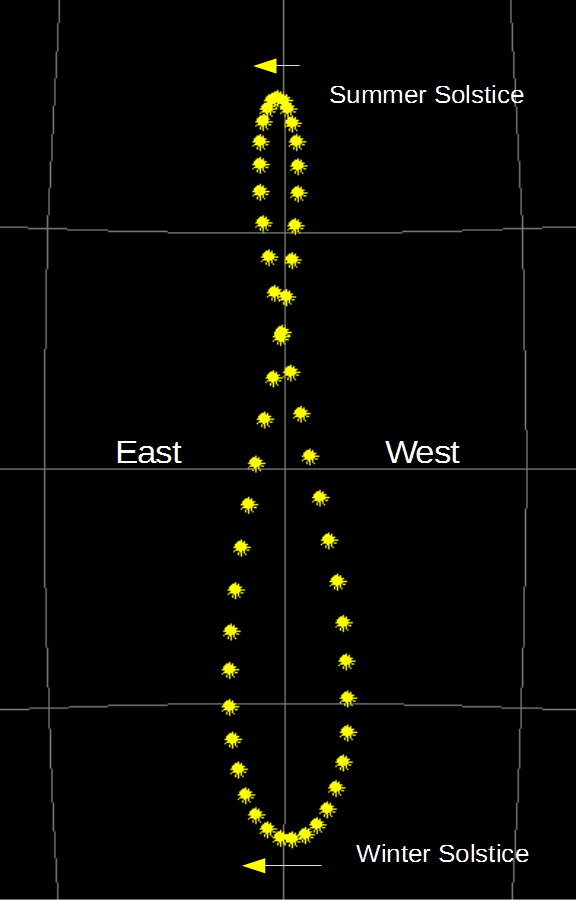
This figure 8 is called an analemma. One can find it on old globes in the Pacific Ocean. Explanation below. Created using my LookingUp program.
I had stated in the prior post that daylight hours would be 12 hours at the equinoxes and also all the time at the equator. So here’s the other question.
At the equator, day length does change over the course of the year, doesn’t it? At the equinoxes it would be 12 hours long, but at the summer solstice up north it would sink towards the south by 23 degrees and at the summer solstice in the south it would sink towards the north by the same amount.
Other than getting cooperation from someone who either lives on or has visited the equator, I generated a calendar of sunrise and sunset times for the equator, specifically for 0º longitude and 0º latitude. A link to it is here. Also read the explanation on that calendar page.
The answer is No, the daylight hours at the equator doesn’t change over the year. The one minute variance has to do with the Analemma.
01/05/2015 – Ephemeris – Ephemeris’ dirty little secret
Ephemeris for Monday, January 5th. The sun will rise at 8:19. It’ll be up for 8 hours and 56 minutes, setting at 5:16. The moon, 1 day past full, will rise at 6:14 this evening.
With the bright moon, blocking all but the brightest stars, it’s a good time to do some housekeeping. When I started this program 39 ½ years ago IPR had only one transmitter and a single antenna pattern. The sunrise and sunset times worked well for that. However since then with transmitters from Manistee to the Straits I cannot hope to cover all that in a single program. The differences in the times vary with the seasons. To get help on the Internet go to my monthly site ephemeris.bjmoler.org and click on Calendars. There are calendars for Ludington, Cadillac, Interlochen/Traverse City, Petoskey and Mackinaw City. Select a month to view or printout a whole year. Use the email link to request a sunrise, sunset, and Moon calendar for your town.
Times are for the Traverse City/Interlochen area of Michigan. They may be different for your location.
Addendum
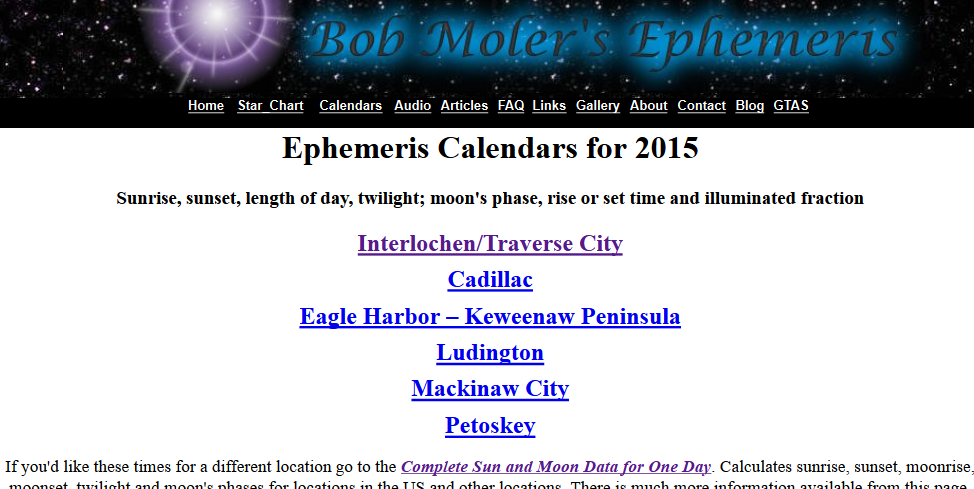
Click on Calendars in the header. and you will get this page.
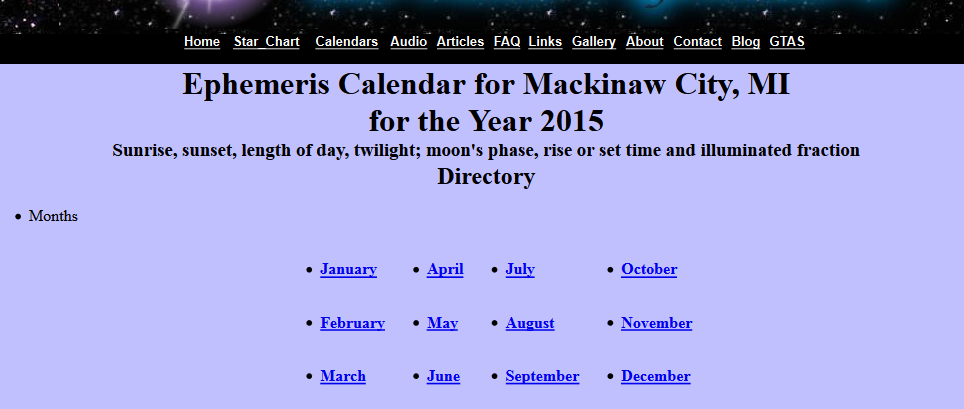
This is the top of the Mackinaw City calendar where you can select to start at any month.
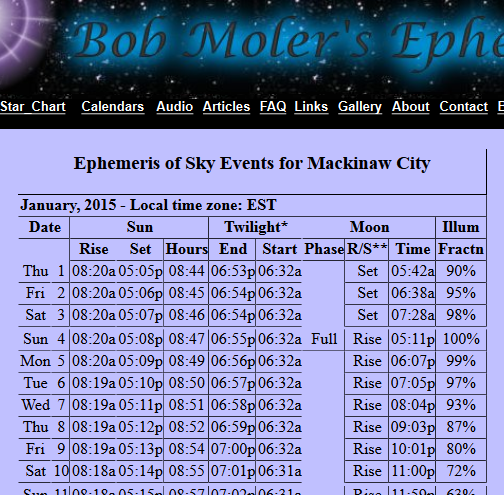
Partial image of the January calendar for Mackinaw City. The last column illum Fractn is the moon’s illuminated fraction. It is set for 24h UT, which is early evening on the date listed.
Interesting note: You can draw a straight line through Ludington, Interlochen/Traverse City, Petoskey and Mackinaw City. The angle with that line and the meridian is about 23 1/2 degrees. The same as the tilt of the Earth’s axis. Therefore near the winter solstice the sunrise times are nearly the same, but the sunset times can differ greatly. Conversely at the summer solstice the sunset times are nearly the same, but the sunrise times are the most divergent.
02/12/2013 – Ephemeris – Astronomical basis for Lent and Easter
Ephemeris for Fat Tuesday, Tuesday, February 12th. The sun will rise at 7:46. It’ll be up for 10 hours and 20 minutes, setting at 6:07. The moon, 2 days past new, will set at 9:17 this evening.
The western ecclesiastical season of Lent starts tomorrow. It lasts 40 days excluding Sundays ending with the celebration of Easter on March 31st this year. It is a movable feast in that it’s on a different date each year following the first full moon of spring. It’s an attempt to follow the Jewish Passover, which starts on the 15th of the month of Nisan. Being a lunar calendar the 15th the generally the night of the full moon. And since the Last Supper was a Seder, the Christian church wanted to follow Passover as closely as possible using the Roman Solar based calendar. The western churches eventually adopted the Gregorian calendar to keep in sync with the seasons. The Eastern churches did not. Their Easter this year is on May 5th.
Times are for the Traverse City/Interlochen area of Michigan. They may be different for your location.
Addendum
The first day of spring is set by the churches as March 21st. In Michigan’s time zone spring now it always starts on March 20th, and will occasionally start on the 19th until 2103 after the Gregorian correction takes place in 2100. The Julian Calendar, instituted by Julius Caesar, was the official calendar for all the Christian world until 1582. The problem with the Julian Calendar is that the leap year every 4 years overcompensated for the seasonal or tropical year. The average year of 365 1/4 days turned out to be 11 minutes 14 seconds too long. By 1582 the actual vernal equinox or first day of spring had slipped back to March 10th.
Astronomers under Pope Gregory XIII proposed a change that was adopted by the Roman Catholic world. First remove 10 days from the calendar between October 4 and 15 1582. Then modify the leap year formula to keep the leap year on years divided by 4, except century years. Century years were ordinary 365 day years unless divisible by 400. This 1900 was an ordinary year, but 2000 was a leap year. The western protestant countries came around eventually. However the eastern churches still use the Julian calendar to set their feasts, thus Eastern Orthodox rarely coincides with western churches.
Note that the dating for Excel spreadsheets, starts the day count on January 1, 1900, except they thought that 1900 was a leap year.
 Bob Moler's Ephemeris Blog