Archive
05/01/2014 – Ephemeris – Previewing May skies
Ephemeris for Thursday, May 1st. The sun rises at 6:32. It’ll be up for 14 hours and 14 minutes, setting at 8:47. The moon, 2 days past new, will set at 11:21 this evening.
Today we will start the month when the promise of spring is finally fulfilled, we hope. Daylight hours in the Interlochen/Traverse City area will increase from 14 hours and 14 minutes today to 15 hours 18 minutes on May 31st. The altitude, or angle, of the sun above the southern horizon at local noon will ascend from 60 degrees today to 67 degrees at month’s end. The altitude of the sun in the Straits area will be a degree lower than that but your length of daylight will be a few minutes longer. Local apparent noon this month, when the sun passes due south, will be about 1:38 p.m. The Eta Aquarid meteor shower will reach its peak about 2 a.m. this Sunday morning the 4th. I’ll have more on my blog bobmoler.wordpress.com today.
Times are for the Traverse City/Interlochen area of Michigan. They may be different for your location.
Addenda
The Eta Aquarid Meteor Shower
This shower is associated with Halley’s Comet. We see two meteor showers from Halley’s comet. One in October where the comet debris is crossing the earth’s orbit heading toward the sun, and again as its leaving. This shower is caused by the debris leaving the vicinity of the sun.
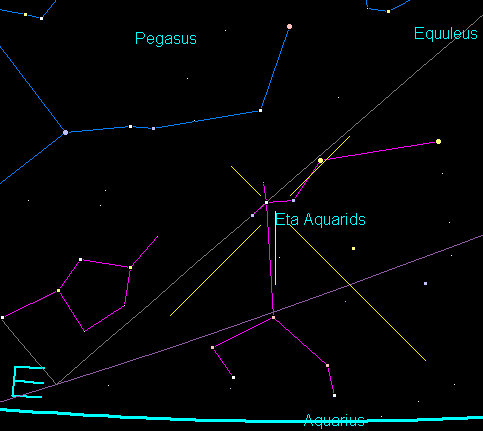
The Eta Aquarid radiant at the peak of the shower. The radiant moves slowly to the east with time. Credit: Bob Moler’s LookingUp program.
The peak of the shower will be at 7 h UT on May 6th. That’s 3 a.m. EDT, about 20 minutes before the radiant will rise. This will give about one hour before astronomical twilight starts to view the meteor shower in completely dark skies.
Possible Meteor Storm – May 24
There will be the possibility of a meteor storm on the morning of May 24th. A meteor storm differs from a meteor shower in the numbers of meteors seen and duration. There is a possibility of up to 400 meteors per hour for the hours of 7h to 8h UT (3 to 4 a.m. EDT).
The body responsible is Comet 209P/LINEAR. It was the 209th periodic comet discovered on February 3, 2004 by Lincoln Near-Earth Asteroid Research (LINEAR). Despite the recent discovery 209P has been orbiting the sun for hundreds of years, maybe longer. This year the comet will come close to the Earth and will allow the Earth to pass through debris that it shed hundreds of years ago.
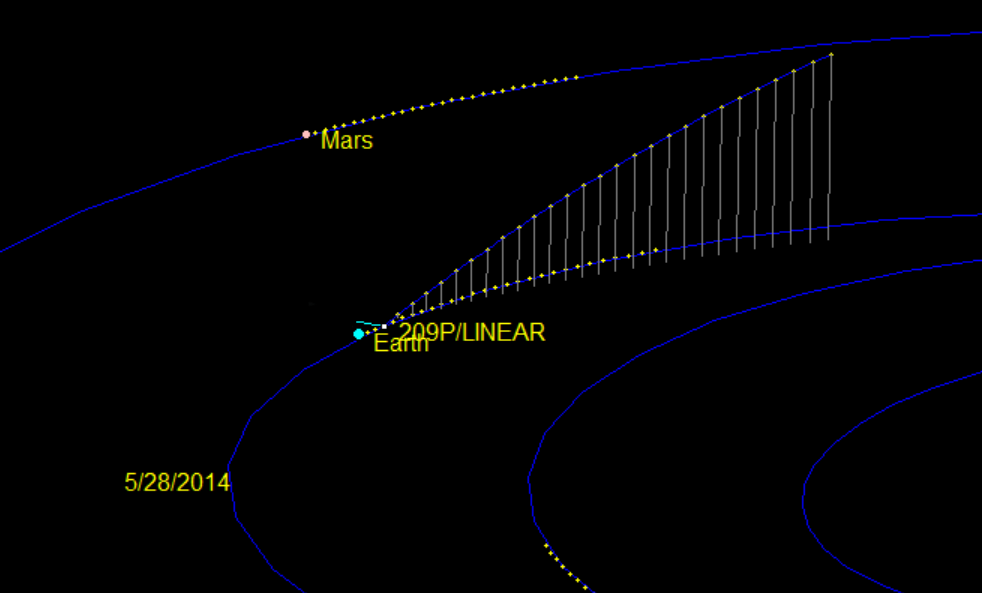
Comet 209P/LINEAR crosses the Earth’s orbit around May 28, 2014. The “stilts” on the comet’s orbit show that it is coming from north of the Earth’s orbital plane. Credit: Bob Moler’s LookingUp program.
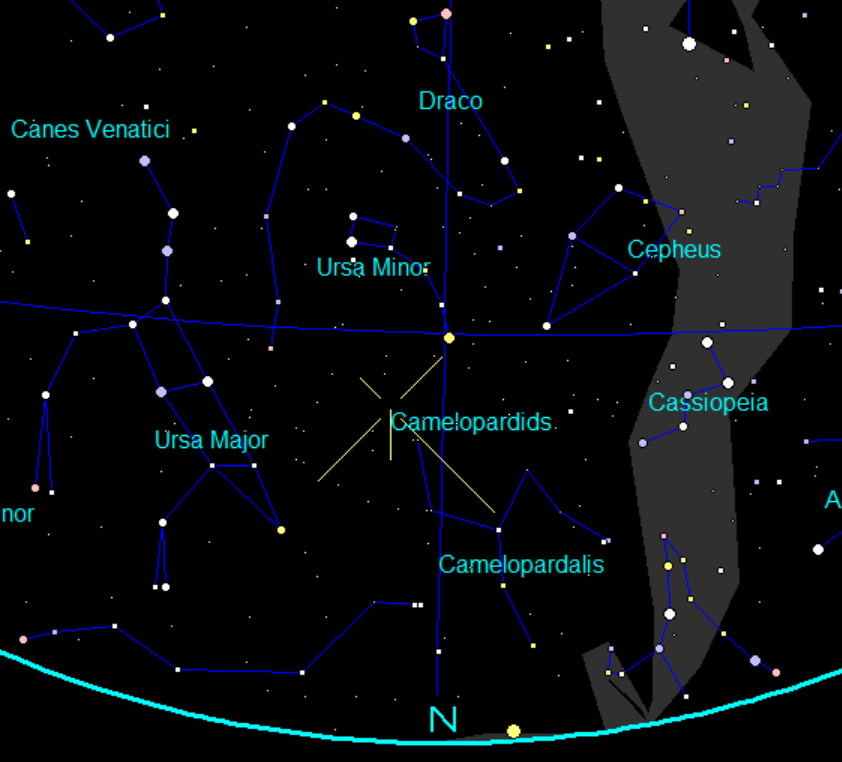
The radiant for the Comet 209P/LINEAR debris. For this purpose I’ve designated it Camelopardids (not official and probably not correct). Credit: Bob Moler’s LookingUp program. Note that the constellation of Camelopardalis is a giraffe.
Astronomical Twilight starts at 3:51 a.m., but the skies should remain dark enough. The 24% illuminated moon will rise about 2:45 or so and may not be much of an impediment in seeing the meteor storm.
May Star Chart
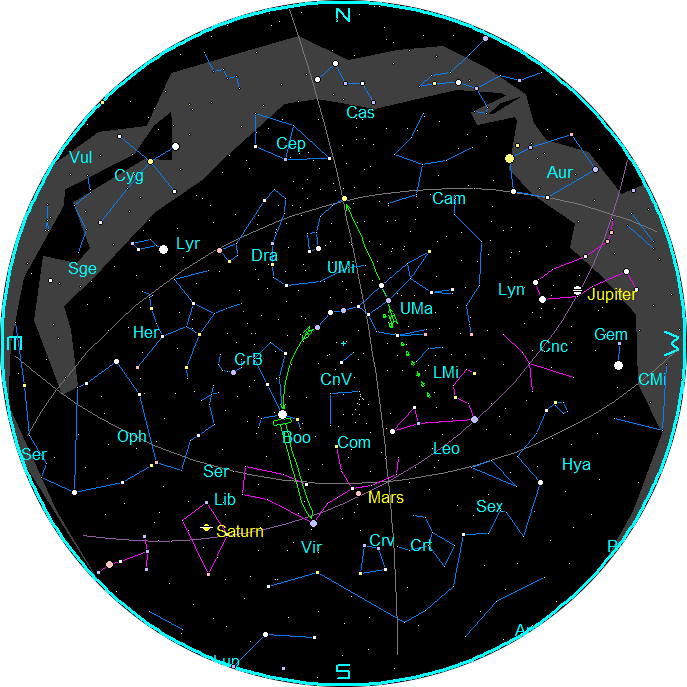
Star Chart for mid-month for May 2014 at 11 p.m. Credit: Bob Moler’s LookingUp program.
Add a half hour to every week before the 15th and subtract and hour for every week after the 15th.
For a list of constellation names to go with the abbreviations click here.
Rosetta’s awake and phoning home
Check out this from Emily Lakdawalla from the Planetary Society. Looks like ESA’s big gamble paid off. Now on to the comet!
01/20/2014 – Ephemeris – Wake up Rosetta!
Ephemeris for Dr. Martin Luther King Day, Monday, January 20th. The sun will rise at 8:12. It’ll be up for 9 hours and 22 minutes, setting at 5:34. The moon, 4 days before last quarter, will rise at 10:22 this evening.
Wake up Rosetta! That’s the message The that the European Space Agency or ESA wants sent to the Rosetta spacecraft to wake it up after 33 months of hibernation when it was too far from the sun for its solar panels to provide adequate power. The wake up call is ESA’s way of gaining the public’s attention for the events later this year when the spacecraft will rendezvous with a comet. Actually the probe will have to wake itself up. It set three alarm clocks, er… timers to wake it up today, find the sun and charge its batteries and phone home. The comet is 67P/Churyumov-Gerasimenko. After orbiting the comet’s nucleus the main spacecraft will release a probe called Philae to land, or actually grapple it. [the two and a half mile [4 km] diameter nucleus, which is known to be of an odd non-round shape.]
Times are for the Traverse City/Interlochen area of Michigan. They may be different for your location.
Addendum
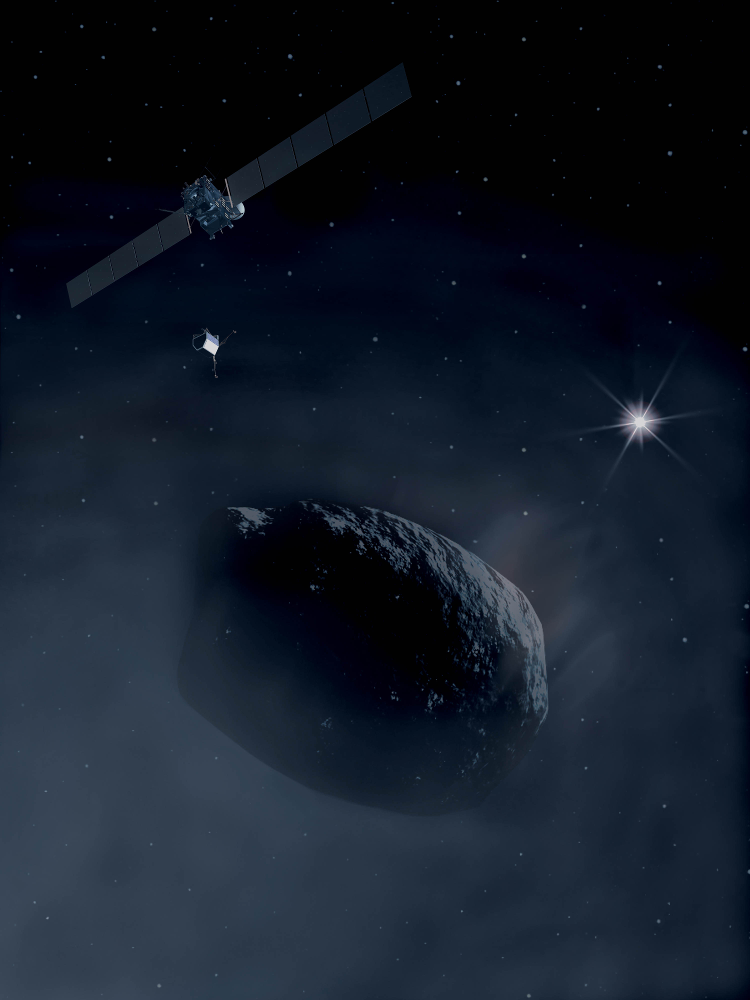
Artist’s rendering of Rosetta orbiting comet 67P/Churyumov–Gerasimenko and sending the Philae lander to the comet’s surface. Credit: ESA
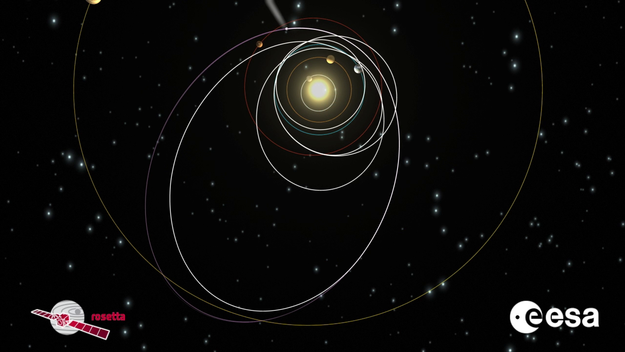
12 years of orbital maneuvers of Rosetta to match orbits with the comet. Credit ESA.
01/01/2014 – Ephemeris – A look at events the month and for the next few days and the planets
Note: The two paragraphs below were aired on IPR. They are not my usual Wednesday feature on the planets which is in the addendum. The first few days of January are busy with astronomical happenings. I’ll have a preview of this year’s eclipses on Monday the 6th with the daily and an extra post.
Ephemeris for New Years Day, Wednesday, January 1st, 2014. The sun will rise at 8:19. It’ll be up for 8 hours and 53 minutes, setting at 5:13. The moon is new today, and won’t be visible.
Happy New Year. We’re too busy with astronomical events to preview the year. Today and tomorrow we’ll cover the highlights of this month. We’re a day from the latest sunrise at about the same time as today and will back down to 8:02 by the 31st. Sunset is current increasing by a minute a day and will set at 5:50 at month’s end. Listeners on the shore of Lake Michigan will have about the same sunrise time from Ludington to Mackinaw City, but the sunset times will vary markedly. Jupiter will be in opposition from the sun and rise at sunset on the 4th. This is your last week to see Venus in the evening sky. It will leave the evening sky on the 11th and enter the morning sky. Start looking for the Quadrantid meteor shower that will peak on the 3rd.
Times are for the Traverse City/Interlochen area of Michigan. They may be different for your location.
Addendum
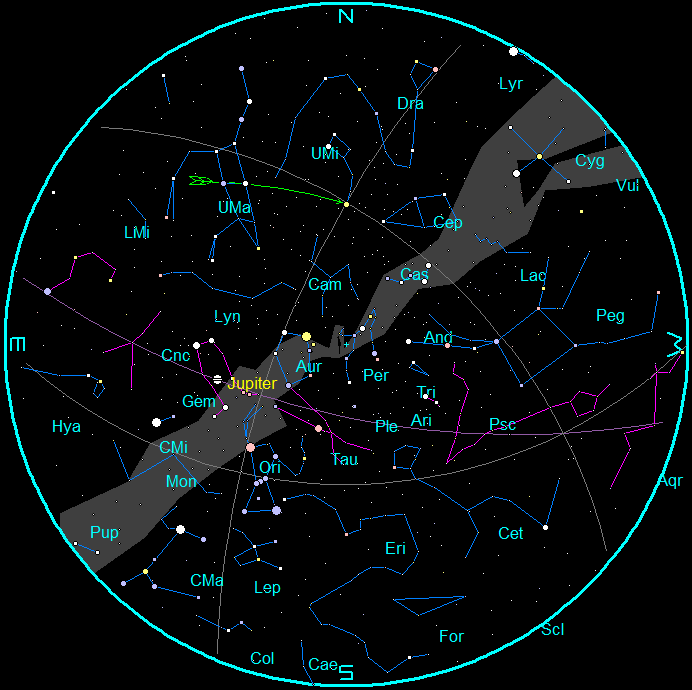
A star chart for January 15th at 9 p.m. Add a half hour to every week before the 15th and subtract and hour for every week after the 15th. Created using my LookingUp program.
For a list of constellation names to go with the abbreviations click here
This is our weekly look at the planets. Venus is brilliant in the southwest after sunset. It will set at 6:36 p.m. Venus is noticeably closing with the sun. It will be lost in the glare of the sun in less than a week. Venus is a thin crescent, and we’re at the point where the crescent can be visible in binoculars. The giant planet Jupiter will rise at 5:24 p.m. in the east northeast. It’s cruising against the stars of Gemini now. It will pass due south at 1:04 a.m. It will be in opposition from the sun on the 4th, where it will rise at sunset and set at sunrise. Mars will rise at 12:51 a.m. in the east. Reddish Mars is to the upper right of the bright star Spica in Virgo. Saturn will rise at 4:12 a.m. in the east southeast. It will be in Libra this year. The ringed planet will best be seen in the evening next summer. There is a comet visible in binoculars in the morning sky. It’s Comet Lovejoy (C/2013R1).
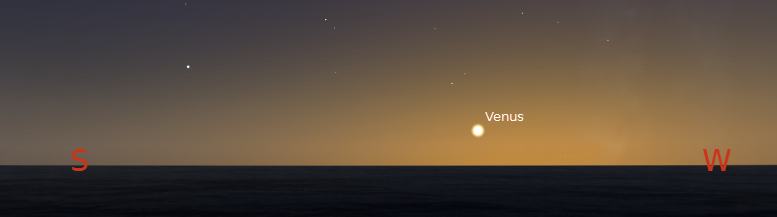
Venus in the west southwest at 6 p.m. on January 1, 2014. Venus will be harder and harder to spot between now and its inferior conjunction with the sun on the 11th. Created using Stellarium.

Venus’ thin crescent on January 1, 2014 at 6 p.m. The crescent will be bright but the night side will not be visible as Stellarium suggests. Created using Stellarium.
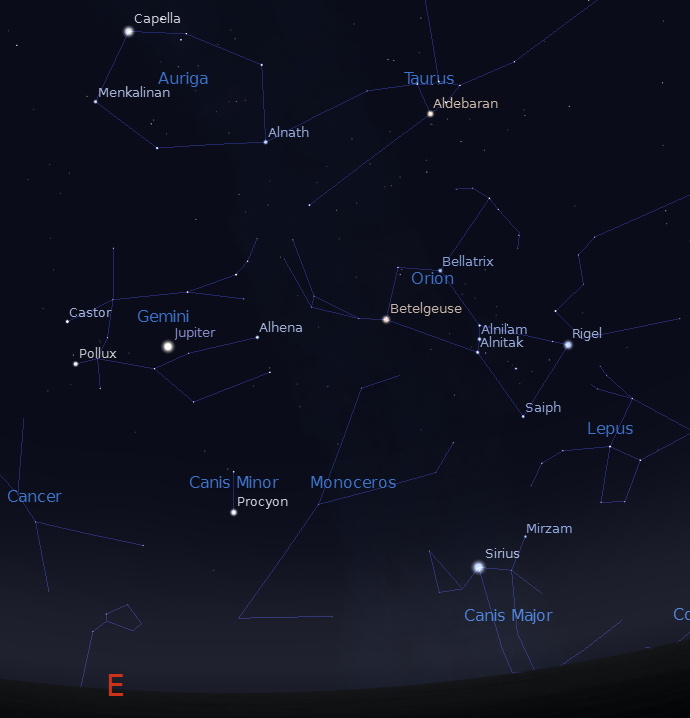
Jupiter and the constellations of winter at 9 p.m. on January 1, 2014. Created using Stellarium.
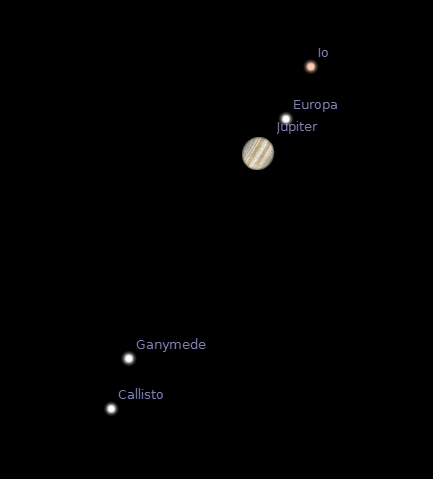
Jupiter and its satellites as seen in a telescope at 9 p.m. on January 1, 2014. That actual rotation of the image depends on the telescope. Created using Stellarium.
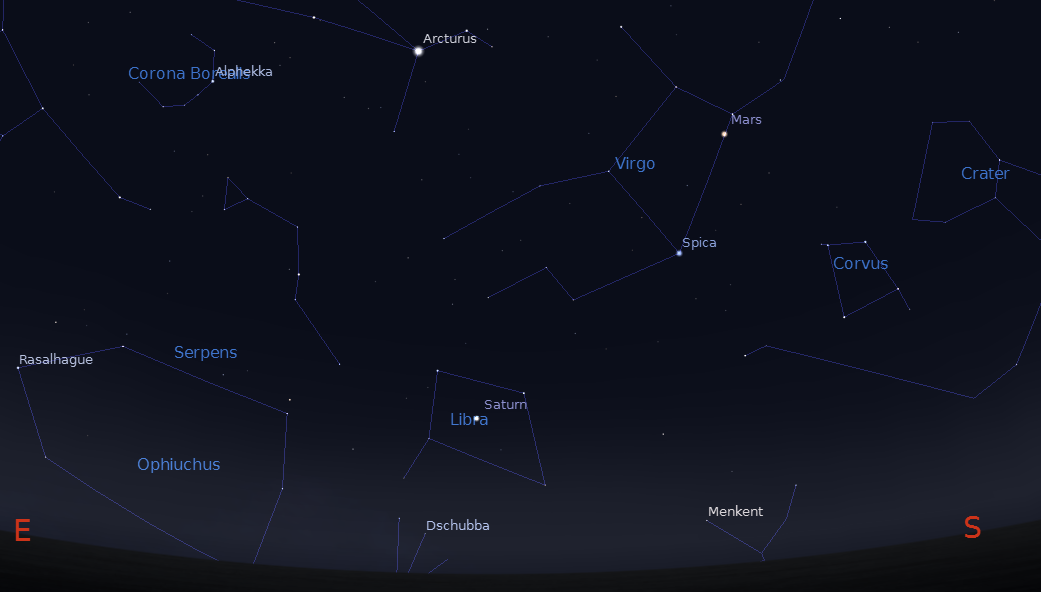
Mars and Saturn among the spring constellations at 6 a.m. January 2, 2014. Created using Stellarium.
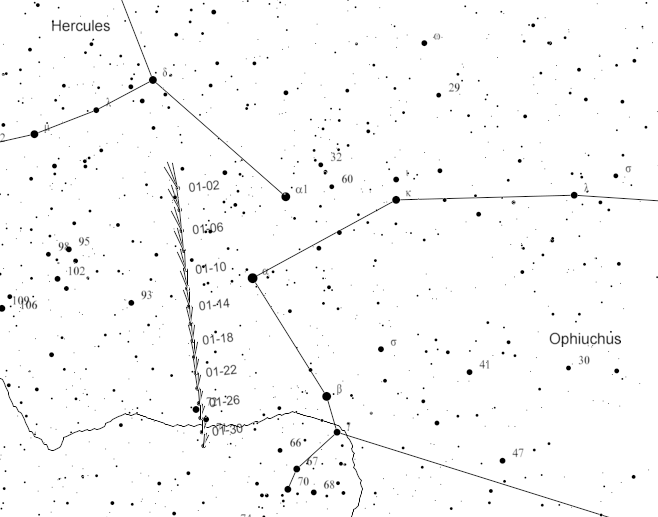
The track of Comet Lovejoy, which still should be visible in binoculars from 01/02/14 to 01/31/14 at 6:30 a.m. Created using Cartes du Ciel (Sky Charts).
12/25/2015 – Ephemeris – Where are the bright planets and Comet Lovejoy this week?
Ephemeris for Christmas Day, Wednesday, December 25th. The sun will rise at 8:18. It’ll be up for 8 hours and 49 minutes, setting at 5:07. The moon, at last quarter today, will rise at 1:34 tomorrow morning.
This is our weekly look at the planets. Venus is brilliant in the southwest after sunset. It will set at 7:08 p.m. Venus is noticeably closing with the sun. It will be lost in the glare of the sun in less than 2 weeks. Venus is a thin crescent, and we’re at the point where the crescent can be visible in binoculars. The giant planet Jupiter will rise at 5:56 p.m. in the east northeast. It’s cruising against the stars of Gemini now. It will pass due south at 1:35 a.m. Mars will rise at 1:02 a.m. in the east. Reddish Mars is to the upper right of the bright star Spica. It will be above the moon tomorrow morning. Saturn will rise at 4:36 a.m. in the east southeast. The ringed planet will best be seen in the evening next summer. There is a comet visible in binoculars in the morning sky. It’s Comet Lovejoy.
Times are for the Traverse City/Interlochen area of Michigan. They may be different for your location.
Addendum

Venus in the southwest at 6 p.m. on December 25, 2013. Created using Stellarium.
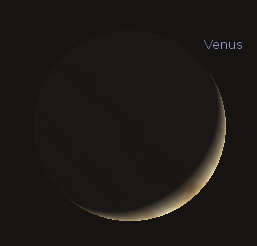
The thin crescent of Venus seen in a telescope. December 25, 2013. Created using Stellarium.
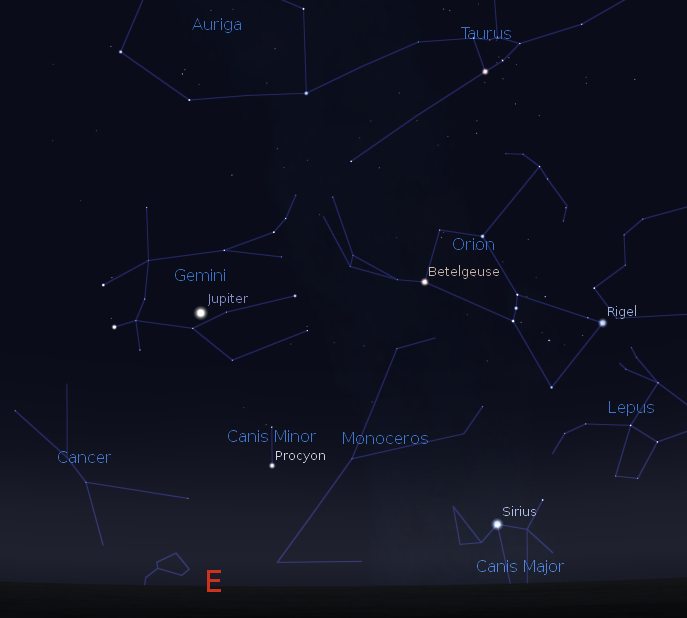
Jupiter and the constellations of winter at 9 p.m. on December 25, 2013. Created using Stellarium.
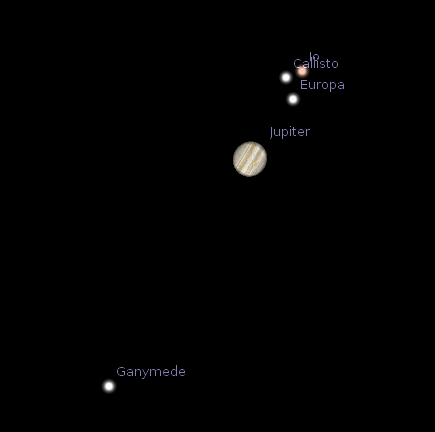
Apparent traffic jam of Jovian satellites as seen in a telescope at 9 p.m. on December 25, 2013. That actual rotation of the image depends on the telescope. Created using Stellarium.
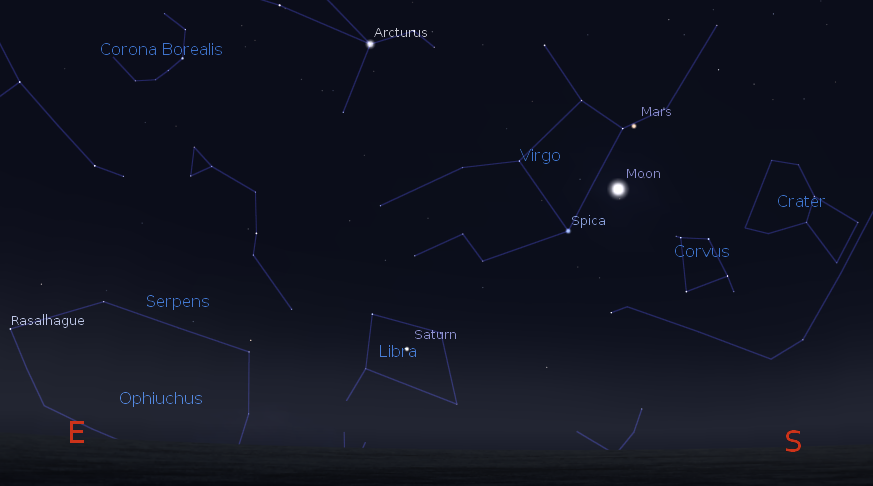
Mars and Saturn among the spring constellations at 6 a.m. December 26, 2013. Created using Stellarium.
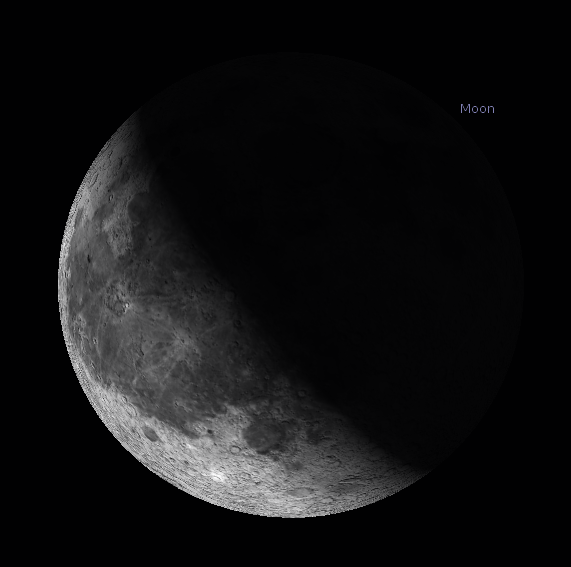
The Moon as seen in binoculars or telescope at 6 a.m. December 26, 2013. Created using Stellarium.
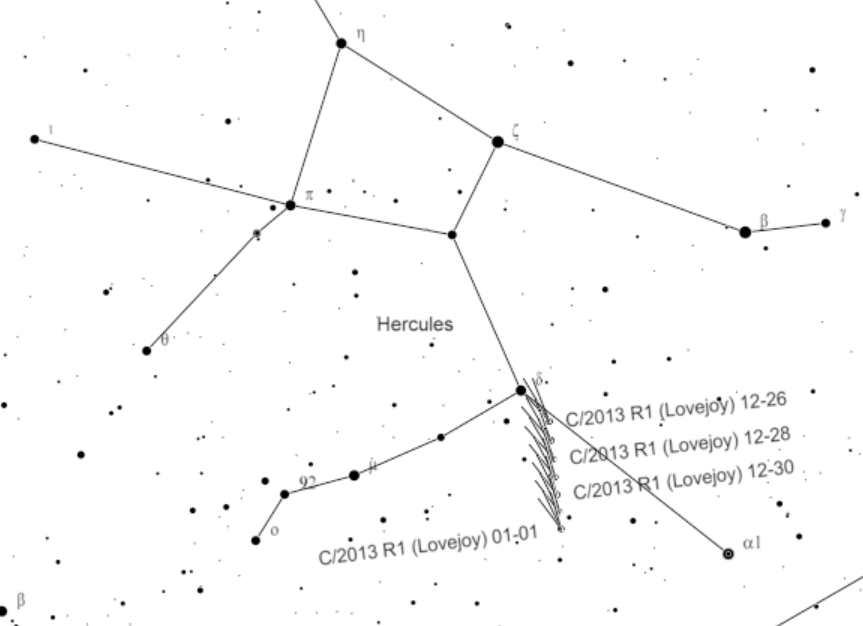
The track of Comet Lovejoy, which still should be visible in binoculars from 12/26/2013 to 01/01/2014 at 6 a.m. Created using Cartes du Ciel (Sky Charts).
Note that Stellarium and Cartes du Ciel as free programs. Links to them can be found at the right under Free Astronomical Programs.
12/18/2013 – Ephemeris – Where are the bright planets and Comet Lovejoy?
Ephemeris for Wednesday, December 18th. The sun will rise at 8:14. It’ll be up for 8 hours and 49 minutes, setting at 5:03. The moon, 1 day past full, will rise at 6:38 this evening.
This is our weekly look at the planets. Venus is brilliant in the southwest after sunset. It will set at 7:30 p.m. Venus us beginning to noticeably close with the sun. It will be gone from our evening sky in a month. Venus is a crescent, and we’re coming to the point where the crescent can be visible in binoculars. The giant planet Jupiter will rise at 6:28 p.m. in the east northeast. It’s cruising against the stars of Gemini now. It will pass due south at 2:07 a.m. Mars will rise at 1:13 a.m. in the east. Reddish Mars is closer to Spica in Virgo than to Regulus in Leo. Saturn will rise at 5 a.m. in the east southeast. There is a comet visible in binoculars in the morning sky. It’s Comet Lovejoy. A finder chart for the next week will be at bobmoler.wordpress.com with today’s transcript.
Times are for the Traverse City/Interlochen area of Michigan. They may be different for your location.
Addendum
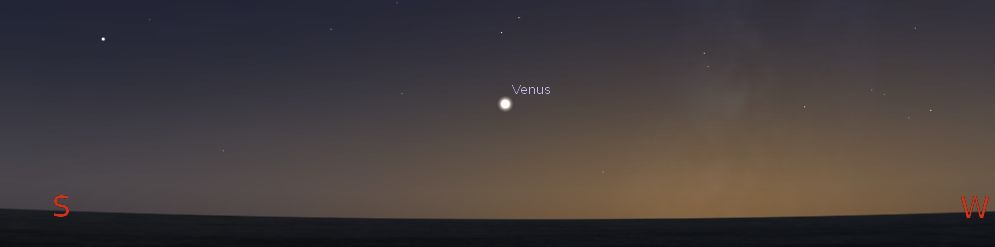
Venus in the southwest at 6 p.m. on December 18, 2013. Created using Stellarium.
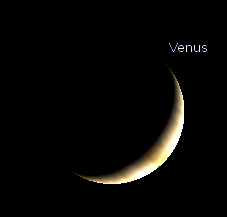
Venus as seen in a telescope at 6 p.m. December 18, 2013. The disk will be blindingly bright with no detail. Created using Stellarium.
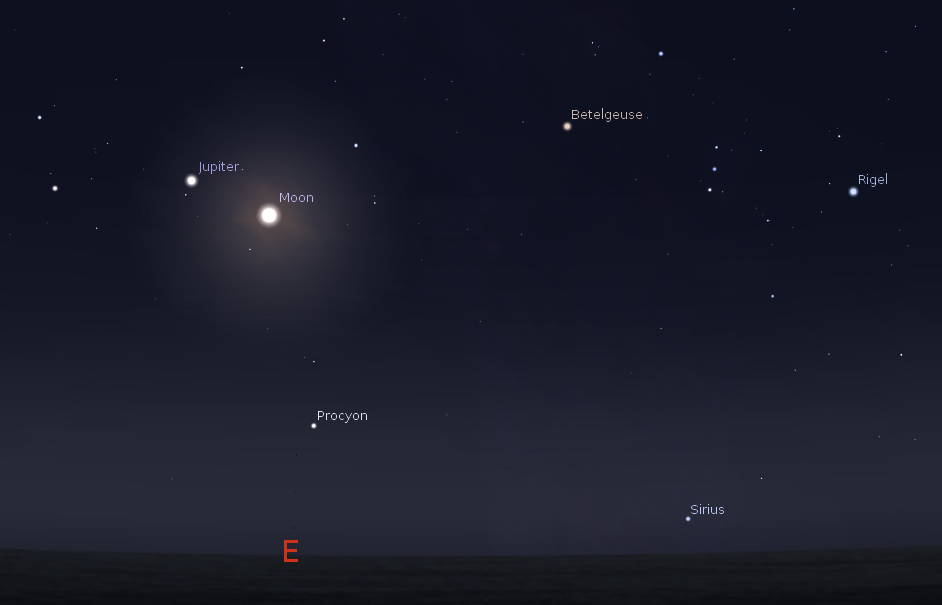
Jupiter and the Moon at 9 p.m. on December 18, 2013. Created using Stellarium.
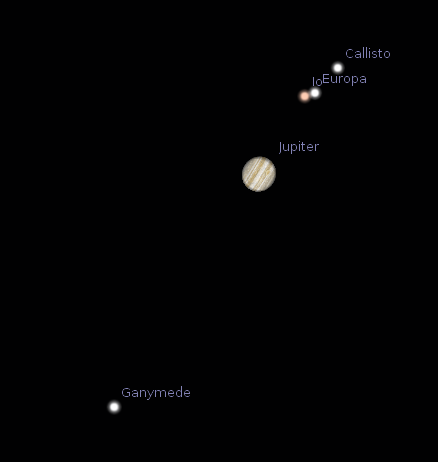
Jupiter and its moons as seen in a telescope at 9 p.m. December 18, 2013. The orientation may be rotated or even mirror image. Created using Stellarium.
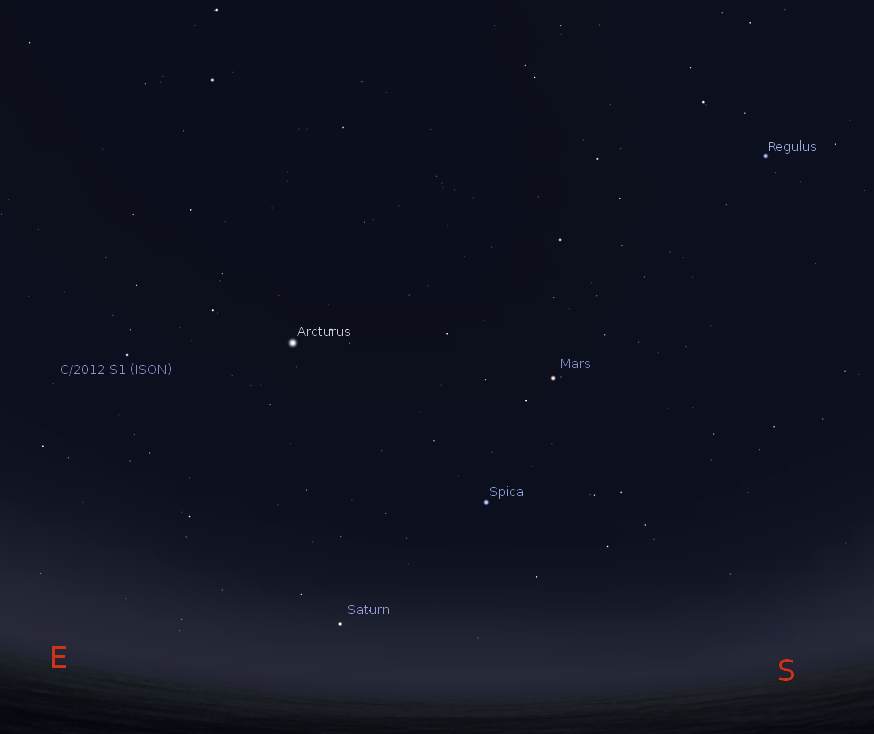
Mars, Saturn and the ghost of Comet ISON at 6 a.m. on December 19, 2013. Created using Stellarium.
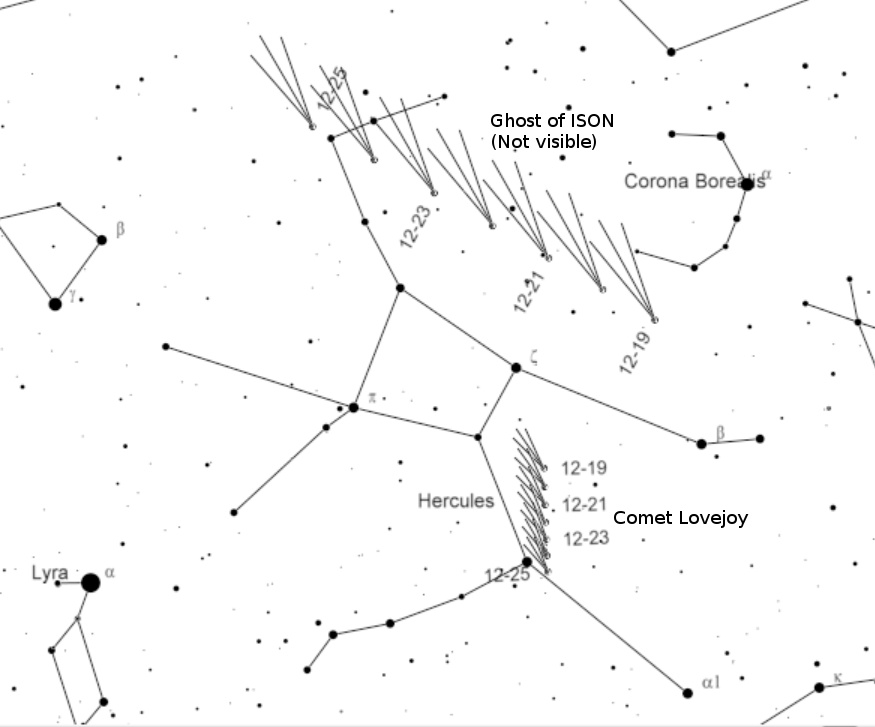
Comet Lovejoy finder chart for the next week at 6 a.m. We’re stuck also with the ghost of Comet ISON. Look in the northeast at the constellation Hercules. Created using Cartes du Ciel.
12/11/2013 – Ephemeris – Where are the bright planets this week, plus a consolation comet
Ephemeris for Wednesday, December 11th. The sun will rise at 8:09. It’ll be up for 8 hours and 52 minutes, setting at 5:02. The moon, 2 days past first quarter, will set at 3:23 tomorrow morning.
Let’s see where the bright planets are this week. Venus is brilliant in the southwest after sunset. It will set at 7:44 p.m. Venus has a crescent appearance because it is between the Earth and Sun which is easily seen in telescopes and can be detected in binoculars now. Venus is 57 million kilometers away from us now or 35.4 million miles. The giant planet Jupiter will rise at 7 p.m.. in the east northeast. It’s cruising against the stars of Gemini now. It will pass due south at 2:37 a.m. Mars will rise at 1:22 a.m. in the east. Mars is a bit closer to Spica in Virgo than Regulus in Leo, and can be distinguished by its yellow-orange color. Saturn will rise at 5:24 a.m. and should be visible low in the east south east by 6 a.m.
Times are for the Traverse City/Interlochen area of Michigan. They may be different for your location.
Addendum
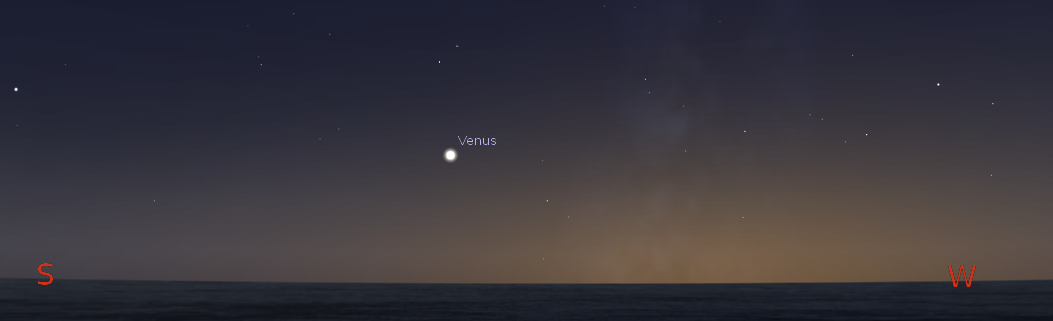
Venus in the southwest at 6 p.m. on December 11, 2013. Created using Stellarium.
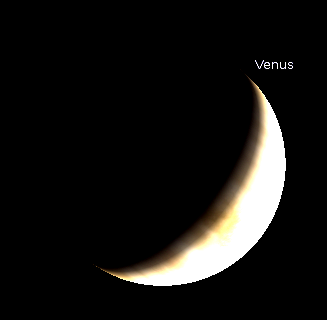
Venus as seen in a telescope at 6 p.m. December 11, 2013. The disk will be blindingly bright with no detail. Created using Stellarium.
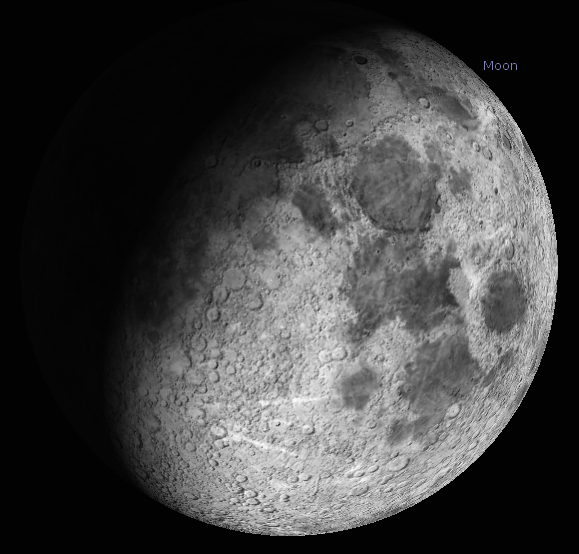
The gibbous Moon magnified at 9 p.m. on December 11, 2013. Created using Stellarium.
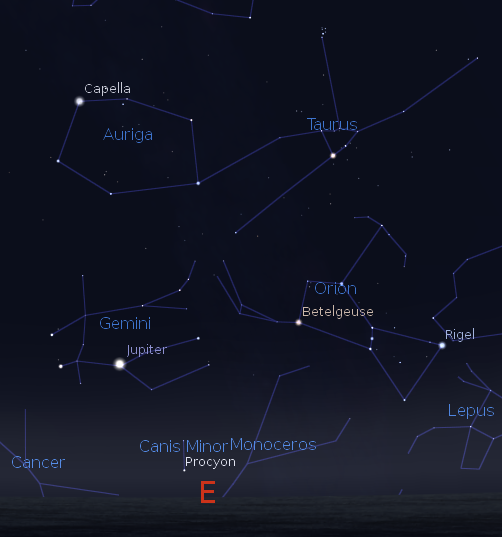
Jupiter and some winter constellations at 9 p.m. on December 11, 2013. Created using Stellarium.
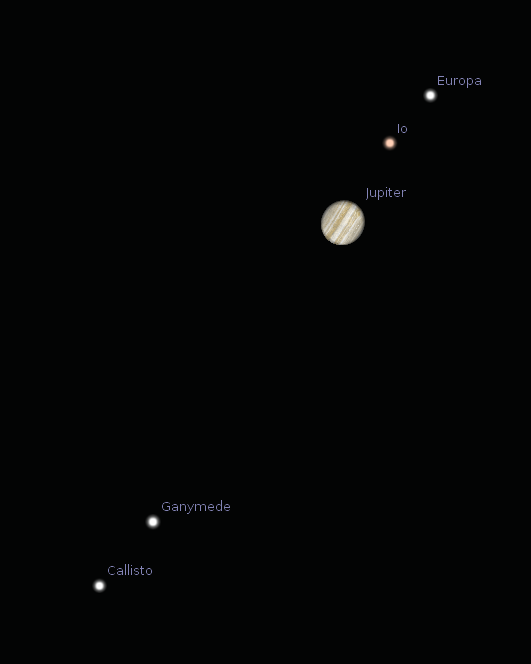
Jupiter and its moons as seen in a telescope at 9 p.m. December 11, 2013. The orientation may be rotated or even mirror image. Created using Stellarium.
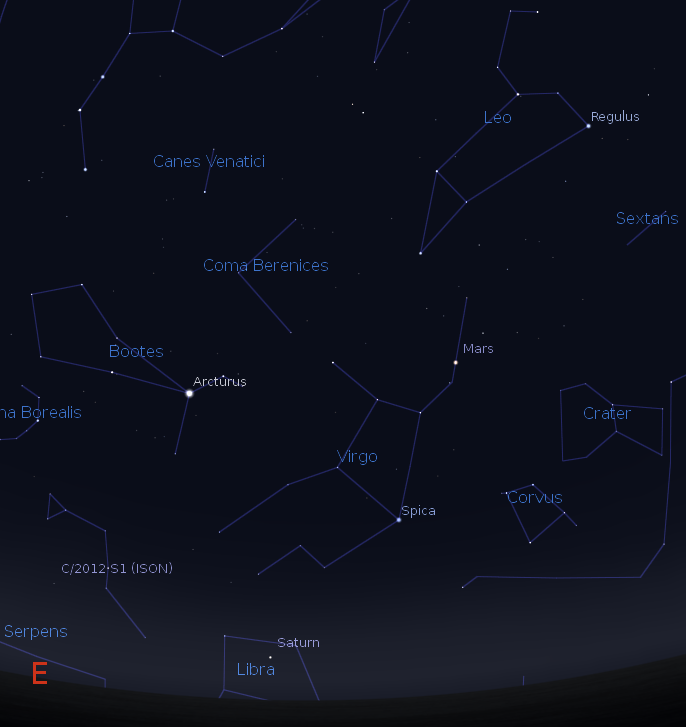
Mars, Saturn and the ghost of Comet ISON at 6 a.m. on December 12, 2013. Created using Stellarium.
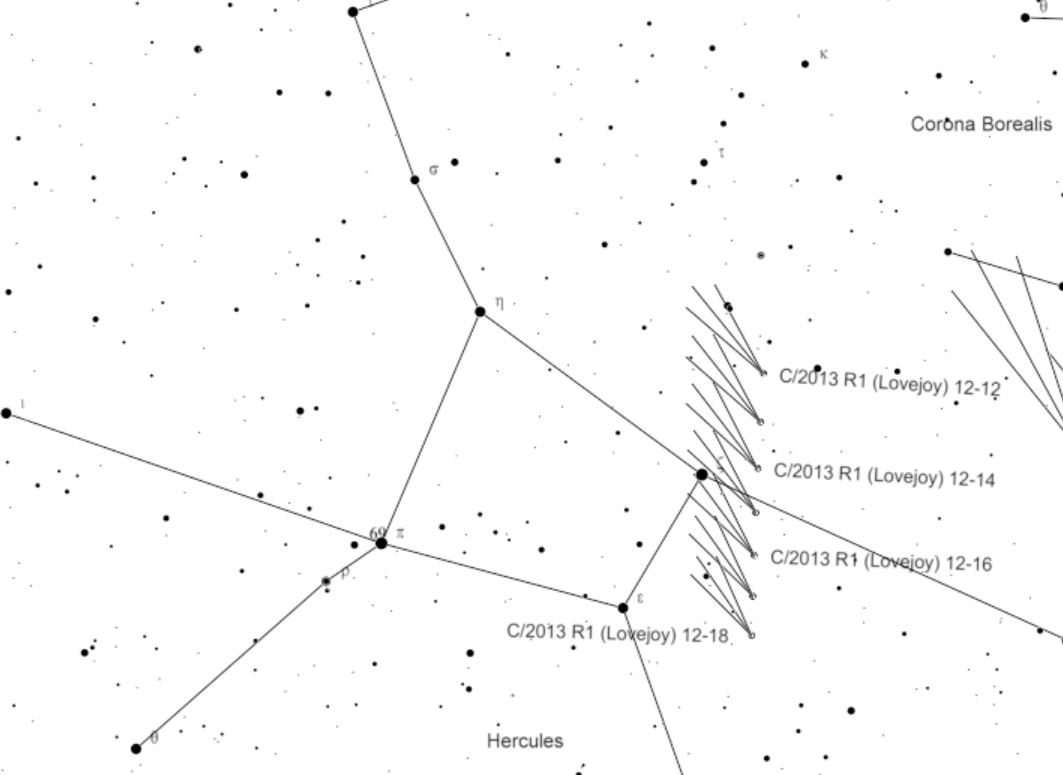
Comet Lovejoy finder chart for the next week at 6 a.m. There a bit of a tail at the right edge from the ghost of ISON (It’s not visible). Look in the northeast at the constellation Hercules with binoculars. Created using Cartes du Ciel.
Comet Lovejoy is an easy binocular object. It’s brighter than Comet ISON was in dark skies.
12/02/2013 – Ephemeris – Comet ISON: RIP (Rest In Pieces)
Ephemeris for Monday, December 2nd. The sun will rise at 8:00. It’ll be up for 9 hours and 2 minutes, setting at 5:03. The moon is new today, and won’t be visible. | I had originally intended to spend today’s program explaining how to view Comet ISON this week. That’s not to be. What can we say to Comet ISON but “Rest in Pieces”. It looks like going in to perihelion last Thursday, its closest point to the sun, ISON finally exhausted all its ices, the glue that holds all its rock and dust together. Coming out from perihelion there was a dense knot of material that gave us hope against hope that the comet survived. But alas the material spread out and got dimmer, what tail there was was definitely a dust tail, no fast moving ion tail from gas could be seen. What will be seen in the morning sky this week will probably be below naked eye visibility, but of great interest to professional astronomers.
Times are for the Traverse City/Interlochen area of Michigan. They may be different for your location.
Addendum
This is a video made from The STEREO Ahead Coronograph 2 camera of Comet ISON passing the sun.
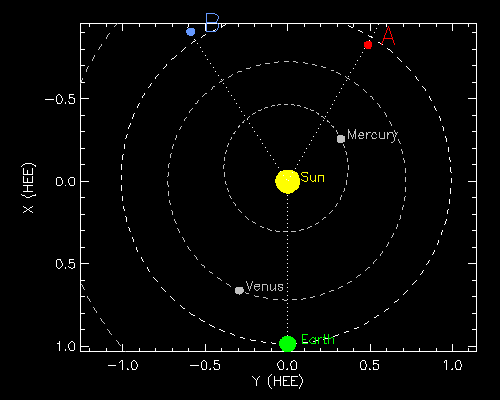
The current positions of the Earth, Sun and STEREO Ahead (A) and STEREO Behind (B) spacecraft. Credit NASA/STEREO.
Here’s Phil Plait, the Bad Astronomer‘s take on it. Besides the video above he put together another video from the SOHO LASCO C3 imager.
11/29/2013 – Ephemeris – What is left of Comet ISON?
Ephemeris for Friday, November 29th. The sun will rise at 7:57. It’ll be up for 9 hours and 7 minutes, setting at 5:04. The moon, 3 days before new, will rise at 5:02 tomorrow morning. | A funny thing happened to Comet ISON on its way to perihelion yesterday. It’s nucleus disappeared. It was dimming all morning as it approached the sun. Most of this was visible in the SOHO LASCO C3 and C2 views. The comet was also visible from the STEREO spacecraft currently on the other side of the sun. These cameras are called chronographs because they hide the bright face of the sun with a disk called an occulting disk. Just before the head of the comet was to disappear behind the disk, it disappeared all by it self, what was left was it’s tail. However later something emerged from behind the disk where the comet was supposed to be. I’m guessing it’s the large cloud of debris from the nucleus.
Times are for the Traverse City/Interlochen area of Michigan. They may be different for your location.
Addendum
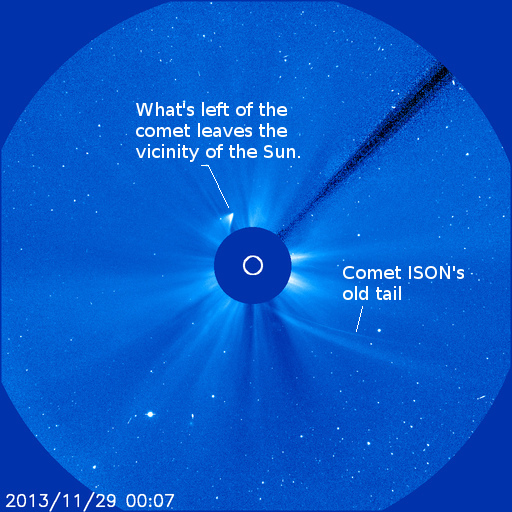
Comet ISON or what’s left of it leaving the sun at 7:07 p.m. (EST) November 28, 2013. Credit NASA/ESA/SOHO LASCO C3. Annotation: mine.
11/28/2013 – Ephemeris – Comet ISON T minus Zero day
Ephemeris for Thanksgiving Day, Thursday, November 28th. The sun will rise at 7:55. It’ll be up for 9 hours and 8 minutes, setting at 5:04. The moon, 3 days past last quarter, will rise at 3:53 tomorrow morning.
This is T minus Zero day for Comet ISON. At 1:35 this afternoon it will pass perihelion, its closest point to the sun, only a bit more than the sun’s diameter above the bright ball of the sun’s photosphere. It’s will look closer than that because the comet will be slightly behind the sun. It will still be visible in the Solar Dynamic Observatory’s telescopes. To check on the comet throughout the day go on the Internet go to spaceweather.com at the page bottom click on STEREO, then click on Latest Images You can call up the Solar Dynamics Observatory (SDO) and the SOHO LASCO images, or go to bobmoler.wordpress.com. I’m sure by tomorrow there will be time-lapse movies on Universe Today.
Times are for the Traverse City/Interlochen area of Michigan. They may be different for your location.
Addendum
There is a NASA sponsored Google + Hangout that will be transmitted on all NASA TV channels.
November 28, Thursday
1 – 3:30 p.m. EST – NASA Google+ Hangout: Comet ISON – GSFC (All Channels)
Here’s a link to NASA-TV: http://www.nasa.gov/multimedia/nasatv/
SOHO LASCO C3 image as of this update (10:10 EST 11/27/13):
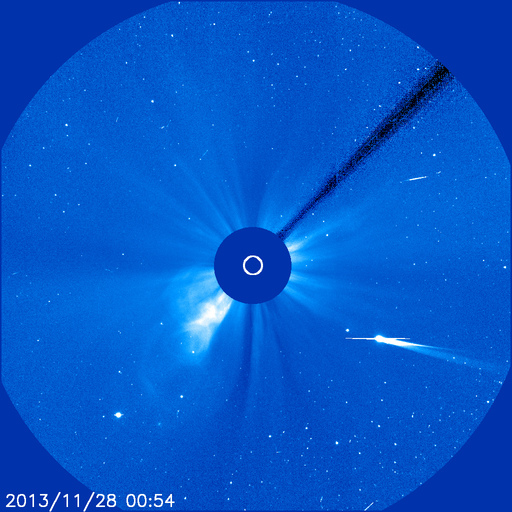
SOHO LASCO C3 image of the sun and Comet ISON. Image timestamped 11/28/13 at 00:54 UT. 7:54 p.m. November 27, 2013 EST. Credit NASA/ESA.
 Bob Moler's Ephemeris Blog