Archive
11/12/2013 – Ephemeris – Not one but four comets grace the morning sky now
Ephemeris for Tuesday, November 12th. The sun will rise at 7:35. It’ll be up for 9 hours and 42 minutes, setting at 5:17. The moon, 2 days past first quarter, will set at 3:19 tomorrow morning.
Comet ISON has competition in the morning sky now. There are actually three other comets within range of telescopes gracing our morning sky now. Comet ISON is still not brightening as predicted. It is still 2 to 3 times dimmer than predicted. Comet Encke is still brighter, Comet C/2013 R1 (Lovejoy) discovered two months ago is almost as bright as ISON. It’s moving between Cancer and Leo now. C/2012 X1 (LINEAR) is the faintest of the four and a tough one to spot. It will appear to pass the bright star Arcturus a week from now. I’ll have finder charts for all these comets at bobmoler.wordpress.com with today’s transcript. Apparently the nucleus of ISON is still holding together.
Times are for the Traverse City/Interlochen area of Michigan. They may be different for your location.
Addendum
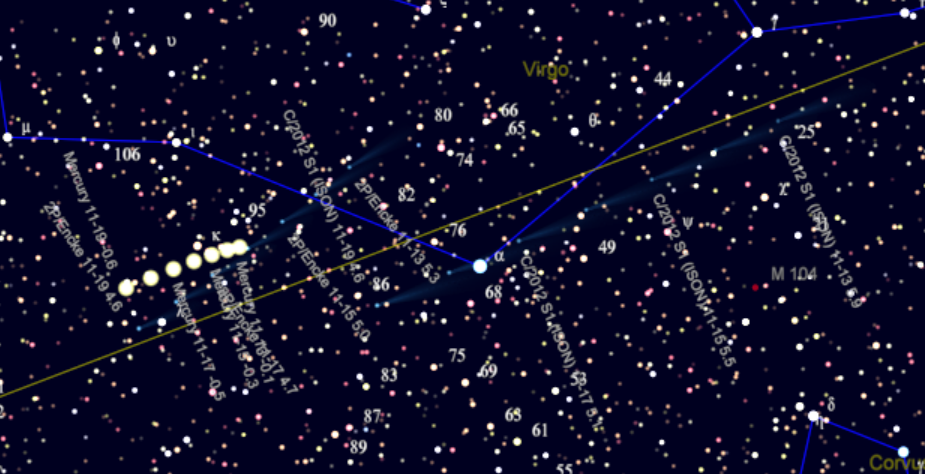
This is a busy chart with Comets ISON and Encke and Mercury for the period November 13th through 19th of November 2013 at 6 a.m. Created using Carts du Ciel.
Note that the star designated α is Spica, Alpha Virginis.
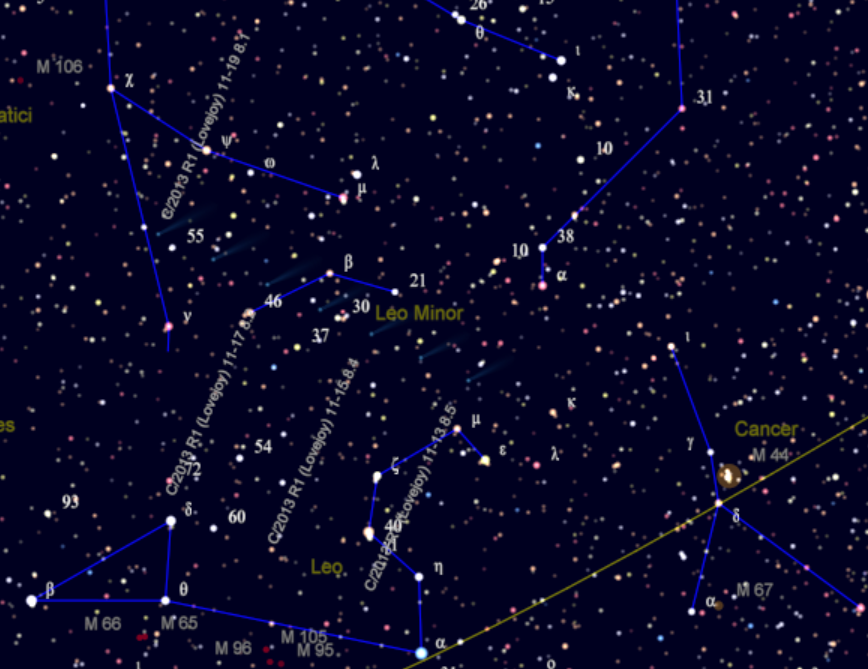
Comet Lovejoy and the constellation Leo for November 13th through 19th, 2013 at 6 a.m. Created using Cartes du Ciel.
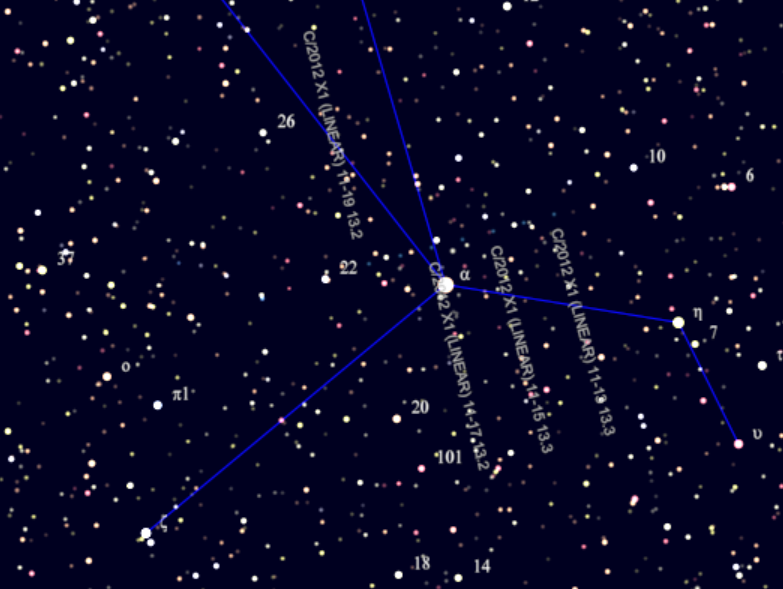
Comet LINEAR track for November 13th through 19th 2013. Created using Cartes du Ciel.
The star designated α is Arcturus or Alpha Boötis. The brightest star is Boötes. Remember follow the arc of the Big Dipper handle to Arcturus.
The following are the latest magnitudes (brightnesses) recorded for these comets:
Comet               Magnitude
C/2012 S1 (ISON)    8  (1 magnitude dimmer than predicted)
P2 (Encke)          8
C/2013 R1 (Lovejoy) 6  (2.5 magnitudes brighter than predicted)
C/2012 X1 (LINEAR)  8  (5 magnitudes* brighter than predicted)
* 5 magnitudes brighter = 100 times brighter!
Source is http://www.icq.eps.harvard.edu/CometMags.html.  Search page using the C/???? ?? instead of name.  Comets Lovejoy and LINEAR have multiple entries.
11/06/2013 – Ephemeris – Where’s the bright planets and comets this week?
Ephemeris for Wednesday, November 6th. The sun will rise at 7:27. It’ll be up for 9 hours and 57 minutes, setting at 5:24. The moon, 3 days past new, will set at 8:25 this evening.
Let’s check out the bright planets. Venus is brilliant in the west southwest after sunset. It will set at 7:46 p.m. The giant planet Jupiter will rise at 9:27 p.m. in the east northeast. It’s cruising against the stars of Gemini now. It will pass due south at 5:04 a.m. Mars will rise at 2:01 a.m. also in the east northeast. Reddish Mars is below and left of the slightly brighter star Regulus in Leo now. It’s in the east at 5 a.m. Comet ISON is nearly the distance below Mars that Mars is below Regulus and nearly in line with the two. My guesstimate for magnitude is about 8, about half as bright as current predictions, but probably visible in small telescopes. Comet ISON will rise about 3:30 a.m. and be visible before the sky begins to brighten around 6 a.m.
Times are for the Traverse City/Interlochen area of Michigan. They may be different for your location.
Addendum
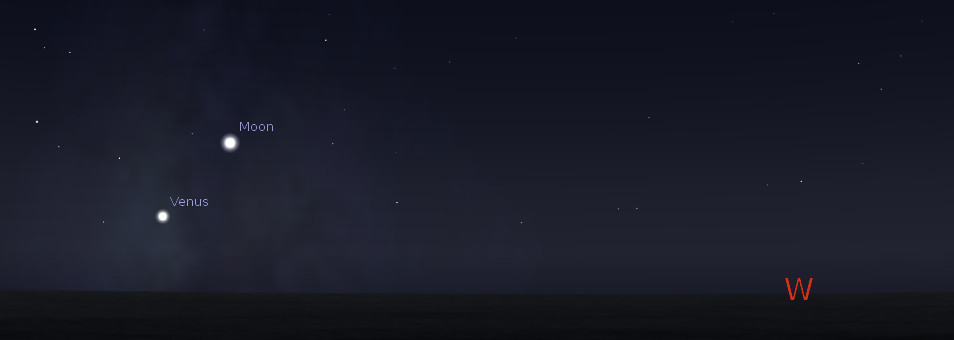
Venus and the Moon at 7 p.m. November 6, 2013. Created using Stellarium.
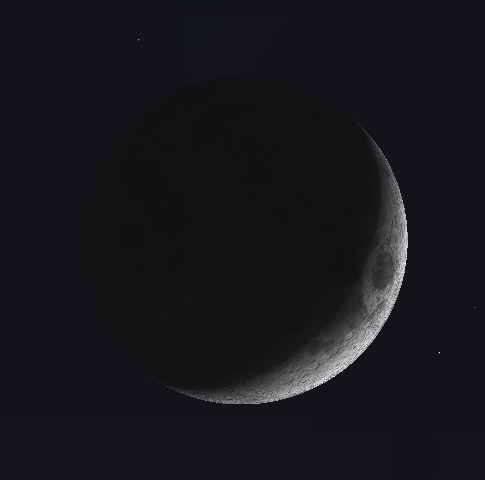
Closeup of the Moon at 7 p.m. November 6, 2013. Created using Stellarium.
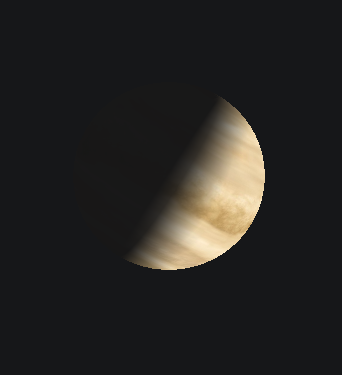
Telescopic view of Venus at 7 p.m. November 6, 2013. Created using Stellarium. The faint stripes are not seen in visible light.
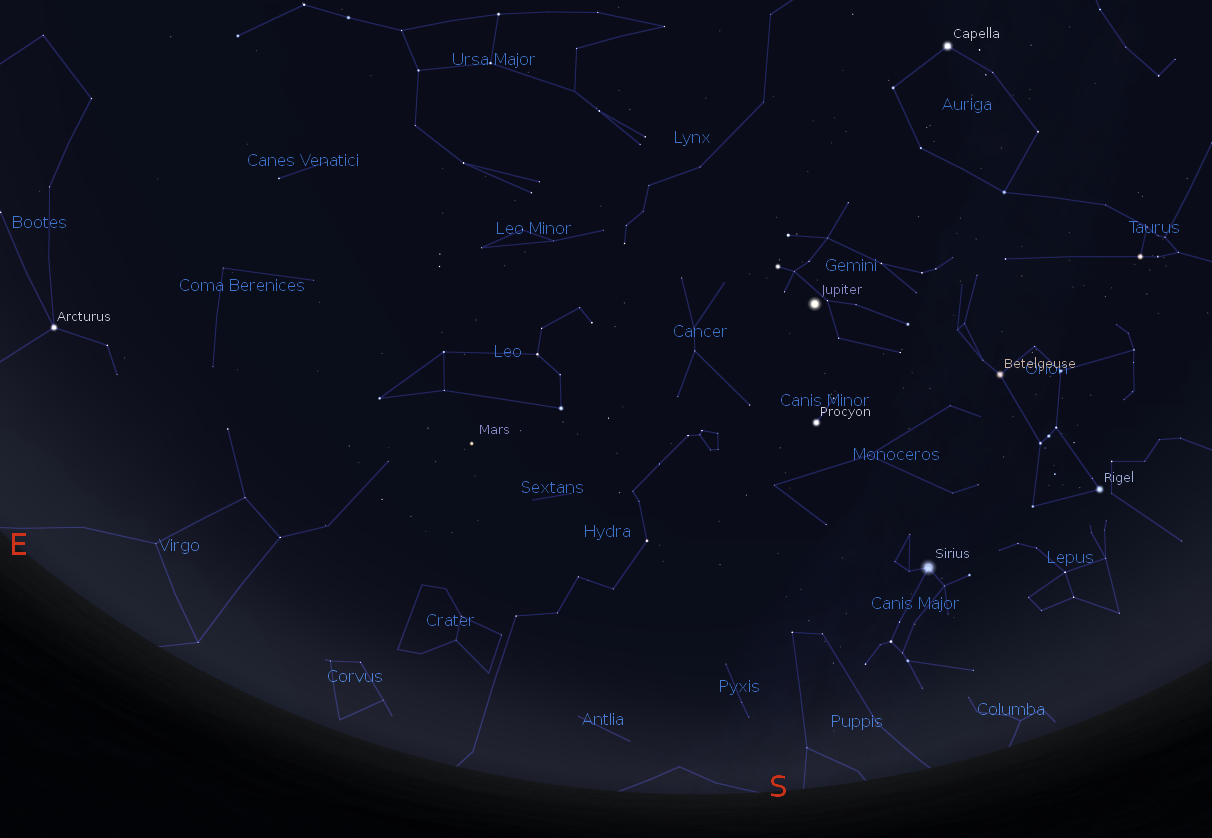
Jupiter and Mars with the winter and spring constellations at 6 a.m. November 7, 2013. Created using Stellarium.
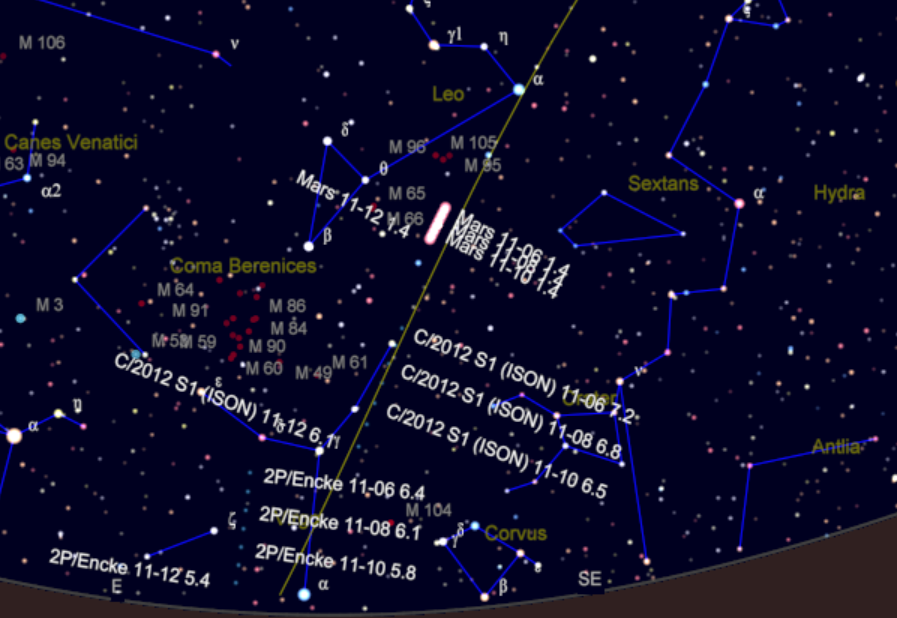
Comets ISON and Encke and Mars at 6 a.m. from November 5 to 12, 2013. Created with Cartes du Ciel.
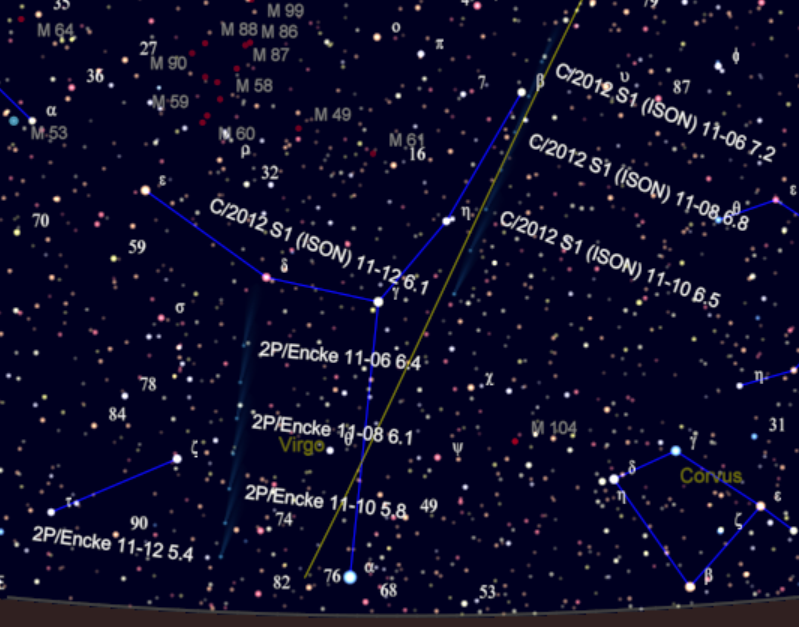
Closeup charts of comets ISON and Encke at 6 a.m. for November 6 through 12, 2013. Created using Cartes du Ciel.
11/05/2013 – Ephemeris – Latest on Comet ISON
Ephemeris for Election Day, Tuesday, November 5th. The sun will rise at 7:25. It’ll be up for 9 hours and 59 minutes, setting at 5:25. The moon, 2 days past new, will set at 7:23 this evening.
I’ve seen some observed brightness measurements of Comet ISON reported to the Minor Planet Center, which is the clearing house for all things asteroid and comet related, and Comet ISON is still fainter than predicted by a factor of two. There was one report of someone spotting it with 10X50 binoculars. From all the reports I’ve seen the comet’s nucleus is holding together, and there is great optimism that ISON will survive its close brush with the sun on Thanksgiving day. Some astronomers think that the comet’s nucleus spin axis is currently pointed toward the sun. After perihelion or closest approach to the sun, the opposite pole will be exposed showing fresh material to the sun for a brighter comet in December.
Times are for the Traverse City/Interlochen area of Michigan. They may be different for your location.
Addendum
Comets ISON and Encke and Mars at 6 a.m. from November 6 to 12, 2013. Created with Cartes du Ciel.
Closeup charts of comets ISON and Encke at 6 a.m. for November 6 through 12, 2013. Created using Cartes du Ciel.
11/04/2013 – Ephemeris – Comet ISON shares the morning sky with Encke’s Comet
Ephemeris for Monday, November 4th. The sun will rise at 7:24. It’ll be up for 10 hours and 2 minutes, setting at 5:26. The moon, 1 day past new, will set at 6:28 this evening.
Yesterday was the peak of the Taurid meteor shower, it was lost in all the other news we had last week. But the source of the Taurid meteor shower is Encke’s Comet. Next to Halley’s Comet it’s that oldest known periodic comet with the designation 2P (Encke). It has the shortest orbit of any known comet of 3.3 years. It also happens that Encke is in the same part of the sky as Comet ISON, and currently outshines it, and if the magnitude projections are correct, and they often aren’t, especially for ISON, will outshine Comet ISON until November 19th, 9 days before ISON’s closest approach to the sun. Both comets will seem to converge for a while. In the last photograph I saw Encke didn’t have a tail, but had a large coma or head and a bright nuclear region.
Times are for the Traverse City/Interlochen area of Michigan. They may be different for your location.
Addendum
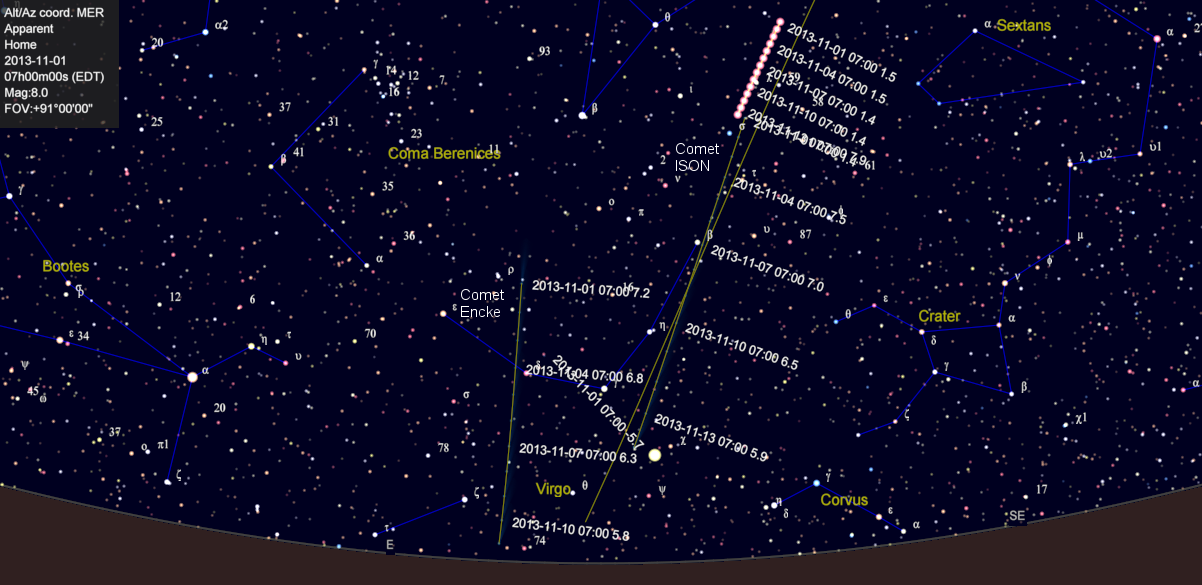
Mars, Comets ISON and Encke on the morning sky for the first part of November 2013. Created using Cartes du Ciel. Click on image to enlarge.
The positions every three days also show the predicted magnitudes of the comets. ISON appears to be a magnitude dimmer. There is also a rogue position of the moon in the image. I had to allow it to display Mars’ positions.
11/01/2013 – Ephemeris – Preview of Comet ISON plus a star party tonight in Traverse City
Ephemeris for Friday, November 1st. The sun will rise at 8:20. It’ll be up for 10 hours and 10 minutes, setting at 6:31. The moon, 2 days before new, will rise at 7:16 tomorrow morning.
This evening’s meeting of the Grand Traverse Astronomical Society starting at 8 p.m. at Northwestern Michigan College’s Rogers Observatory will be a special one. Yours truly will preview the viewing prospects for Comet ISON for this and next month. What will happen? Where do I look to see it? Will it be the comet of the century? On that last question, I can give an answer right now, we’ll know immediately if it isn’t. We probably won’t know for 87 years if it is. The century is still young. Due to the extreme interest in this subject, the visuals and other information from the talk will be released to the society’s gtastro.org web site. At 9 p.m. there will be a star party at the observatory, and another program if it’s cloudy.
Times are for the Traverse City/Interlochen area of Michigan. They may be different for your location.
Addendum
Click on image for slides from tonight’s talk:
10/31/2013 – Ephemeris – A look ahead at the skies of November
Ephemeris for Halloween, Thursday, October 31st. The sun will rise at 8:19. It’ll be up for 10 hours and 13 minutes, setting at 6:32. The moon, 3 days before new, will rise at 6:07 tomorrow morning.
Let’s look at the skies for the month of November. Comet ISON will continue to brighten this month, but will encounter bright twilit skies as it closes in with the sun the week of Thanksgiving. I’m hoping the comet will be visible to the naked eye by mid-month. The sun is still moving south rapidly. Daylight hours in the Interlochen/Traverse City area and will drop from 10 hours and 10 minutes tomorrow to 9 hours 5 minutes on the 30th. The altitude, or angle, of the sun above the southern horizon at local noon will be at 30 degrees tomorrow and will descend to 23 and a half degrees on the 30th. The altitude of the sun in the Straits area will be a degree lower. Local noon, this month, will be about 12:30 p.m. when standard time returns.
Times are for the Traverse City/Interlochen area of Michigan. They may be different for your location.
Addendum
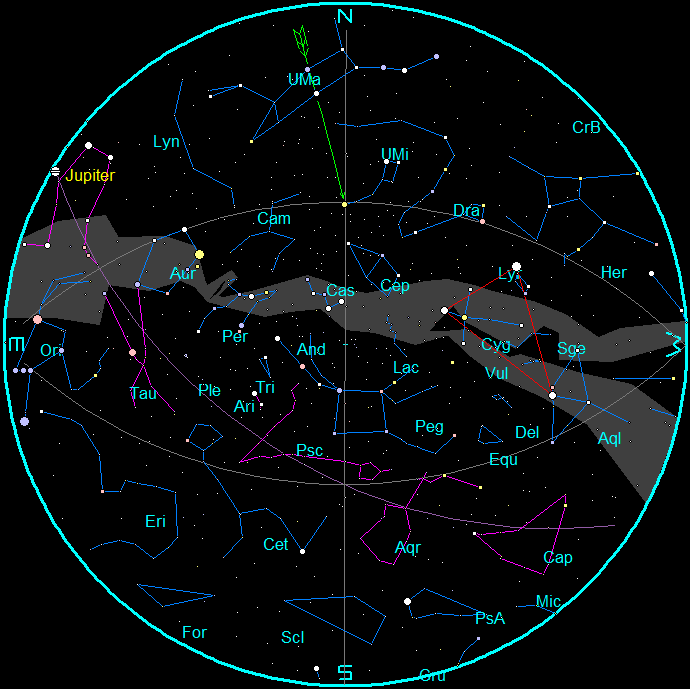
Star Chart based on 9 p.m. on November 15, 2013. Created using my program LookingUp.
The constellation abbreviations, names and bright star names are found here.
The red triangle is the Summer Triangle. The arrow through then front of the Big Dipper point to Polaris.
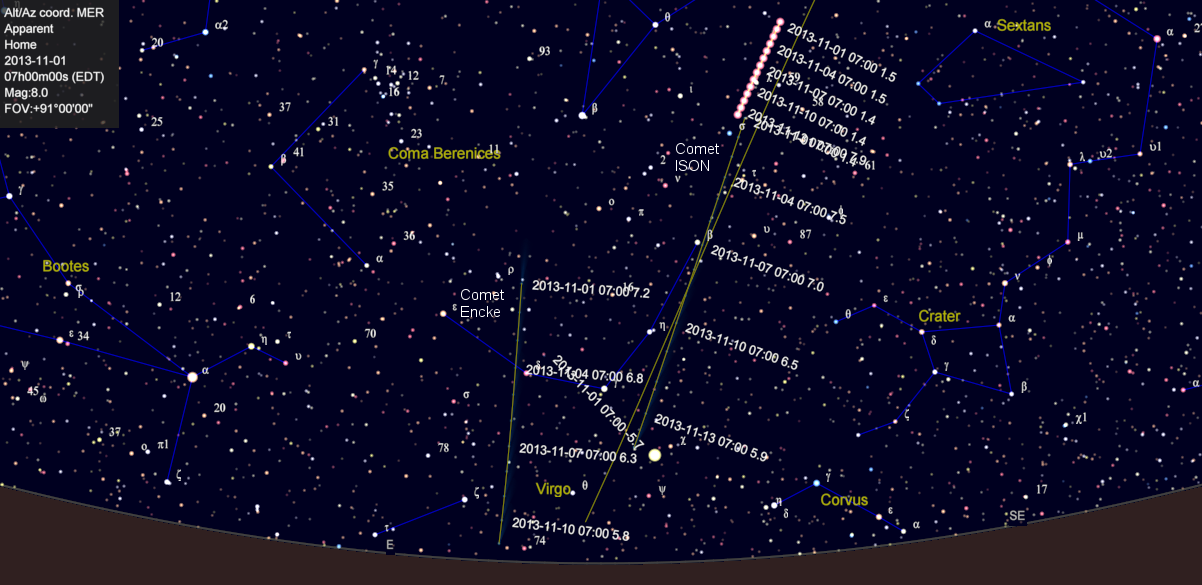
The path of Comet ISON and Comet Encke for November 1st through 14th, 2013. Created using Cartes du Ciel. Labels contain date and predicted magnitude. Click to enlarge.
Comet ISON will remain an early morning comet for November and most of December.
The oddball object with the skewed label is the moon.
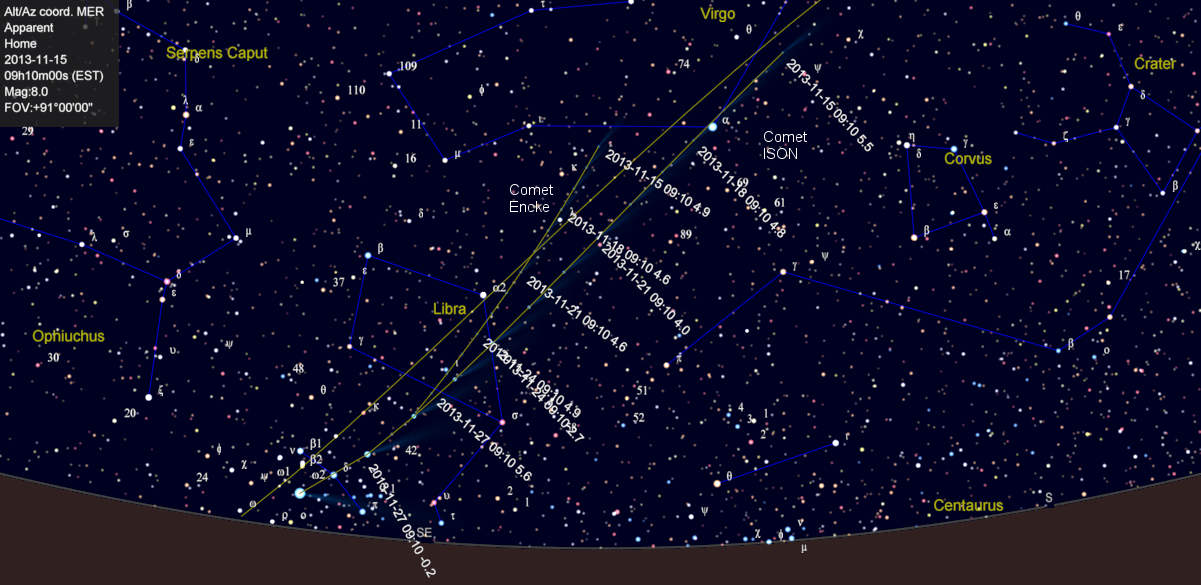
The path of Comet ISON and Comet Encke for November 15th through 28th, 2013. Created using Cartes du Ciel. The planets, Sun and Moon have been removed for clarity. Labels contain date and predicted magnitude. Click to enlarge.
The above two images are from my program Prospects for Viewing Comet ISON to be given tomorrow night at the regular meeting of the Grand Traverse Astronomical Society starting at 8 p.m. at Northwestern Michigan College’s Rogers Observatory south of Traverse City on Birmley Road.
Local school groups or clubs ca request the program by commenting to this post or emailing to info@gtastro.org.
10/30/2013 – Ephemeris – Where are the bright planets and Comet ISON now?
Ephemeris for Wednesday, October 30th. The sun will rise at 8:17. It’ll be up for 10 hours and 16 minutes, setting at 6:33. The moon, half way from last quarter to new, will rise at 5:01 tomorrow morning.
Let’s check out the bright planets. Venus is brilliant in the west southwest after sunset. Friday it will be at its greatest separation or elongation from the sun. Venus will set at 8:44 p.m. The giant planet Jupiter will rise at 10:55 p.m. in the east northeast. It’s cruising against the stars of Gemini now. It will pass due south at 6:31 a.m. Mars will rise at 3:08 a.m. also in the east northeast. Reddish Mars is below and left of the slightly brighter star Regulus in Leo now. It’s in the east at 6 a.m. Comet ISON is two-thirds the distance below Mars that Mars is below Regulus and nearly in line with the two. My guesstimate for magnitude is about 9, probably visible in telescopes. I haven’t seen it since earlier this month.
Times are for the Traverse City/Interlochen area of Michigan. They may be different for your location.
Addendum
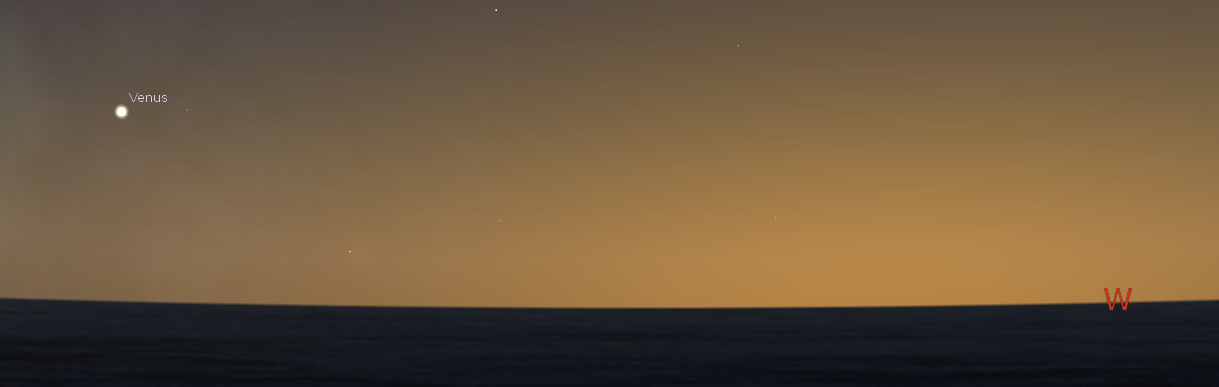
Venus in twilight at 7:15 p.m. on October 30, 2013. Created using Stellarium.
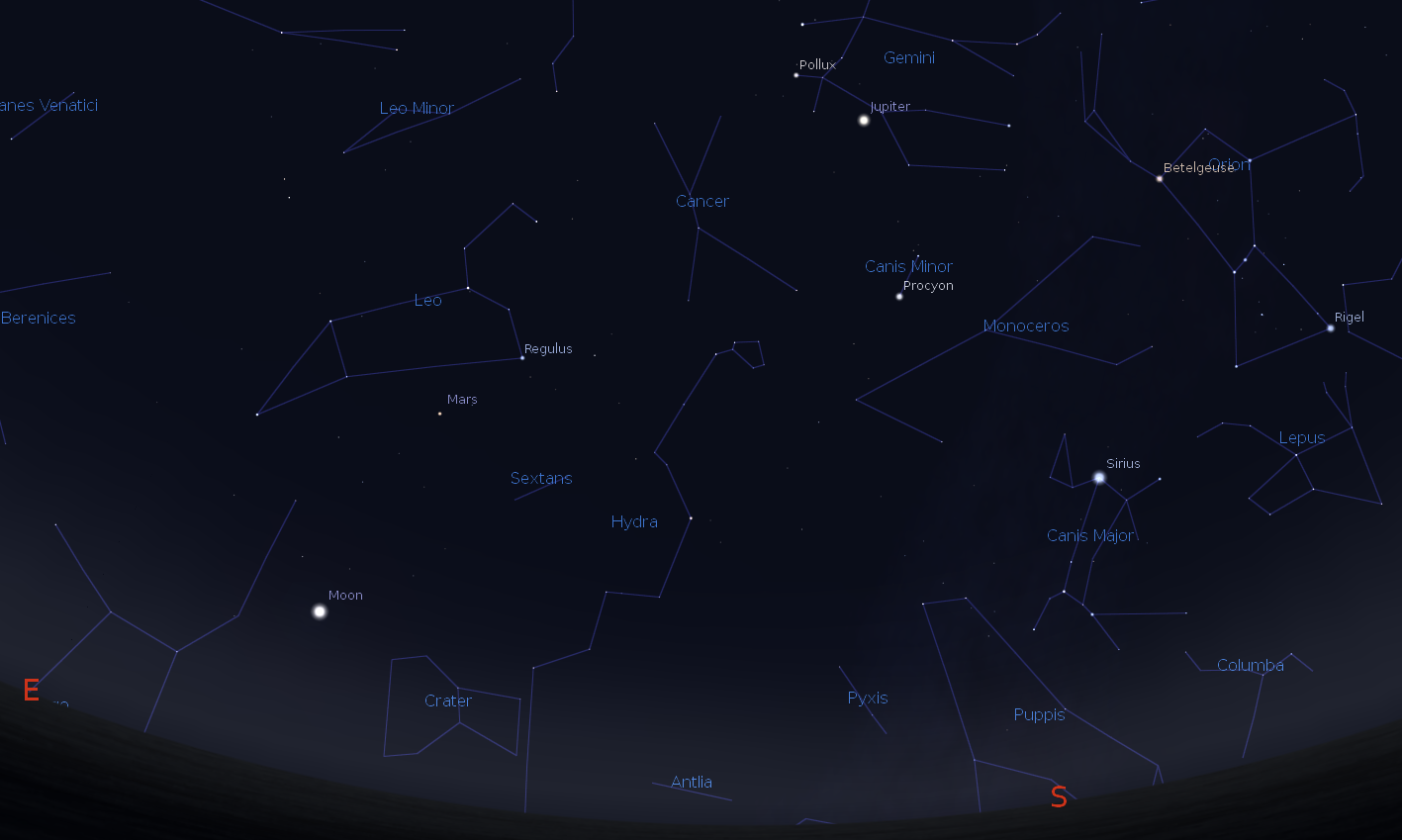
Jupiter and Mars at 6:30 a.m. October 31, 2013. Created using Stellarium.
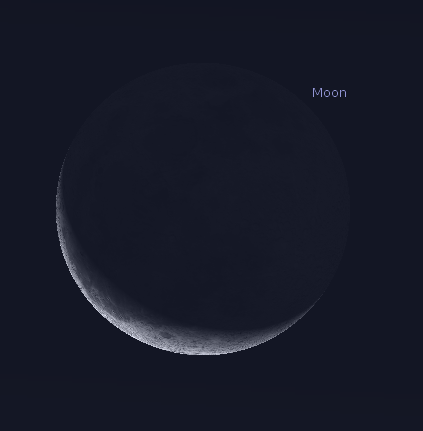
Closeup of the Moon at 6:30 a.m. on October 31, 2013. Created using Stellarium.
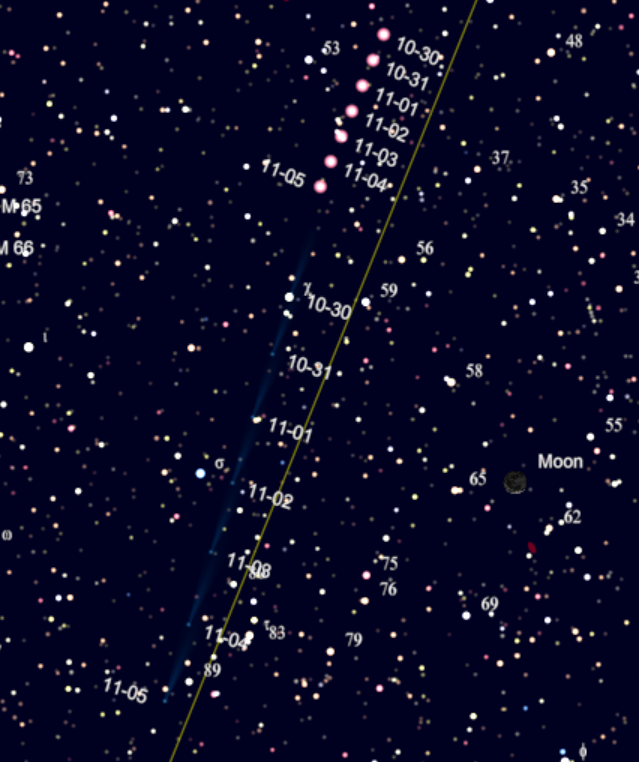
Comet ISON for October 30 to November 5, 2013. Created using Cartes du Ciel.
Click on the images to enlarge.
10/29/2013 – Ephemeris – Comet ISON 30 days before perihelion
Ephemeris for Tuesday, October 29th. The sun will rise at 8:16. It’ll be up for 10 hours and 18 minutes, setting at 6:35. The moon, 3 days past last quarter, will rise at 3:56 tomorrow morning.
In 30 days Comet ISON will meet its date with the sun. November 28th, Thanksgiving day Comet ISON will whip around the sun, and to us will seem to be sent at a near 90 degree angle from heading eastward to heading nearly due northward. That’s an illusion because we, on the earth will be moving, in effect under it. The closest Comet ISON will get to us is just under 40 million miles on December 26th and 27th. The morning waning crescent is no longer affecting the visibility of the comet, so barring clouds, it should be visible in dark skies in small telescopes. The website gtastro.org now has lots of information on the comet and where you can find more from good sources. I’ll tell you more on Friday.
Times are for the Traverse City/Interlochen area of Michigan. They may be different for your location.
Addendum
This is the major document from the Gtastro website cited above: The article from the GTAS Stellar Sentinel plus extra charts and information for viewing Comet ISON at perihelion (closest approach to the sun) safely online.
10/22/2013 – Ephemeris – Misinformation about Comet ISON: It ain’t Nibiru
Ephemeris for Tuesday, October 22nd. The sun will rise at 8:07. It’ll be up for 10 hours and 38 minutes, setting at 6:45. The moon, half way from full to last quarter, will rise at 9:19 this evening.
Don’t believe a lot of what you hear about Comet ISON from friends or the Internet. YouTube, for instance, has some good information, and some really nutty stuff. A couple of items to debunk right here. No, Comet ISON is not the rogue planet Nibiru. Nibiru was a Babylonian astronomical term, probably for the summer solstice point in the sky, not a planet. Ill-informed people want to frighten you by attaching the name to about any bright comet that comes along. I can tell because their knowledge of astronomical terms and planetary orbits is way off base. While the head of a comet can swell up to be greater than the size of the earth, it’s still a pretty good vacuum. We’ve sent spacecraft into cometary heads which have all survived.
Times are for the Traverse City/Interlochen area of Michigan. They may be different for your location.
10/23/2013 – Ephemeris – Where are the bright planets and Comet ISON for this week?
Ephemeris for Wednesday, October 23rd. The sun will rise at 8:08. It’ll be up for 10 hours and 35 minutes, setting at 6:44. The moon, 3 days before last quarter, will rise at 10:08 this evening.
Time again to check out the bright planets. Venus is brilliant in the west southwest after sunset. It will set at 8:44 p.m. The next planetary action will have to wait till after 11 p.m. The giant planet Jupiter will rise at 11:21 p.m. in the east northeast. It’s cruising against the stars of Gemini now. It will pass due south at 6:57 a.m. Mars will rise at 3:14 a.m. also in the east northeast. Reddish Mars is below and left of the slightly brighter star Regulus in Leo now. It’s in the east at 6 a.m. Comet ISON is a bit less than half the distance below Mars that Mars is below Regulus and in line with the two. The bright moon will interfere with spotting it. My guesstimate for magnitude is about 9.5, probably visible in telescopes if the moon wasn’t out.
Times are for the Traverse City/Interlochen area of Michigan. They may be different for your location.
Addendum:
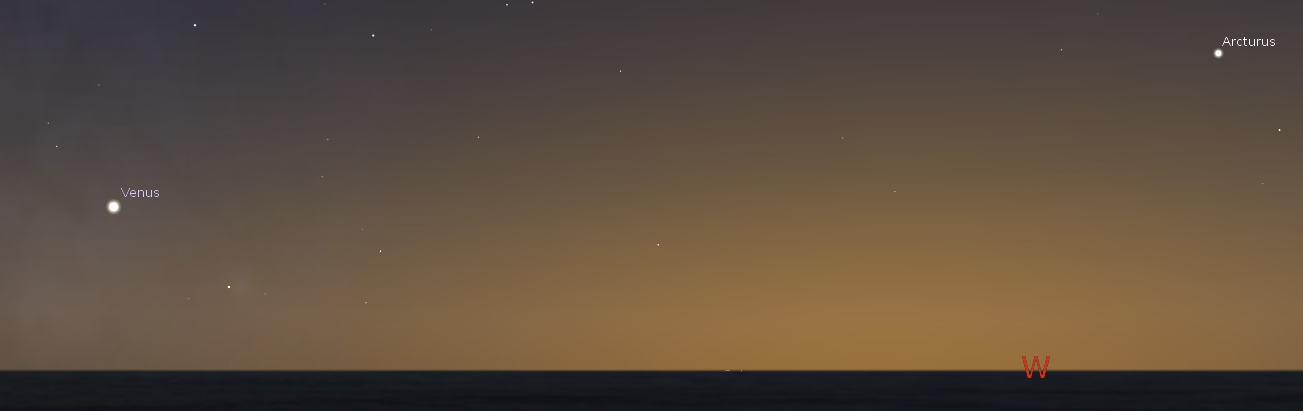
Venus low in the west southwest at 7:30 p.m. on October 23, 2013. Created using Stellarium
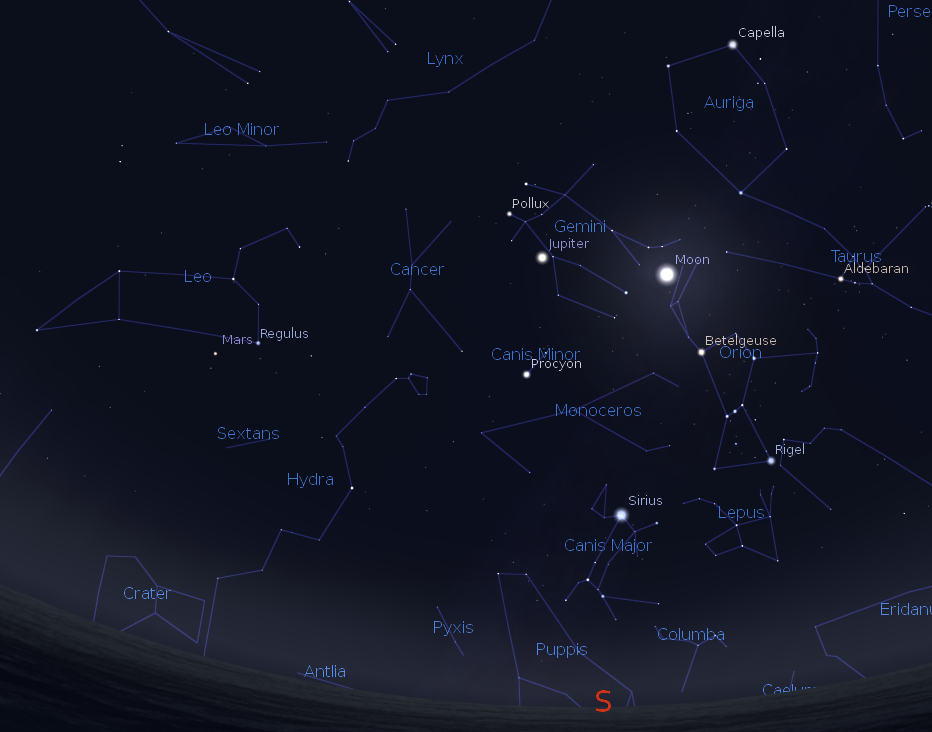
Jupiter, Mars and the Moon with the Winter and some spring constellations at 6:30 a.m. on October 24, 2013. Created using Stellarium.
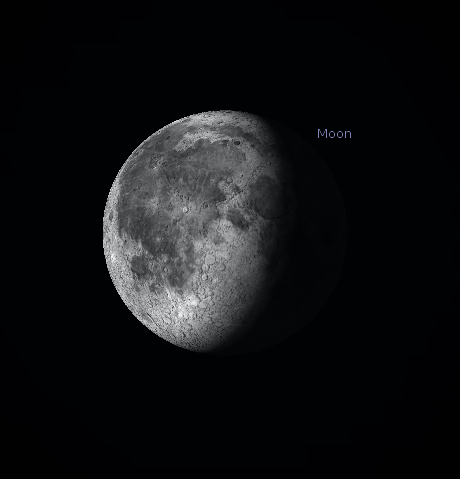
The moon’s phase the morning of October 24, 2013. Created using Stellarium.
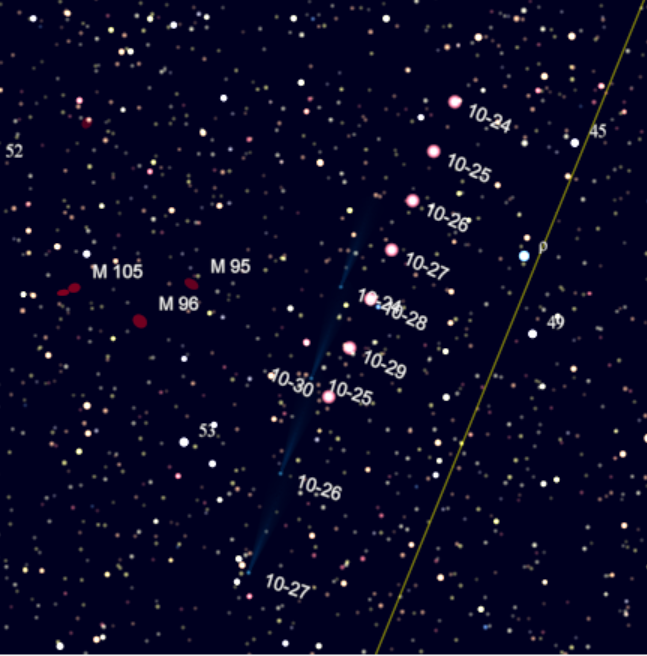
Mars and Comet ISON daily track from October 24th to the 30th, 2013. Be sure to match Mars dates with the comet dates. Created using Cartes du Ciel (Sky Charts).
 Bob Moler's Ephemeris Blog