Archive
03/13/2013 – Ephemeris – Comet PanSTARRS and two bright planets
Ephemeris for Wednesday, March 13th. The sun will rise at 7:58. It’ll be up for 11 hours and 48 minutes, setting at 7:46. The moon, 2 days past new, will set at 10:10 this evening.
It’s time to check out a comet and the two remaining bright planets for this week. Comet PanSTARRS is in the west, moving away from the sun, and not getting that much higher in the west as it moves northward rather than eastward. The comet will set at 9:11. The tail may still be visible after the head sets. Jupiter is located in the constellation of Taurus and is in the high southwest during the evening. It will set at 2:19 a.m. Jupiter is a wonderful sight in telescopes with its cloud bands and its moons which change positions each night. The other bright planet Saturn will rise at 11:42 p.m. in the east southeast. It’s located in eastern Virgo. Saturn will pass due south at 4:52 a.m. Saturn is the most beautiful of planets.
Times are for the Traverse City/Interlochen area of Michigan. They may be different for your location.
Addendum

Comet PanSTARRS and the moon at 45 minutes after sunset on March 13, 2013. Created using Stellarium, Cartes du Ciel and my LookingUp program.
See yesterdays post on how the image was created. The moon’s size annd the comet’s brightness are exaggerated a bit.
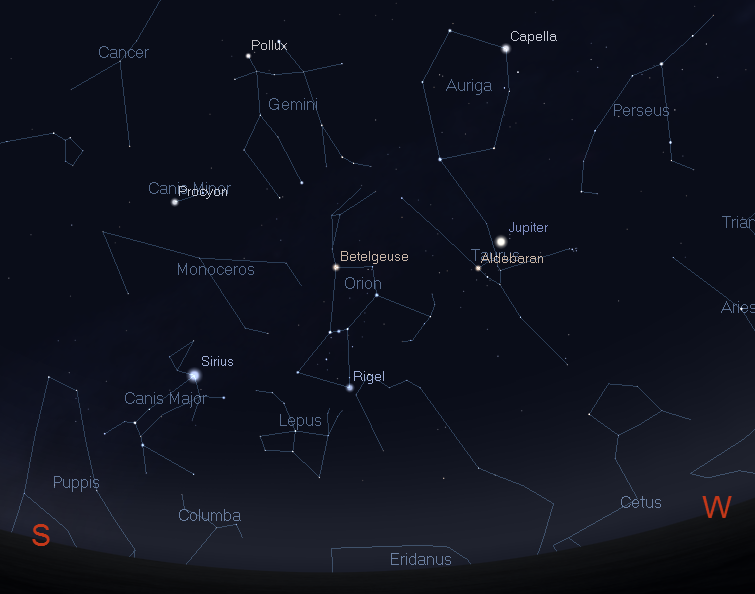
Jupiter and the winter constellations tip to the southwest at 10 p.m. on March 13, 2013. Created using Stellarium. Click on the image to enlarge.
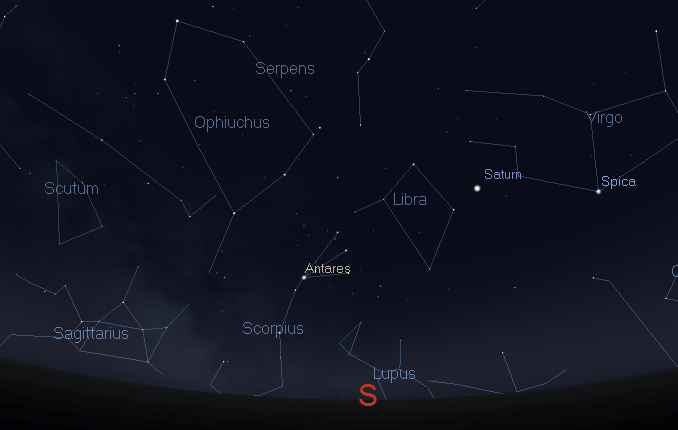
Saturn with a preview of the summer constellations seen at 6 a.m. on March 14, 2013. Created using Stellarium. Click on the image to enlarge.
08/12/2013 – Ephemeris – Comet PanSTARRS will appear near the moon tonight
Ephemeris for Tuesday, March 12th. The sun will rise at 7:59. It’ll be up for 11 hours and 45 minutes, setting at 7:45. The moon, 1 day past new, will set at 9:05 this evening.
Tonight 40 to 45 minutes after sunset, that’s about 8:30 p.m., if it’s very clear down to the western horizon Comet PanSTARRS might be glimpsed low on the western horizon. The day old sliver of the moon will point to the comet. The comet will appear just to the left of the moon by about 8 moon widths. The comet will appear due west, so a compass will help locate it. It’s tail is expected to be nearly vertical and canted to the left. If the comet is bright enough the tail will appear to be split in two. The gas component is ionized and is pushed back rapidly by the solar wind. Cometary dust is pushed by the pressure of sunlight. Near perihelion, its closest to the sun as comet is moving crosswise to its tail. The tail will swing to the right in the coming days.
Times are for the Traverse City/Interlochen area of Michigan. They may be different for your location.
Addendum

Comet PanSTARRS with the moon at 8:30 p.m. or 45 minutes after sunset) on March 12, 2013. Created using Stellarium, Cartes du Ciel and my Looking Up.
As noted in yesterday the sky is from, Stellarium and the comet from Cartes du Ciel. Both free programs that can be downloaded from links on this page. The moon is from my own, much simpler LookingUp program. The moon does appear slightly larger and brighter than how it will appear in the sky, as does the comet. The comet will set shortly after 9 p.m. and the tail may be visible for a while after that.
Reports show that the comet is reaching 1st magnitude, but not for long. Check the link for spaceweather.com for some cool pictures of the comet in the evening twilight.
03/11/2013 – Ephemeris – Comet PanSTARRS enters the northern sky
Ephemeris for Monday, March 11th. The sun will rise at 8:01. It’ll be up for 11 hours and 42 minutes, setting at 7:43. The moon is new today, and won’t be visible.
Comet PanSTARRS is now officially in our skies. It may be visible very low on the western horizon about 45 minutes after sunset. That will make it about 8:30 p.m. The head of the comet may make it to second magnitude, about as bright as a Big Dipper star. The tail should point nearly straight up. As the days go by the tail will lean to the right and the comet moves northward. Tomorrow night the comet will be just left of the thin crescent moon. Pictures of the comet can be found at spaceweather.com, from earlier this month. PanSTARRS or Comet 2011 L4, as its official designation goes will probably not return. It came in reasonably near the plane of the solar system, but is leaving far to the north. Binoculars are the tool best used to spot it.
Times are for the Traverse City/Interlochen area of Michigan. They may be different for your location.
Addendum
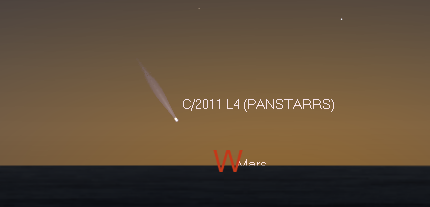
Comet PanSTARRS as it might appear above the western horizon at 45 minutes after sunset on March 11, 2013. Created using Stellarium and Cartes du Ciel.
Note that the comet will most likely not appear this bright. At this time the comet is only 4 degrees above the horizon. That’s less that half the width of a fist held at arms length above the horizon. The comet will set in less than a half hour after that.
The reason for using images from Stellarium and Cartes du Ciel is that Stellarium does not show comet tails, and Cartes du Ciel does not try to show a realistic twilight.
03/08/2013 – Ephemeris – Next week: Comet PanSTARRS enters our skies
Ephemeris for Friday, March 8th. The sun will rise at 7:07. It’ll be up for 11 hours and 32 minutes, setting at 6:39. The moon, 3 days before new, will rise at 5:33 tomorrow morning.
Next week it will be darker in the morning and lighter in the evening as daylight time falls upon the land. But the big attraction next week will be the appearance of Comet PanSTARRS into our northern skies. This comet was discovered by an observatory with that acronym at the summit of the Haleakala on Maui, Hawaii. Tomorrow the comet will come as close to the sun as Mercury does before heading out to deep space again. It’s distance from us will always be farther than the sun. Monday night will be our first time to spot it low in the west 45 minutes after sunset. Tuesday its will appear just to the left of the thin crescent moon. PanSTARRS is not as bright as originally predicted, so it will be difficult to spot in twilight. Binoculars are the best bet for spotting it.
Times are for the Traverse City/Interlochen area of Michigan. They may be different for your location.
Addendum
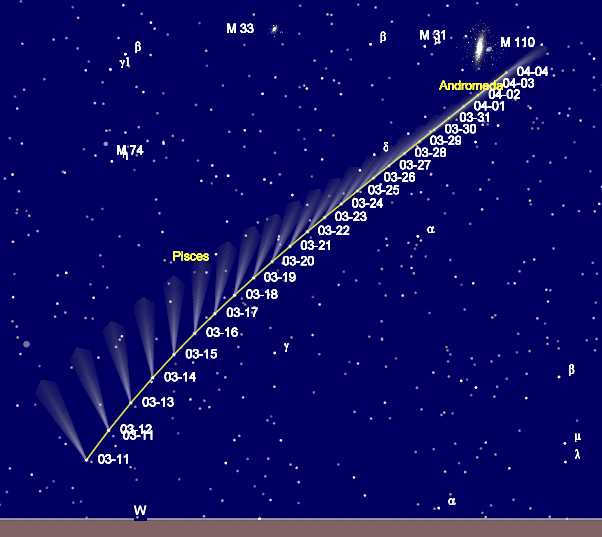
Comet PanSTARRS path in the March evening sky. Created using Cartes duCiel.
Taken and updated from my article in the GTAS newsletter the Stellar Sentinel:
Comet 2011 L4 (PanSTARRS) will be entering our evening sky this month after passing perihelion on March 10th.. Here is my reporting of its discovery in the November 2012 issue:
Obviously PanSTARRS isn’t a person’s name but the first telescope of the Panoramic Survey Telescope and Rapid Response System (Pan-STARRS) located on the summit of the Haleakala volcano on Maui, Hawaii. There are several Comet PanSTARRS so if you use Google or any other search engine to get more information don’t be confused. This one is C/2011 L4. Comet PanSTARRS was discovered on June 6, 2011.
We were hoping for a comet that would reach magnitude 0, as bright as the brightest stars. It seems that this is not going to be the case. The current track of the comet brightness appears to be about a magnitude dimmer than what was previously predicted. To follow PanSTARRS magnitude track, go to the web page http://www.aerith.net/comet/catalog/2011L4/2011L4.html.
The dimness of the comet will make it difficult to spot in the fading twilight. The position of the comet and the moon on the 12th. is seen above, at an hour after sunset. The sliver of the 30 hour old moon will itself be hard to spot. day by day the comet will slowly move higher in the sky and away from evening twilight, On April 1st the comet will begin to pass the Great Andromeda Galaxy.
In photographs displayed on spaceweather.com as I put this issue to bed, the comet appears to have a short tail, divided into a narrow bluish ion tail and a wide dust tail.
Next week I’ll diagram the comet for each of the evenings.
03/05/2013 – Ephemeris – Mars in the crosshairs
Ephemeris for Tuesday, March 5th. The sun will rise at 7:12. It’ll be up for 11 hours and 23 minutes, setting at 6:35. The moon, 1 day past last quarter, will rise at 3:29 tomorrow morning.
Last week we got the news that a newly discovered comet C/2013 A1 (Siding Springs) would come very close to the planet Mars. The calculated least distance from Mars was 0. That means the comet does have as of now a 1 in 7000 chance of hitting the Red Planet. Better it than us I’d say, but the U.S. have several billion dollars of assets on and orbiting Mars: two rovers and two satellites, plus another due to arrive just before the comet passes through. The expected miss distance will be several tens of thousands of miles a bit farther than the asteroid that passed us a few weeks ago. It’s the uncertainty that puts Mars in the cross-hairs. Also comets are messy with a coma or a head of debris tens of thousands of miles in diameter.
Times are for the Traverse City/Interlochen area of Michigan. They may be different for your location.
Addendum
One item I forgot to mention in the program is the date of the comet encounter. It’s October 19, 2014.
The two NASA rovers are Opportunity, operational since 2004, and Curiosity just landed last August. The satellites are Odyssey, and Mars Reconnaissance Orbiter. To arrive next year the Maven satellite.
Emily Lakdawalla of the Planetary Society and Phil Plait the Bad Astronomer have the information.
12/31/2012 – Ephemeris – Looking at the prospective comets of 2013
Ephemeris for New Years Eve, Monday, December 31st. The sun will rise at 8:19. It’ll be up for 8 hours and 53 minutes, setting at 5:12. The moon, 3 days past full, will rise at 8:51 this evening.
As we enter a new year tonight, let\s look ahead at what we expect to see in the skies in 2013. The big events next year will be two comets that could be quite bright. Mid-March will bring Comet PanSTARRS to the evening sky. This is a first time comet for astronomers, so its behavior may be unpredictable, but it is currently sticking to brightness projections and may be as bright as the brightest stars at its brightest. The second comet is Comet ISON. This will fly close to the sun on November 28th. It could disintegrate, its nucleus could split into multiple pieces, or it could survive intact. The last two scenarios will give us a bright morning comet in early December. So may we have a happy comet new year.
Times are for the Traverse City/Interlochen area of Michigan. They may be different for your location.
Addendum
Here are two links to the website of Seiichi Yoshida for each of the comets. Most revealing at this point are the magnitudes graphs showing the actual brightness measurements as black dots with the predicted magnitudes as an orange line, The vertical line is the perihelion date, the date the comet is closest to the sun. Comet ISON has a second magnitude graph for when the comet is closest the sun and may become bright enough to be seen in the daytime.
Magnitudes are like golf scores, the lower the number the better, or in this case brighter the comet is. the Faintest star visible to the naked eye is 6th magnitude. Jupiter is usually around -2, Venus -4, and the sun -26. As you can see from the scatter of the actual brightness estimates, pinning down the brightness of a fuzzy comet is rather difficult. Comets generally appear dimmer than their magnitudes would suggest.
Here are the ;inks:
10/02/2012 – Ephemeris – Two bright comets next year, maybe?
Ephemeris for Tuesday, October 2nd. The sun will rise at 7:42. It’ll be up for 11 hours and 38 minutes, setting at 7:20. The moon, 3 days past full, will rise at 8:23 this evening.
It looks like we’ll have possibly two comets to grace our skies next year. These are first time comets and there is trouble with predicting their brightness. We can make a guess when we see them far from the sun, but that doesn’t always pan out. The first comet to be seen will be Comet 201l L4, named PANSTARRS. It will reach its closest to the sun on April 17th. It was discovered with the Pan-STARRS telescope in Haleakala, Hawaii. It could optimistically be as bright as the star Vega. The second was Comet 2012 S1 ISON (I hope that’s how it’s pronounced) discovered on September 21st, 10 days ago. This comet has the added problem. On November 29th, 2013 it will pass a million miles from the center of the sun, and may not survive.
Times are for the Traverse City/Interlochen area of Michigan. They may be different for your location.
Addendum
Here’s some information on these comets from Gary Kronk’s Cometography: http://cometography.com/current_comets.html
12/26/11 – Ephemeris – Comet Lovejoy wows southern hemisphere observers
Monday, December 26th. The sun will rise at 8:18. It’ll be up for 8 hours and 49 minutes, setting at 5:07. The moon, 2 days past new, will set at 7:40 this evening.
Comet Lovejoy has been the morning Christmas comet for folks in the southern hemisphere for the past week. After whipping around the sun and losing its tail comet Lovejoy grew another brighter tail that has been greeting early risers in the southern hemisphere since the 17th.. It surprised the astronauts on the International Space Station, who were not given the heads up in advance. However they did get some great time lapse movies of the comet rising. From the ground the tail rose for 40 or so minutes before the head. The comet is moving away from the sun so its heads out tail first. Comet Lovejoy hasn’t made it big on normal news channels, but astronomical sites on the Internet have been buzzing with the latest news.
* Times, as always are for the Traverse City/Interlochen area of Michigan.
Addendum
www.spaceweather.com is a great place to start. Look in their archives for the past week too.
12/19/11 – Ephemeris – Comet Lovejoy survives!
Monday, December 19th. The sun will rise at 8:14. It’ll be up for 8 hours and 49 minutes, setting at 5:04. The moon, 2 days past last quarter, will rise at 3:29 tomorrow morning.
Comet Lovejoy surprised most astronomers by surviving its encounter with the sun last Thursday evening. By Friday morning it was receding from the sun minus its tail. The tail it had approaching the sun was still there, but what emerged looked like a really bright star. It fooled me until I saw the animated images that showed the comet disappearing around the left side of the sun and a bright star-like object emerge on the right. As Friday wore on comet Lovejoy began to grow a new tail. Over the weekend images came in from all the six solar monitoring satellites. All had recorded the comet, and some as the comet came very close to the sun to see the interaction of the comet’s tail with the sun’s corona. The comet has since been picked up from the ground.
* Times, as always are for the Traverse City/Interlochen area of Michigan.
Addendum
The comet has been photographed by a Las Vegas astronomer in the morning before sunrise!
For more information go to www.spaceweather.com. Checkout the archive pages too!
Here is a US Navy site following Comet Lovejoy: http://sungrazer.nrl.navy.mil/index.php?p=news/birthday_comet
For Scott: I haven’t seen a good magnitude on it yet. It’s going to be a southern hemisphere object.
Here’s a link to the Elements and Ephemeris of the comet from the Minor Planet Center: http://scully.cfa.harvard.edu/cgi-bin/returnprepeph.cgi?d=c&o=CK11W030
Comet Lovejoy is growing a new tail
Wow! It looks like C/2011W3 Lovejoy is growing two new tails, a faint ion tail and a brighter dust tail.
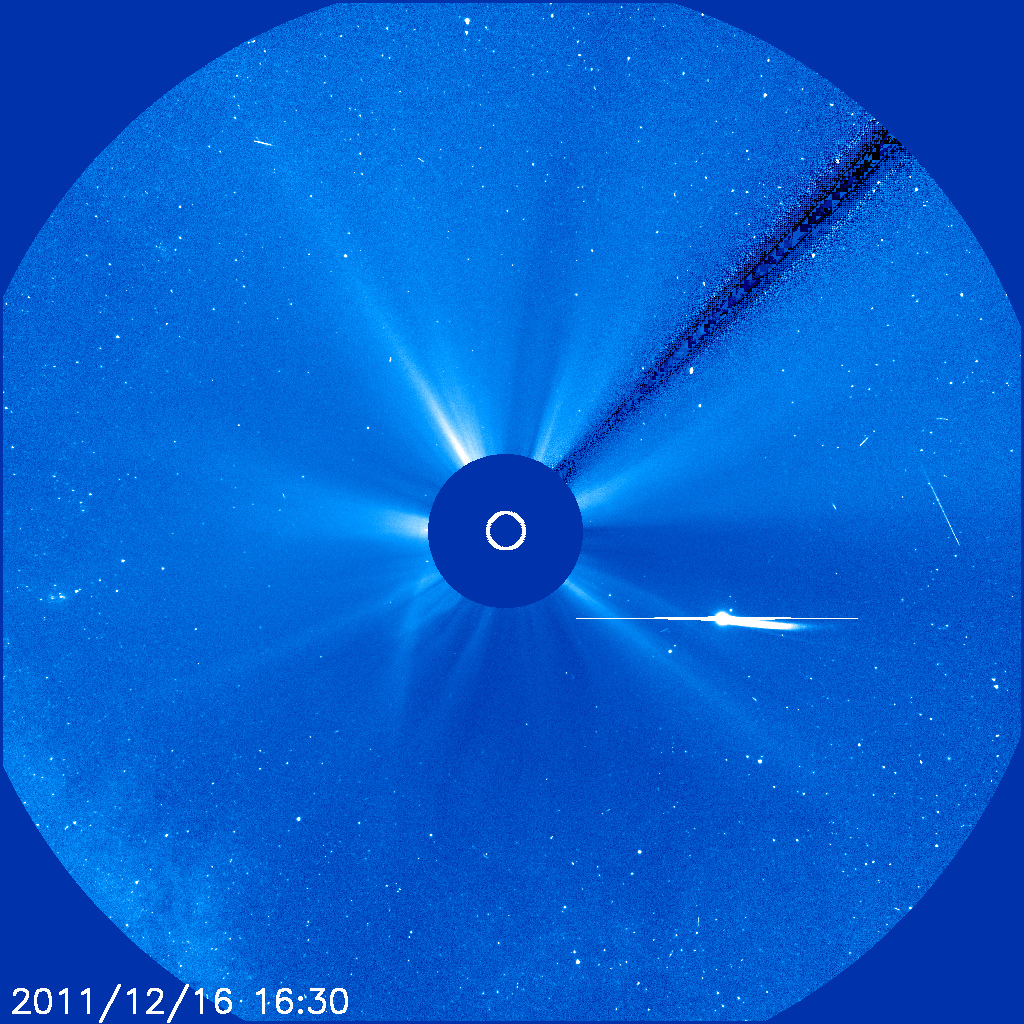
Comet Lovejoy growing new tails. Courtesy ESA, NASA, LASCO C3 group.
The old tail is still visible.
 Bob Moler's Ephemeris Blog