Archive
05/14/2015 – Ephemeris – The constellation Virgo in mythology
Ephemeris for Thursday, May 14th. Today the Sun will be up for 14 hours and 46 minutes, setting at 9:02. The Moon, 3 days past last quarter, will rise at 4:51 tomorrow morning. Tomorrow the Sun will rise at 6:14.
Tonight in the sky: to the left of the constellation of Leo the lion, which lies in the west-southwest at 11 p.m. is the next constellation of the zodiac: Virgo the virgin, is seen in the south. Virgo is a large constellation of a reclining woman holding a stalk of wheat. The bright star in the center of the constellation, Spica, is the head of that spike of wheat; and as such ruled over the harvest in two of Virgo’s guises as the goddesses Persephone and Ceres. Virgo is also identified as Astraea the goddess of justice. The constellation of Libra, the scales, is found just east of her. Early Christians saw Virgo as the Virgin Mary. Virgo is the home of the Virgo Cluster of thousands of galaxies.
Times are for the Traverse City/Interlochen area of Michigan. They may be different for your location.
Addendum
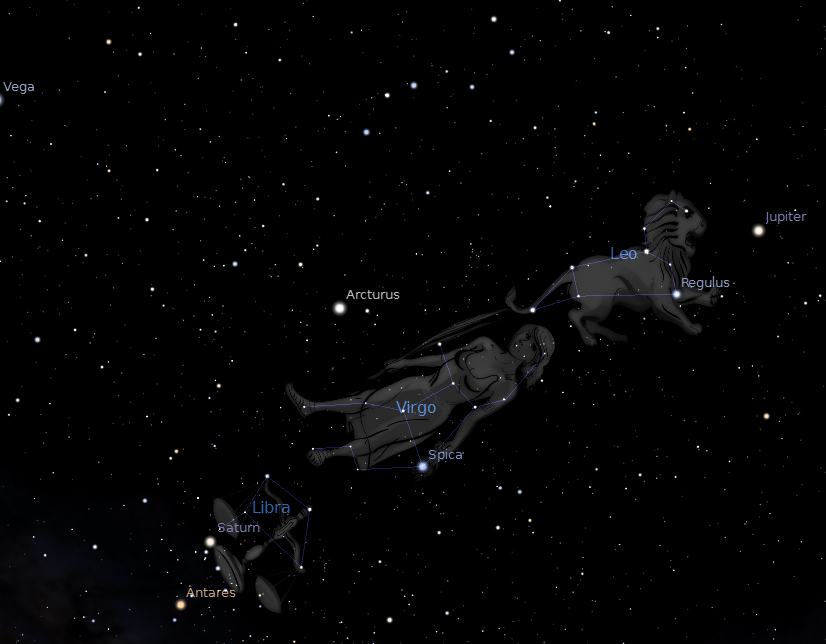
Virgo with the also mentioned constellations of Leo and Libra for 11 p.m., May 14, 2015. Created using Stellarium.
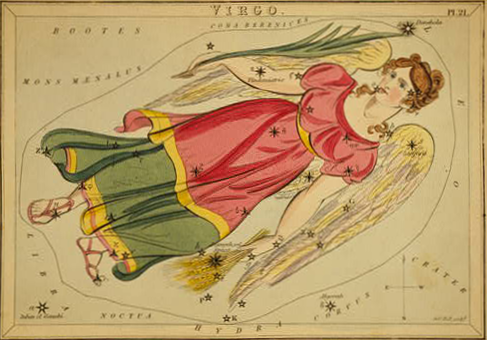
Virgo as depicted in Urania’s Mirror, a set of constellation cards published in London c.1825. From the Library of Congress. H/T Wikipedia.
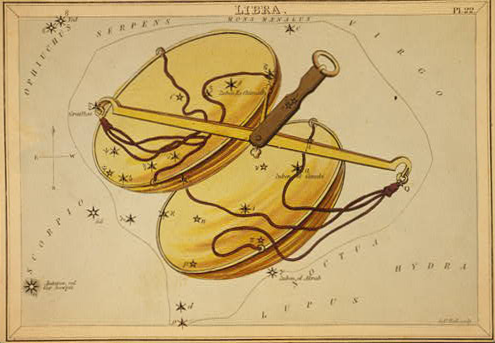
Libra as depicted in Urania’s Mirror, a set of constellation cards published in London c.1825. From the Library of Congress. H/T Wikipedia.
4/16/2015 – Ephemeris – A constellation commemorating a real person
Ephemeris for Thursday, April 16th. The Sun rises at 6:57. It’ll be up for 13 hours and 31 minutes, setting at 8:28. The Moon, 2 days before new, will rise at 6:19 tomorrow morning.
Half way up the sky in the east-southeast at 10 p.m. is a tiny and faint constellation of Coma Berenices, or Berenice’s hair. In it are lots of faint stars arrayed to look like several strands of hair. The whole group will fit in the field of a pair of binoculars, which will also show many more stars. The story behind it was that Berenice was a real Queen of Egypt, whose husband was away at war. This was in the days when the Greeks ruled Egypt after Alexander conquered it. She offered her golden tresses to the gods for the king’s safe return. The hair, was placed in a temple. However the offering disappeared when the king returned. Ever since then the constellation of Coma Berenices has been seen to commemorate the queen’s sacrifice.
Times are for the Traverse City/Interlochen area of Michigan. They may be different for your location.
Addendum
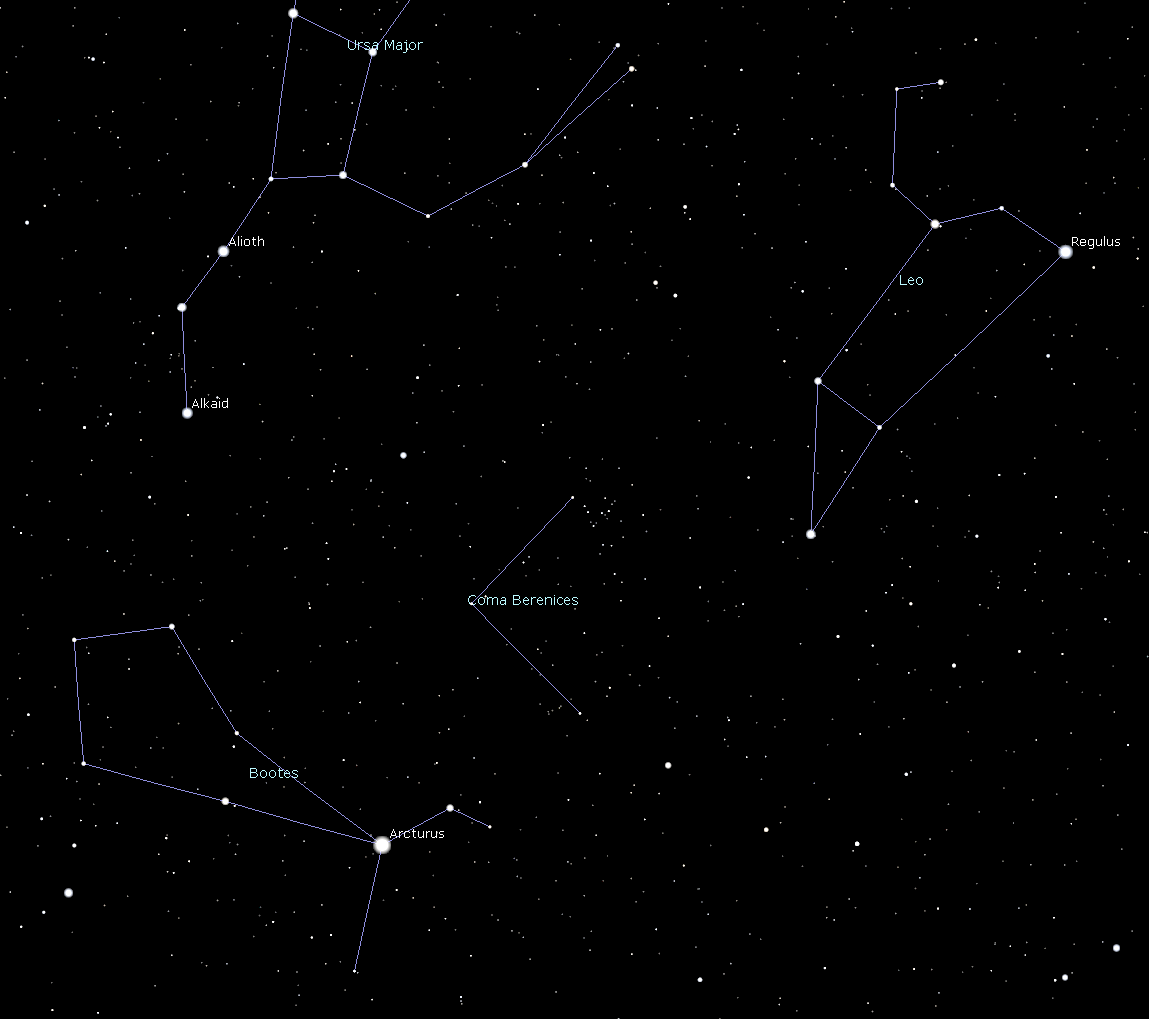
Coma Berenices and neighboring constellations at 10 p.m. on April 16, 2015. Note that only the upper right star of the upside down L shape actually belongs to the cluster. Created using Stellarium.
04/14/2015 – Ephemeris – Arcas and Callisto
Ephemeris for Tuesday, April 14th. The Sun will rise at 7:00. It’ll be up for 13 hours and 25 minutes, setting at 8:26. The Moon, 3 days past last quarter, will rise at 5:08 tomorrow morning.
Rising in the eastern sky at 10 p.m. tonight is the kite shaped constellation of Boötes the herdsman. The bright star Arcturus is at the bottom of the kite, pointed to by the arc of the handle of the Big Dipper, overhead. In one story Boötes represents a young hunter named Arcas, son of Callisto, a beautiful young lady who had the misfortune of being loved by Zeus the chief Greek god. Zeus’ wife Hera, found out about it, and since she couldn’t punish Zeus, turned Callisto into an ugly bear. Arcas, unaware of why his mother disappeared in his youth was about to kill the bear when Zeus intervened and placed them both in the sky. Now Arcas as Boötes chases the Great Bear forever around the pole of the sky each night.
Times are for the Traverse City/Interlochen area of Michigan. They may be different for your location.
Addendum
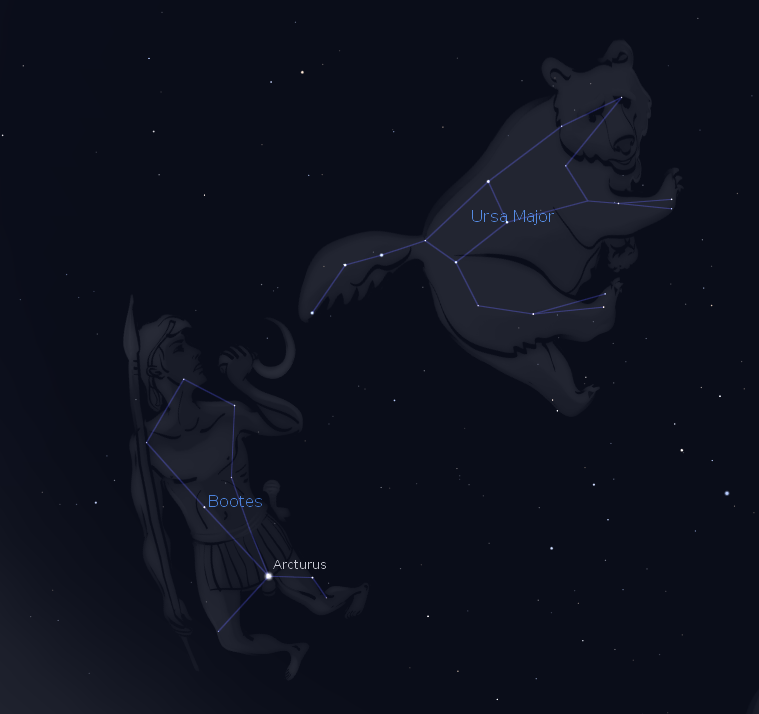
Bootes and Ursa Major aka Arcas chasing Callisto around the pole of the sky. Created using Stellarium.
öö
03/13/2015 – Ephemeris – Leo rising
Ephemeris for Friday, March 13th. The Sun will rise at 7:59. It’ll be up for 11 hours and 46 minutes, setting at 7:46. The Moon, at last quarter today, will rise at 3:35 tomorrow morning.
The constellation Leo the lion is now rising in the east at 9 pm. It’s below and left of the Big Dipper higher up in the east-northeast. Leo is marked by two sets of easily recognizable stars. The front of him is a backward question mark of stars, also known as the Sickle that mark his head and mane, along with the front part of his body. Regulus is the star at the bottom of that backwards question mark. It’s the Little King Star. Jupiter this year is above right if it. The hind end of him is a triangle of stars ending with another bright star, but not as bright as Regulus. It’s Denebola which means Lion’s tail. It is thought when the sun was in this constellation long ago that the lions were driven by the heat to quench their thirst in the Nile river. Ancients physicians thought medicines were poison when the sun was here too.
Times are for the Traverse City/Interlochen area of Michigan. They may be different for your location.
Addendum
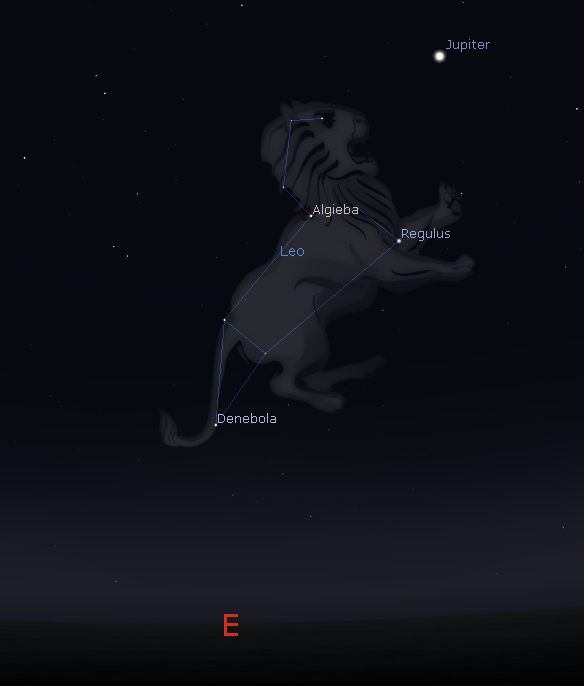
Leo rising in the east behind Jupiter at 9 p.m. on March 13, 2015. Created using Stellarium.
01/16/2015 – Ephemeris – Orion’s greater hunting dog: Canis Major
Ephemeris for Friday, January 16th. The sun will rise at 8:16. It’ll be up for 9 hours and 13 minutes, setting at 5:29. The moon, 3 days past last quarter, will rise at 5:09 tomorrow morning.
The great winter constellation or star group Orion the Hunter, is located in the south-southeastern sky at 9 p.m. His elongated rectangle of a torso is almost vertical. In the center of the rectangle are three stars in a line that make his belt. As a hunter, especially one of old, he has two hunting dogs. The larger, Canis Major can be found by following the three belt stars of Orion down and to the left. There lies the brilliant star called Sirius, also known as the Dog Star. It’s in the heart of a stick figure dog low in the southeast facing Orion that appears to be begging. I’ll have more to say about Sirius on Monday, but there’s a fine star cluster, caller M41, at the 5 o’clock position from Sirius easily visible in binoculars or a small telescope.
Times are for the Traverse City/Interlochen area of Michigan. They may be different for your location.
Addendum
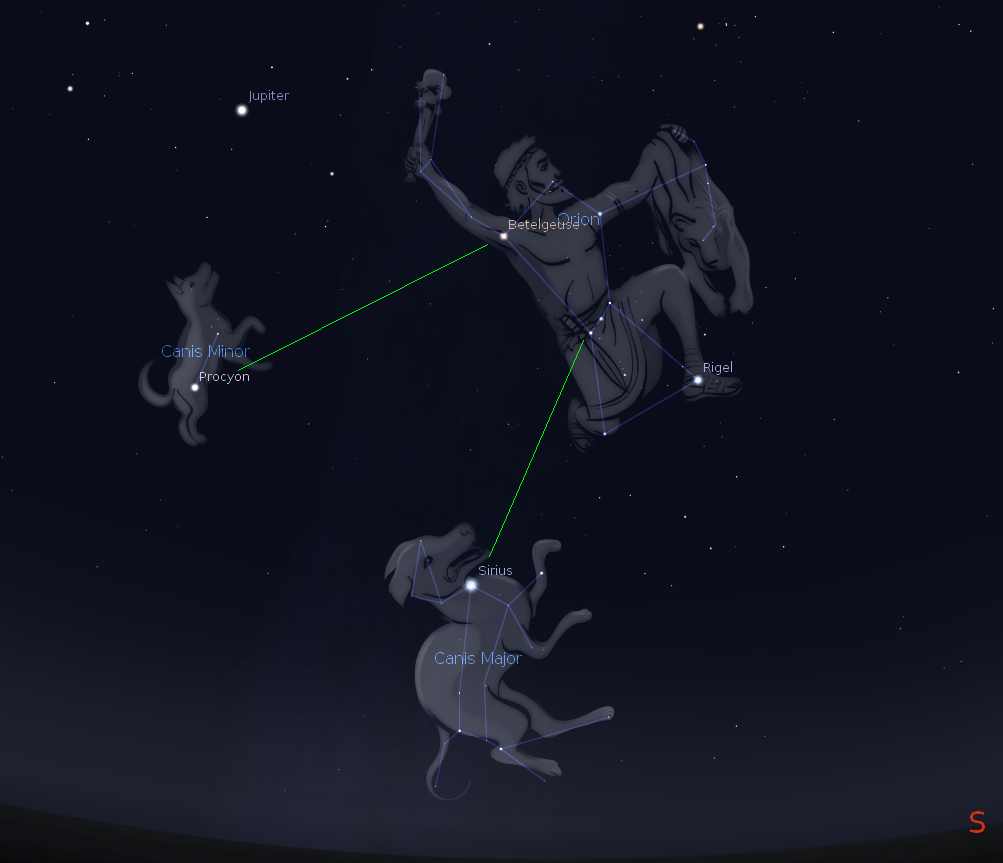
Orion and his hunting dogs with pointers as seen at 9 p.m. in the second half of January. Created using Stellarium.
12/23/2014 – Ephemeris – Is the constellation of Cetus a whale or a sea monster?
Ephemeris for Tuesday, December 23rd. The sun will rise at 8:17. It’ll be up for 8 hours and 49 minutes, setting at 5:06. The moon, 2 days past new, will set at 7:25 this evening.
The identity of the constellation Cetus is a bit mixed up. Officially it’s a whale, but in the story of the constellations above it, (Cassiopeia, Pegasus, Andromeda, Perseus and Cepheus) it is the monster sent to ravage the Ethiopian coast, and to whom the sacrifice of Andromeda was to stop. Either can be seen in the stars in the south at 8 p.m. It is a large constellation of dim stars below and left of the Great Square of Pegasus and Pisces. The whale can be seen diving, its tail of 5 stars in a squished pentagon, is seen to the upper left. If you see the stars differently and put the head of the sea monster where the tail of whale is the dreaded Cetus of the story appears. One of its stars is variable and will not be visible without a telescope, it’s Mira, the wonderful.
Times are for the Traverse City/Interlochen area of Michigan. They may be different for your location.
Addendum
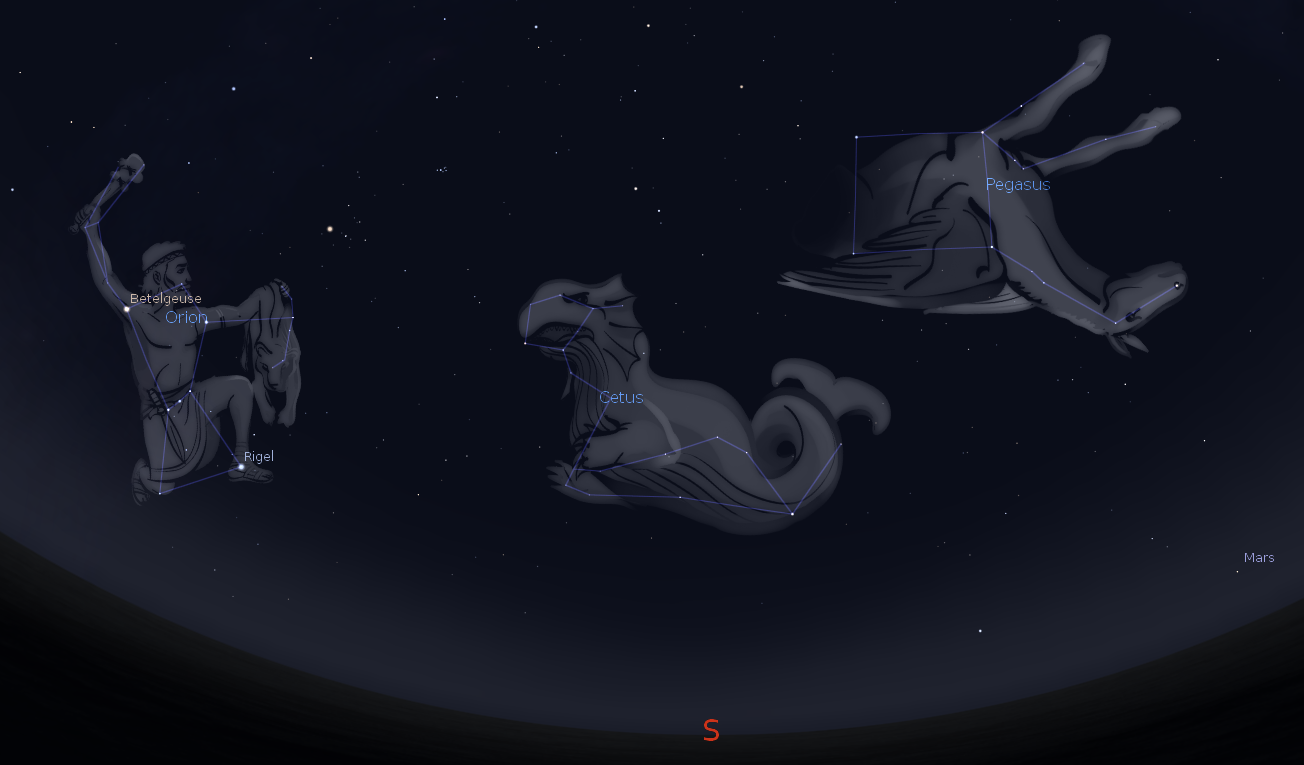
Cetus with Pegasus and Orion displaying mythological images at 8 p.m. on December 23, 2014. Created using Stellarium.
10/31/2014 – Ephemeris – The spookiest star
Ephemeris for Halloween, Friday, October 31st. The sun will rise at 8:18. It’ll be up for 10 hours and 13 minutes, setting at 6:32. The moon, 1 day past first quarter, will set at 1:59 tomorrow morning.
Not all the ghosts and goblins out Sunday will be children. One will be out every night, because it’s a star. Its name is Algol, from the Arabic for Ghoul Star or Demon Star. The Chinese had a name for it that meant “piled up corpses”. It’s the second brightest star in the constellation Perseus the hero, rising in the northeast this evening. The star is located where artists have drawn the severed head of Medusa, whom he had slain. Medusa was so ugly that she turned all who gazed upon her to stone. Algol is her still glittering eye. Astronomers finally found out what was wrong with Algol. It does a slow 6 hour wink every two days 21 hours, because it is two stars that eclipse each other. Her next wink will be 10 p.m. Sunday night.
Times are for the Traverse City/Interlochen area of Michigan. They may be different for your location.
Addendum
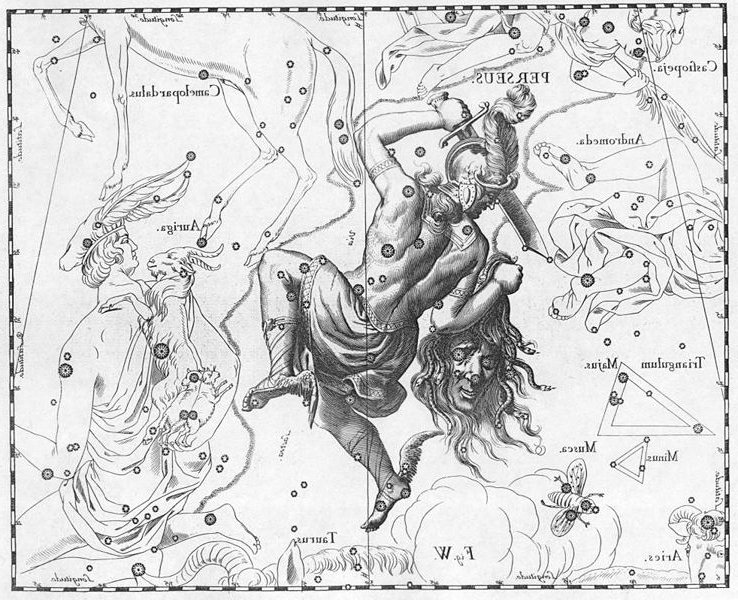
Perseus and the head of Medusa from the 1690 Uranographia by Johannes Hevelius. Image found with the article on Algol in Wikipedia.
Celestial globes of the day showed the celestial sphere from the outside, so the constellations appeared reversed. The star atlases of the day kept the trend. I reversed the image to correspond with the actual sky.
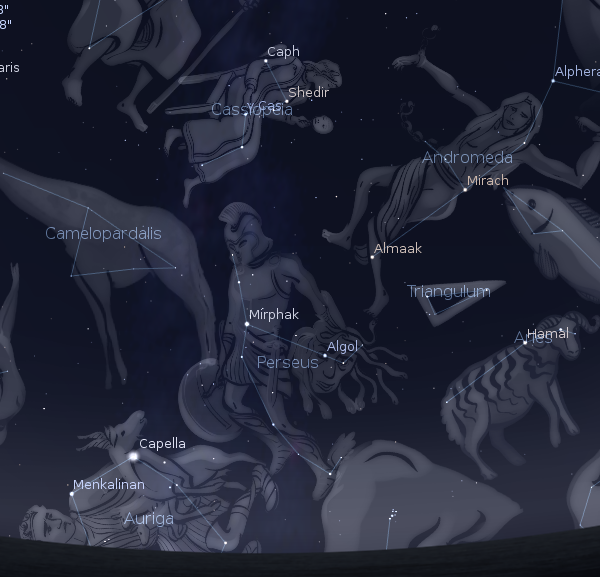
Algol at 7:30 p.m. on Halloween, in a modern portrayal. Created using Stellarium.
Update
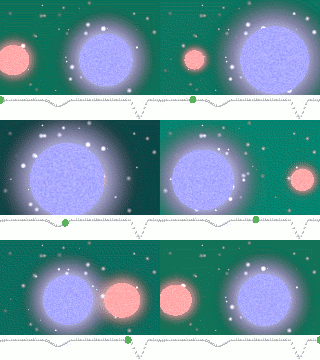
Animation of an eclipsing binary star like Algol. Credit: Wikimedia Commons. H/T EarthSky
Here’s a link to EarthSky’s post on Algol.
10/27/2014 – Ephemeris – The Pleiades in Greek and Native American mythology
Ephemeris for Monday, October 27th. The sun will rise at 8:13. It’ll be up for 10 hours and 25 minutes, setting at 6:38. The moon, 3 days before first quarter, will set at 9:38 this evening.
Visible low in the east at 10 in the evening sky can be spotted a small group of stars. It’s called the Pleiades or Seven Sisters. The Pleiades are really spectacular when seen in binoculars. It is remarkable that both the Greeks and the American Plains Indians saw this group as female stars fleeing from danger. In the former case they were fleeing the constellation Orion the giant hunter of the winter sky who will soon rise over the eastern horizon, and in the latter case a giant bear. Legend has it that the maidens fled to the top of Devils Tower in Wyoming. It’s said that the claw marks of this bear are seen in the walls of the tower. The maidens were then spirited from the top of the tower to the heavens, where we see them today. Whichever story you like the Pleiades is worth searching for.
Times are for the Traverse City/Interlochen area of Michigan. They may be different for your location.
Addendum
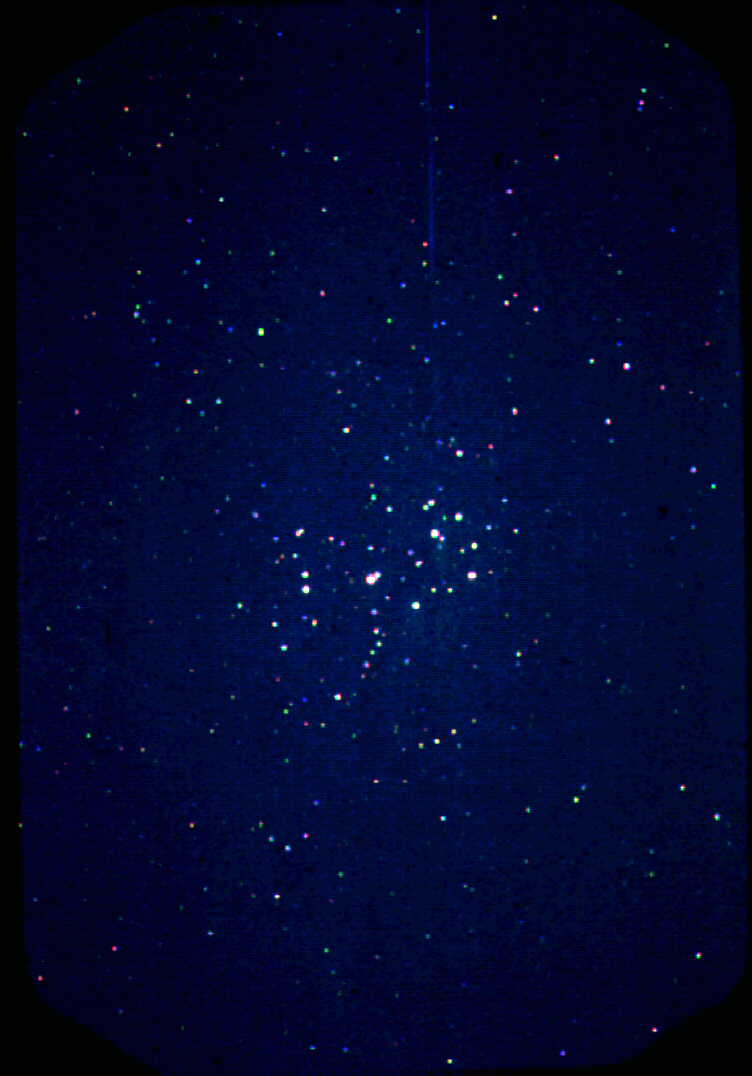
The Pleiades, about what you’d see in binoculars.
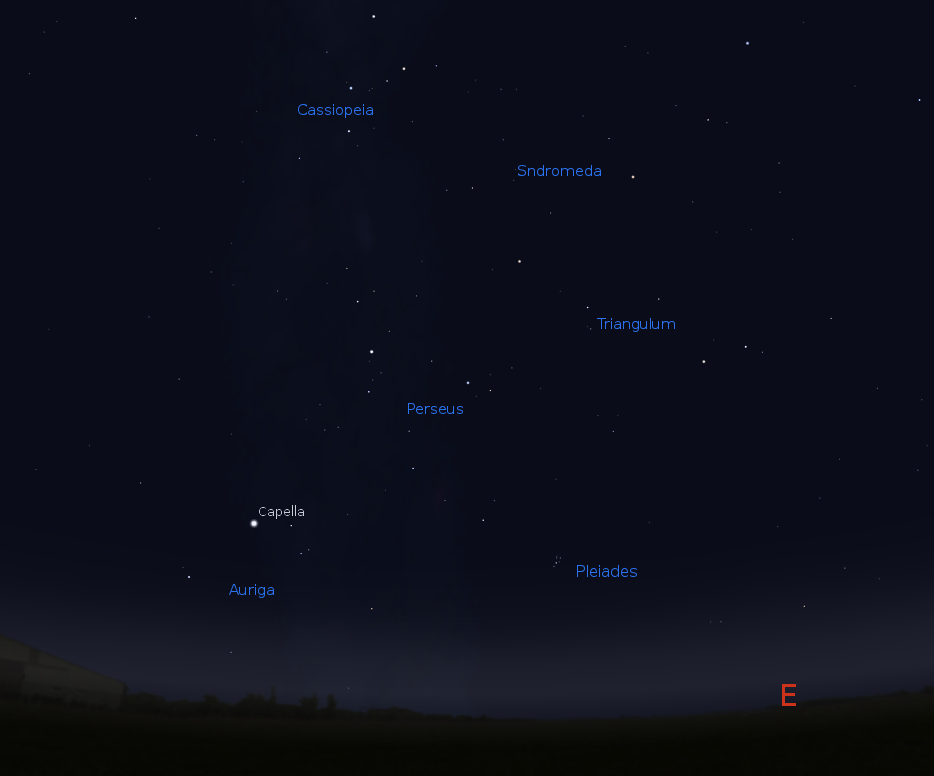
Looking to the east northeast at the Pleiades: 9 p.m. on October 27th. Created using Stellarium,
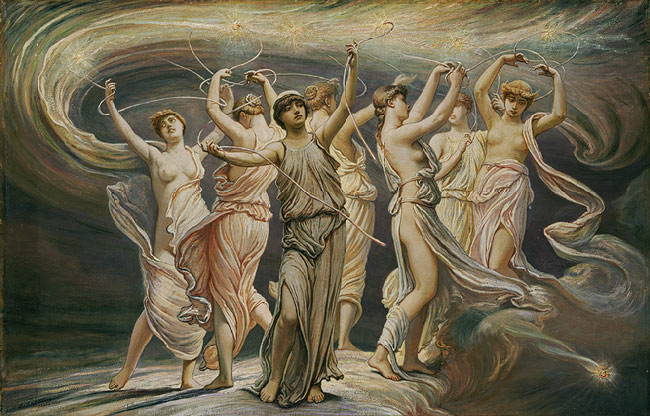
The Greek Pleiades a painting by Elihu Vedder in the Metropolitan Museum of Art, New York City. Public Domain.

Legend of Devils Tower Credit: Indian Country Today Media Network
This is the illustration from http://indiancountrytodaymedianetwork.com/article/the-legend-of-devils-tower-3273
08/21/2014 – Ephemeris – What do a dolphin, an arrow and a coffin have in common?
Ephemeris for Thursday, August 21st. The sun rises at 6:52. It’ll be up for 13 hours and 46 minutes, setting at 8:38. The moon, half way from last quarter to new, will rise at 4:12 tomorrow morning.
Located below the eastern edge of the Summer Triangle of three of the brightest stars in the sky, which is high in the southeast in the sky at 10 p.m., is the tiny constellation of Delphinus the dolphin. Delphinus’ 6 stars in a small parallelogram with a tail, really does look like a dolphin leaping out of the water. The parallelogram itself has the name Job’s Coffin. The origin of this asterism or informal constellation is unknown. Of the dolphin itself: the ancient Greeks appreciated this aquatic mammal as we do, and told stories of dolphins rescuing shipwrecked sailors. There’s another tiny and slender constellation to the right of Delphinus called Sagitta the arrow, which is said to represent Cupid’s dart.
Times are for the Traverse City/Interlochen area of Michigan. They may be different for your location.
Addendum
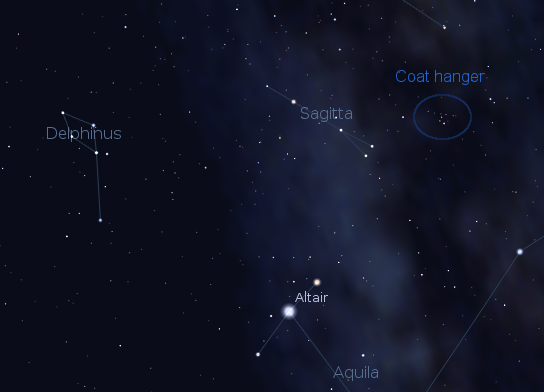
Delphinus, Sagitta and the Coat hanger. Diagram created using Stellarium.
The Coat hanger is strictly a binocular asterism. However it was discovered by the great Arabian astronomer Al Sufi inn the 10th century, and is currently designated Collinder 399. It is actually a random pattern of unrelated stars.
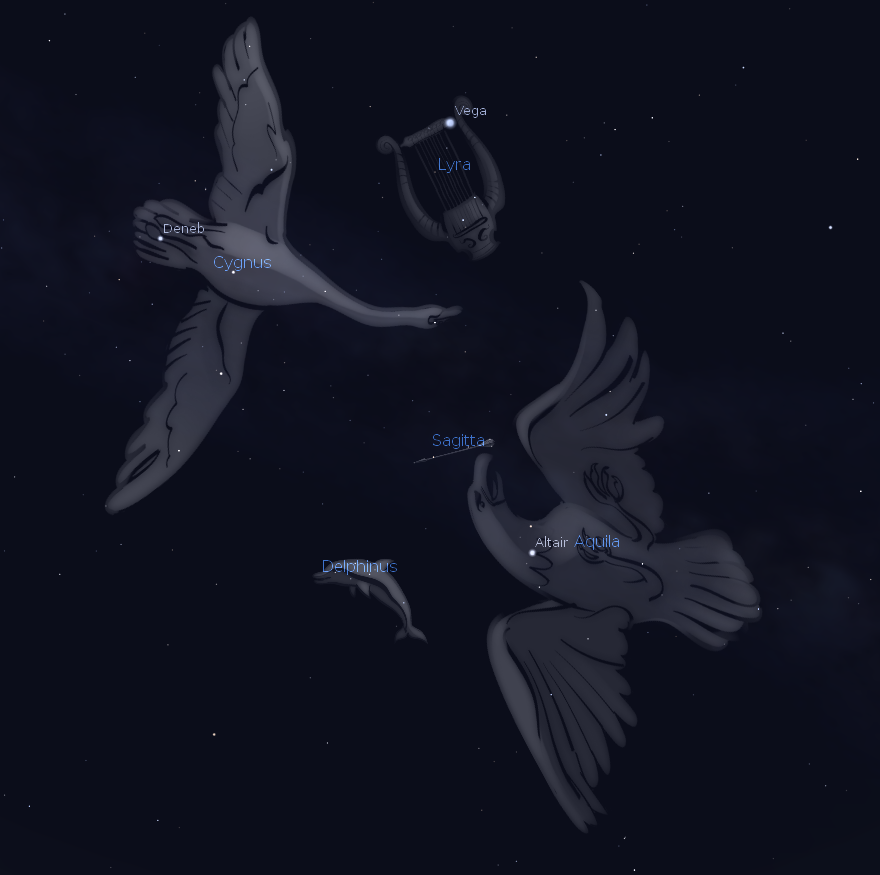
Delphinus and Sagitta images along with the stars and constellations of the Summer Triangle. Created using Stellarium.
08/19/2014 -Ephemeris – Scutum’s place in history
Ephemeris for Tuesday, August 19th. The sun rises at 6:49. It’ll be up for 13 hours and 51 minutes, setting at 8:41. The moon, 2 days past last quarter, will rise at 2:26 tomorrow morning.
Yesterday we took a look at the wonders in the constellation of Scutum the shield above the Teapot of Sagittarius and below Aquila the eagle. Scutum is the shield of John Sobieski the Polish king who stopped the advance of the Turks at Kalenberg in 1683. The Polish half of me is very proud. Scutum is one of two official constellations which are related to a real person. The other one is Coma Berenices, a hank of the Egyptian queen Berenice’s hair. However the stars here are so dim and embedded in the glow of the Milky Way as to be nearly impossible to discern. Scutum lies in one of the richest portions of the Milky Way, wonderful to scan with binoculars and telescopes for star clusters and nebulae or clouds of dust and gas.
Times are for the Traverse City/Interlochen area of Michigan. They may be different for your location.
Addendum
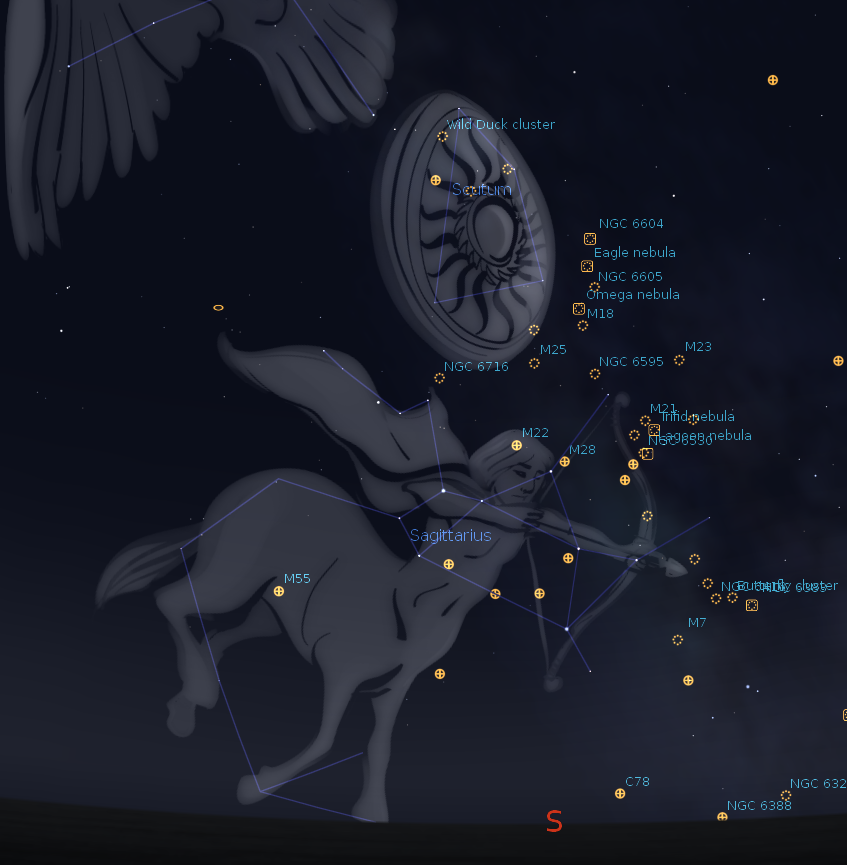
Binocular and telescope deep sky objects in Scutum and Sagittarius. Created using Stellarium.
 Bob Moler's Ephemeris Blog