Archive
07/29/2014 – Ephemeris – The celestial Teapot
Ephemeris for Tuesday, July 29th. The sun rises at 6:25. It’ll be up for 14 hours and 45 minutes, setting at 9:11. The moon, 3 days past new, will set at 10:14 this evening.
The Milky Way runs from north to south through the heavens at 11 p.m. You’ll notice that the Milky Way is brighter and broader just above the horizon in the south. In that glow in the south is a star pattern that looks like a stout little teapot, with a bright stream of the Milky Way rising from the spout, which faces the west. This pattern of stars is the major part of the constellation called Sagittarius. According to Greek mythology Sagittarius is a centaur with a bow and arrow poised to shoot Scorpius the scorpion to the right. This centaur is called Chiron, the most learned of the breed, centaurs usually being a rowdy bunch. The center of the pin wheel of our Milky Way galaxy lies hidden beyond the stars and clouds above the spout of the teapot.
Times are for the Traverse City/Interlochen area of Michigan. They may be different for your location.
Addendum
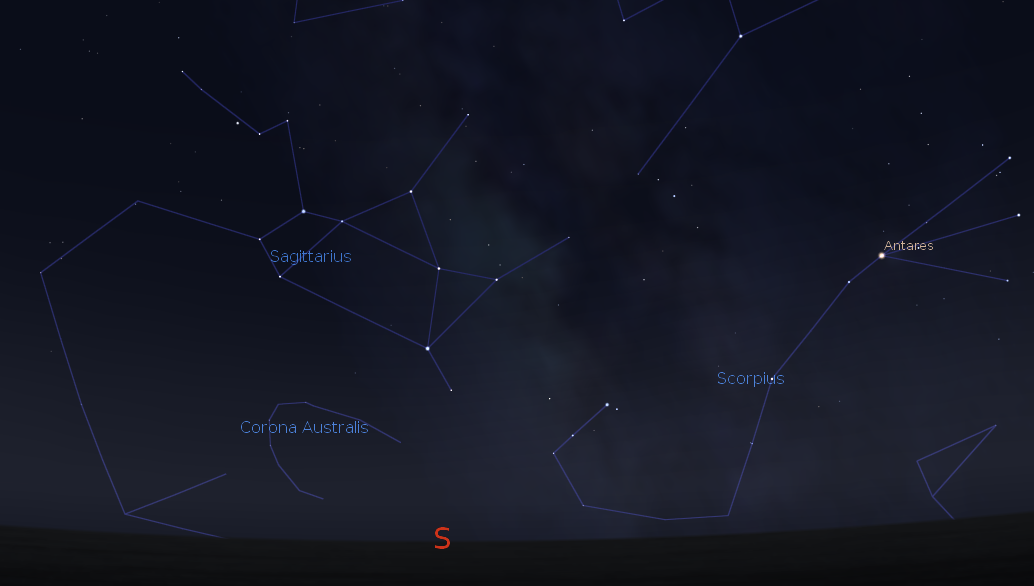
Sagittarius and Scorpius. Created using Stellarium.
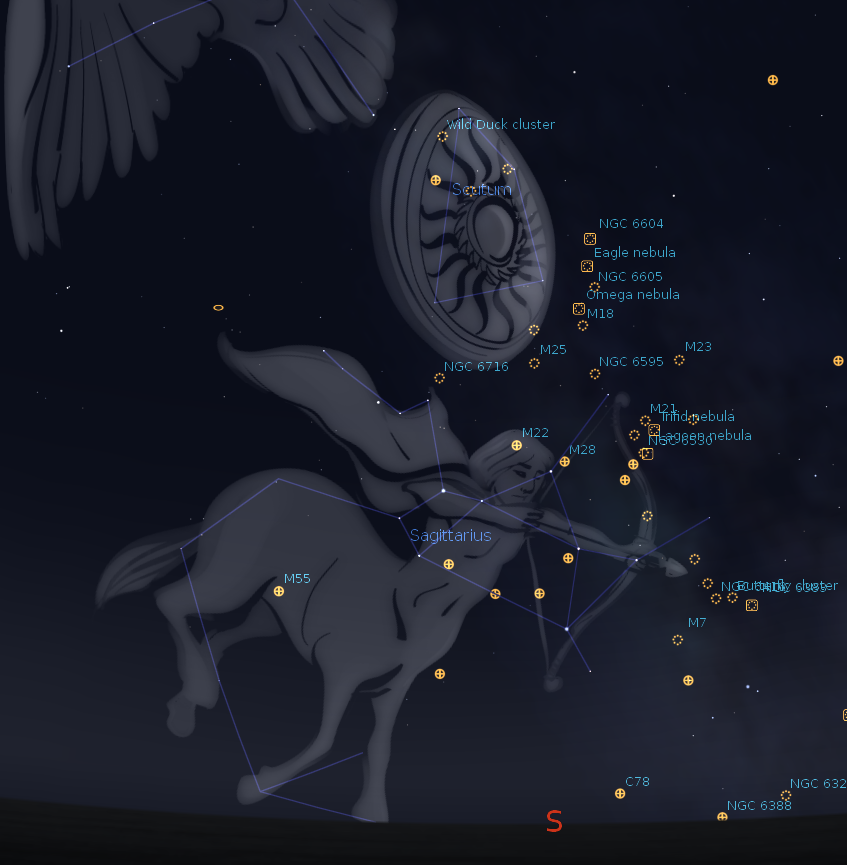
Binocular and telescope deep sky objects in Scutum and Sagittarius. Created using Stellarium.
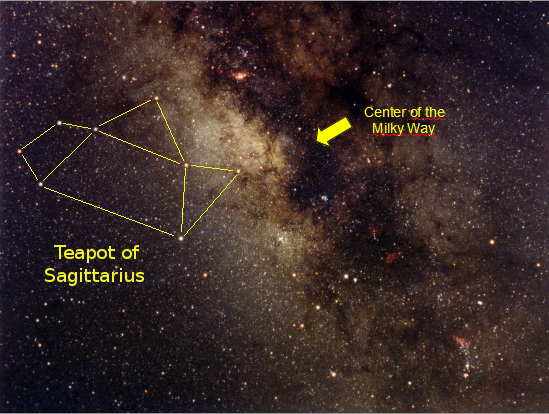
Location of the center of the Milky Way and the Teapot of Sagittarius.
07/15/2014 – Ephemeris – The constellation of Lyra the harp
Ephemeris for Tuesday, July 15th. Today the sun will be up for 15 hours and 13 minutes, setting at 9:24. The moon, half way from full to last quarter, will rise at 11:19 this evening. Tomorrow the sun will rise at 6:12.
Very high up in the eastern sky at 11 p.m. can be found a bright star just north of a small, narrow, but very distinctive parallelogram of stars. They are the stars of the constellation Lyra the harp. The bright star is Vega, one of the twenty one brightest first magnitude stars. Vega is actually the 5th brightest night-time star. The harp, according to Greek mythology, was invented by the Greek god Hermes. The form of the harp in the sky, is as he had invented it: by stretching strings across a tortoise shell. Hermes gave it to his half-brother Apollo, who in turn gave it to the great musician Orpheus. The sun has a motion with respect to most stars around it. Its direction is towards the vicinity of Lyra.
Times are for the Traverse City/Interlochen area of Michigan. They may be different for your location.
Addendum
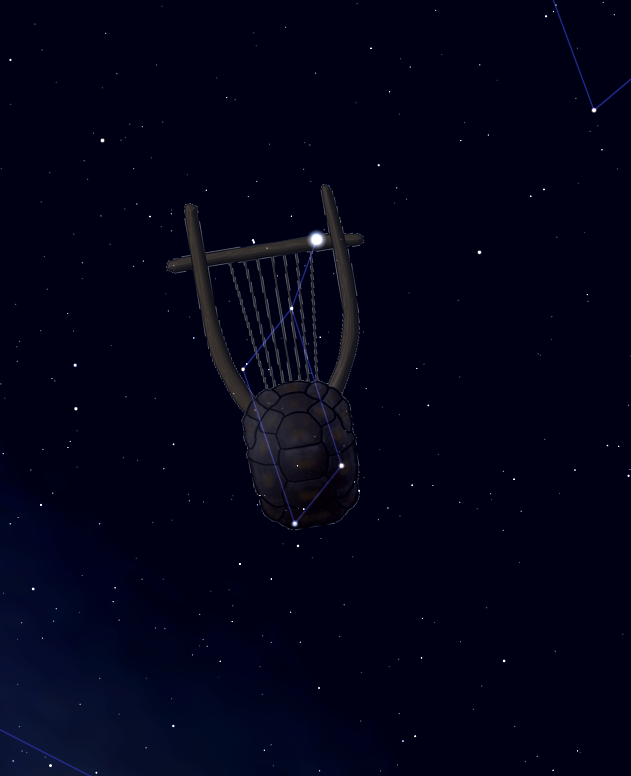
Lyra as a tortoise shell harp. Created using Stellarium and free clip art.
06/30/2014 – Ephemeris – The celestial snake handler
Ephemeris for Monday, June 30th. Today the sun will be up for 15 hours and 30 minutes, setting at 9:31. The moon, 3 days past new, will set at 11:14 this evening. Tomorrow the sun will rise at 6:01. | The red star Antares shines in the south at 11 p.m. In the constellation of Scorpius. In the area of sky above and a little to the left lies a large constellation of faint stars called Ophiuchus, the serpent bearer. The constellation shape is like a large bell, which reminds me of the head, shoulders and arms of a fellow that’s holding the snake-like a weight lifter pulling up a heavy bar bell. The serpent he’s holding is Serpens, the only two-part constellation in the heavens. The head rises to Ophiuchus’ right and the tail extends up to the left. In legend Ophiuchus was a great physician, educated by the god Apollo, and the centaur Chiron, also found in the stars as Sagittarius, now rising below and left of him.
Times are for the Traverse City/Interlochen area of Michigan. They may be different for your location.
Addendum
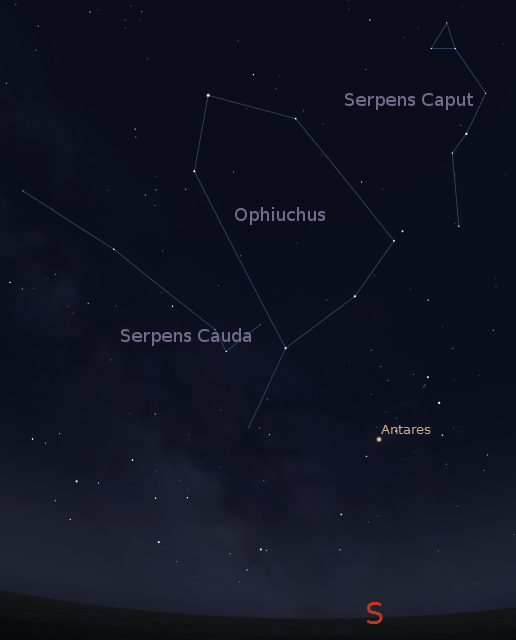
Ophiuchus and Serpens at 11 p.m.. Created using Stellarium.
06/19/2014 – Ephemeris – The constellation Hercules
Ephemeris for Thursday, June 19th. Today the sun will be up for 15 hours and 33 minutes, setting at 9:30. The moon, at last quarter today, will rise at 1:50 tomorrow morning. Tomorrow the sun will rise at 5:57.
Orion, the hard luck Greek hunter gets a splashy constellation in the winter sky, but the greatest hero of all, Hercules, gets a dim group of stars on the border between the spring and summer stars. At 11 p.m. Hercules is high in the southeast. It is located above and right of the bright star, Vega in the east. Hercules’ central feature is a keystone shaped box of stars, called the Keystone, which represents the old boy’s shorts. From each top corner extend lines of stars that are his legs, from the bottom stars, the rest of his torso and arms extend. So in one final indignity he’s upside down in our sky. Some see him crouched down, club upraised holding the Hydra about to throttle it. [For those with a telescope it contains the beautiful globular star cluster M13.]
Times are for the Traverse City/Interlochen area of Michigan. They may be different for your location.
Addendum
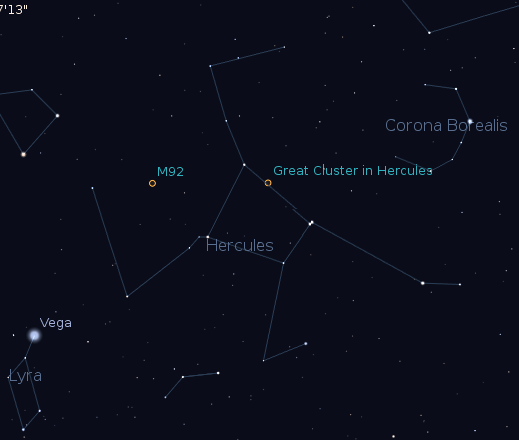
The constellation Hercules and his neighbors. Created with Stellarium.
On Tuesday I mentioned that for the Anishinabek people around the Great Lakes, Corona Borealis is a Sweat Lodge. Incidentally the Pleiades, only seen in the sky at the same time as Corona Borealis on autumn evenings on opposite ends of the sky, are the seven stones of the Sweat Lodge ceremony. The stars of Hercules represents one poor fellow, who couldn’t stand the heat of the sweat lodge and is splayed on the snow near by.

M13, the Great Globular Star Cluster in Hercules. Credit: Scott Anttila
06/17/2014 – Ephemeris – The constellation Corona Borealis, the Northern Crown
Ephemeris for Tuesday, June 17th. Today the sun will be up for 15 hours and 33 minutes, setting at 9:30. The moon, 2 days before last quarter, will rise at 12:46 tomorrow morning. Tomorrow the sun will rise at 5:56.
High in the south at 11 p.m. can be found a small but easily spotted constellation of Corona Borealis, the Northern Crown. It is located just east or left of the kite shaped constellation of Boötes, with its bright star Arcturus at the base. The Northern Crown is a semicircle of stars, like a tiara, with a brighter star Gemma at the bottom. Despite the obvious allusion of stars to diamonds and the sound of the star’s name, this is not a gem studded crown. Gemma means blossom, so Corona Borealis may represent a floral crown. According to Greek mythology it belonged to Princess Ariadne, daughter of King Minos of Crete. She was abandoned by Theseus, whom she helped out of the Labyrinth of the Minotaur.
Times are for the Traverse City/Interlochen area of Michigan. They may be different for your location.
Addendum

Corona Borealis with Boötes. Created with Stellarium.
For the Anishinabek peoples around the Great Lakes, Corona Borealis is a Sweat Lodge.
04/28/2014 – Ephemeris – The legend of the constellation of Corvus the crow
Ephemeris for Monday, April 28th. The sun rises at 6:37. It’ll be up for 14 hours and 6 minutes, setting at 8:43. The moon, 1 day before new, will rise at 6:53 tomorrow morning.
The small constellation of Corvus the crow is located low in the south at 10:30 this evening. It’s made of 5 dim stars, but the pattern is a distinctive distorted box with two stars at the upper left marking that corner. To the right is a fainter constellation of a thick stemmed goblet called Crater. Both appear above the long constellation of Hydra the water snake who is slithering just above the southern horizon. In Greek mythology Corvus, then white, was the god Apollo’s pet. He once bid Corvus to take a cup and fetch him some water. Corvus however dallied and waited for a green fig to ripen. Corvus grabbed a snake and returned with a story on how the snake had delayed him. The angry Apollo turned the crow and all crows to this day black.
Times are for the Traverse City/Interlochen area of Michigan. They may be different for your location.
Addendum
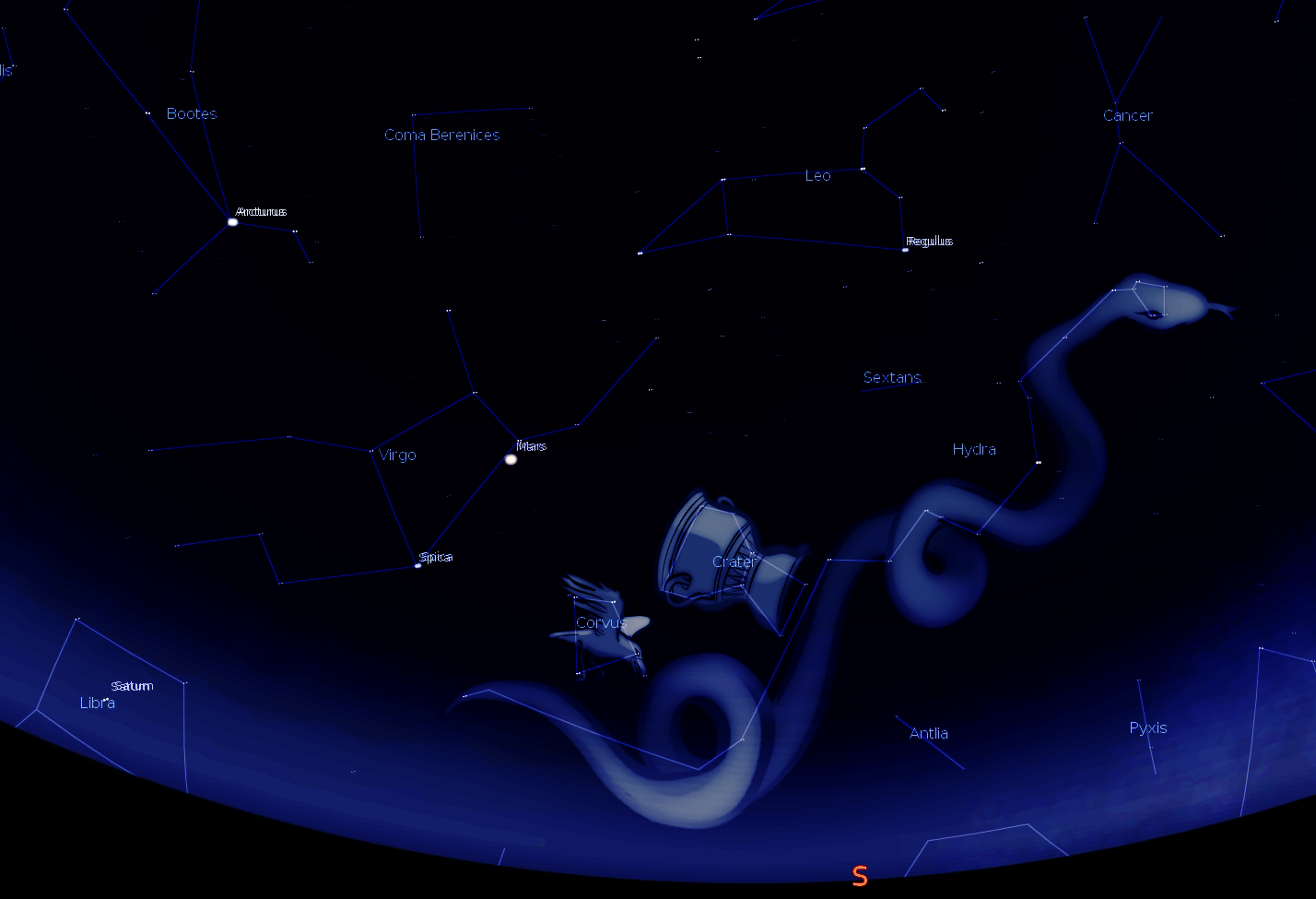
Corvus the crow, Crater the cup and Hydra the water snake along with the other spring constellations ay 10 p.m. April 28, 2014. Created using Stellarium.
01/23/2014 – Ephemeris – The river Eridanus
Ephemeris for Thursday, January 23rd. The sun will rise at 8:10. It’ll be up for 9 hours and 28 minutes, setting at 5:38. The moon, 1 day before last quarter, will rise at 1:31 tomorrow morning.
There is a long and sinuous constellation that’s part of the winter sky. It is Eridanus, which depicts a river. The river starts near the lower right corner of Orion, near the bright star Rigel and flows to the right then down near the southern horizon, then it meanders below the horizon. One has to travel to the far southern United States or even farther south to see the southern terminus of the river, the bright star Achernar. Writers over the ages have seen here the Nile and the earth circling river Ocean of the flat earth days. One of its stars is close to us and famous. It’s Omicron 2 Eridani a triple star system and the fictional home to Mr. Spock and other Vulcans of the Star Trek franchise. No real planet has been found there. Yet.
Times are for the Traverse City/Interlochen area of Michigan. They may be different for your location.
Addendum
Note: In previous posts about Eridanus I had identified Epsilon Eridani and the fictional Mr. Spock’s home star. It’s actually Omicron 2 according to Gene Roddenberry himself.
Speaking of Vulcan, Star Trek fans nominated Vulcan for one of the names for Pluto’s latest two satellites, apparently forgetting that Vulcan was borrowed from Roman mythology as the god of fire, and the history of astronomy. Pluto and its satellites are some of the coldest bodies in the solar system, and the International Astronomical Union (IAU) had designated that the satellites carry on the Pluto and Hades or underworld theme. Anyway, in the mid 19th century some astronomers thought they discovered a planet that resided inside the orbit of Mercury and named it appropriately, Vulcan. If anything is ever found orbiting inside Mercury, it may get the name Vulcan. As for the names of the latest two moons of Pluto, they are Styx named after the the River Styx; and Kerberos, Greek for Cerberus the three headed dog that guards the entrance to Hades. Harry Potter fans may know this creature better as “Fluffy”.
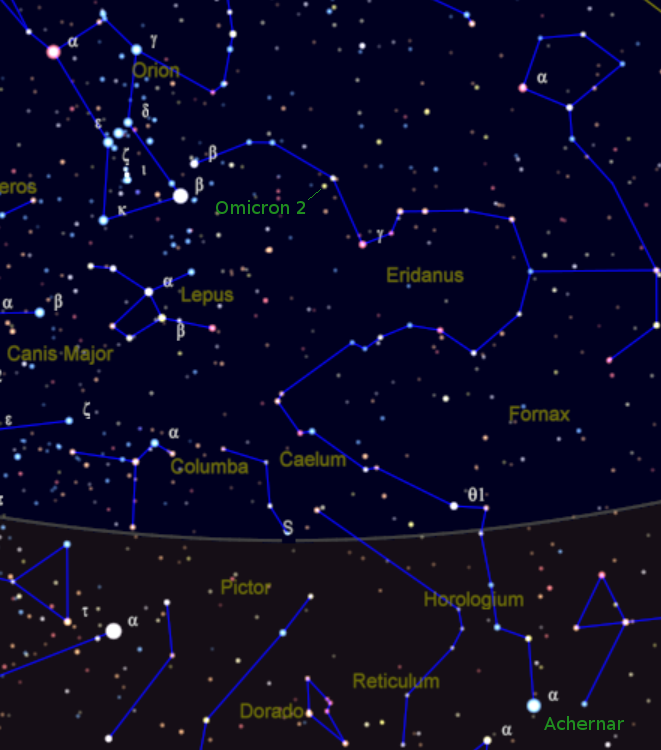
The constellation of the river Eridanus above and below the horizon for 9 p.m. on January 23, 2014. Created using Cartes du Ciel (Sky Charts).
12/30/2013 – Ephemeris – The tale of Gemini the twins
Ephemeris for Monday, December 30th. The sun will rise at 8:19. It’ll be up for 8 hours and 52 minutes, setting at 5:11. The moon, 2 days before new, will rise at 7:09 tomorrow morning.
The constellation Gemini, the Twins is visible in the east at 9 p.m. with the bright planet Jupiter interloping against its stars. The namesake stars of the two lads, will be on the left end of the constellation, nearly vertically aligned. Castor is on top, while Pollux, a slightly brighter star is on the bottom. Lines of stars from Castor and Pollux to the right delineate the lads. In Greek mythology Castor and Pollux were twins, and half brothers, Castor was fathered by a mere mortal, while Pollux was fathered by Zeus in the famous Leda and the swan affair. The brothers, however were inseparable, and when Castor was killed during the quest for the Golden Fleece, Pollux pleaded with Zeus to let him die also. Zeus placed them together in the sky forever.
Times are for the Traverse City/Interlochen area of Michigan. They may be different for your location.
Addendum
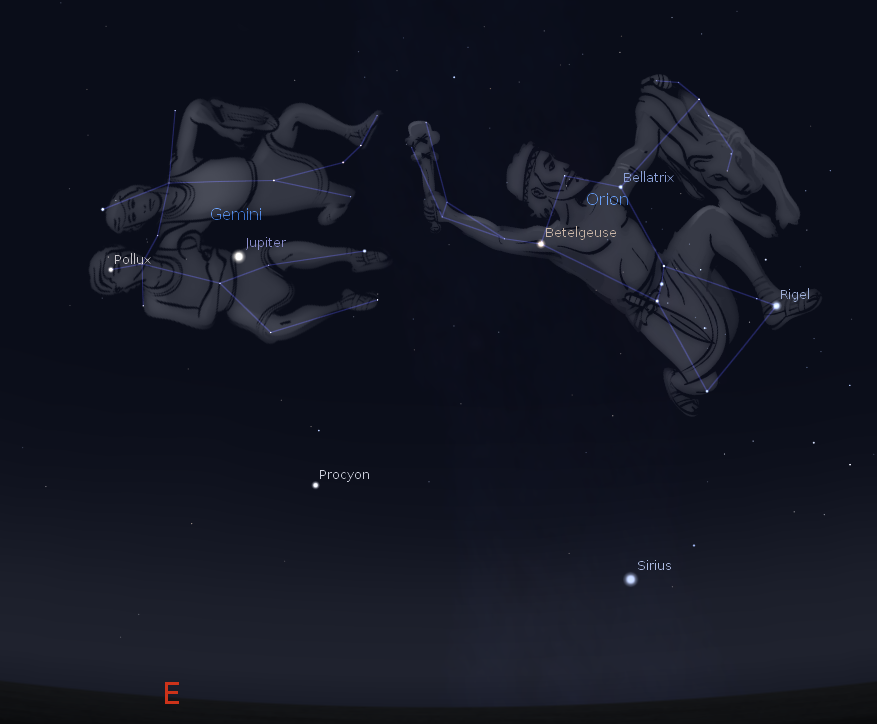
Gemini with Jupiter and Orion near by at 9 p.m. on December 30, 2013. Created using Stellarium.
12/23/2013 – Ephemeris – The constellation Orion: The hard luck hero
Ephemeris for Monday, December 23rd. The sun will rise at 8:17. It’ll be up for 8 hours and 49 minutes, setting at 5:06. The moon, 2 days before last quarter, will rise at 11:29 this evening.
The large and bright constellation of Orion is now in the southeast at 9 p.m. It is seen as an upright rectangle of bright stars tilting to the left, his shoulders and knees, with a belt of three stars in the center. Orion is a minor character in Greek mythology, much less celebrated than Hercules, which has a dim constellation named for him. Orion was a hunter. He had an ill-fated romance with Merope, whose father King Oenopion, had him blinded. After having his sight restored, Orion became a companion of Diana goddess of the hunt and they wanted to marry. Apollo, Diana’s brother disapproved of Orion also and was able to trick Diana into accidentally killing Orion with her bow. Another story had Orion dying of a scorpion sting.
Times are for the Traverse City/Interlochen area of Michigan. They may be different for your location.
Addendum
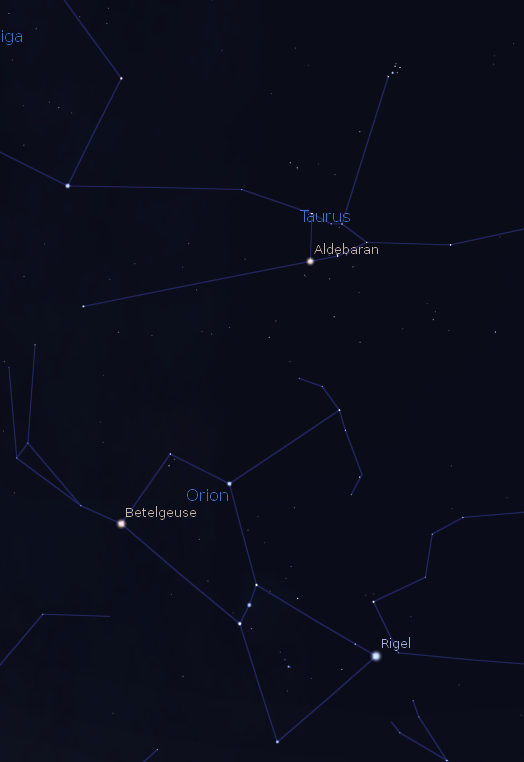
Taurus and Orion with Orion’s brightest stars named. Created using Stellarium.
10/28/2013 – Ephemeris – The constellation Perseus the hero
Ephemeris for Monday, October 28th. The sun will rise at 8:15. It’ll be up for 10 hours and 21 minutes, setting at 6:36. The moon, 2 days past last quarter, will rise at 2:54 tomorrow morning.
About a third the way from the east northeastern horizon to the zenith at 9 p.m. and below the letter W shaped constellation of Cassiopeia the queen is Perseus the hero. It’s kind of a odd shape for a hero, To me it looks like a chicken running across the road. To those who’s imagination doesn’t run to poultry, its shape is also like the Greek letter pi. It’s two brightest stars are Mirfak and Algol the demon star. Look at the area around Mirfak with binoculars and you will see a large group of stars just below naked eye visibility. It’s called the Alpha Persei association. That because Mirfak is Alpha Persei. The group is about 560 light years away, which means, though close, are farther away than the Pleiades, below and right of them.
Times are for the Traverse City/Interlochen area of Michigan. They may be different for your location.
Addendum
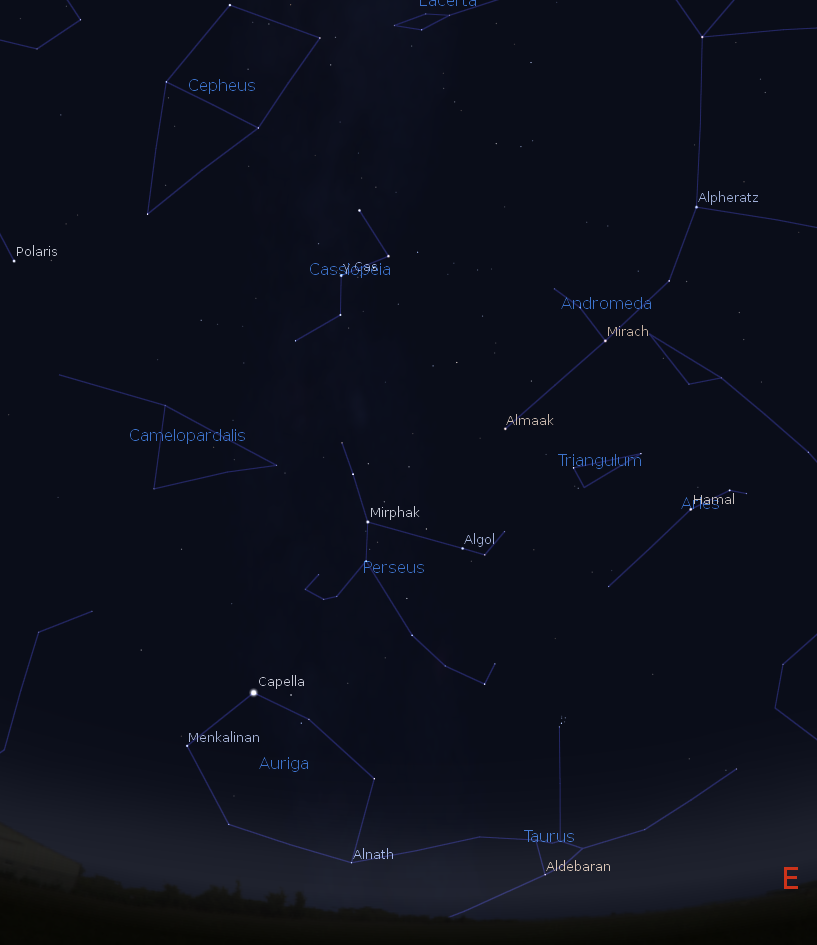
Perseus finder chart. Note the star Mirfak is spelled Mirphak on the chart. Created using Stellarium.
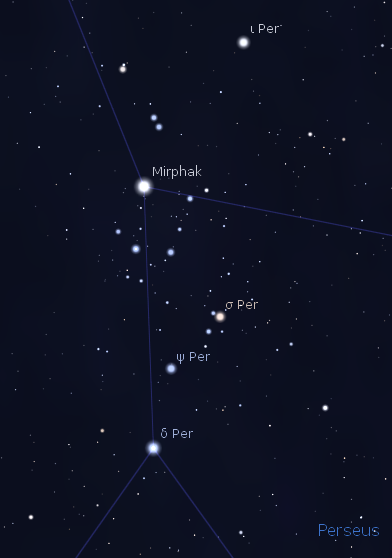
Alpha Persei Association. Created using Stellarium.
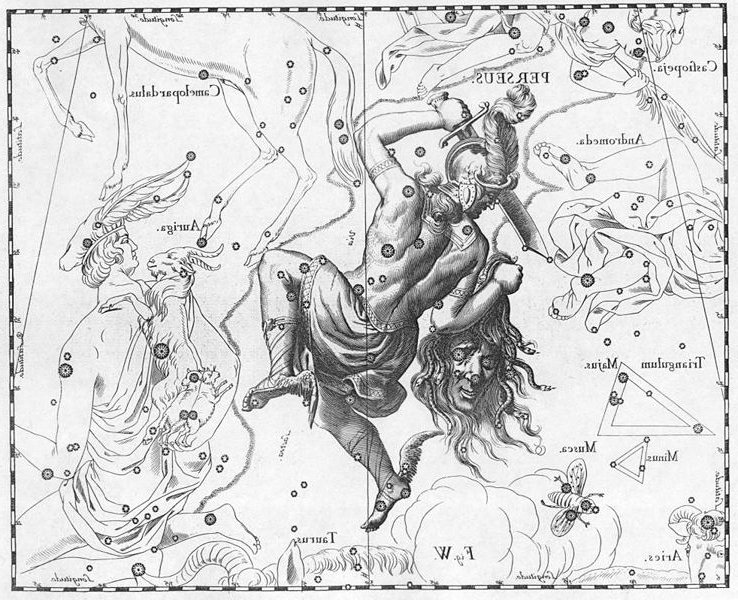
Perseus and the head of Medusa from the 1690 Uranographia by Johannes Hevelius. Image found with the article on Algol in Wikipedia.
 Bob Moler's Ephemeris Blog