Archive
Ephemeris: 03/03/2026 – Eclipse prospects for the rest of the year
This is Ephemeris for Tuesday, March 3rd. Today the Sun will be up for 11 hours and 16 minutes, setting at 6:33, and it will rise tomorrow at 7:14. The Moon, at full today, will rise at 7:04 this evening.
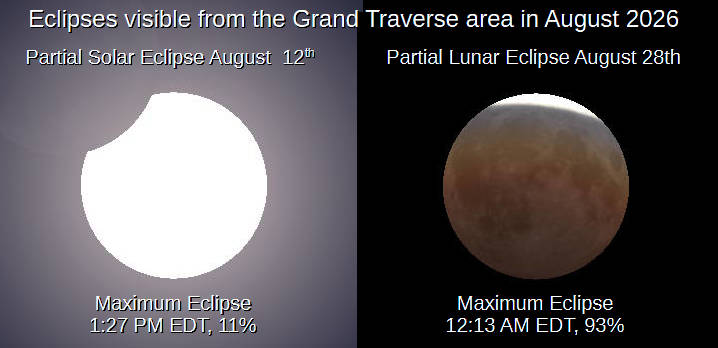
If you’re listening to me right now the total lunar eclipse this morning has ended or will shortly end. In any case it’s invisible because, even if it’s ongoing, twilight has wiped it out. Then there is the possibility of clouds, which I can’t predict from when I’m recording this Sunday night. We do have another chance to view a lunar eclipse, this year, on the night of August 27-28th. It’ll be a little bit earlier. It will start late in the evening and be almost total after midnight. There’s also going to be a solar eclipse on August 12th, but it will be just a little nibble of the moon on the sun for us. It’s going to be total for the east coast of Greenland, the northern Atlantic, and northern Spain, before ending at sunset in the Mediterranean Sea.
The astronomical event times given in this blog are for the Traverse City/Interlochen area of Michigan (Lat 44.7° N, Long 85.7° W; EST, UT – 5 hours) unless stated otherwise. Times will be different for other locations.
Addendum
Ephemeris: 02/17/2026 – There’s an annular solar eclipse today… if you’re a penguin
This is Ephemeris for Fat Tuesday, February 17th. Today the Sun will be up for 10 hours and 34 minutes, setting at 6:14, and it will rise tomorrow at 7:38. The Moon is new today, and won’t be visible.
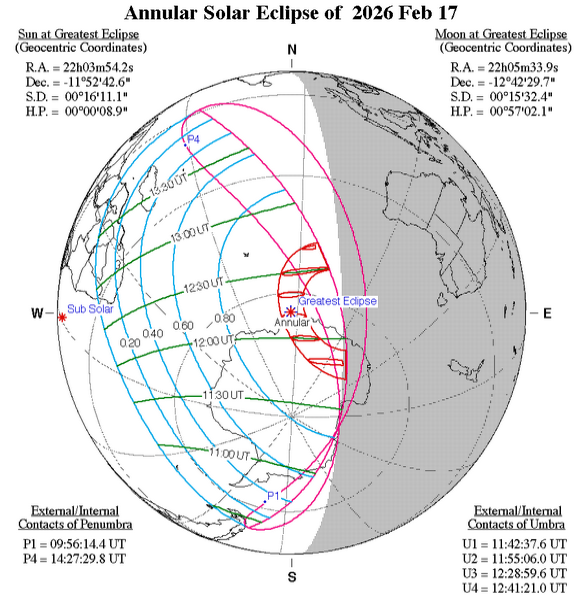
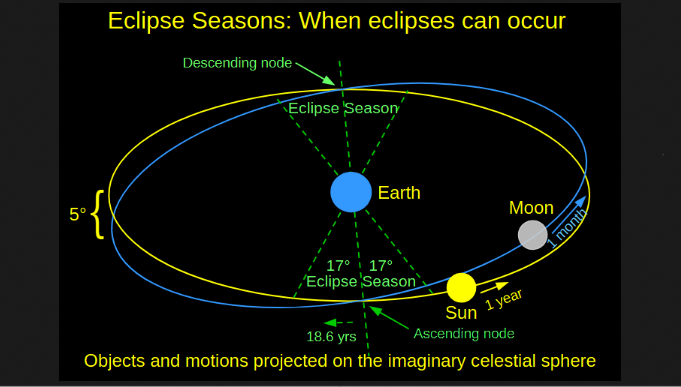
This morning there is an annular solar eclipse occurring. Don’t run outside to see it, especially if you’re here in northern Michigan. The eclipse is only visible in the Southern Ocean and Antarctica. However, this eclipse marks the beginning of an eclipse season, and we will have an eclipse that will be visible for our location in two weeks: a total lunar eclipse, which will be visible before sunrise on Tuesday morning, March 3rd. There are two periods were eclipses will occur in a year, with at least one of the sun and the moon. These periods are separated by a little less than six months, and last about 35 days. That’s about 5 1/2 days longer than a lunar month, so it is possible to squeeze in another eclipse, though not this time.
The astronomical event times given in this blog are for the Traverse City/Interlochen area of Michigan (Lat 44.7° N, Long 85.7° W; EST, UT – 5 hours) unless stated otherwise. Times will be different for other locations.
Addendum
Ephemeris: 10/09/2025 – Eclipses and occultations of Jupiter’s satellites by each other
This is Ephemeris for Thursday, October 9th. Today the Sun will be up for 11 hours and 17 minutes, setting at 7:08, and it will rise tomorrow at 7:52. The Moon, 3 days past full, will rise at 8:16 this evening.
To astronomers the word occult doesn’t mean what you think it means. It’s not a mysterious thing, but the word occult simply means hidden, when one body hides behind another. For example, a solar eclipse isn’t really an eclipse by astronomical standards it is an occultation: the Sun hides behind the Moon. But, a lunar eclipse is really an eclipse where the Moon enters the Earth’s shadow. There is a period for the next 2½ years when Jupiter’s satellites will be both occulting and eclipsing each other. This can easily be seen in a small telescope or even binoculars. Satellites will slowly seem to merge in occultations and disappear, for some minutes, being eclipsed in another satellite’s shadow. The main show starts in May next year and ends in August 2028.
The astronomical event times given in this blog are for the Traverse City/Interlochen area of Michigan (Lat 44.7° N, Long 85.7° W; EDT, UT – 4 hours) unless stated otherwise. Times will be different for other locations.
Addendum


IOTA’s website is occultations.org. Occult is free software. Besides occultations, it can be used to investigate historical and future solar and lunar eclipses, and transits of Mercury and Venus across the face of the Sun. And more.
Ephemeris: 03/28/25 – There’s a partial solar eclipse tomorrow, but not for Michigan
This is Bob Moler with Ephemeris for Friday, March 28th. Today the Sun will be up for 12 hours and 35 minutes, setting at 8:05, and it will rise tomorrow at 7:28. The Moon, 1 day before new, will rise at 7:29 tomorrow morning.
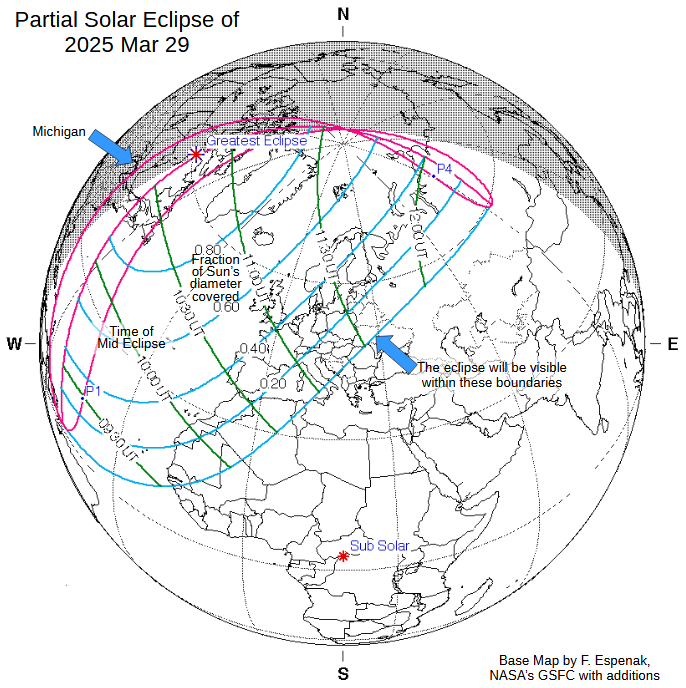
There will be a partial solar eclipse tomorrow morning which will end about 14 minutes before sunrise for Northwestern Lower Michigan. It will be visible to the east and north of here, including all the way to northern Asia. It belongs to the same eclipse season as our total lunar eclipse two weeks ago. Eclipse seasons occur twice a year and last about 35 days. During that time, since it’s a little bit longer than a lunar month, there will be at least 2 eclipses, one of each kind, lunar and solar. There’s a possibility of three, if there is a central lunar eclipse. Then there can be two partial solar eclipses, one to the extreme north, the other to the extreme south of the Earth. The eclipse seasons slip a bit earlier each year. Last year’s total solar eclipse occurred April 8th.
The astronomical event times given are for the Traverse City/Interlochen area of Michigan (EDT, UT – 4 hours). Times will be different for other locations.
Addendum
Ephemeris: 03/14/2025 – Viewing today’s eclipse from the Moon
This is Ephemeris for Pi Day, Friday, March 14th. Today the Sun will be up for 11 hours and 51 minutes, setting at 7:48, and it will rise tomorrow at 7:54. The Moon, at full today, will rise at 8:27 this evening.
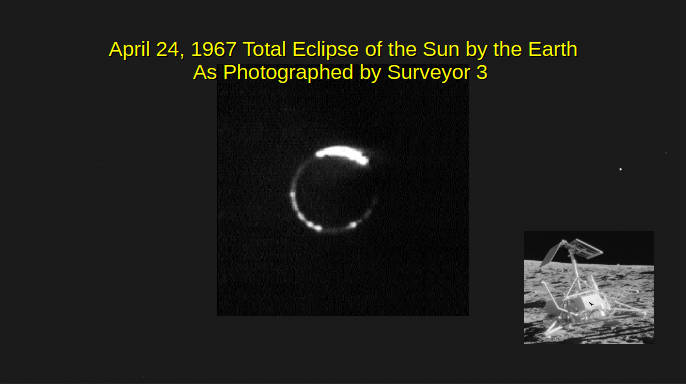
I hope you had a good look at the eclipse this morning I don’t know if it was clear or cloudy because I’m recording this last Sunday night. One entity got a cloudless shot at seeing the eclipse without any obstructions. That was the Blue Ghost lander on Mare Crisium on the Moon. However, it was on the Moon so it was seeing a total eclipse of the Sun. I’ll be really interested to see the photographs coming back from that. There was a satellite and one lander, the Surveyor 3 Lander on the Moon that took pictures of the Earth during the solar eclipse. Of course, we saw a lunar eclipse. It just saw a ring of light around the Earth where the Sun’s light was being bent through the Earth’s atmosphere into it’s shadow to dully illuminate the Moon.
The astronomical event times given are for the Traverse City/Interlochen area of Michigan (EDT, UT – 4 hours). Times will be different for other locations.
Addendum
Sorry, I couldn’t spend any time on the program to celebrate Pi day, so I’ll give it a token appreciation here:

Update
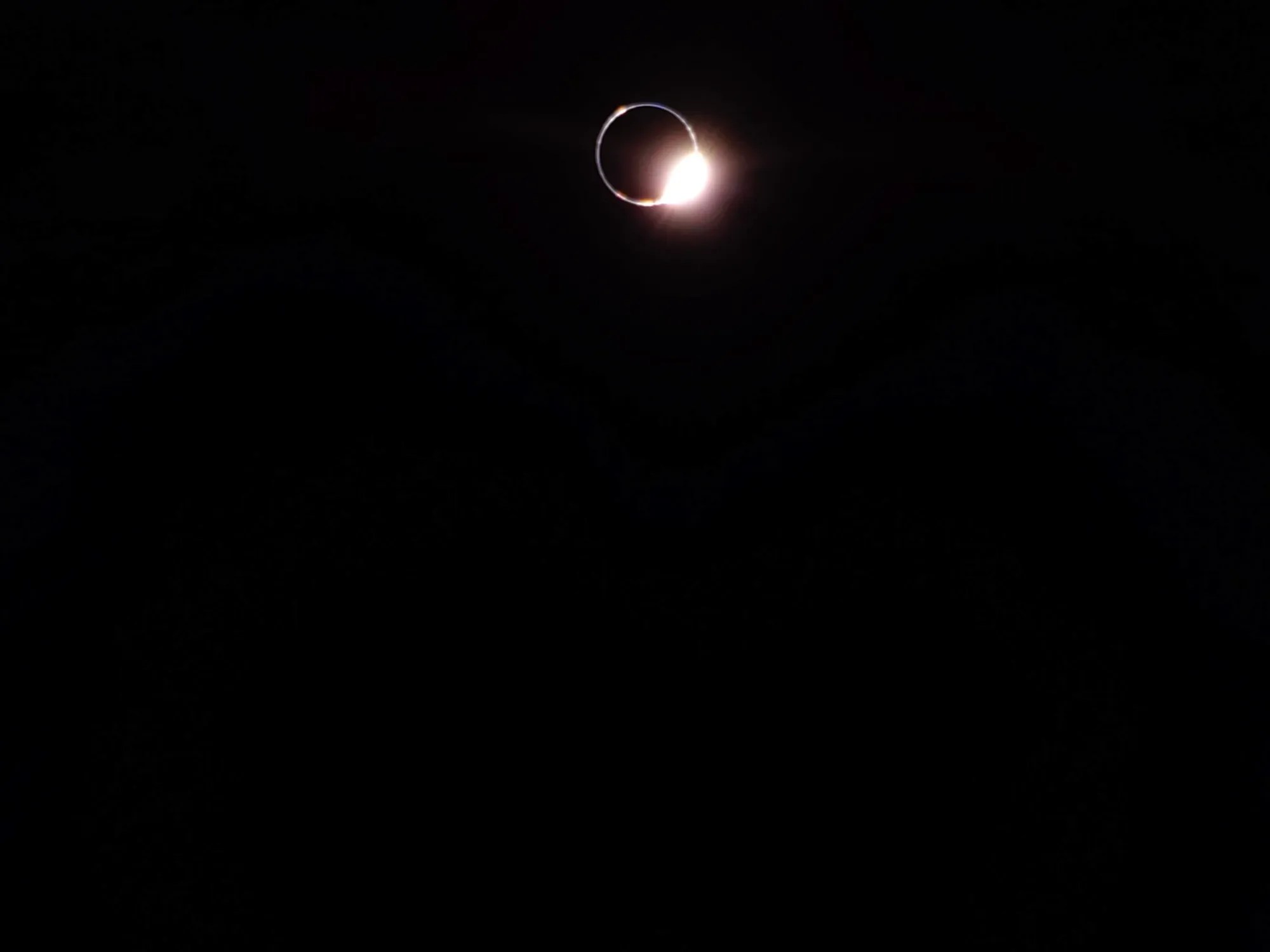
Firefly Aerospace.
Ephemeris: 03/13/2025 – Get ready for tomorrow morning’s total lunar eclipse
This is Ephemeris for Thursday, March 13th. Today the Sun will be up for 11 hours and 48 minutes, setting at 7:46, and it will rise tomorrow at 7:56. The Moon, 1 day before full, will set at 8:06 tomorrow morning.
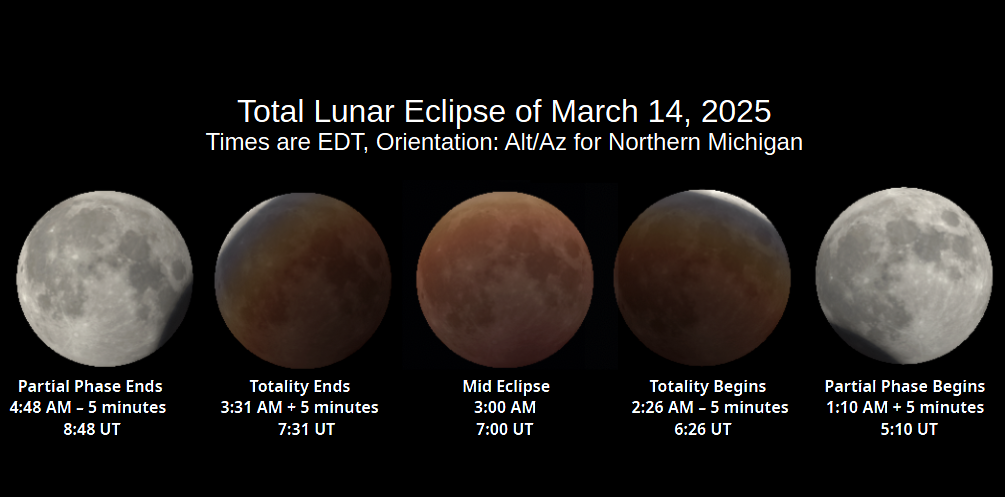
Late, late, late, tonight, or actually early tomorrow morning there will be a total eclipse of the Moon. The moment of full moon, which is necessary for a lunar eclipse will occur at 2:55 AM tomorrow, and the middle of the eclipse will be 5 minutes later. The partial phase of the lunar eclipse will start at 1:10 AM. This partial phase will grow until 2:26 AM when totality will begin. During this period of time the Moon should have a dull reddish color because it is illuminated only by the light filtering through the Earth’s atmosphere from the combined sunrises and sunsets around the world at that time. The total phase will end at 3:31 AM. The ending partial phase will continue until 4:48 AM.
The astronomical event times given are for the Traverse City/Interlochen area of Michigan (EDT, UT – 4 hours). Times will be different for other locations.
Addendum
Ephemeris: 03/11/2025 – There will be a lunar eclipse early Friday morning
This is Ephemeris for Tuesday, March 11th. Today the Sun will be up for 11 hours and 42 minutes, setting at 7:44, and it will rise tomorrow at 8:00. The Moon, 3 days before full, will set at 7:32 tomorrow morning.
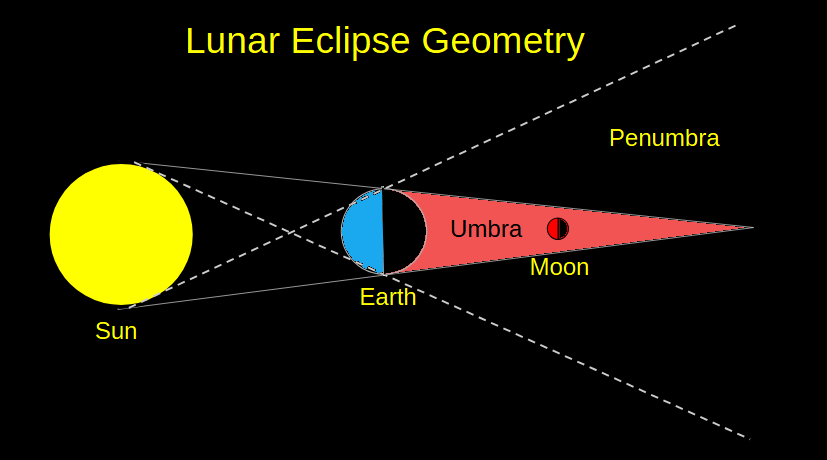
Early Friday morning, the 14th there will be a total eclipse of the Moon. Of course, we all hope for clear skies, but this is March. About 12:30 AM, keen observers might notice that the lower left side of the Moon seems to be a bit dimmer than the opposite side rather than the Moon being evenly illuminated. That’s because that leading edge of the Moon is witnessing a partial eclipse of the Sun. The moon is in the Earth’s penumbra or partial shadow where the Sun is being gradually cut off from the eastern part of the moon to the western part. The partial phase will begin at 1:10 AM Friday morning. Totality will begin at 2:26 AM and last until 3:31 AM. The ending partial phase will continue to 4:48 AM.
The astronomical event times given are for the Traverse City/Interlochen area of Michigan (EDT, UT – 4 hours). Times will be different for other locations.
Addendum
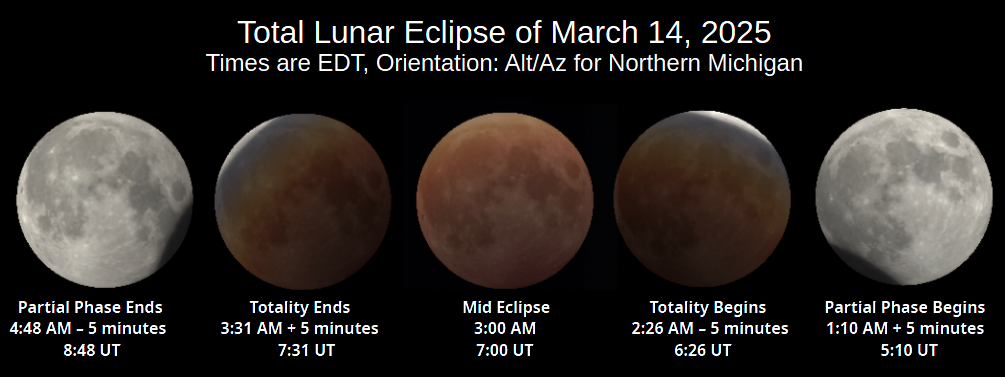
I don’t show the Moon when it enters or leaves the penumbra is because nothing is noticeable. About a half hour before the Moon enters the umbra to begin the partial phase of the eclipse, the side of the Moon nearest the umbra will be noticeably duller than the other side. The same is true after the partial phase is over. The effect of the deepening penumbra is more easily seen in sunglasses, that will darken the still bright Moon.
Ephemeris: 03/25/2024 – Your subsequent opportunities for total solar eclipses in the U.S. if you miss the April 8th one
This is Ephemeris for Monday, March 25th. Today the Sun will be up for 12 hours and 26 minutes, setting at 8:02, and it will rise tomorrow at 7:33. The Moon, at full today, will rise at 8:39 this evening.
The Moon was officially full at 3:00 this morning. At that time it was in a penumbral eclipse. If you didn’t see it you didn’t miss much. Deep penumbral eclipses only show that the moon has a proverbial 5 o’clock shadow. This means that for the next new moon we’ll have a total solar eclipse. It’s in exactly 2 weeks. The eclipse totality path, in the United States, will run from Texas to Maine, and through Indiana and northwestern Ohio. The next total solar eclipse for the U.S. will occur in 2044, a sunset eclipse visible from parts of Montana and North Dakota. The next great eclipse for North America and the U.S. will be on August 12th of 2045, twenty years from now. The totality path will pass from Northern California all the way through to Florida.
The astronomical event times given are for the Traverse City/Interlochen area of Michigan (EDT, UT–4 hours). They may be different for your location.
Addendum
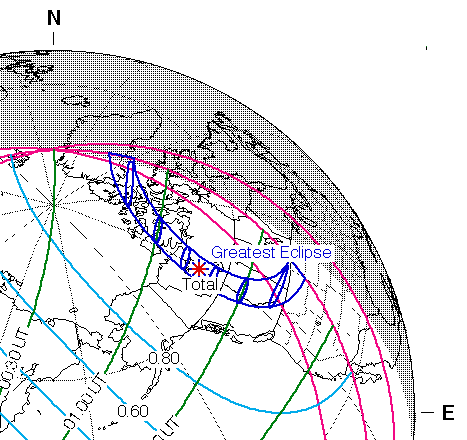
The eclipse will be visible in the area underneath the red lines. Within the dark blue lines is where totality will be visible. In United States that only includes parts of North Dakota and Montana at sunset. the funny three line teardrop in the right is where the eclipse will be in progress at sunset . Adapted from an eclipse map from NASA/GSFC, Fred Espenak.
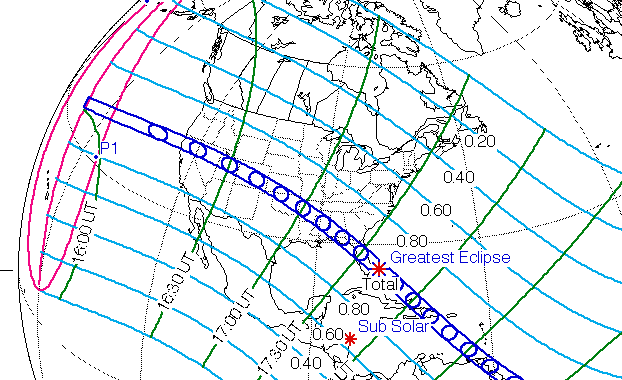
This is the next Great American Eclipse after the April 8th eclipse . The path runs from Northern California to Florida . It is generally parallel to and south of the eclipse path of the August 21st 2017 eclipse. Adapted from an eclipse map from NASA/GSFC, Fred Espenak.
Ephemeris: 12/26/2023 Some astronomical/space events of 2023
This is Ephemeris for Tuesday, December 26th. Today the Sun will be up for 8 hours and 48 minutes, setting at 5:07, and it will rise tomorrow at 8:19. The Moon, at full today, will rise at 4:30 this evening.
Looking back at 2023 in astronomy: an important event that was visible locally was the partial eclipse of the Sun on October 14th. For most of us it was mostly cloudy. I happened to be in Thompsonville at the Betsie Valley District Library to talk about eclipses and to view that one. We got about 15 minutes of clear skies to see the Sun near the middle of the eclipse, so it wasn’t a total washout. Of course the big event is next year on April 8th, a total solar eclipse whose path is going to be passing quite close to us. The James Webb Space Telescope astronomers have reported their first year findings, some of which have contradicted previous assumptions, or seem to have. The second of SpaceX’s Starship launches came within 4,000 kilometers an hour of achieving orbit.
The astronomical event times given are for the Traverse City/Interlochen area of Michigan (EST, UT –5 hours). They may be different for your location.
Addendum
Ephemeris: 10/13/2023 – Tomorrow’s solar eclipse
This is Ephemeris for Friday, October 13th. Today the Sun will be up for 11 hours and 6 minutes, setting at 7:01, and it will rise tomorrow at 7:56. The Moon, 1 day before new, will rise at 7:45 tomorrow morning.
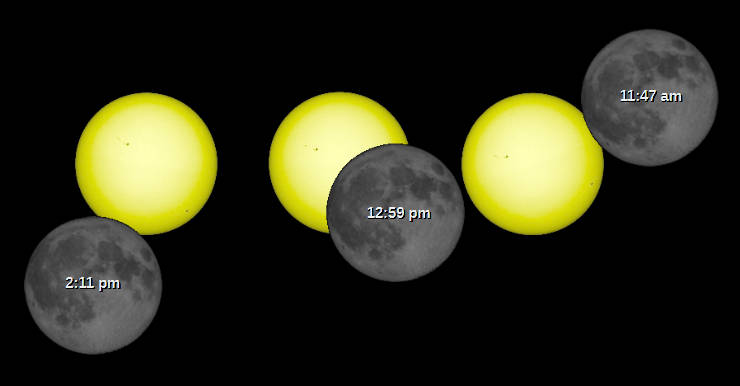
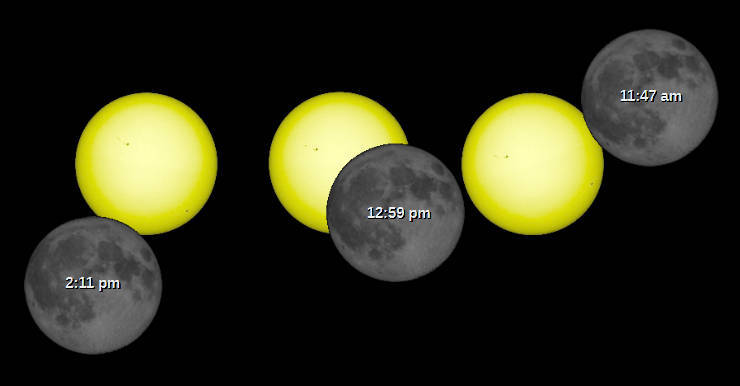
The safest way to view tomorrow’s solar eclipse is by projection, we call it pinhole projection, although the pinhole can be up to 1/4 inch in diameter and will cast a usable image of the Sun about 6 feet. My wife once used the mirror in her compact to reflect the Sun’s image onto the north side of a building across the street. It’s probably too late to buy them, but if you have any eclipse glasses leftover from the 2017 eclipse make sure they don’t have any pinholes in them. They can be used to view the eclipse. Make sure they are ISO approved. Still projection is your safest bet. For our area the eclipse will last from 11:42 am to 2:18 pm. I’ll be at the Betsie Valley District Library in Thompsonville for the eclipse. You’ll be in good shape for next April 8th total eclipse, whose path of totality will be much closer to us.
Jerry Dobek, Northwestern Michigan College instructor will be on campus with telescopes to view the eclipse on campus.
The astronomical event times given are for the Traverse City/Interlochen area of Michigan (EDT, UT –4 hours). They may be different for your location.
Addenda
In case of clouds, I will still be at the Betsie Valley District Library with an alternate program of my experience with five previous total solar eclipses, and a look at some future eclipses. Being a NASA Solar System Ambassador, I’ll have some NASA stickers and other things to hand out to the kids, big or small.
The next solar eclipse
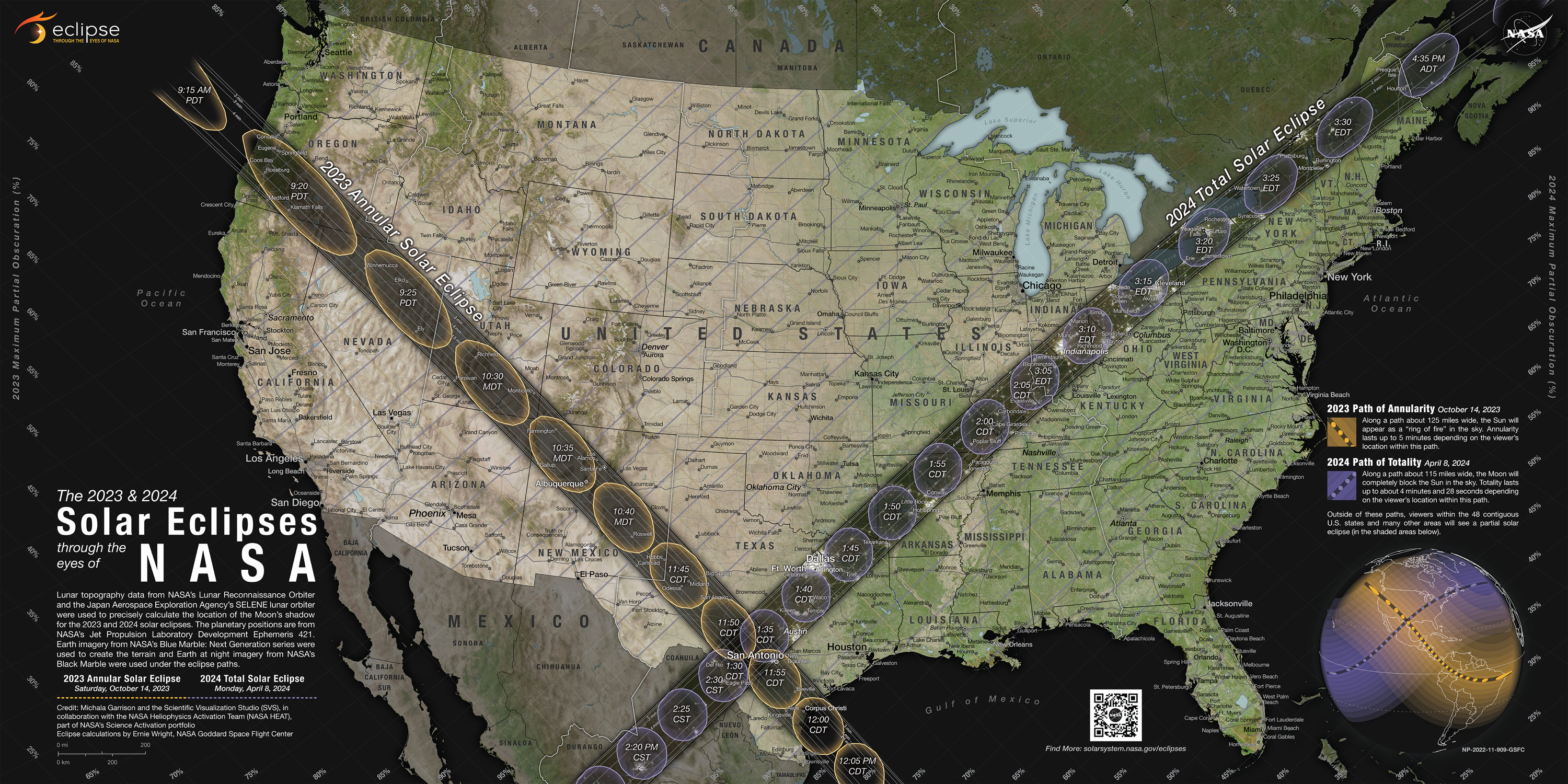
The next eclipse visible from our area will occur on April 8, 2024, six months from now. It will be a total solar eclipse whose path of totality is within a day trip from our area, if it’s clear in Indiana or Ohio. I’ll have a lot more information as we approach April. On the Internet search for american eclipse 2024, or words to that effect. It’s always best to plan early.
 Bob Moler's Ephemeris Blog