Archive
02/28/11 – Ephemeris – Preview of March skies
Monday, February 28th. The sun will rise at 7:22. It’ll be up for 11 hours and 6 minutes, setting at 6:28. The moon, half way from last quarter to new, will rise at 5:34 tomorrow morning.
During March, which starts tomorrow, the increase in daylight hours are at its greatest, with Spring 3 weeks away. Daylight hours will increase from 11 hours and 9 minutes tomorrow to 12 hours and 42 minutes on the 31st. Along with that the altitude of the sun at noon will increase from 38 degrees tomorrow to 49 ½ degrees at month’s end. Local noon, by the way for Interlochen and Traverse City is about 12:50 p.m, which is mainly due to the fact that our standard time meridian happens to run through Philadelphia. The MESSENGER spacecraft will arrive at Mercury and will enter into orbit of this innermost planet after a 7 year odyssey on the 18th. Here on earth spring will start at 7 20 p.m. on the 20th.
* Times are for the Traverse City/Interlochen area of Michigan. They may be different for your location.
02/14/11 – Ephemeris – Stardust-NExT reaches Comet Tempel 1 tonight
St Valentine’s Day, Monday, February 14th. The sun will rise at 7:44. It’ll be up for 10 hours and 24 minutes, setting at 6:09. The moon, 3 days past first quarter, will set at 5:41 tomorrow morning.
About 11:40 this evening the Stardust spacecraft will pass about 120 miles from comet Tempel 1’s nucleus. It’s happening over 200 million miles away, near Mars’ distance from the sun. The spacecraft will take 72 pictures as it speeds past the comet at over 24,000 miles an hour. By tomorrow morning many of the photographs should be available on the Internet and TV. On Tempel 1’s last approach to Mars’ orbit it was struck bu a big chunk of copper when the Deep Impact spacecraft’s impactor struck the comet’s nucleus. That was July 4th, 2005. This time the Stardust-NExT mission is interested in changes in the comet that have occurred over the orbit, and it’s looking for the crater left by Deep Impact.
* Times are for the Traverse City/Interlochen area of Michigan. They may be different for your location.
01/31/11 – Ephemeris – February preview
Monday, January 31st. The sun will rise at 8:02. It’ll be up for 9 hours and 46 minutes, setting at 5:49. The moon, 2 days before new, will rise at 7:01 tomorrow morning.
Let’s preview February the shortest month. Through out the month the daylight hours will be getting longer at an increasing pace. Daylight hours will increase from 9 hours and 51 minutes tomorrow to 11 hours and 6 minutes on the 28th. The sunrise time will decrease from 8:02 tomorrow to 7:21 at month’s end. The sunset times will increase from 5:51 on the 1st to 6:29 on the 28th. Along with that the altitude of the sun at noon will increase from 28 degrees to nearly 38 degrees during the month. Local noon, by the way for Interlochen and Traverse City is about 12:55 p.m, which is mainly due to the fact that our standard time meridian happens to run through Philadelphia. The Stardust spacecraft will swing past comet Tempel 1 on the 14th.
* Times are for the Traverse City/Interlochen area of Michigan. They may be different for your location.
Merry Christmas!
 Have a very merry and safe Christmas from this old astronomer. I hope Santa is good to you.
Wishing you clear skies to you and Santa.
12/21/10 – Ephemeris – Winter solstice
Tuesday, December 21st. The sun will rise at 8:16. It’ll be up for 8 hours and 48 minutes, setting at 5:05. The moon, at full today, will rise at 5:37 this evening.
Today autumn will end and winter will start. The exact moment will be at 6:38 this evening. That’s when the sun will appear directly over the Tropic of Capricorn at 23 ½ degrees south latitude. After that moment the sun will appear to inch northward. Winter will end as the sun crosses the equator on March 20th next year. The sun’s low appearance in our skies and the fewer hours of daylight now, due to the earth’s tilt has caused the rapid decrease in temperatures we are experiencing. Unfortunately with the increased amount of solar heat we in the northern hemisphere will be getting starting tomorrow, it will take until mid January before the sun’s effect begins to show with warmer days. It’s hard to believe but winter is the shortest season.
* Times are for the Traverse City/Interlochen area of Michigan. They may be different for your location.
12/20/10 – 12/21/10 Live eclipse blogging
9:47 p.m. EST: It started out clear, but by 9:30 p.m. we’re getting some light cloud. I’m staying home for this one near Traverse City, Michigan. Below is my 9:30 p.m. picture:
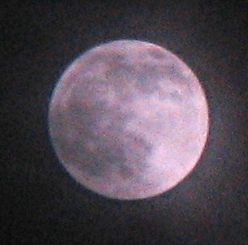
The full moon 12/20/10 9:30 p.m. EST through light clouds
My equipment is simple. I’m using my Canon A570 IS camera with 2X telephoto in manual mode.
11:23 p.m. EST: It’s hazing over. The moon looks better than this photograph taken at 11:10 p.m. The color balance is off. I don’t know whay, though it is intensified by adjusting the levels of the image.
The moon at 11:14 p.m. EST
According to http://www.wunderground.com (Weather Underground) at this time we’re in the middle of a relatively thin cloud band that may pass over before the eclipse starts. Here’s hoping.
12:27 a.m. EST: The penumbral part of the eclipse is starting now. The moon is entering the moon’s outer shadow. Nothing will be visibly different about the moon until about 1 a.m. when the left part of the moon will begin to appear a bit dusky. It’s still hazy out but not as bad as an hour ago. The map on Weather Underground shows the cloud dissipating and moving to the east. Looks like the clouds are coming from the southwest. However now we’re getting a radar image of precipitation now moving near Manistee, about 6o miles southwest of us. It’s gong to be a race to see if we can see the start of the partial eclipse before the clouds and snow get us. The weather service says that there will be snow after 1 a.m. I’d hate for them to be right for a change.
1:11 a.m. EST: When I took the shot below it was much clearer than a half hour ago. I underexposed the photo but it does show the duskiness on the left edge of being deep in the penumbral shadow. It really wasn’t apparent to the eye. Sunglasses help is seeing it.
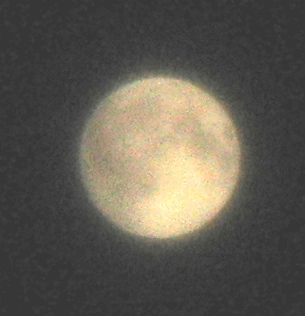
Under exposed moon about half way into the earth's penumbral shadow at 1:03 a.m.
1:17 a.m. EST: The Weather Underground maps show the snow either dissipating or moving east rather the northeast. We might get this eclipse in after all.
1:38 a.m. EST: We are in the partial phase now: The image below was taken at 1:33, just 2 minutes into the eclipse.
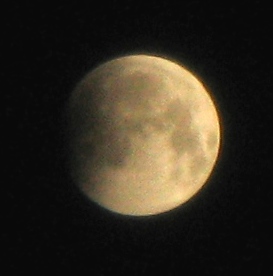
The moon 2 minutes into the partial phase of the eclipse at 1:33 a.m.
It is clearer that at any time since the first photograph. I did spot some heavier clouds to the southwest, but they weren’t very big. The Weather Underground map still looks promising.
1:57 a.m. EST: High clouds are affecting the moon’s image again making it fuzzy. It looks clearer visually than in photographs. At this point in the eclipse I try to get an idea of the brightness and color of the umbra. The haze has so far prevented me.
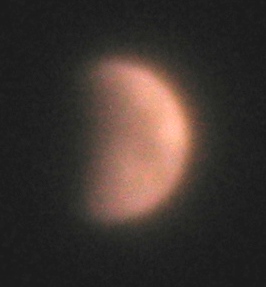
The partially eclipsed moon at 1:53 a.m.
2:15 a.m. EST: It’s getting hazier, so I didn’t attempt a photograph. With binoculars I was able to ascertain that the umbral shadow appears to be the red of a normal eclipse. I heard one prediction on the radio yesterday that the shadow may be darker than usual due to volcanic ash high in the atmosphere. Whomever didn’t quote a source. Bu it looks like a normal red colored moon in totality.
2:42 a.m. EST: We’re in totality. I can hardly see the moon through the thickening clouds. I can see the the moon in binoculars, so this isn’t a particularly dark eclipse. I’m hanging it up now. I have to go to work this morning.
Update 3:40 p.m. EST: It never did clear up after my last post, so I got nearly 3 hours sleep. I’m really dragging about now. There’s lots of good eclipse images posted on space.com, spaceweather.com and even the Huntington post.
11/30/10 – Ephemeris – December Preview
Tuesday, November 30th. The sun will rise at 7:58. It’ll be up for 9 hours and 6 minutes, setting at 5:04. The moon, 2 days past last quarter, will rise at 3:16 tomorrow morning.
Let’s preview December’s skies. Winter will officially arrive on the 21st at 6:38 p.m., the winter solstice. The noontime sun will dip from 23 ½ degrees to a bit less than 22 degrees above the southern horizon on that day. There will be little movement in the sunset times: In the Traverse City/Interlochen area this will be from 5:03 tomorrow, down to 5:02 and then advancing to 5:11 at the end of the month. There is more movement in the sunrise times which will advance from 7:59 tomorrow morning to 8:19 on the 31st. The big events in December will be the Geminid meteor shower whose maximum is on the morning of the 14th, and a total lunar eclipse that will be visible on the morning of the 21st.
* Times are for the Traverse City/Interlochen area of Michigan. They may be different for your location.
My shakedown cruise
A week an a half ago my granddaughter and I went out on the schooner Manitou for as two hour cruise with over 50 folks on the west arm of the Grand Traverse Bay. It was my shakedown cruise, not the boat’s. I was asked to be the astronomer on the four day Astronomy Cruise. The regular physicist/astronomer was on sabbatical this year.

Astronomy Cruise image from the Ephemeris Web site
Here’s the image on the Ephemeris web site that I’ve been running since last autumn.
Anyway, back to the cruise. There was a steady wind and after the ship motored away from the dock and headed into the wind. 12 of us hauled on the line to raise the mainsail. Others raised the foresail and the crew raised two jibs. (If I got anything wrong, I’m working on the terminology, OK?). We stayed in the south end of the bay, sailing back and forth. I never knew our speed, but the boat seemed fast and responsive enough. I had a long chat with the captain with what the itinerary would be. She said their wasn’t one. That was determined by the wind Though they did expect to make it to one of the Manitou islands. I checked out below decks at the cabins and the galley. Snug but nice.
My companion and bunk mate for this cruise is a veteran of many cruises Norm Wheeler. He’s the instructor for Science and English at the Leelanau School and the head of the school’s Lanphier Observatory. He’s also a member of the Beach Bards, a story telling troupe that entertains at a bonfire on the beach at the school and on the Manitou.
I’m going to bring my 8 inch Celestron telescope for viewing at night from onshore, a couple of pair of binoculars I’ll also bring my laptop computer if worse comes to worst and it’s cloudy. I have a stock of my Grand Traverse Astronomical Society presentations to use.
Here’s some photos from the cruise.

Looking Aft
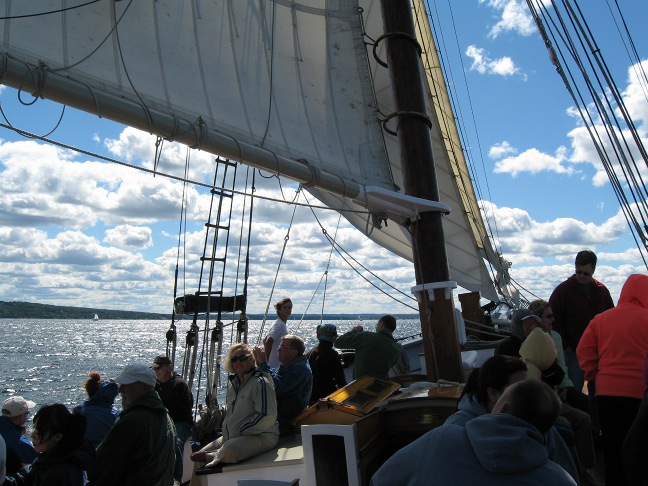
Looking Forward
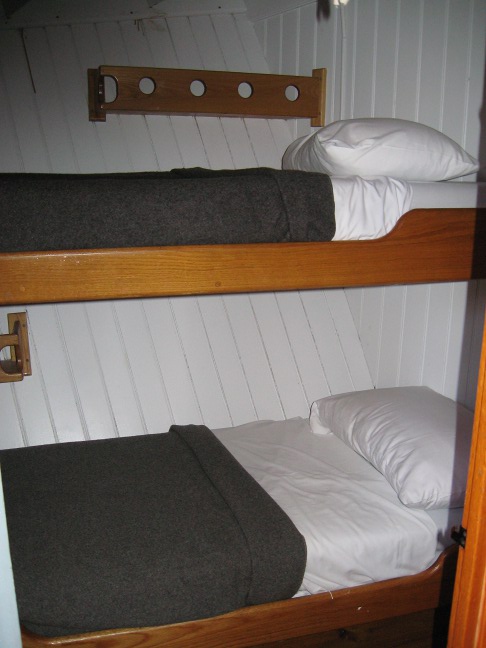
The bunks in one of the forward cabins

My granddaughter Coley near the ladder below deck

Coley on deck
9/15/10 – Ephemeris – the planets this week
September 15: This is Ephemeris for Wednesday, September 15th.* The sun will rise at 7:21. It’ll be up for 12 hours and 31 minutes, setting at 7:53. The moon, at first quarter today, will set at 12:37 tomorrow morning. | Lets take a look at the bright planets for this week. Venus and Mars are very low in the twilight. Venus is the brightest. It’s 45 million miles away and slowly approaching, and appears as a tiny crescent. It will set at 8:57 p.m. Mars is right of Venus and a bit above, and much dimmer. I doubt if you could spot it. Mars will set at 9:13 p.m. The star Spica is just right of Venus and Mars. The planet Jupiter now rises just about due east at 8:06 p.m., moving due south at 2:01 a.m.. It’s located in Pisces this year. Mercury is becoming visible low in the east before sunrise It will rise tomorrow morning at 5:53 a.m. Mercury is becoming more and more visible in the morning twilight. 6:30 to 7 a.m. is the best time to spot it.
*Times are for the Grand Traverse Area of Northern Michigan, USA.
International Observe the Moon Night 9/18/10
The Sidewalk Astronomers of the Grand Traverse Astronomical Society will be observing the moon Saturday night September 18th starting at 8 p.m. near the Clinch Park Marina in Traverse City, MI. This is part of the International Observe The Moon Night.
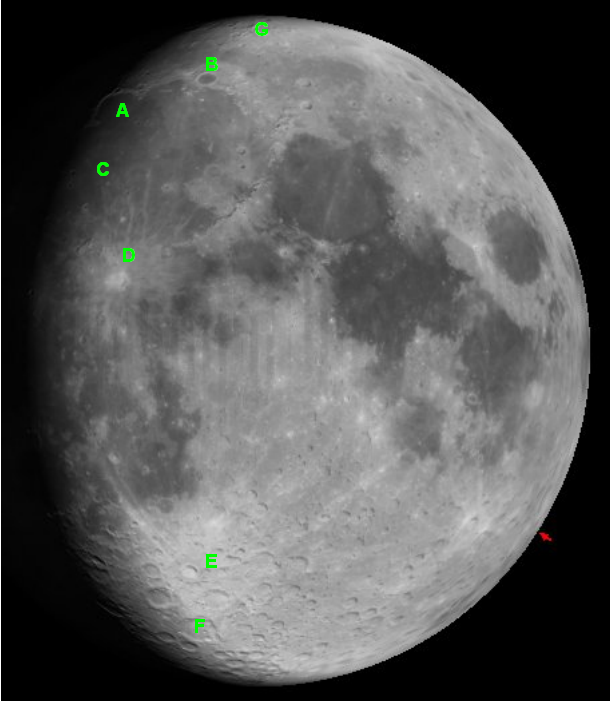
The moon on the evening of September 18, 2010
A Few Points of Interest
A – Sunrise at Sinus Iridium (Bay of Rainbows)
B – The ringed plain Plato
C – Watch for wrinkle ridges in Mare Imbrium (Sea of Showers)
D – The crater Copernicus
E – The crater Tycho and its moon girdling rays.
F – The crater Clavius. Notice the ring of craterlets inside
G – The crater Barrow, a nearly square crater.
Also occurring that night is a conjunction of Jupiter and Uranus. And on Jupiter the Great Red Spot will be centrally located.
We’ll be there if it’s clear or partly cloudy.
 Bob Moler's Ephemeris Blog