Archive
Ephemeris: 09/23/2025 – Neptune is at opposition today
This is Ephemeris for Tuesday, September 23rd. Today the Sun will be up for 12 hours and 6 minutes, setting at 7:37, and it will rise tomorrow at 7:32. The Moon, 2 days past new, will set at 8:07 this evening.
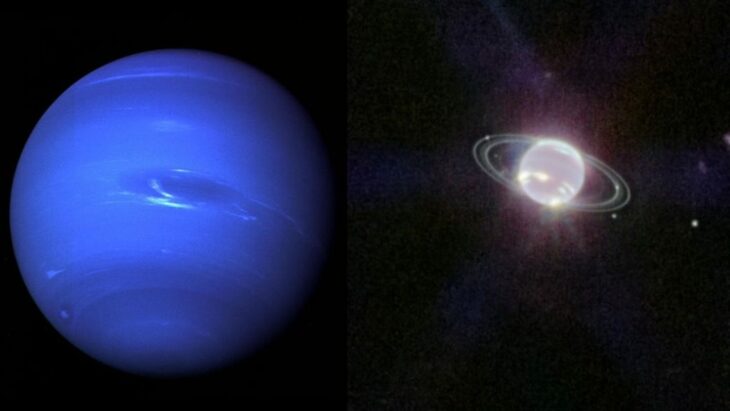
I normally don’t talk about observing things in the sky unless it can be seen with the naked eye, or can be seen in binoculars which are near stars that are visible to the naked eye. So I rarely talk about the planet Neptune. The last time was eight years ago and for the same reason as today. Neptune is in opposition with the Sun. That is, it is exactly opposite to the Sun in the sky, rising at sunset and setting at sunrise. Not only that, today is the 179th anniversary of the date it was discovered in 1846. Interestingly, it was first seen by Galileo. In one of his drawings of Jupiter and its moons that he made with his small telescope, there happened to be a background star that he recorded. That star turned out to be Neptune.
The astronomical event times given in this blog are for the Traverse City/Interlochen area of Michigan (Lat 44.7° N, Long 85.7° W; EDT, UT – 4 hours) unless stated otherwise. Times will be different for other locations.
Addendum
Ephemeris: 09/05/2024 – Looking at the center of the Milky Way
This is Ephemeris for Thursday, September 5th. Today the Sun will be up for 13 hours even, setting at 8:11, and it will rise tomorrow at 7:11. The Moon, 3 days past new, will set at 9:09 this evening.
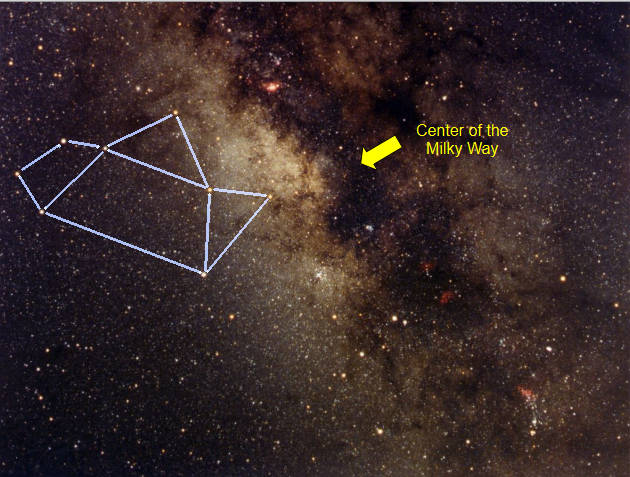
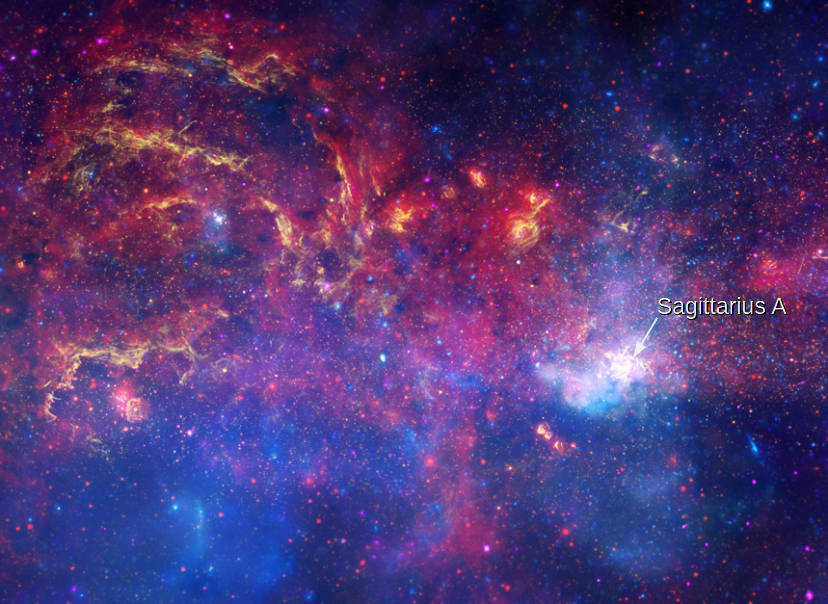
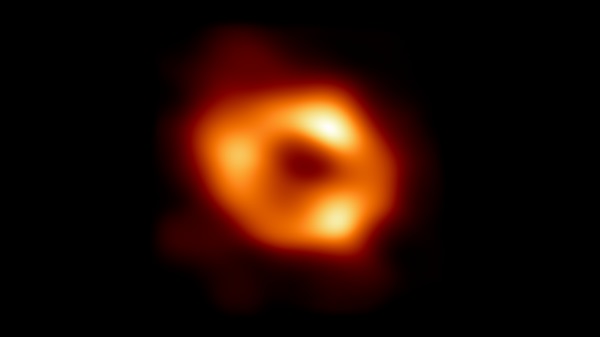
The moon sets in twilight so it will not bother viewing of the Milky Way when it gets dark. Looking to the south and little Teapot asterism of the constellation Sagittarius is the center of the Milky Way. It’s located just off the tip of the spout of that teapot. It’s about 25 to 27,000 light years away and is blocked from our view by clouds of gas and dust. In it lies the Milky Way’s central black hole. Astronomers have found that most galaxies have a black hole in their centers. Ours, it turns out, is a little smallish for our size of galaxy. It has the mass of four million times the mass of the Sun. Imaging of our black hole occurred at the same period of time that the data for the black hole in the galaxy M87. But its image took longer to produce due to the obstruction of that dust and gas.
The astronomical event times given are for the Traverse City/Interlochen area of Michigan (EDT, UT–4 hours). Times will be different for other locations.
Addendum
06/02/2023 – Ephemeris – A South Pole adventure and a comet collision presentation – Tonight!
This is Bob Moler with Ephemeris for Friday, June 2nd. Today the Sun will be up for 15 hours and 22 minutes, setting at 9:22, and it will rise tomorrow at 5:59. The Moon, 1 day before full, will set at 5:14 tomorrow morning.
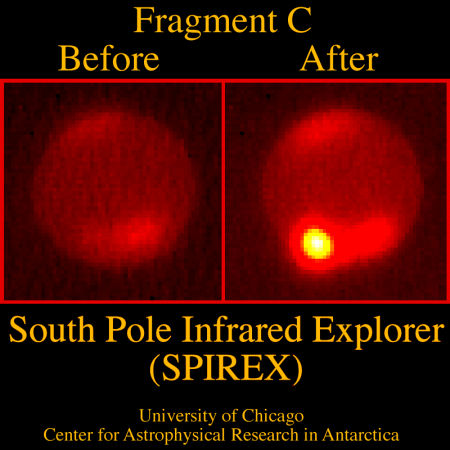
An Antarctic Odyssey: Winter-Over at South Pole Station will be the presentation by John W. Briggs, via Zoom, at tonight’s meeting of the Grand Traverse Astronomical Society at Northwestern Michigan College’s Rogers Observatory at 9 pm. John was a team member building a 24-inch infrared telescope and related experiments that were set up at the South Pole in time for him and colleagues to observe the July 1994, explosive crash of fragmented comet Shoemaker-Levy 9 into the planet Jupiter. There are two ways to attend: In person at the observatory, south of Traverse City on Birmley Road, or via Zoom with a link provided by the society’s website gtastro.org just prior to the meeting.
The astronomical event times given are for the Traverse City/Interlochen area of Michigan (EDT, UT –4 hours). They may be different for your location.
Addendum
About the Program
An Antarctic Odyssey: Winter-Over at South Pole Station
A presentation via Zoom by John W. Briggs
Abstract:
In a lavishly illustrated presentation, John W. Briggs of New Mexico will describe his year-long experience living at the Geographic South Pole while working for the Center for Astrophysical Research in Antarctica. In preparation for this at Yerkes Observatory of the University of Chicago, John was a team member building a 24-inch infrared telescope and related experiments that were set up at the Pole in time for him and colleagues to observe the July 1994, explosive crash of fragmented comet Shoemaker-Levy 9 into the planet Jupiter.
John weathered the “winter-over” with 26 other members of the U.S. Antarctic Program in an experience that many believe approximates what life will be like someday at a lunar or Martian outpost. Once begun, South Pole winter-over is an irreversible commitment, since the Program’s special LC-130 ski planes can’t land in the winter temperatures — in 1994, sometimes as low as 107 degrees F. below zero (with windchill, as low as -180 degrees). John will delight the audience with his perspective on the total South Pole experience — the strange natural environment, the odd social atmosphere, and the challenging, ongoing science.
07/12/2022 – Ephemeris – The rest of the first images and data from the James Webb Space Telescope to be released tomorrow
This is Bob Moler with Ephemeris for Tuesday, July 12th. Today the Sun will be up for 15 hours and 18 minutes, setting at 9:27, and it will rise tomorrow at 6:09. The Moon, 1 day before full, will set at 5:26 tomorrow morning.
Later today at 10:30 am, NASA and the Space Telescope Science Institute will present the first results from the James Webb Space Telescope. These will be, I believe, four multi-spectral images rendered in full color, and other data. The wavelength coverage of Webb in the infrared is greater than Hubble Space Telescope, which is mostly visible light, by several factors. The test images we’ve seen released so far are monochromatic and rendered in white, yellow, orange and red to depict a wide brightness range. There will be a Webb image release with explanations at the Milliken Auditorium of the Dennos Museum at 10:30, with doors opening at 10 am; and also at the Main Library in Traverse City. I’ll endeavor to be at the library.
The astronomical event times given are for the Traverse City/Interlochen area of Michigan (EDT, UT – 4 hours). They may be different for your location.
Addendum
Not known by me last Sunday night when I wrote and recorded today’s program was that President Biden was going to preview one of the images Monday evening. If I were the general public, I would have been underwhelmed. It wasn’t enlarged, or particularly colorful. Here it is below. Click on it for an even larger view:
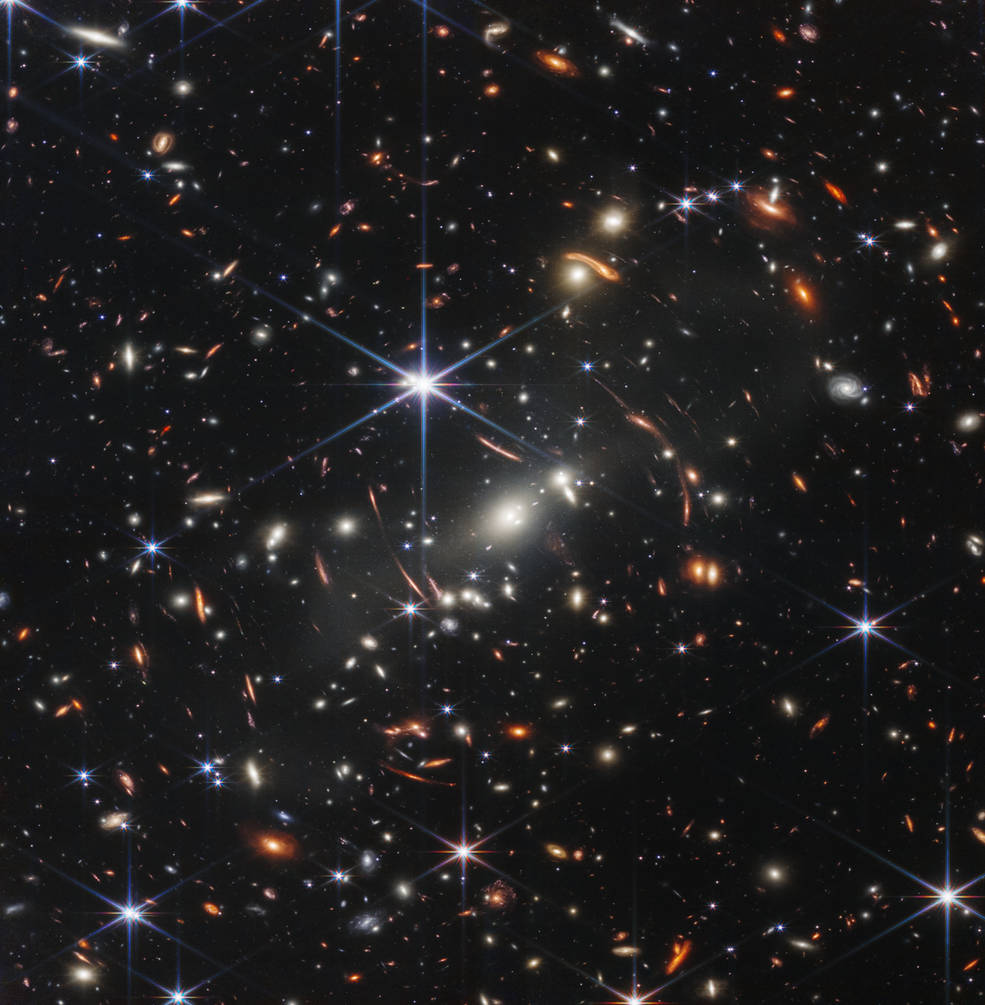
The teaser deep field image from President Biden’s July 11th presentation. Click on the image to fill your screen with it. Credit: NASA, ESA, CSA, JWST, STScI.
In the image above, anything with diffraction spikes is a star in our galaxy. Everything else is a galaxy, like the Milky Way, with billions of stars. This is a tiny piece of sky. As a rule of thumb, the redder the galaxy, the farther away it is. The light emitted by these galaxies are starlight in mostly visible wavelengths, but shifted to the infrared by their great speed of recession caused by the expansion of space between us and them. Also note that many of these galaxies are distorted into short arcs. They seem curved as if being part of a circle around the large, bright galaxy in the center. This is caused by the gravitational lensing caused by the mass of that galaxy, dark matter, and other galaxies in its cluster. This is an effect predicted by Einstein’s theory of General Relativity. I have a feeling that we are going to see a lot more gravitational lensing as the JWST probes into deeper and deeper fields.
One thing to remember about deep fields, is that because of the speed of light being finite, that the farther we look out, the farther back in time we see into an evolving universe. The farthest back we can see with electromagnetic radiation (that is gamma rays, x-rays, ultraviolet, visible, and infrared light, microwaves and radio waves) is the era of the cosmic microwave background, when the universe became transparent, about 380 thousand years after the Big Bang. After that came a period called the dark ages before galaxies formed and the first stars ignited, called the dark ages. At least that’s what I hear-tell. There are lots of questions, like the chicken and egg question: Which came first, supermassive black holes or galaxies?
We will find answers to some of our questions, I’m sure. Even more intriguing, we will be able to ask even more and deeper questions to probe the mystery and beauty of the universe.
12/28/2021 – Ephemeris – The James Webb Telescope is on its way to L2
This is Ephemeris for Tuesday, December 28th. Today the Sun will be up for 8 hours and 50 minutes, setting at 5:09, and it will rise tomorrow at 8:19. The Moon, 2 days past last quarter, will rise at 3:18 tomorrow morning.
The James Webb Space Telescope was launched Christmas morning and is heading out past the Moon’s orbit. It was launched from the European Space Agency’s Spaceport in Kourou, French Guiana on the northeast coast of South America, as part of their contribution to the project. It will orbit a point called Lagrange Point 2, or L2 for short, over four times the Moon’s distance in a direction opposite of the Sun. It will take the telescope 29 days to unfold itself. First order of business was to unfold the solar panels to obtain power, then to deploy its high gain antenna for communications with the Earth. Next to begin to deploy a 5 layer, tennis court sized sun shield. After that, the telescope will be unfolded.
The astronomical event times given are for the Traverse City/Interlochen area of Michigan (EST, UT – 5 hours). They may be different for your location.
Addendum
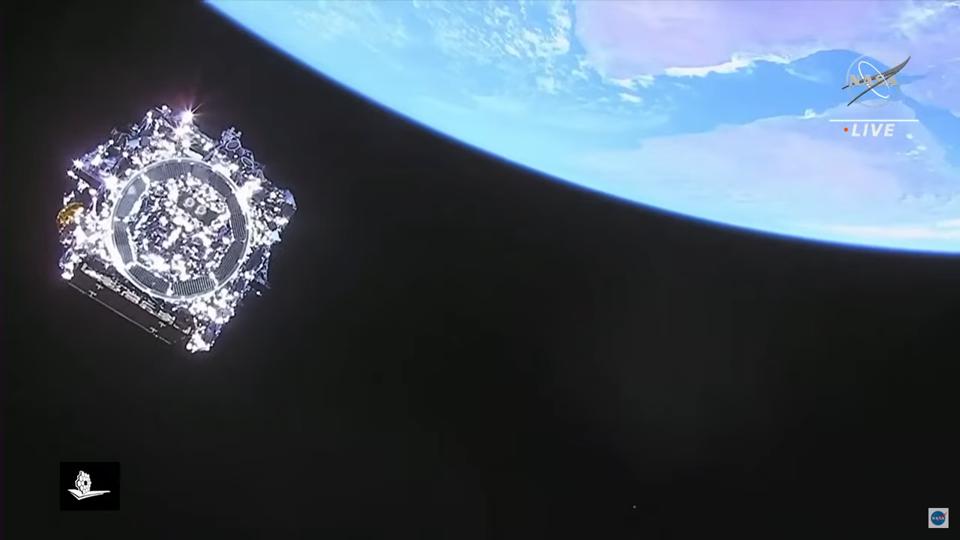
The last view of Webb as it separated from the Ariane 5 launch vehicle. Credit: NASA.
07/08/2019 – Ephemeris – The bright star Vega
Ephemeris for Monday, July 8th. Today the Sun will be up for 15 hours and 24 minutes, setting at 9:29, and it will rise tomorrow at 6:06. The Moon, 1 day before first quarter, will set at 1:31 tomorrow morning.
The bright star high in the east is Vega, one of the stars of the Summer Triangle an informal constellation called an asterism. Vega belongs to the official constellation Lyra the harp, which includes a narrow parallelogram of stars to its south. Vega is regarded by astronomers as a standard calibration star. Though a first magnitude star, its actual magnitude is 0.03. It is a type A0 a pure white star, and is 25 light years away. Astronomers however got a shock in 1983 when calibrating the Infrared Astronomy Satellite (IRAS) on it: Vega showed an excess of Infrared radiation which means the star is orbited by a disk of dust, perhaps a Kuiper belt of its own. Due to the slow wobble of the earth’s axis Vega will become our pole star in about 14 thousand years.
The times given are for the Traverse City/Interlochen area of Michigan. They may be different for your location.
Addendum
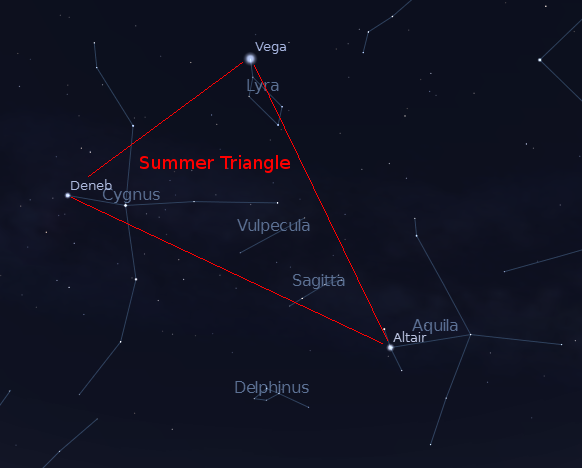
The Summer Triangle. Created using Stellarium.
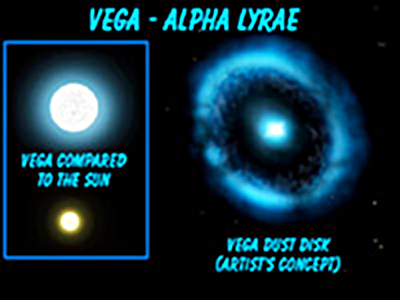
Vega: Comparison to the Sun and its dust ring. Credit Orange County Astronomers.
06/24/2013 – Ephemeris – Infrared astronomy
Ephemeris for Monday, June 24th. Today the sun will be up for 15 hours and 33 minutes, setting at 9:31. The moon, 1 day past full, will rise at 10:27 this evening. Tomorrow the sun will rise at 5:58.
During most of history astronomers viewed the heavens in visible light. That’s all we had, our eyes, later augmented by telescopes, and photography. Today astronomers view the heavens with a myriad of detectors on the earth, above the earth and inside the earth. Radiation detected, beside visible are radio, infrared, ultraviolet, x-rays, and gamma rays, all part of the electromagnetic spectrum as is visible light. Besides that the observe neutrinos and cosmic rays, and are searching for gravitational waves. An intense field of study now is infrared, which must be observed from high mountaintops or from space. Last year I visited one of those facilities at nearly 14,000 feet altitude the observatories atop Mauna Kea in Hawaii. [Which included the two largest telescopes in the world the twin 10 meter Keck telescopes, Gemini North, Subaru and other telescopes. ]
Times are for the Traverse City/Interlochen area of Michigan. They may be different for your location.
Addendum
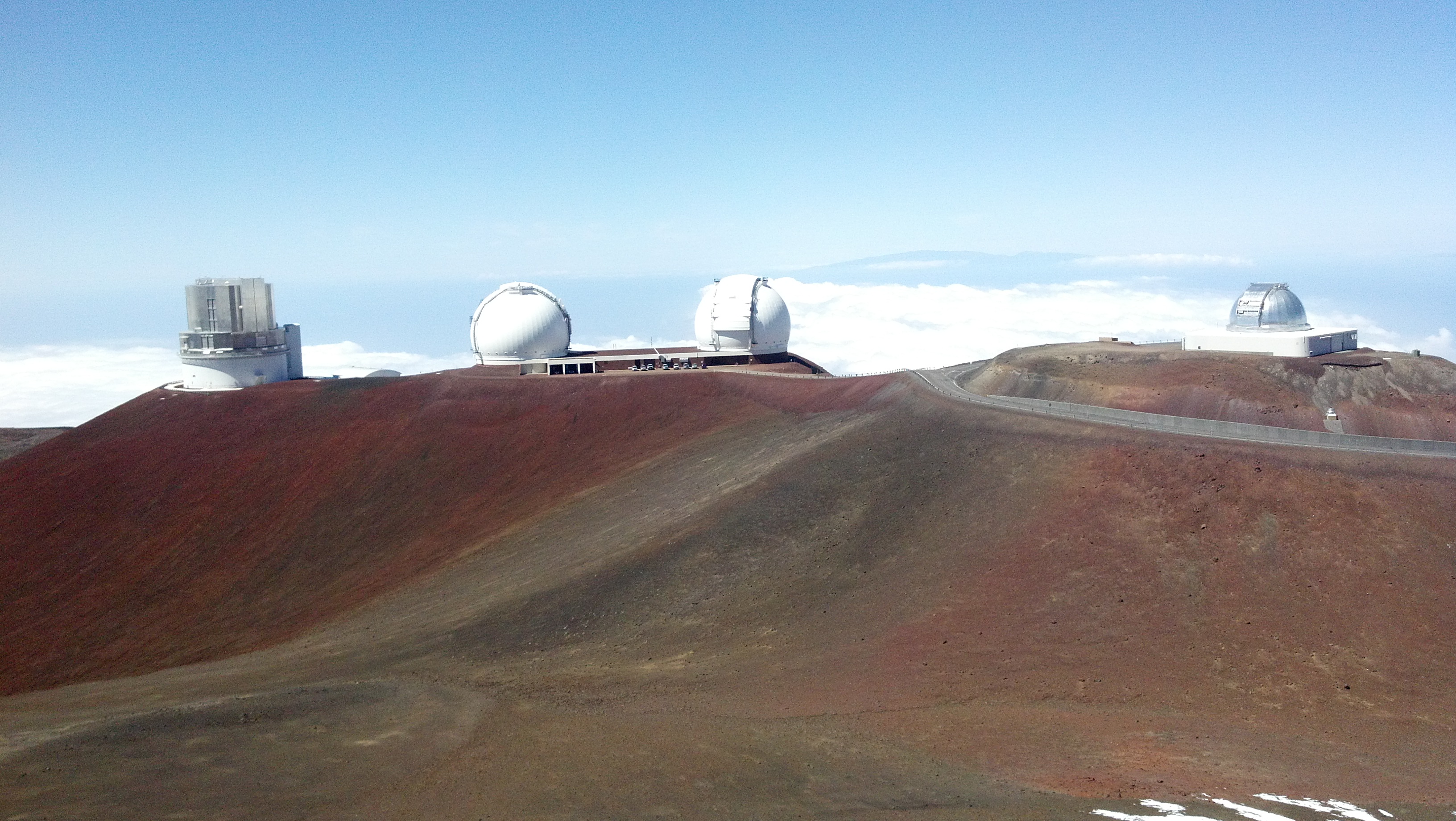
The twin domes of the Keck 10 meter telescopes. Left is the Japanese Subaru telescope. Right is the NASA Infrared Telescope facility. Credit: Bob Moler. Click to enlarge.
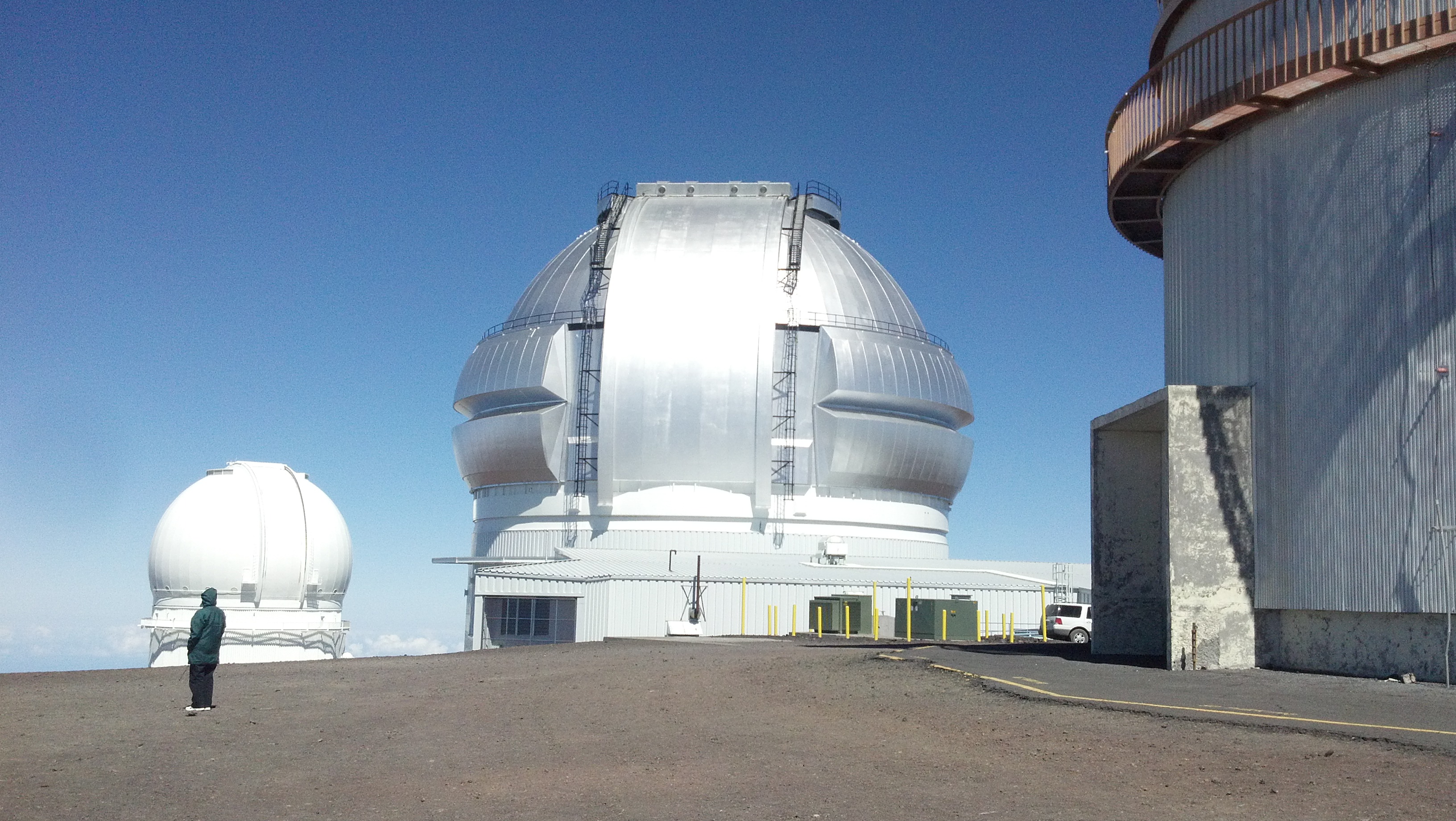
The 8.1 meter Gemini North telescope dome in the center. To the left is the Canada-France-Hawaii Telescope dome. Credit: Bob Moler.
 Bob Moler's Ephemeris Blog