Archive
Ephemeris: 03/26/26 – Jupiter compared to Earth and its visible features
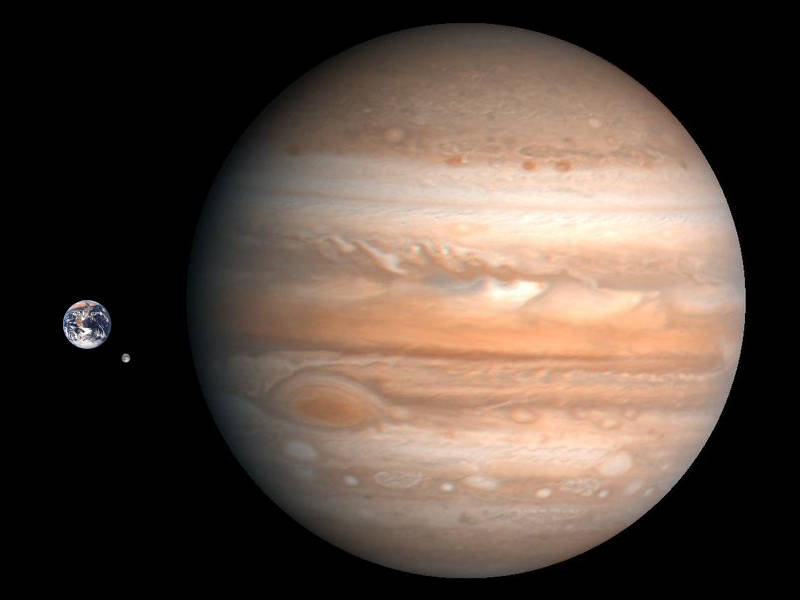
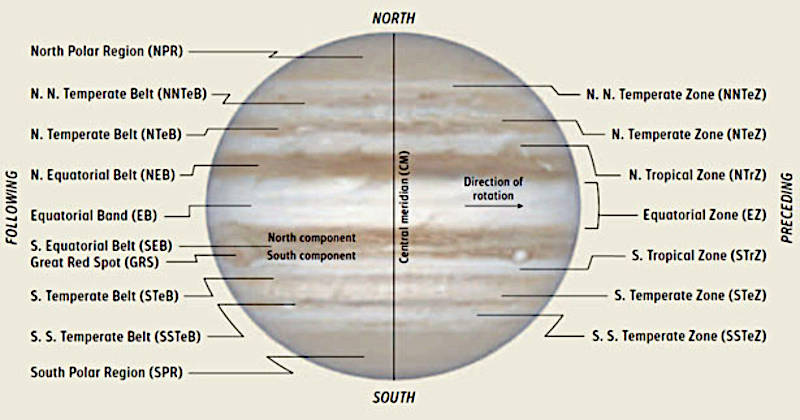
This is Bob Moler with Ephemeris for Thursday, March 26th. Today the Sun will be up for 12 hours and 28 minutes, setting at 8:03, and it will rise tomorrow at 7:32. The Moon, 1 day past first quarter, will set at 5:07 tomorrow morning. | The planet Jupiter rules over the night sky with the Moon after Venus sets. Jupiter, 11 times the diameter of the Earth, has the volume of 1,300 earths, however it is only 318 times the mass of the Earth. It is made-up mostly of hydrogen and helium, so it is called a gas giant planet, rather than a terrestrial or rocky planet like the Earth. Jupiter is the most viewable of the planets in a small telescope. It has 2 dark bands across it called belts of darker appearing clouds. The famed Great Red Spot is an anticyclone embedded in the southern of those belts. The spot is not as red anymore. I remember it being brick-red back in the late 1950s and early 60s. Jupiter spins very rapidly, its day lasts only 10 hours.
The astronomical event times given in this blog are for the Traverse City/Interlochen area of Michigan (Lat 44.7° N, Long 85.7° W; EDT, UT – 4 hours) unless stated otherwise. Times will be different for other locations.
Ephemeris: 12/05/2024 – More about Jupiter: it’s very gassy
This is Bob Moler with Ephemeris for Thursday, December 5th. Today the Sun will be up for 8 hours and 57 minutes, setting at 5:02, and it will rise tomorrow at 8:05. The Moon, 3 days before first quarter, will set at 9:14 this evening.
The planet Jupiter rules over the night sky with the Moon after Venus sets. Jupiter, 11 times the diameter of the Earth, has the volume of 1300 earths, however it is only 318 times the mass of the Earth. It is made-up mostly of hydrogen and helium, so it is called a gas giant planet, rather than a terrestrial or rocky planet like the Earth. Jupiter is the best viewable of the planets in a small telescope. It has 2 dark bands across it called belts of darker appearing clouds. The famed Great Red Spot is an anticyclone embedded in the southern of those belts. The spot is not as red anymore. I remember it being brick-red back in the late 1950s and early 60s. Jupiter spins very rapidly, its day lasts only 10 hours.
The astronomical event times given are for the Traverse City/Interlochen area of Michigan (EST, UT – 5 hours). Times will be different for other locations.
Addendum
Ephemeris: 11/05/2024 – Bright Jupiter is now seen earlier in the evening
This is Ephemeris for Election Day, Tuesday, November 5th. Today the Sun will be up for 9 hours and 58 minutes, setting at 5:25, and it will rise tomorrow at 7:28. The Moon, 4 days before first quarter, will set at 7:51 this evening.
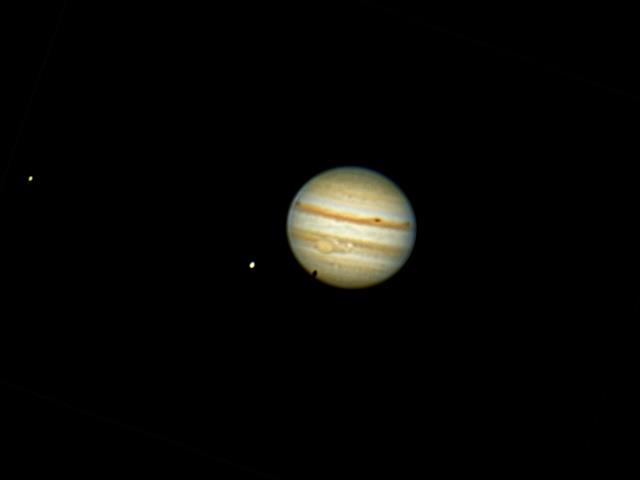
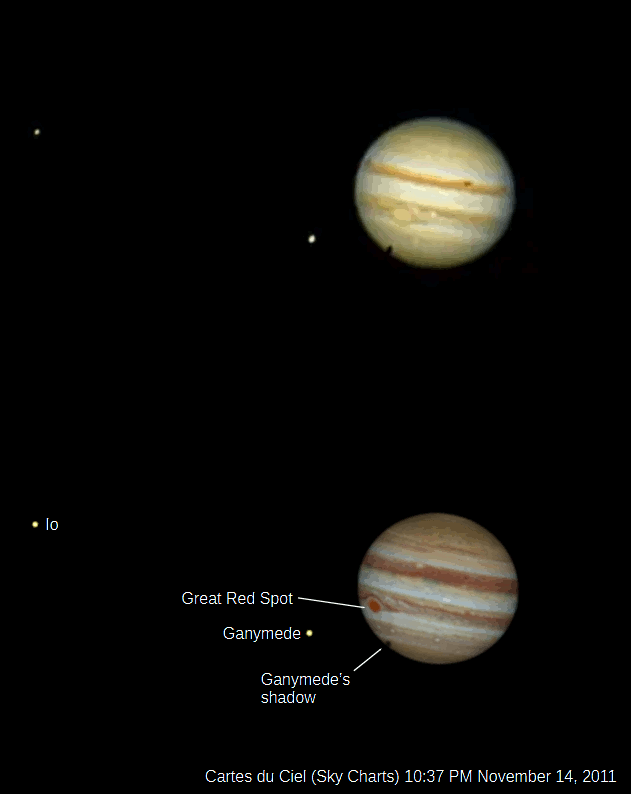
There’s a bright star in the east these evenings. It is extremely bright. If Venus wasn’t around in the evening in the southwest, one might mistake it for Venus. Well this bright star is not a star at all, but the planet Jupiter. Jupiter is the solar system’s largest planet. It is by and large the easiest planet to observe with a small telescope, which will also reveal four of its many moons, which I think is approaching 100 now. (It’s hard to keep track of them.) These four moons were the same ones discovered by Galileo over 400 years ago. Jupiter’s moons move quite rapidly compared to the Earth’s moon. From night to night Jupiter’s moons shift around. Their motions can also be detected over the period of an evening, or night.
The astronomical event times given are for the Traverse City/Interlochen area of Michigan (EST, UT – 5 hours). Times will be different for other locations.
Addendum
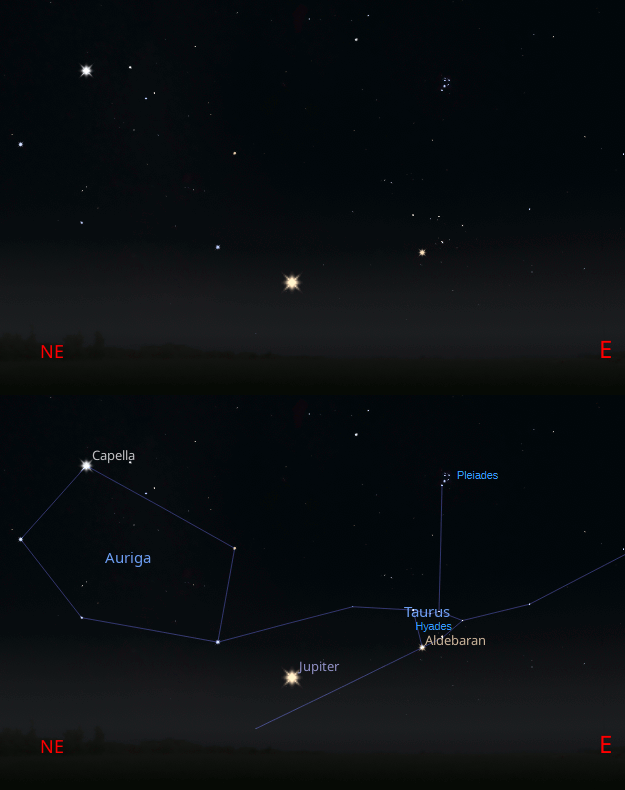
Ephemeris: 10/26/2023 – A closer look at Jupiter’s moon Io
This is Ephemeris for Thursday, October 26th. Today the Sun will be up for 10 hours and 28 minutes, setting at 6:40, and it will rise tomorrow at 8:13. The Moon, 2 days before full, will set at 6:36 tomorrow morning.
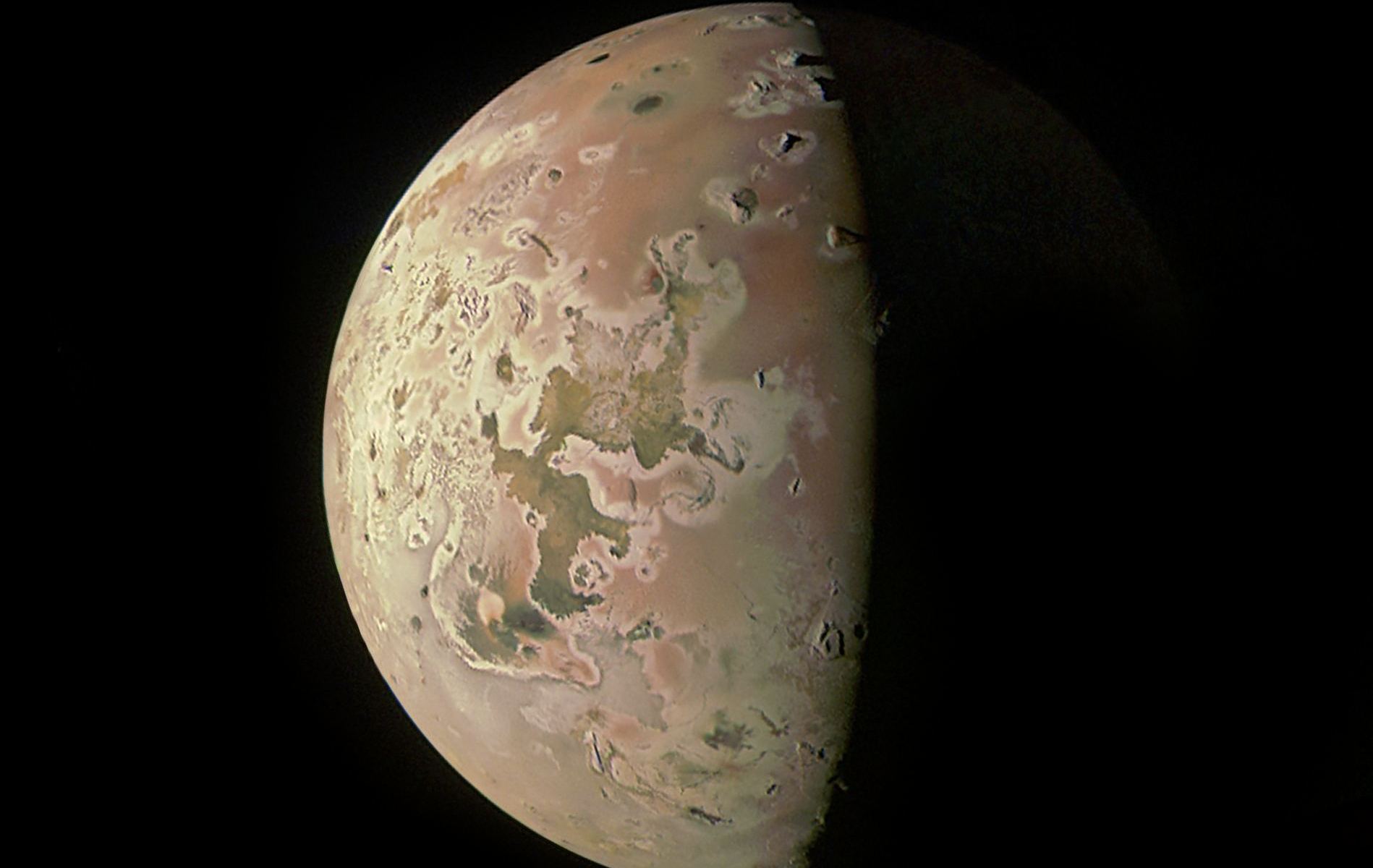
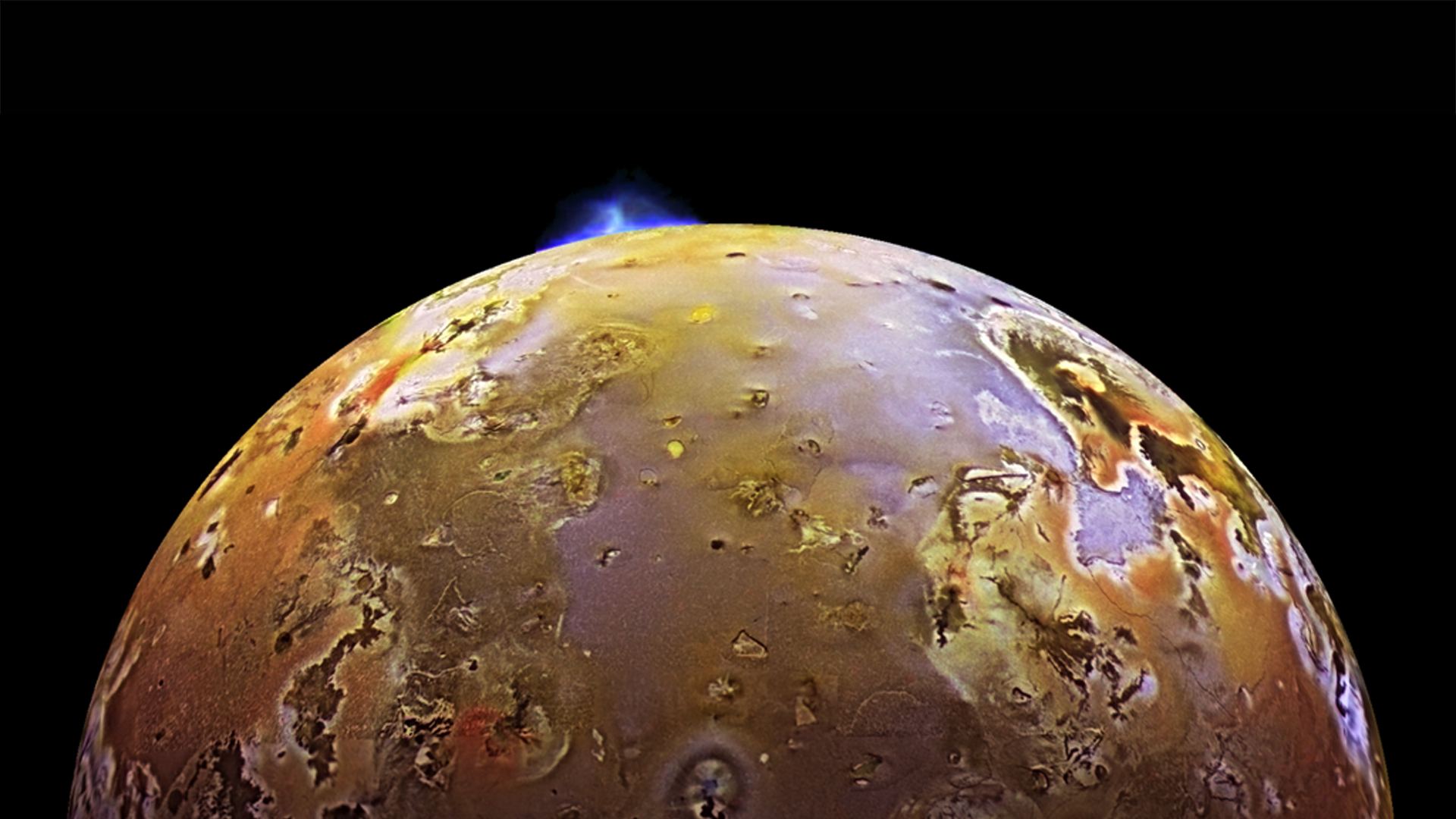
My favorite moon of Jupiter has been Io ever since the Voyager 1 spacecraft discovered volcanoes on it. It turns out that Io is the most volcanic body in the solar system and perhaps the least studied of the Galilean moons of Jupiter. Most of the probes that have swung by or orbited Jupiter never got very close to Io, so we never really got a good close look at it. Well, now we are getting that closer look. The Juno spacecraft, which was sent to Jupiter to work out the interior of Jupiter using gravitational effects on its orbit, has now completed its main mission and its orbit has precessed so that now comes close to Io. The Juno spacecraft has a camera, mainly there for the public, which is showing amazing closeups of this moon.
The astronomical event times given are for the Traverse City/Interlochen area of Michigan (EDT, UT –4 hours). They may be different for your location.
Addendum
06/02/2023 – Ephemeris – A South Pole adventure and a comet collision presentation – Tonight!
This is Bob Moler with Ephemeris for Friday, June 2nd. Today the Sun will be up for 15 hours and 22 minutes, setting at 9:22, and it will rise tomorrow at 5:59. The Moon, 1 day before full, will set at 5:14 tomorrow morning.
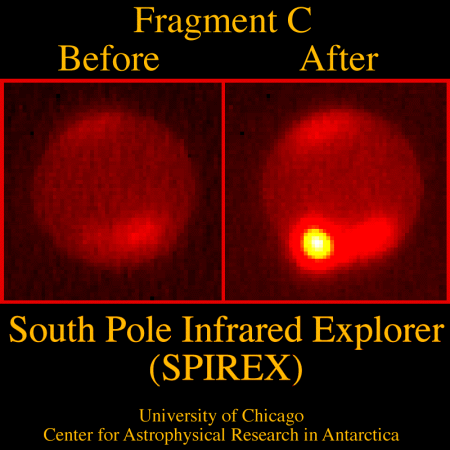
An Antarctic Odyssey: Winter-Over at South Pole Station will be the presentation by John W. Briggs, via Zoom, at tonight’s meeting of the Grand Traverse Astronomical Society at Northwestern Michigan College’s Rogers Observatory at 9 pm. John was a team member building a 24-inch infrared telescope and related experiments that were set up at the South Pole in time for him and colleagues to observe the July 1994, explosive crash of fragmented comet Shoemaker-Levy 9 into the planet Jupiter. There are two ways to attend: In person at the observatory, south of Traverse City on Birmley Road, or via Zoom with a link provided by the society’s website gtastro.org just prior to the meeting.
The astronomical event times given are for the Traverse City/Interlochen area of Michigan (EDT, UT –4 hours). They may be different for your location.
Addendum
About the Program
An Antarctic Odyssey: Winter-Over at South Pole Station
A presentation via Zoom by John W. Briggs
Abstract:
In a lavishly illustrated presentation, John W. Briggs of New Mexico will describe his year-long experience living at the Geographic South Pole while working for the Center for Astrophysical Research in Antarctica. In preparation for this at Yerkes Observatory of the University of Chicago, John was a team member building a 24-inch infrared telescope and related experiments that were set up at the Pole in time for him and colleagues to observe the July 1994, explosive crash of fragmented comet Shoemaker-Levy 9 into the planet Jupiter.
John weathered the “winter-over” with 26 other members of the U.S. Antarctic Program in an experience that many believe approximates what life will be like someday at a lunar or Martian outpost. Once begun, South Pole winter-over is an irreversible commitment, since the Program’s special LC-130 ski planes can’t land in the winter temperatures — in 1994, sometimes as low as 107 degrees F. below zero (with windchill, as low as -180 degrees). John will delight the audience with his perspective on the total South Pole experience — the strange natural environment, the odd social atmosphere, and the challenging, ongoing science.
10/15/2021 – Ephemeris – NASA mission to Trojan Asteroids
This is Bob Moler with Ephemeris for Friday, October 15th. Today the Sun will be up for 10 hours and 59 minutes, setting at 6:57, and it will rise tomorrow at 7:59. The Moon, 3 days past first quarter, will set at 3:25 tomorrow morning.
Tomorrow opens up a window to launch a satellite named Lucy to the Trojan asteroids of Jupiter. Lucy is named for a fossil of a human ancestor discovered in Africa. After launch, Lucy will make two gravitational assist passes of the Earth to get up enough velocity to reach Jupiter’s orbit and pass near Five asteroids in the leading L4 cloud of Trojans. Its orbit will take it back to the Earth, where another gravitational assist will send it to a double asteroid in the trailing Trojan group. On its way out it will pass close to a tiny main belt asteroid DonaldJohanson, named after the discoverer of the Lucy fossil. The mission will last 12 years. After that, Lucy will orbit between the Earth’s orbit and each of the Trojan swarms in turn.
Lucy is scheduled to launch on an Atlas V on Saturday, 16 October 2021 at 09:34 UT (5:34 a.m. EDT) from Cape Canaveral. If the launch can’t take place then, they have something like 22 more days in which they can get it launched.
The astronomical event times given are for the Traverse City/Interlochen area of Michigan (EDT, UT-4 hours). They may be different for your location.
Addendum
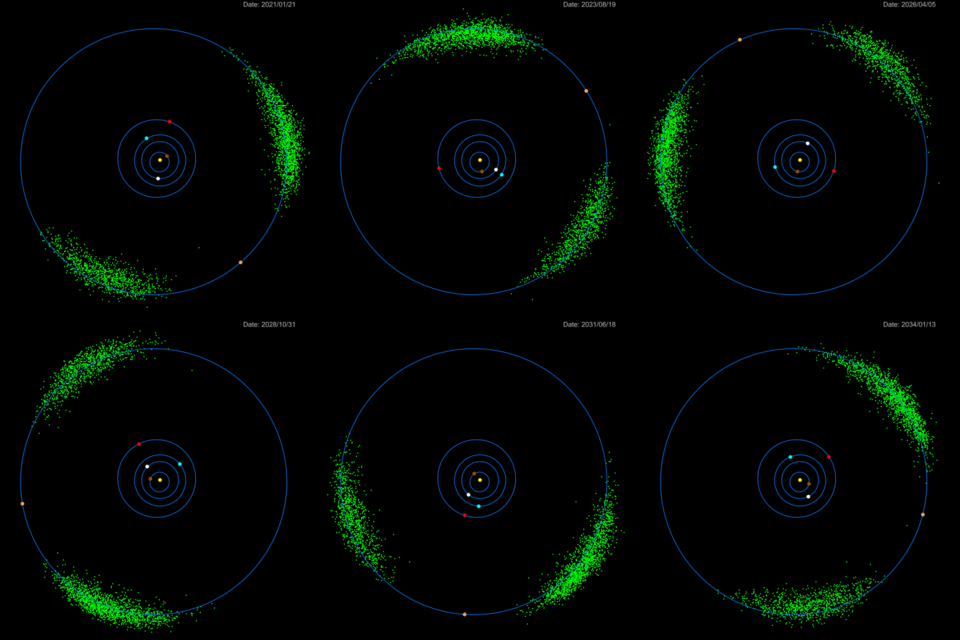
Animated GIF showing Jupiter and Trojan Asteroids during one Jovian year, which repeats. Credit: Astronomical Institute of CAS/Petr Scheirich.
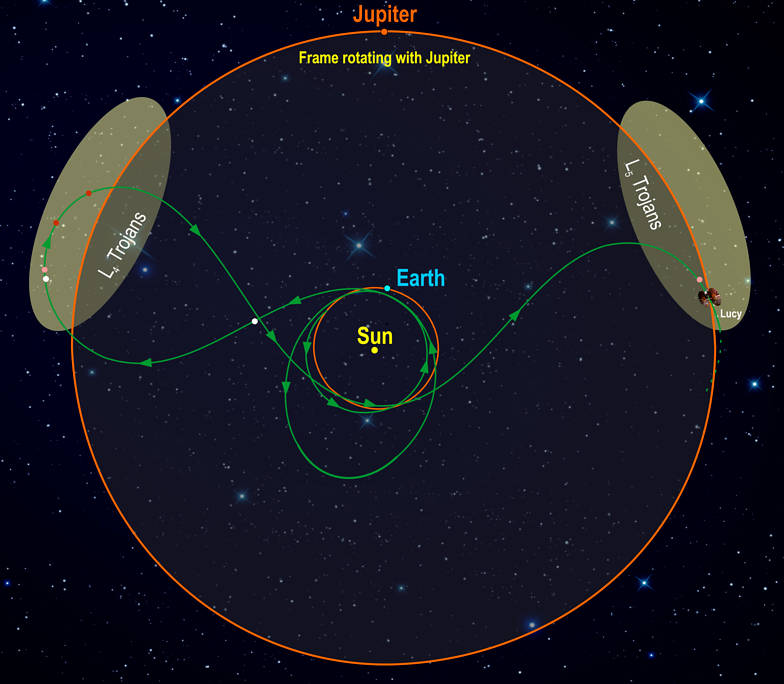
The Lucy spacecraft orbits as seen in the rotating frame of Jupiter’s orbit. Lucy’s orbits are actually ellipses. (I wish they would take the stars out, they should appear as circular trails centered on the Sun from Jupiter’s rotating frame.) Click on the image to enlarge it. Credit: Southwest Research Institute.
10/14/2021 – Ephemeris – What is a Trojan Asteroid?
This is Bob Moler with Ephemeris for Thursday, October 14th. Today the Sun will be up for 11 hours and 2 minutes, setting at 6:59, and it will rise tomorrow at 7:58. The Moon, 2 days past first quarter, will set at 2:13 tomorrow morning.
The Moon is near Jupiter tonight. On this Saturday, the 16th, the window opens up for the launch of NASA’s Lucy mission to Jupiter’s Trojan asteroids. More about the mission tomorrow, but what’s a Trojan asteroid? The Trojan asteroids are over 10,000 in number that lie in Jupiter’s orbit. One group, the Greeks, orbit around the L4 point 60 degrees ahead of Jupiter. The other, the Trojans orbit the L5 point 60 degrees behind Jupiter. Named after participants of the Trojan War, they are collectively named Trojan asteroids. Other planets, including the Earth, have Trojan asteroids. Trojan asteroids orbit the L4 and L5 gravitational equilibrium points in a planet’s orbit of the Sun, discovered by Joseph-Louis Lagrange in 1772. The first Trojan asteroid, was named Achilles after a warrior in the Trojan War, and was discovered in 1906. As new asteroids were found in these special positions, they were also given names from Homer’s Iliad.
The astronomical event times given are for the Traverse City/Interlochen area of Michigan (EDT, UT-4 hours). They may be different for your location.
Addendum
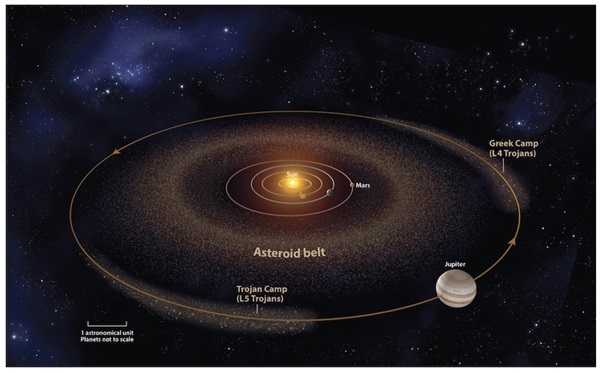
The two “camps” of Jupiter’s Trojan Asteroids. The Greek camp at L4 and the Trojan camp at L5. Credit Astronomy.com/Roen Kelly.
Other planets have Trojan Asteroids in their orbits. Earth has one, Mars has four, Uranus has two, Neptune has 28. These are not the final numbers, just what has been found so far. Apparently, Venus has a temporary one. When the term Trojan Asteroids is used without reference to a planet, they are assumed to belong to Jupiter.
08/19/2021 – Ephemeris – Jupiter is at opposition today!
This is Ephemeris for Thursday, August 19th. Today the Sun will be up for 13 hours and 51 minutes, setting at 8:41, and it will rise tomorrow at 6:51. The Moon, 3 days before full, will set at 4:11 tomorrow morning.
Tonight, Jupiter will be at opposition. That’s a shortcut term for Jupiter being opposite the Sun in our sky. At that time, Jupiter rises at sunset and sets at sunrise. It is also at its closest to us. It also officially becomes an evening planet, available in the evening for those of us with daytime jobs. In even small telescopes, Jupiter shows two dark bands. There’s more, but those two are the most prominent. Its four largest moons will be visible before 9:50 pm tonight, after that the innermost of the four, Io, will start to cross the face of Jupiter. It will leave Ganymede on Jupiter’s east side. On the west side will be the moon Europa, and farther out, Callisto. At 12:08 am, Io will reappear on the west side of Jupiter, joining Europa and Callisto. The moons do put on a show.
The astronomical event times given are for the Traverse City/Interlochen area of Michigan (EDT, UT – 4 hr). They may be different for your location.
Addendum
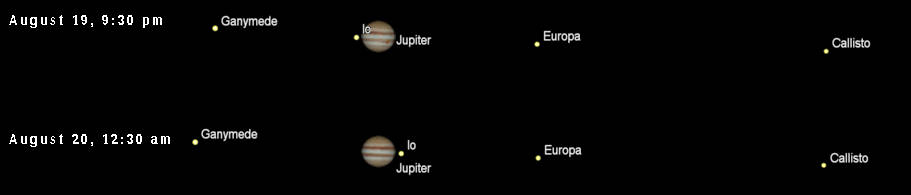
Jupiter’s Galilean moons at two times tonight, August 19th at 9:30 pm (01:30 on the 20th, UT) and 12:30 am (04:30 UT). From 9:50 pm to 12:08 am (01:50 – 04:08 UT), Io will pass in front of Jupiter and be practically invisible. Click on the image to enlarge it. Created using Cartes du Ciel (Sky Charts).
06/21/2021 – Ephemeris – A quick look at three of the naked-eye planets
This is Ephemeris for Monday, June 21st. Today the Sun will be up for 15 hours and 34 minutes, setting at 9:32, and it will rise tomorrow at 5:57. The Moon, 3 days before full, will set at 4:02 tomorrow morning.
I have a couple of pieces of planetary news. Venus will pass south of the star Pollux in Gemini tonight. That means in their current orientation, low on the west-northwestern horizon, that Pollux will appear above and right of the much brighter Venus. This may be visible by 10:30 pm. Venus will set tonight at 11:07. You’ll need a really low western horizon to see it. In the morning sky, Saturn is backtracking to the west slowly, and now Jupiter has stopped its eastward motion and is stationary today and will start its retrograde or westward motion. Both retrograde motions are caused by the Earth, which is in the process of passing these planets. We will pass Saturn August 2nd, and pass Jupiter August 19th. We call these events, oppositions.
The astronomical event times given are for the Traverse City/Interlochen area of Michigan (EDT, UT – 4hr). They may be different for your location.
Addendum
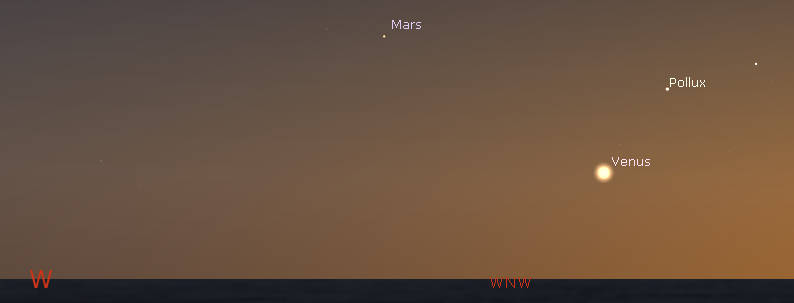
Venus, Pollux and Mars in the evening twilight tonight at 10:30 pm. Venus and Pollux in evening twilight. Venus will be about 5 degrees above the sea or lake horizon at that time. Venus and Mars will cross their apparent paths and be in conjunction on July 13th. Click on the image to enlarge. Created using Stellarium.
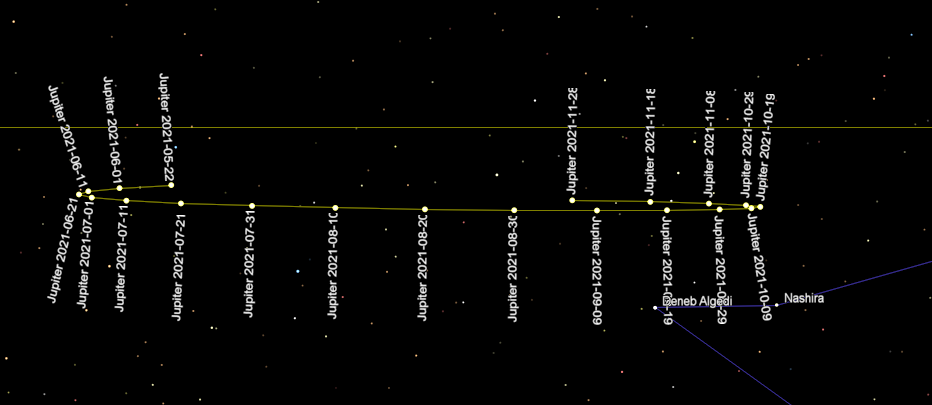
Jupiter’s retrograde path, June 21, to October 20, 2021. The constellation lines in the lower right are for the eastern end of Capricornus. We pass Jupiter, officially called opposition from the Sun, on August 20th. The solid yellow line above Jupiter’s apparent path is the Ecliptic, the Sun’s apparent path in the sky. Click on the image to enlarge. Created using Cartes du Ciel (Sky Charts).
08/28/2020 – Ephemeris – Tonight Jupiter and the Moon will appear together in the sky
This is Ephemeris for Friday, August 28th. Today the Sun will be up for 13 hours and 24 minutes, setting at 8:25, and it will rise tomorrow at 7:02. The Moon, 3 days past first quarter, will set at 2:56 tomorrow morning.
Tonight at 9:33 pm the Moon will pass Jupiter in our skies. Jupiter will appear about 5 moon-widths above the Moon. It’s a good time to get out those binoculars or a small telescope to look at them. Jupiter will have its four brightest moons, two on each side. They are pretty close in. Tomorrow night they will all be on the west side of the planet. The waxing Gibbous Moon shows most of the Earth facing side now. The sunrise line a day ago brought the crater Copernicus into light on the east or left side of the Moon. Otherwise the east side of the Moon is flatter than the west side being dominated by two flat lunar seas, actually lava plains called the Sea of Clouds and Ocean of Storms. The Moon has never seen clouds or storms.
The event times given are for the Traverse City/Interlochen area of Michigan. They may be different for your location.
Addendum
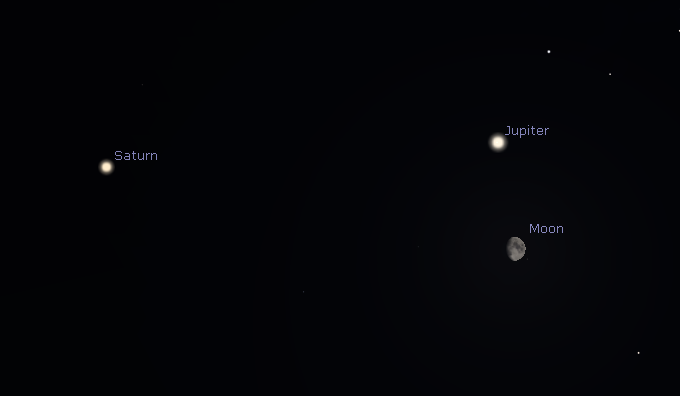
Jupiter, Saturn and the Moon as they would appear to the naked eye at 9:33 pm tonight August, 28, 2020. Created using Stellarium which unfortunately shows the Moon dimmer than the planets. In reality is that the Moon very much brighter, almost overpowering the planets.
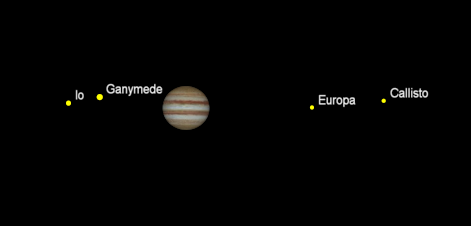
Jupiter and its 4 Galilean moons as the would appear in a telescope tonight August 28, 2020. Created using Cartes du Ciel (Sky Chart).
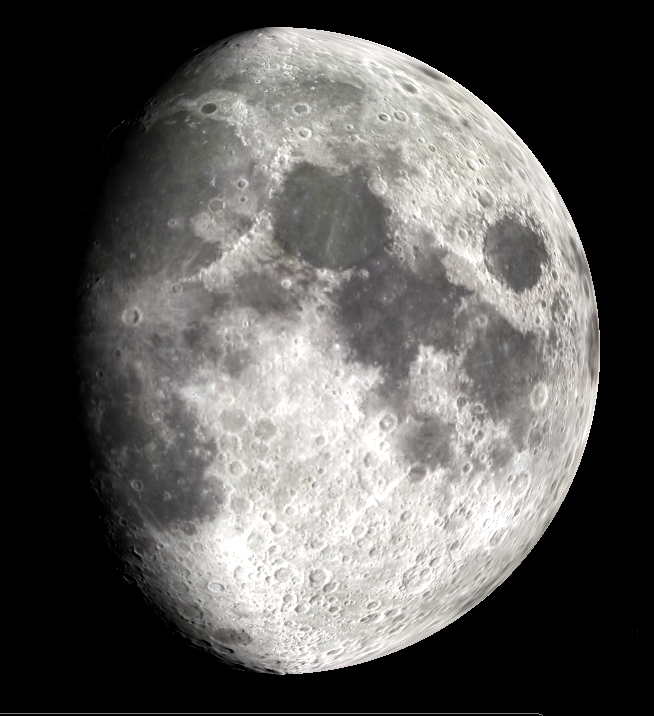
The gibbous Moon tonight as it might appear in a low power telescope. Created using Stellarium.
 Bob Moler's Ephemeris Blog