Archive
08/04/2020 – Ephemeris – Viewing Jupiter and its moons with binoculars or small telescope
This is Ephemeris for Tuesday, August 4th. Today the Sun will be up for 14 hours and 30 minutes, setting at 9:03, and it will rise tomorrow at 6:34. The Moon, 1 day past full, will rise at 10:06 this evening.
The planet Jupiter is a fine object to view with just about any optical aid be it a pair of binoculars, spotting scope or telescope. In binoculars, if held steady or mounted on a tripod Jupiter itself will no longer look star-like, but a tiny disk. Several of Jupiter’s moons can also be seen. With a telescope four of them can be seen, the same four Galileo discovered 410 years ago. At 10 pm they will be in the same order of distance from the planet that they actually are. The two nearest will be on the west side of the planet Io the closest, the Europa the next moon out. On the east side there is the third farthest Ganymede, and farthest out is Callisto. Their orbits are nearly edge on to us, so they shuttle from one side to the other of the planet.
The event times given are for the Traverse City/Interlochen area of Michigan. They may be different for your location.
Addendum
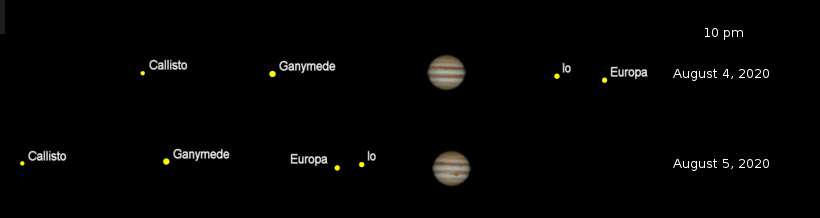
Jupiter and its Galilean moons for tonight and tomorrow night August 4 & 5, 2020. Those moons really move from night to night. This is shown north at the top, east to the left. Based on telescope design the image presented could be inverted, mirror image or both. Created using Cartes du Ciel (Sky Charts).
Due to the lack of time (59 seconds) I could only cover the moons. I’ll address Jupiter’s cloud features at another time. Can’t wait? Here’s a link: https://bobmoler.wordpress.com/2018/05/22/05-22-2018-ephemeris-seeing-detail-on-the-face-of-jupiter-with-a-small-telescope/
01/21/2019 – Ephemeris – Venus and Jupiter will pass each other tomorrow morning
Ephemeris for Martin Luther King Jr. Day, Monday, January 21st. Today the Sun will be up for 9 hours and 23 minutes, setting at 5:35, and it will rise tomorrow at 8:11. The Moon, at full today, will rise at 6:23 this evening.
I hope you’ve been noticing the bright planets Venus and Jupiter in the morning this month on the few mornings that have been clear. Jupiter and Venus have been drawing together. And tomorrow morning they will pass each other. The event is called a conjunction. To astronomers it’s a cool looking event, where the planets happen to be along the same line of sight. They are nowhere near each other in actuality. Venus is 76 million miles (120 million km) away, while Jupiter is 555 million miles (894 million km) away. It doesn’t affect anything on the Earth. It’s just cool looking. After this, Jupiter will move farther and farther from the Sun, while Venus will appear to fall back towards the Sun, even though they both are traveling eastward against the stars.
The times given are for the Traverse City/Interlochen area of Michigan. They may be different for your location.
Addendum
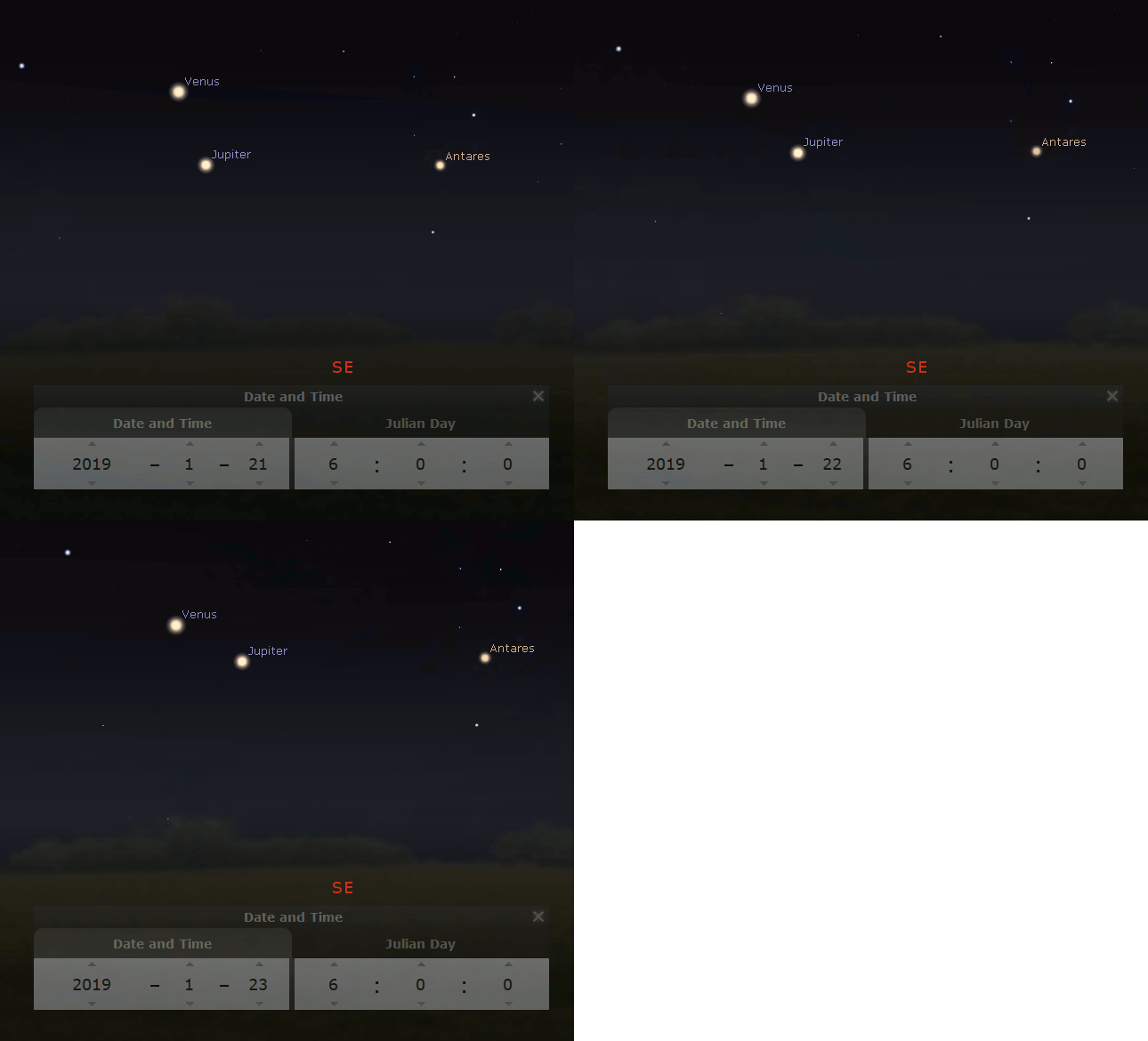
Three day animation of Venus and Jupiter on the 21st, 22nd, and 23rd of January 2019. Created using Stellarium and GIMP.
05/29/2018 – Ephemeris – Jupiter, big and massive
Ephemeris for Tuesday, May 29th. Today the Sun will be up for 15 hours and 16 minutes, setting at 9:18, and it will rise tomorrow at 6:01. The Moon, at full today, will rise at 9:21 this evening. | Jupiter is not only the largest planet, but the largest appearing planet pretty much all the time. Venus can look larger when it is a thin crescent about to or having just passed between the Earth and the Sun. Mars, because of its small actual size, that of half the Earth varies greatly in distance, and at its closest appears about half the size of Jupiter in telescopes. Jupiter’s great mass is the key to reasonable travel times of spacecraft to Saturn and beyond. A spacecraft sent to catch up to Jupiter will be accelerated with respect to the Sun into a faster trajectory to arrive at their destination sooner. New Horizon’s trip to Pluto would have taken 13 years, that’s 3 years longer without Jupiter’s gravity assist.
The times given are for the Traverse City/Interlochen area of Michigan. They may be different for your location.
Addendum
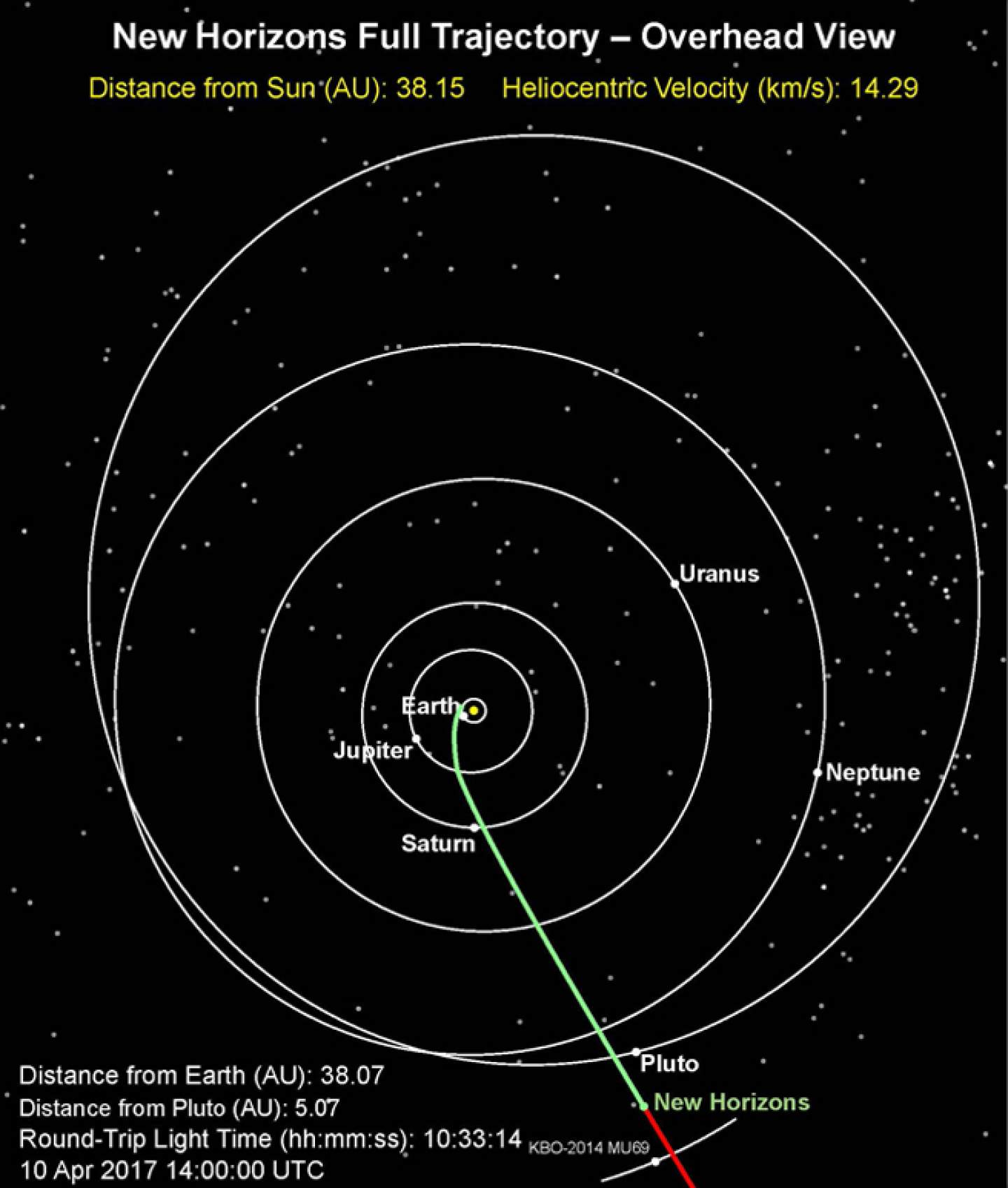
New Horizons trajectory as of last April showing the effect og Jupiter’s gravitational assist. Credit: NASA/Johns Hopkins University Applied Physics Laboratory/Southwest Research Institute.
05/28/2018 – Ephemeris – NASA’s Juno spacecraft takes deep dives at Jupiter
Ephemeris for Memorial Day, Monday, May 28th. Today the Sun will be up for 15 hours and 15 minutes, setting at 9:17, and it will rise tomorrow at 6:02. The Moon, 1 day before full, will set at 6:24 tomorrow morning.
NASA’s Juno spacecraft has made 11 close passes of Jupiter since being inserted into Jovian orbit in July 2016. It has a highly elliptical orbit. It comes in over the north pole, passes only 2,000 miles over the cloud tops at the equator and heads out over the south pole, avoiding the most intense parts of Jupiter’s radiation belts. The high latitude and polar clouds appear more chaotic than expected. We can’t see these very well from the Earth. The magnetic field is much stronger and lumpier than thought before. A very much improved and complex picture of our largest planet is emerging, as we expected. The mission isn’t over and years of analysis are ahead to begin to more fully understand the solar system’s greatest planet.
The times given are for the Traverse City/Interlochen area of Michigan. They may be different for your location.
Addenda
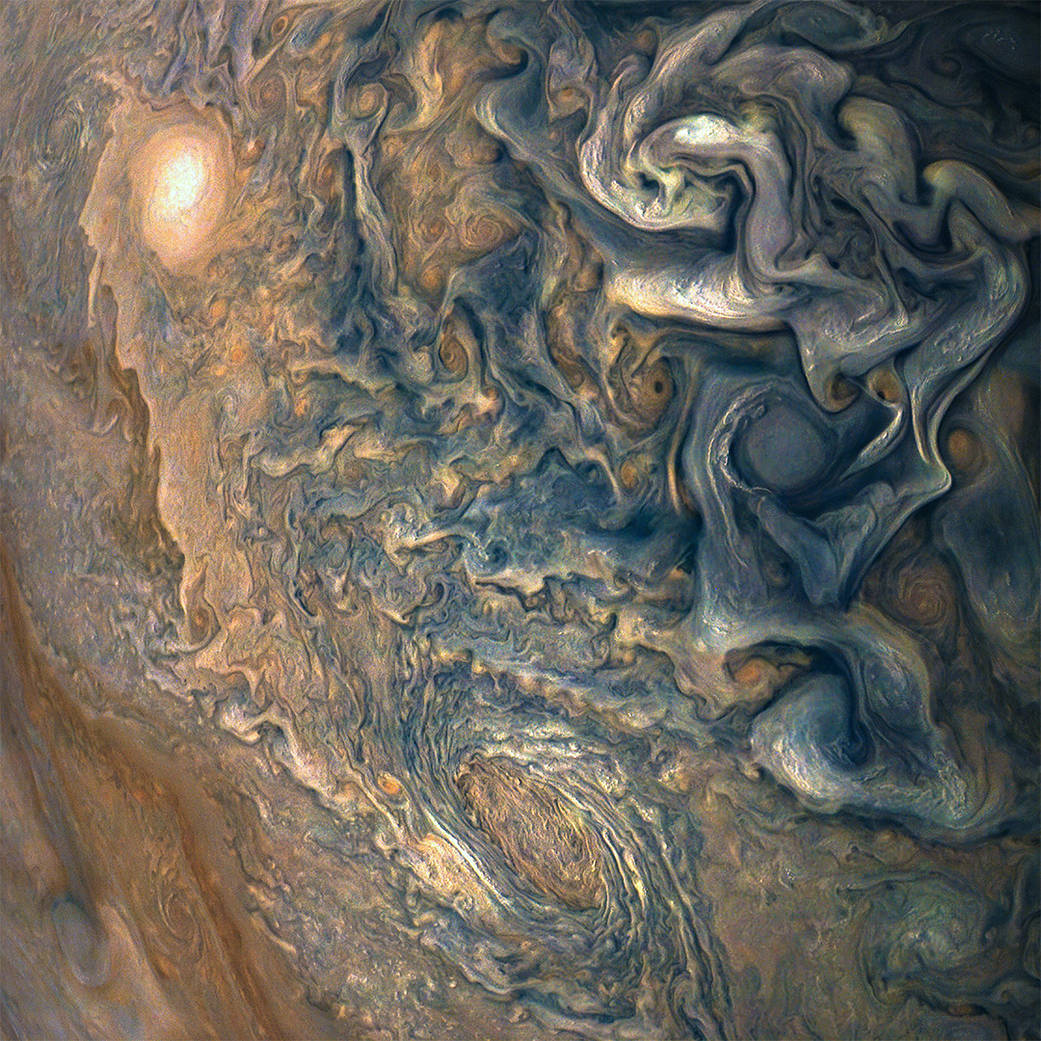
Chaotic storms at Jovian high latitudes. Credit NASA/JUNO
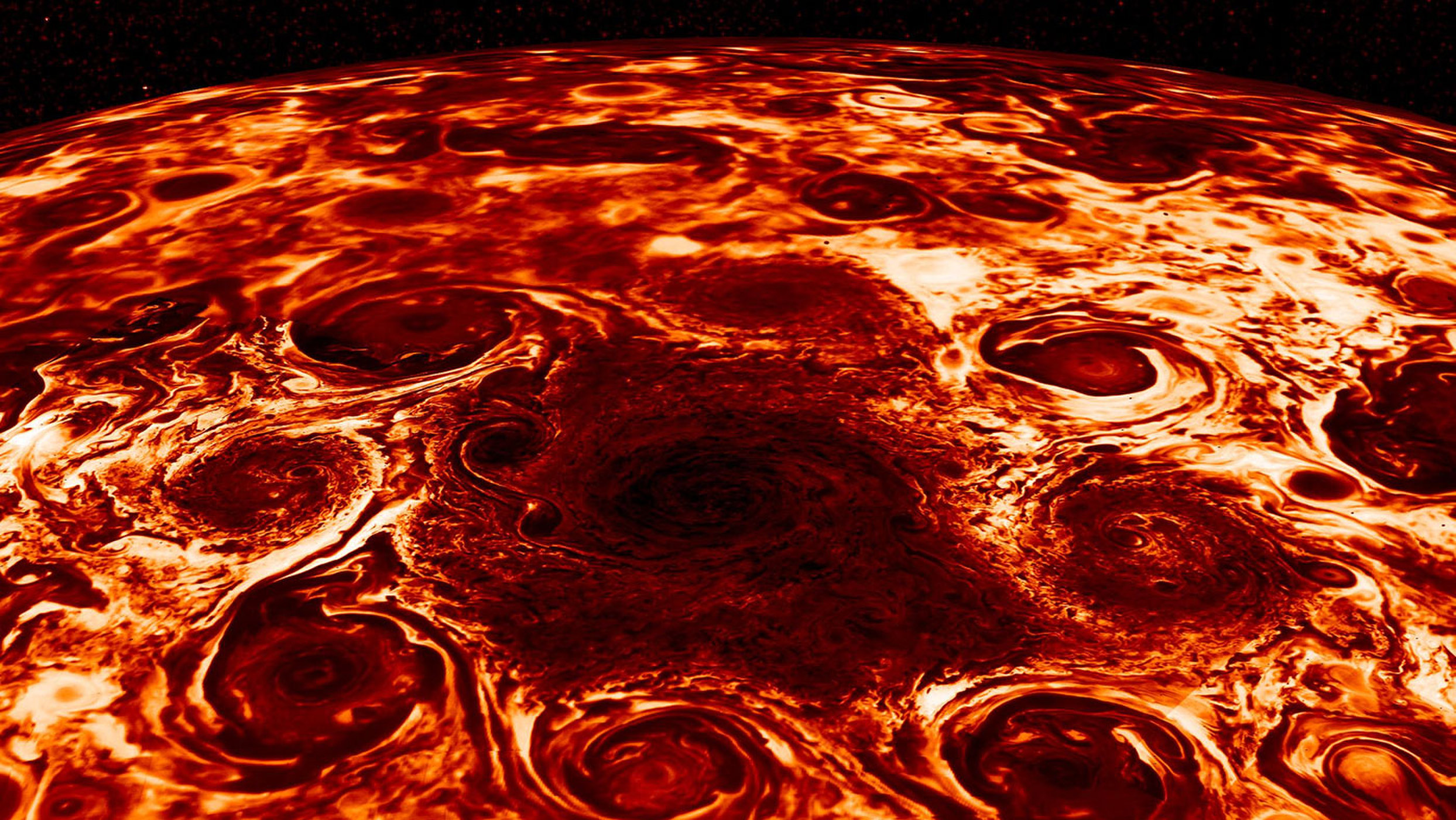
Jupiter’s North Pole in the infrared. 8 cyclones surrounding a 9th at the pole. Credit: NASA/JPL-Caltech/SwRI/ASI/INAF/JIRAM
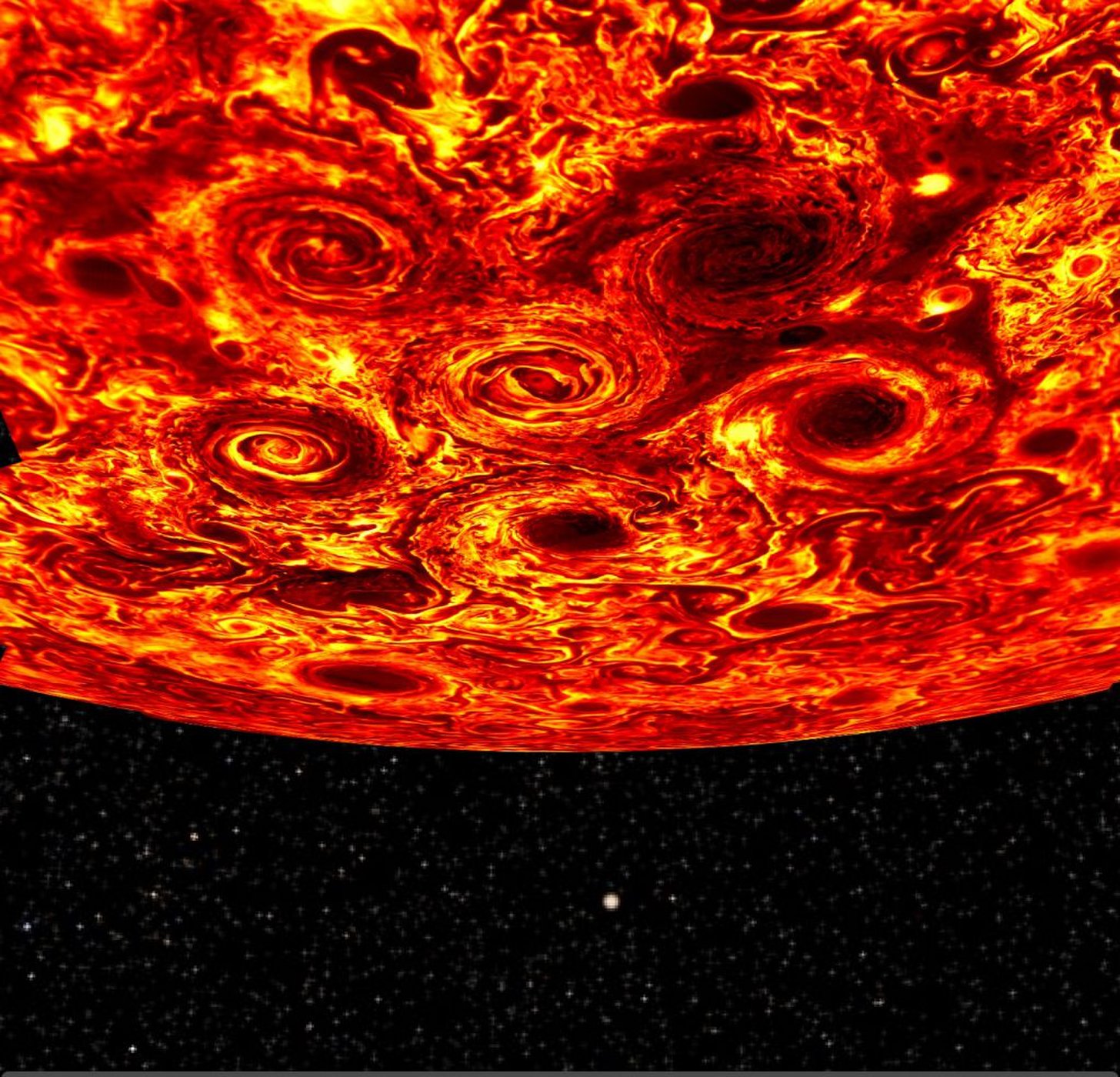
Jupiter’s South Pole in the infrared. 5 cyclones surrounding a 6th at the pole. Credit: NASA/JPL-Caltech/SwRI/ASI/INAF/JIRAM
Alan Bean
Astronaut Alan Bean, 4th person to walk on the Moon with Apollo 12 passed away this weekend. He also commanded the second Skylab mission and retired to become an artist, a painter of his adventures on the Moon and in space. Of the twelve men who walked on the Moon, only four survive.
05/24/2018 – Ephemeris – Jupiter is really BIG
Ephemeris for Thursday, May 24th. Today the Sun will be up for 15 hours and 8 minutes, setting at 9:14, and it will rise tomorrow at 6:05. The Moon, 3 days past first quarter, will set at 4:24 tomorrow morning.
Jupiter is a big planet. How big is it? One could fit thirteen hundred Earths inside it. Even so Jupiter has the mass of only 318 Earths, so Jupiter is made of lighter stuff than the Earth, including a lot of hydrogen and helium. NASA’s Juno spacecraft is currently orbiting Jupiter, working that out. Still, Jupiter is massive. The late science and science fiction writer Isaac Asimov wrote that the solar system consists of the Sun, Jupiter and debris. Jupiter contains more than twice the mass of all the other planets and asteroids combined. Jupiter is also surrounded by a huge set of radiation belts, lethal to all but the most radiation hardened spacecraft. And that goes for would be astronauts too.
The times given are for the Traverse City/Interlochen area of Michigan. They may be different for your location.
Addendum
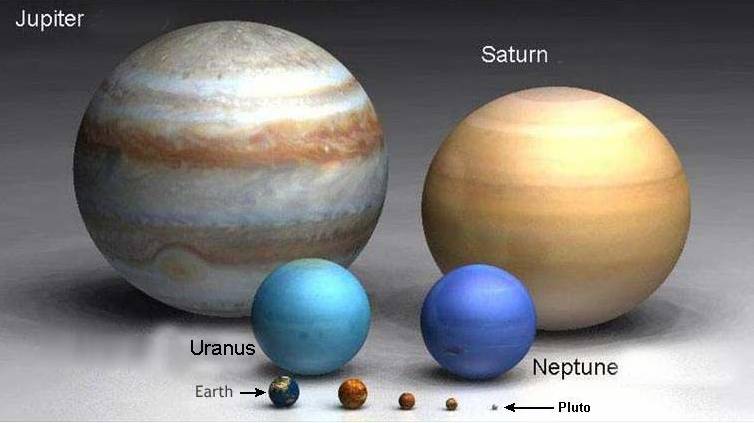
Planet size comparison. Note that even though Saturn looks almost as large as Jupiter it is less than 30% of Jupiter’s mass. From connormorency.wordpress.com
05/22/2018 – Ephemeris – Seeing detail on the face of Jupiter with a small telescope
Ephemeris for Tuesday, May 22nd. Today the Sun will be up for 15 hours and 4 minutes, setting at 9:12, and it will rise tomorrow at 6:06. The Moon, 1 day past first quarter, will set at 3:27 tomorrow morning.
Even in small telescopes Jupiter shows some detail. The larger the telescope in diameter the more detail can be seen. It also depends on what astronomers call seeing, or the steadiness of the atmosphere. The easiest detail to spot are the parallel brown and cream-colored cloud bands. These run in the direction that Jupiter’s moons move, since the four Galilean moons orbit over Jupiter’s equator. Jupiter, 11 time’s the Earth’s diameter, rotates on its axis in a bit less than 10 hours, though the clouds at the equator rotate faster than those at higher latitudes. It also gives Jupiter a slightly squashed appearance., enhanced by the horizontal stripes. Embedded in one of the dark stripes is the famous Great Red Spot.
The times given are for the Traverse City/Interlochen area of Michigan. They may be different for your location.
Addendum
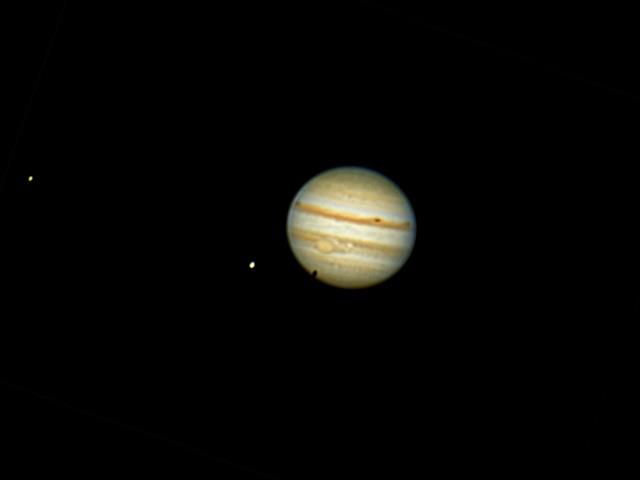
Scott Anttila image of Jupiter from November 14, 2011.
05/21/2018 – Ephemeris – 408 years ago Galileo discovered that Jupiter had moons
Ephemeris for Monday, May 21st. Today the Sun will be up for 15 hours and 2 minutes, setting at 9:10, and it will rise tomorrow at 6:07. The Moon, at first quarter today, will set at 2:55 tomorrow morning.
Jupiter is the bright star-like object in the southeast in the evening. In telescopes and even in binoculars the observer can spot up to four stars nearby. These aren’t stars, but moons or satellites of Jupiter. Galileo discovered them 408 years ago with his small telescope. Jupiter has 69 satellites in all at last count, but the rest are tiny objects. Of the four ‘Galilean’ satellites all but one is larger than the Moon. They are, in order from Jupiter Io, a volcano riddled world which is constantly resurfacing itself. Next is Europa an icy moon with a good probability of a salty ocean beneath. Giant Ganymede is next, larger than Mercury, it is also icy with the possibility of an ocean. Last is Callisto a dark moon with bright craters.
The times given are for the Traverse City/Interlochen area of Michigan. They may be different for your location.
Addendum
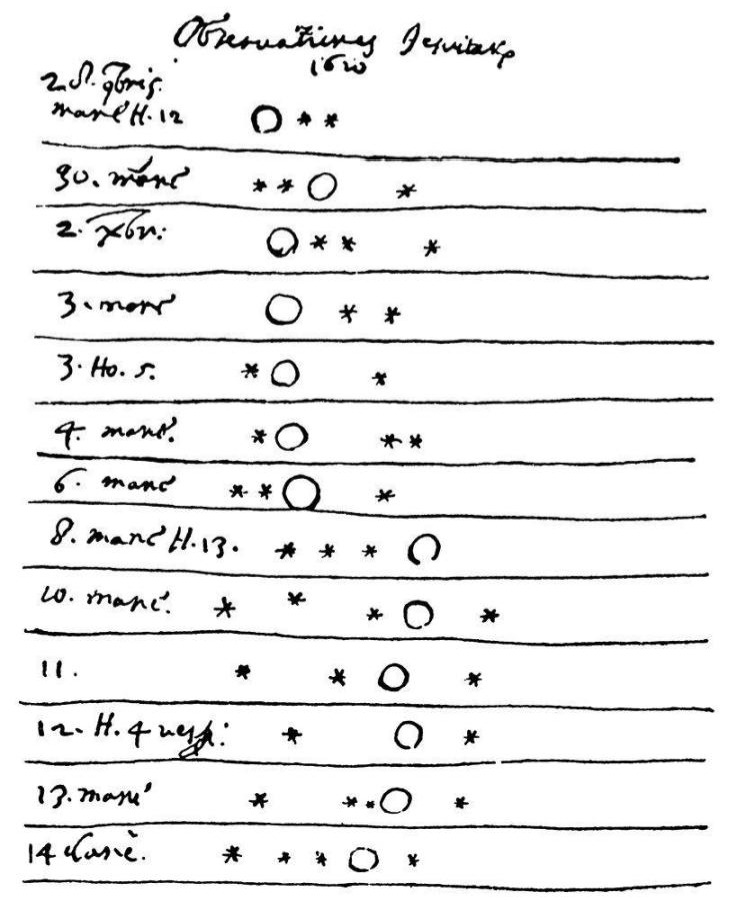
Multiple night sightings of Jupiter’s moons by Galileo.
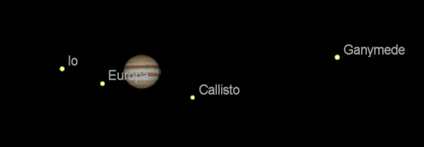
Jupiter and its moons tonight, May 21, 2018. Created using Cartes du Ciel (Sky Charts).
05/08/2018 – Ephemeris – Jupiter at opposition
Ephemeris for Tuesday, May 8th. The Sun rises at 6:23. It’ll be up for 14 hours and 33 minutes, setting at 8:56. The Moon, 1 day past last quarter, will rise at 3:45 tomorrow morning.
At 8:10 p.m. Jupiter will be in opposition, that is opposite the Sun in the sky. Thursday at 8 a.m. it will be its closest to the Earth at 408.9 million miles away, and its biggest in telescopes at 44.8 arc seconds. The Moon averages about 1,800 arc seconds in diameter. So the Moon appears 40 times larger in diameter, meaning you could put 40 Jupiters across the diameter of the moon. Jupiter’s disk is visible in binoculars, along with several of its moons. The moons change position from night to night. Most computer planetarium programs will show the moons for any time past and future. Telescopes will reveal that Jupiter’s face is crossed by bands of contrasting colors of clouds, and the famous Great Red Spot.
The times given are for the Traverse City/Interlochen area of Michigan. They may be different for your location.
Addendum
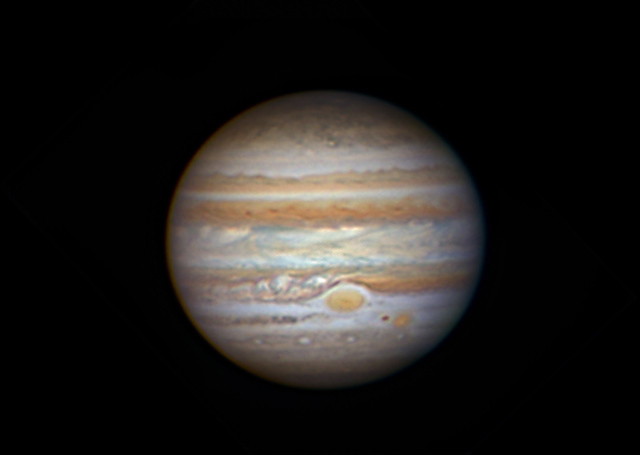
Jupiter with its Great Red Spot November 18, 2012 by Scott Anttila.
04/30/2018 – Ephemeris – Venus-Earth resonances, and Jupiter & the Moon tonight
Ephemeris for Monday, April 30th. The Sun rises at 6:34. It’ll be up for 14 hours and 12 minutes, setting at 8:46. The Moon, 1 day past full, will rise at 9:30 this evening.
Jupiter will be near the moon tonight. The gravitational force between the planets produces some interesting resonances in their orbital periods. Venus has three different kinds with the Earth. First, Venus orbits the Sun 13 times in the same time it takes the Earth to orbit the Sun 8 times. This is a 13 to 8 resonance. This sets up the 5 Venus Cycles equaling 8 years resonance the Mayan’s discovered. A Venus cycle of 584 days takes Venus to go from Morning Star to Evening Star and back again. The next one wasn’t discovered until we started to bounce radar signals off Venus. We found it rotates backwards, and very slowly at that. Its rotation with respect to the stars is longer than its year. And it so happens that every passage near the Earth the same side of Venus is facing us.
The times given are for the Traverse City/Interlochen area of Michigan. They may be different for your location.
Addendum
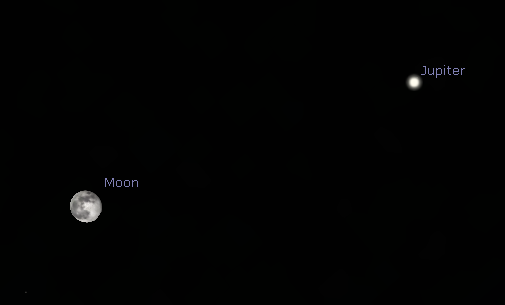
The Moon and Jupiter at 10 p.m. tonight, April 30, 2018. Created using Stellarium.
01/11/2018 – Ephemeris – This morning the Moon passes Jupiter and Mars
Jan 11. This is Bob Moler with Ephemeris for Thursday, January 11th. The Sun will rise at 8:18. It’ll be up for 9 hours and 5 minutes, setting at 5:23. The Moon, 3 days past last quarter, will rise at 4:19 tomorrow morning.
This morning the thin crescent Moon will be poised over Jupiter and Mars in the east southeast at 7 a.m. It will make a pretty sight for the eye and camera. I follow many amateur astronomers on Twitter with clearer skies than ours who take many great pictures of planetary conjunctions, the Moon and other wonders of the heavens.
There is space mission orbiting Jupiter right now. It doesn’t make great discoveries that shake up the astronomical world enough to make the national news. The Juno mission skims close and then away from Jupiter in order to ferret out its internal structure. It does contain a camera for the public that reveals the spectacular cloud formations of Jupiter’s polar cloudscapes.
The times given are for the Traverse City/Interlochen area of Michigan. They may be different for your location.
Addendum
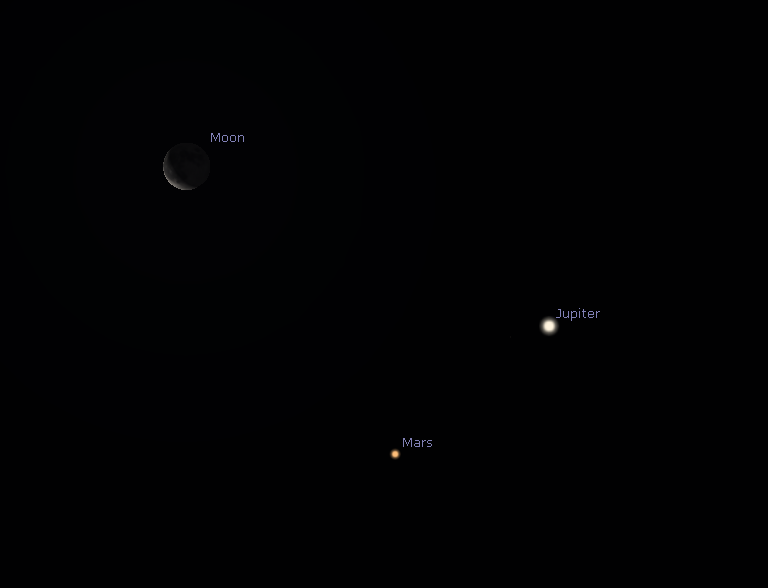
The Moon with Jupiter and Mars this morning January 11, 2018 at 7 a.m. Created using Stellarium.
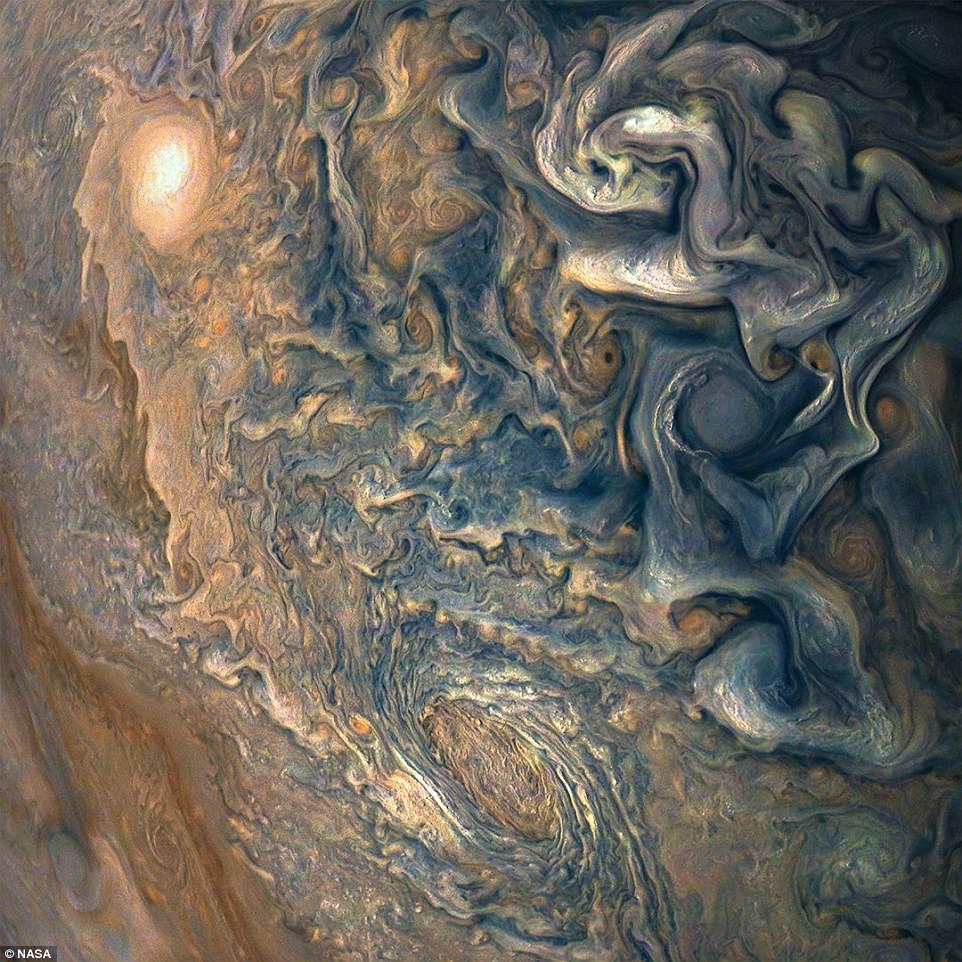
Some of Jupiter’s clouds photographed by NASA’s Juno spacecraft.
Ride along with Juno on its 6th close encounter (perijove 6) with Jupiter. Jove is another Roman name for Jupiter, by Jove!
Jupiter: Juno Perijove 06 from Seán Doran on Vimeo.
 Bob Moler's Ephemeris Blog