Archive
12/28/2015 – Ephemeris – Mercury is at its greatest penetration into the evening tonight
Ephemeris for Monday, December 28th. The Sun will rise at 8:19. It’ll be up for 8 hours and 49 minutes, setting at 5:09. The Moon, 3 days past full, will rise at 8:57 this evening.
Later this evening the tiny planet Mercury will appear at its greatest separation from the Sun. This is a little early to be viewing Mercury in the evening. Generally the best time to be able to view Mercury, when it’s east of the Sun, in the evening is from late winter into spring. Mercury’s event is called its greatest eastern elongation from the Sun. The sky may be dark enough in the west to start looking for Mercury 20 minutes after sunset. That’s about 5:30 when Mercury will be 9 degrees above the true horizon and due southwest. For the next half hour Mercury will drop to 5 degrees altitude, but the skies will be darker. Mercury will set at 6:38, and you will lose it before that. Mercury has always been a difficult planet to view from the Earth.
Times are for the Traverse City/Interlochen area of Michigan. They may be different for your location.
Addendum
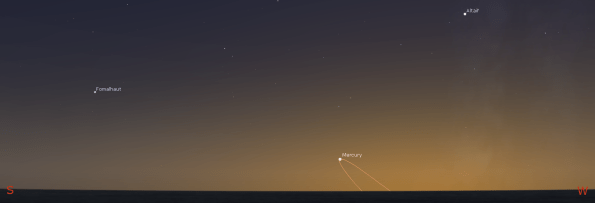
Mercury at greatest eastern elongation (19.7 degrees) from the Sun. 6 p.m. December 28, 2015. Created using Stellarium.
11/12/2015 – Ephemeris – The North Taurid meteor shower
Ephemeris for Thursday, November 12th. The Sun will rise at 7:35. It’ll be up for 9 hours and 42 minutes, setting at 5:18. The Moon, 1 day past new, will set at 6:19 this evening.
Today is the expected peak of the Northern Taurid meteor shower. While poor in numbers, the two Taurid showers produce many fireballs, that are really, really bright. So bright they are not hindered by a bright moon. They will be visible all night because the radiant, near the head of Taurus the bull will rise in the east by the end of twilight. The radiant is below the Pleiades star cluster and just above the letter V group of stars that is the head of the bull. The path of Encke’s comet, which is responsible, crosses near the Earth’s orbit twice a year. Now and where the Earth is on June 30th. Those meteors then would seem to come from out of the Sun, leaving some to speculate that the Tunguska event in 1908 was caused by a piece of Encke’s Comet.
Times are for the Traverse City/Interlochen area of Michigan. They may be different for your location.
Addendum
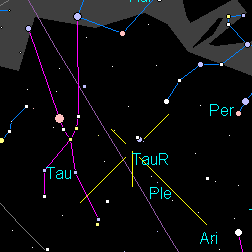
The Taurid Radiant
It turns out that Earth isn’t the only planet to have a meteor shower from Encke’s Comet. It happens to be Mercury. Dave Dickinson has a post on Universe Today pointing to an announcement of data returned from the MESSENGER spacecraft that orbited Mercury at the Division of Planetary Sciences of the American Astronomical Society (#DPS15) meeting this week.
05/07/2015 – Ephemeris – Mercury is at greatest eastern elongation today
Ephemeris for Thursday, May 7th. Today the Sun will be up for 14 hours and 30 minutes, setting at 8:54. The Moon, half way from full to last quarter, will rise at 12:20 tomorrow morning. Tomorrow the Sun will rise at 6:23.
The tiny planet Mercury has been in the news lately because the MESSENGER spacecraft plunged onto its surface a week ago, after having mapped and studied chemical composition of this planet for four years. Today, for Mercury watchers from the Earth, it reached its greatest angular separation from the sun in its orbit, of 21 degrees just before 1 a.m. Mercury has always been a tough planet to study, low to the horizon in twilight. It’s also a tough planet to get to with a spacecraft, being far down the Sun’s gravity well. MESSENGER took 7 years to get there, bleeding off energy by passing Earth, Venus and Mercury itself to fall into orbit of this little world that was full of surprises.
Times are for the Traverse City/Interlochen area of Michigan. They may be different for your location.
Addendum
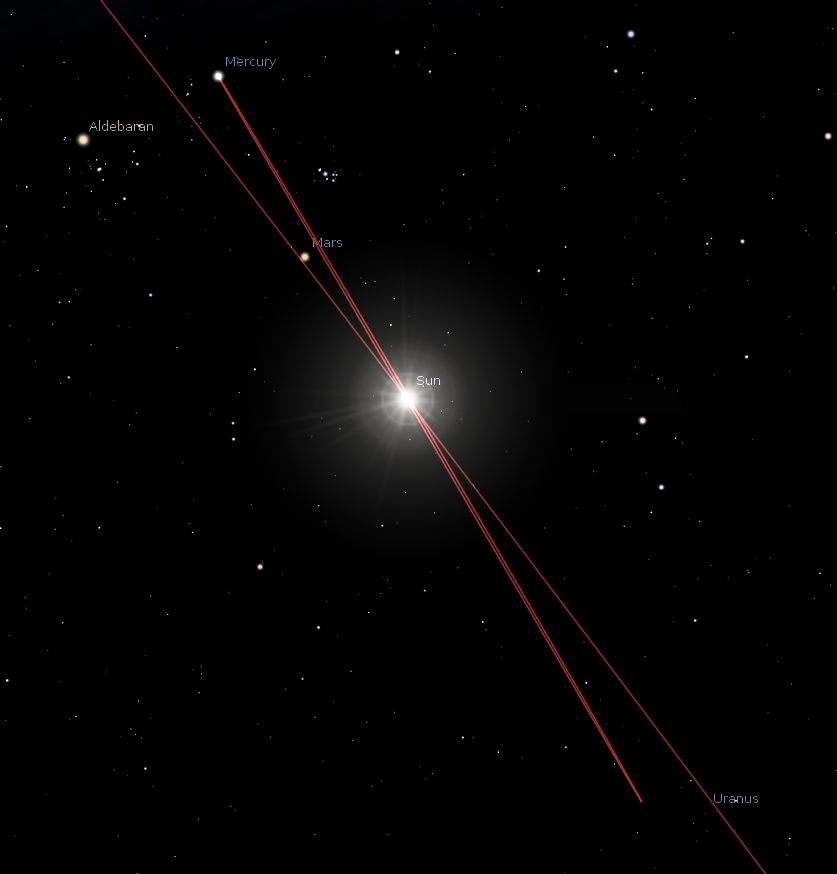
Mercury’s orbit as seen from about 45 degrees north latitude Earth at the greatest eastern elongation at sunset on May 7, 2015. Created using Stellarium.
°
The other red line is the plane of the Earth’s orbit. In the spring at sunset it is much closer to vertical than in autumn. The angle of the ecliptic to the horizon at sunset on the vernal equinox is 90° – (your latitude) + 23.5°. Here near 45° north latitude it’s 68.5°. For the sunset at the autumnal equinox the formula is 90° – (your latitude) – 23.5° or 21.5°. The ecliptic will really lay down making planets close to the direction of the Sun hard to spot. In the morning sky the ecliptic will be steep at the autumnal equinox and lay down at the vernal equinox. Thus the best time to spot Mercury, which never strays far from the sun is on late winter and spring evenings and late summer and autumn mornings. Also note that Mercury’s 7 degree inclination to the ecliptic helps it now.
Also note that we are seeing Mercury’s orbit nearly edge on. It will be edge-on in a couple of days. It so happens that a year from now, the morning of May 9th, 2016, for us in the United States, Mercury will transit, or cross in front of, the Sun. Three years ago this June we witnessed the extremely rare transit of Venus. The transit of Mercury isn’t as spectacular or rare, but it’s rare enough.
05/04/2015 – Ephemeris – Last good evening appearance of Mercury for the year*
Note: This program was recorded before the MESSENGER spacecraft crashed into Mercury.
Ephemeris for Monday, May 4th. Today the Sun will be up for 14 hours and 22 minutes, setting at 8:51. The Moon, 1 day past full, will rise at 9:29 this evening. Tomorrow the Sun will rise at 6:27.
The tiny and elusive planet Mercury will be making its final easily observable evening appearance of the year. For the next week or so. Not that Mercury is ever easy to spot. The MESSENGER spacecraft, which has been orbiting Mercury for the past four years is out of fuel and is descending to an impact any day now. It may already have. Mercury is the smallest planet only 50% larger than the diameter of our Moon. There are two planetary satellites larger than it: Jupiter’s Ganymede and Saturn’s Titan. It is a whole lot larger than Pluto, which was demoted to dwarf planet 9 years ago. Mercury is the second densest planet after the Earth. And even Venus with its greenhouse effect is hotter.
Times are for the Traverse City/Interlochen area of Michigan. They may be different for your location.
*For northern hemisphere viewers.
Addendum
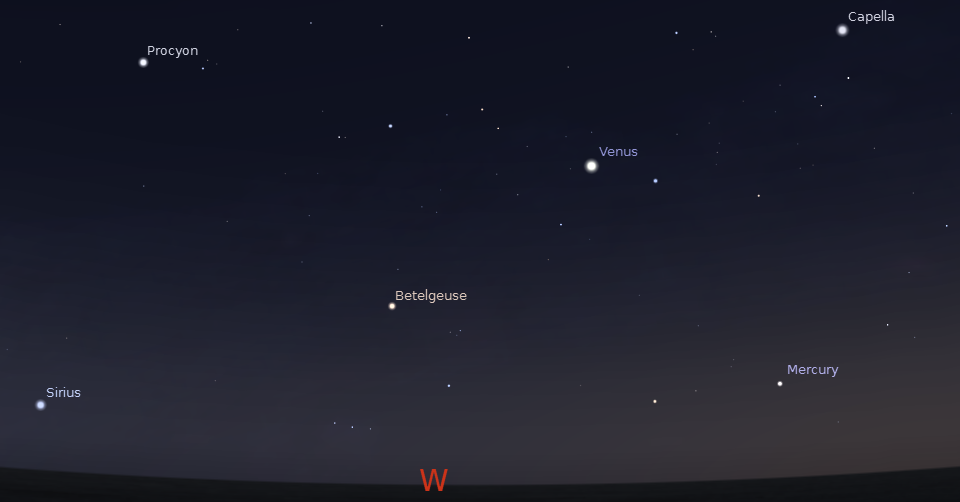
Mercury, Venus and the setting stars of winter at 10 p.m., May 4, 2015. Created using Stellarium.
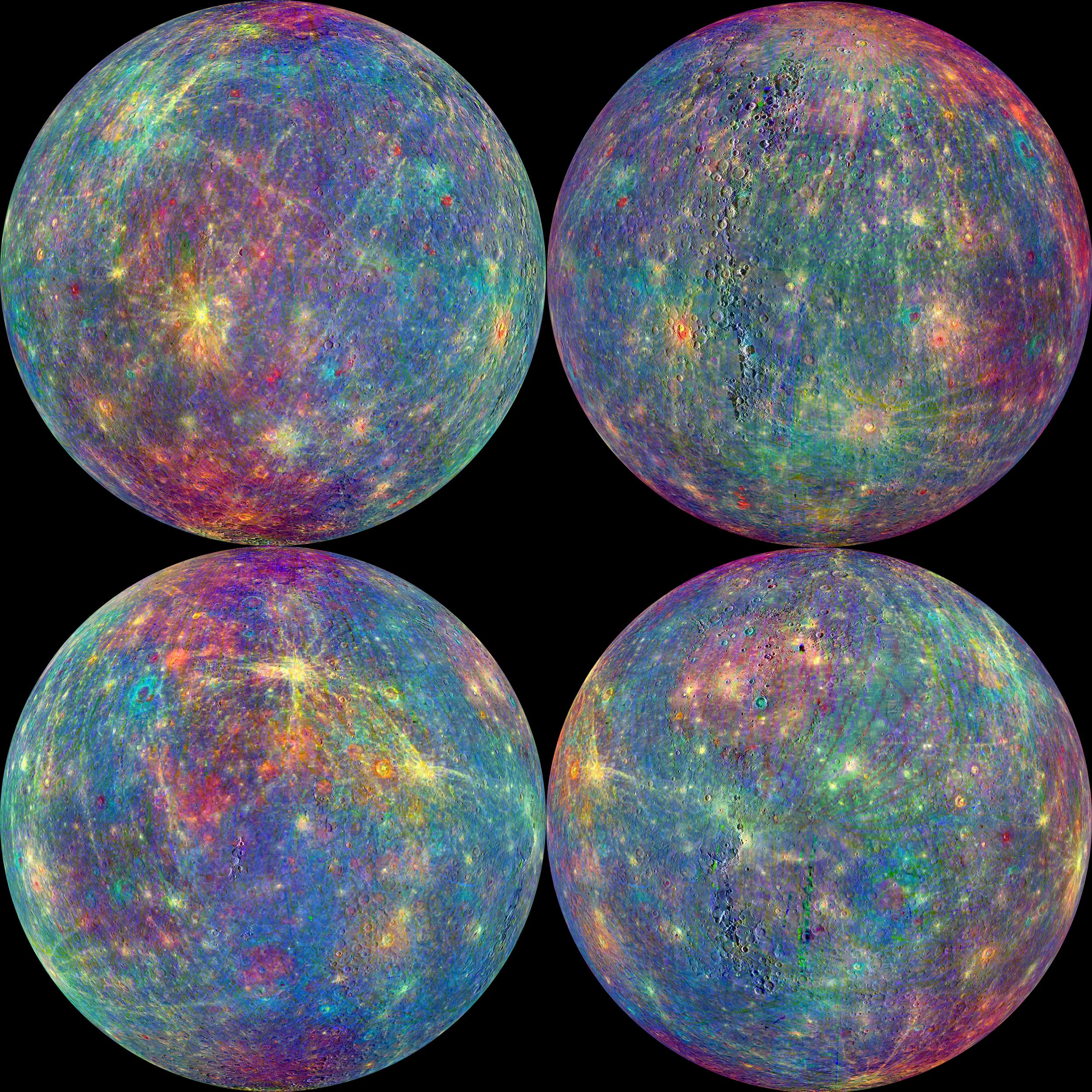
Four views of Mercury with colors based on the mineralogy seen. Credit: NASA/Johns Hopkins University Applied Physics Laboratory/Carnegie Institution of Washington. Click on image to enlarge.
02/24/2015 – Ephemeris – Not all greatest elongations of Mercury are equal
Ephemeris for Tuesday, February 24th. The sun will rise at 7:29. It’ll be up for 10 hours and 54 minutes, setting at 6:23. The moon, 1 day before first quarter, will set at 1:28 tomorrow morning.
Today Mercury is at its greatest distance west of the Sun. Don’t go out to view Mercury right before sunrise unless you’re way south of here, or better yet south of the equator. Because of the tilt of the Earth’s axis and our latitude the positions of the planets that appear near the sun at sunrise and sunset are easier or harder to spot depending on the season. The best time to spot Mercury when it’s at its greatest elongation or distance east of the Sun is on late winter and spring evenings, or late summer and autumn mornings when Mercury is west of the Sun. Since the seasons south of the equator are opposite ours the same rule holds. It’s late summer down there which is favorable to spot Mercury in the morning, but not here.
Times are for the Traverse City/Interlochen area of Michigan. They may be different for your location.
Addendum
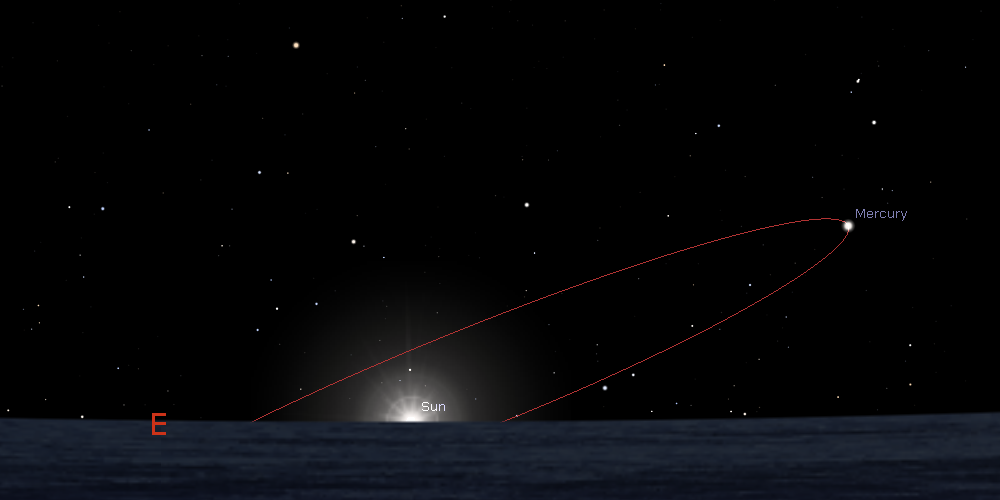
Mercury at greatest western elongation on late a winter morning. Mercury is off to the side of the Sun and quite low. This is a poor elongation for us in the northern hemisphere. Created using Stellarium.
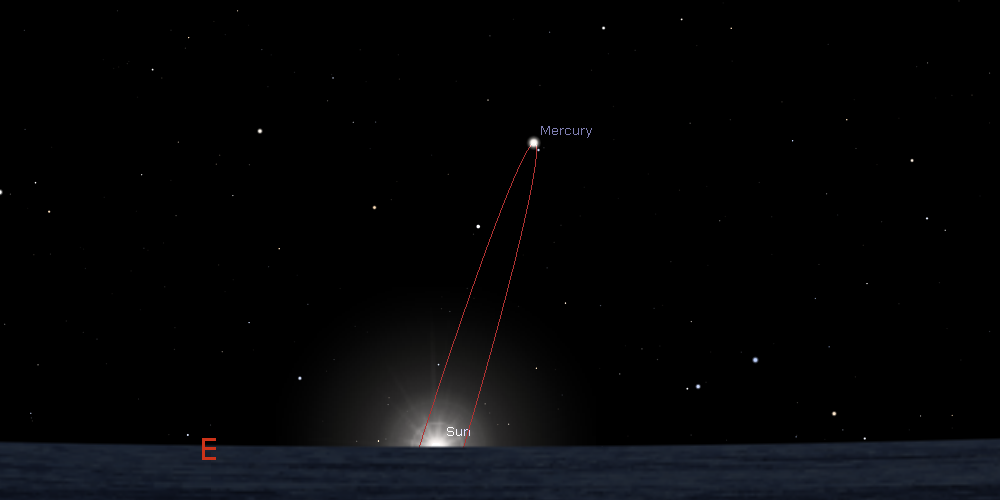
Mercury at greatest western elongation on an autumn morning. Mercury is above the Sun and quite high. This is a good elongation for us in the northern hemisphere. Created using Stellarium.
01/09/2015 – Ephemeris – Tomorrow Mercury almost makes a conjunction with Venus but falls back
Ephemeris for Friday, January 9th. The sun will rise at 8:19. It’ll be up for 9 hours and 1 minute, setting at 5:20. The Moon, 4 days before last quarter, will rise at 10:06 this evening.
Low in the southwest just after sunset, say around 6 to 6:15 in the evening Venus and Mercury can be seen seeming to flirt with one another. Venus has been moving away from the Sun in the evening sky for a couple of month’s not, but hasn’t been all that visible. Mercury, named after the messenger of the gods is fleet of orbit and is almost about to catch up with Venus. Except it can’t, not this time. Tomorrow evening Mercury will appear closest to Venus about 0.6 angular degrees away, a bit more than the width of the Moon. So for another day the two planets will appear close. But after tomorrow night they will separate with Mercury not able to keep up. Next Tuesday it will reach its greatest elongation or separation from the sun and fall back.
Times are for the Traverse City/Interlochen area of Michigan. They may be different for your location.
Addendum
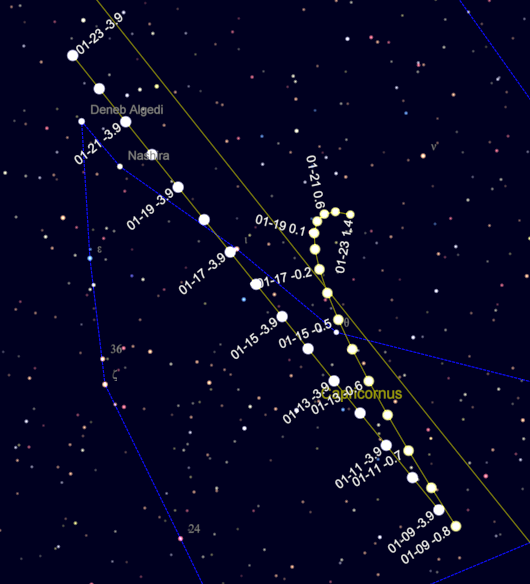
Venus, the straight track, and Mercury are shown for every evening from yesterday 1/08/15 to 01/23/15. The planets are marked for every night at 6 p.m. and tagged every other day. with month-day and magnitude. The higher the magnitude value the dimmer it is. Created using Cartes du Ceil (Sky Charts).
01/08/2015 – Ephemeris -Venus and Mercury quasi-conjunction Saturday – I
Ephemeris for Thursday, January 8th. The sun will rise at 8:19. It’ll be up for 9 hours even, setting at 5:19. The moon, 4 days past full, will rise at 9:08 this evening.
The planets Venus and Mercury are closing their positions in the southwest in the early evening. They will appear their closest Saturday. For the last few years these two planets without natural satellites have hosted an artificial satellite each. Venus is orbited by the European Space Agency’s Venus Express spacecraft since 2006. Just a few weeks ago it’s fuel tanks ran dry, so it could no longer point its solar panels toward the sun and antenna toward the earth. It will soon plunge into Venus’ thick atmosphere. A like fate will also befall the MESSENGER spacecraft now orbiting close to Mercury. It took 7 years to get to Mercury and so far orbited it for nearly 4 years. It too is running out of fuel and will soon crash on the planet.
Times are for the Traverse City/Interlochen area of Michigan. They may be different for your location.
Addendum
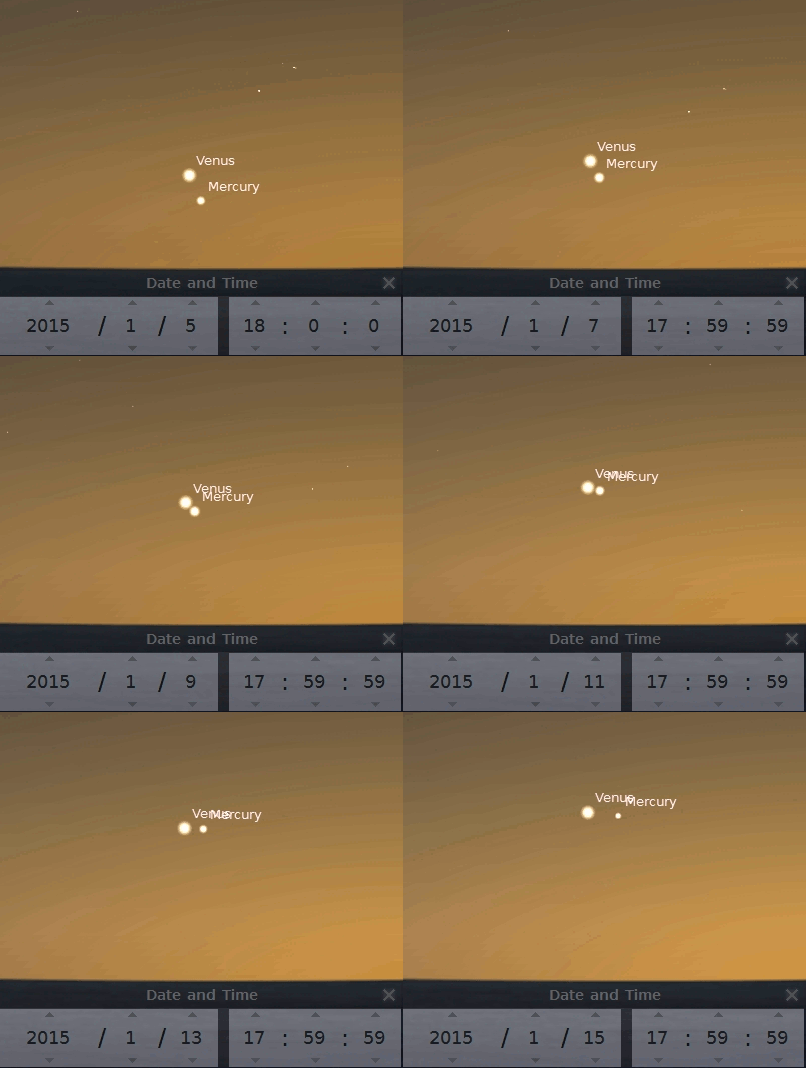
Animation of the Quasi-conjunction of Venus and Mercury. Time span 1/05/2015 to 1/15/2015 at 7 p.m. Created by Bob Moler using Stellarium and GIMP.
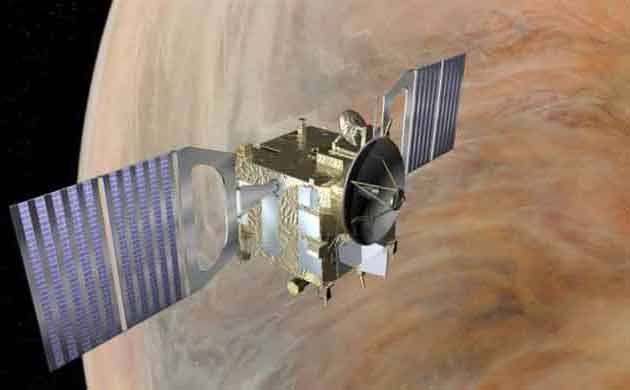
Artist rendition of Venus Express at Venus. Credit: ESA/AP.
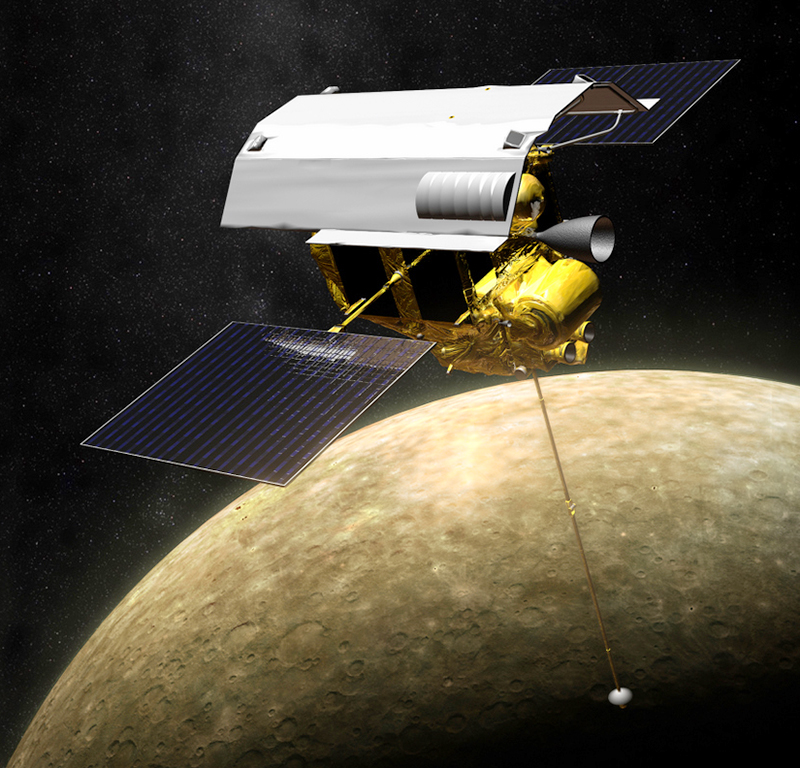
MESSENGER spacecraft at Mercury an artist’s concept. Credit NASA/JPL/APL.
Here’s your chance to name some craters on Mercury
Here’s a message from Heather Weir at NASA’s Goddard Space Center:
“TO HONOR THE ASTOUNDING ACHIEVEMENTS OF THE MESSENGER MISSION, THERE WILL BE AN INTERNATIONAL COMPETITION TO NAME A CRATER ON MERCURY!
“OPENS DECEMBER 15, 2014 (00:00 UTC) CLOSES JANUARY 15, 2015 (11:59 UTC)
“The MESSENGER Team is seeking help from all Earthlings to suggest names for five impact craters on Mercury. This is a chance to immortalize an important person in the Arts and Humanities from any nation or cultural group by having a crater on the planet Mercury named in their honor! We will accept submissions beginning midnight (00:00 UTC) December 15, 2014 until January 15, 2015 (23:59 UTC). All entries will be reviewed by Team representatives and expert panels. Then, 15 finalist names will be submitted to the International Astronomical Union (IAU) for selection of the 5 winners. Winning submissions will be announced by the IAU to coincide with MESSENGER’s End of Mission Operations in late March/April 2015. Full details are available on the MESSENGER web site http://namecraters.carnegiescience.edu/.”
As the MESSENGER mission to orbit and study the solar system’s innermost planet Mercury is coming to an end when the spacecraft runs out of fuel in a few more months, the MESSENGER team has selected five small but important craters that need names.
The link above will provide all the information needed to enter including rules, pictures, descriptions of the craters to be named and a list of craters already named.
The official naming rules for craters are these: “Deceased artists, musicians, painters, and authors who have made outstanding or fundamental contributions to their field and have been recognized as art historically significant figures for more than 50 years.”
Tip of the old astronomer’s observing cap to the NASA/JPL Solar System Ambassadors.Program.
11/03/2014 – Ephemeris – Mercury is now visible in the morning
Ephemeris for Monday, November 3rd. The sun will rise at 7:22. It’ll be up for 10 hours and 5 minutes, setting at 5:28. The moon, 3 days before full, will set at 4:35 tomorrow morning.
When I talk about the planet Mercury I usually use the adjective elusive. There’s a good reason for that. Mercury is always close to the sun, being the innermost planet, and it has the most eccentric orbit of all the planets. Due to our location on the northern hemisphere of the Earth Mercury is best visible on autumn mornings and spring evenings. These two views, 6 months apart, means that we, at both times are looking at the same part of Mercury’s orbit, but from opposite sides. The part of Mercury’s orbit we see is the part of its orbit closest to the sun, so the angular separation is not very wide, 19 degrees this elongation. Observers in the southern hemisphere whose seasons are opposite ours have a much better view. For them Mercury is at its farthest from the sun, and they get elongations of over 25 degrees.
Times are for the Traverse City/Interlochen area of Michigan. They may be different for your location.
Addendum
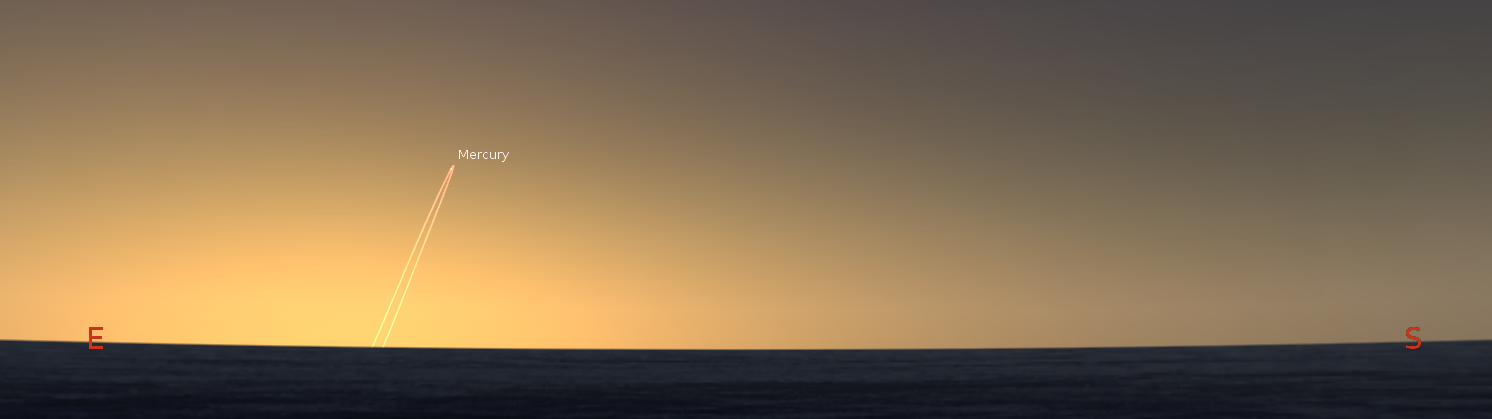
Mercury at 7 a.m. November 3, 2014 showing its orbit. Created using Stellarium.
01/27/2014 – Ephemeris – Mercury’s back in the evening sky now
Ephemeris for Monday, January 27th. The sun will rise at 8:06. It’ll be up for 9 hours and 37 minutes, setting at 5:44. The moon, half way from last quarter to new, will rise at 5:47 tomorrow morning.
Mercury is now making an appearance in the evening sky. It will have its greatest elongation or angular separation from the sun on Friday of 18.4 degrees. Mercury has a markedly elliptical orbit. Unfortunately both the best times to view Mercury from the northern hemisphere of earth, late summer and autumn mornings and late winter and spring evenings, Mercury is near perihelion or closest point in its orbit to the sun. The southern hemisphere, which has seasons opposite from ours, has the same viewing opportunities in late summer and autumn mornings and late winter and spring evenings. Only for them Mercury is near aphelion or its farthest from the sun, so this planet can be seen just outside of twilight, where we don’t have that luxury.
Times are for the Traverse City/Interlochen area of Michigan. They may be different for your location.
Addendum
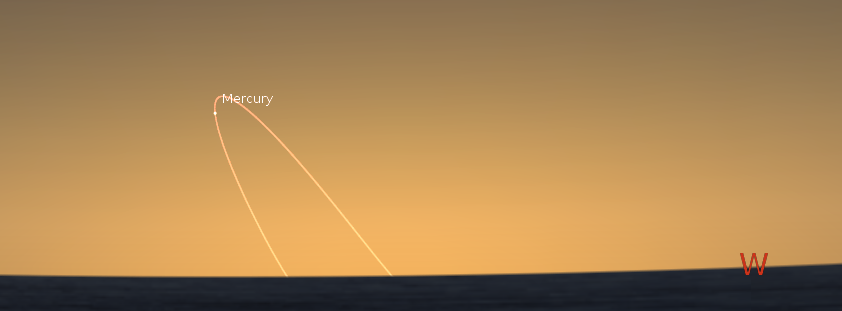
Mercury and its orbit as seen from Earth at 6:15 p.m. on January 27, 2014. Created using Stellarium.
Mercury will move to the top of the orbital loop Friday about 5 a.m. and descend to the right. The Mercury image will be posted Wednesday again.
 Bob Moler's Ephemeris Blog