Archive
08/03/2015 – Ephemeris – The Perseids are coming!
Ephemeris for Monday, August 3rd. The Sun rises at 6:30. It’ll be up for 14 hours and 35 minutes, setting at 9:06. The Moon, half way from full to last quarter, will rise at 10:58 this evening.
After the Moon sets in the evening and morning hours for the next week and a half the numbers of meteors visible will increase each night. These are members of the Perseid meteor shower of August. The peak this year is expected to be during the 2 o’clock hour on the morning of the 13th. These meteors are the result of debris left in the orbit of Comet Swift-Tuttle shed by innumerable visits to the inner solar system. Every year at this time the Earth passes through this trail of debris which intersects its orbit giving rise to the meteor shower. We call them the Perseids, because the appear to come from the direction of the constellation Perseus the hero, which is first seen in the early evening low in the northeast.
Times are for the Traverse City/Interlochen area of Michigan. They may be different for your location.
Addendum
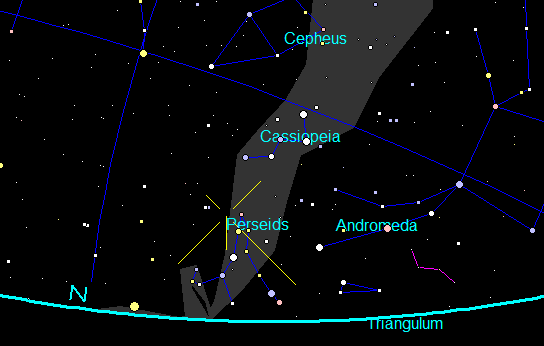
Perseid radiant at 10:30 p.m.
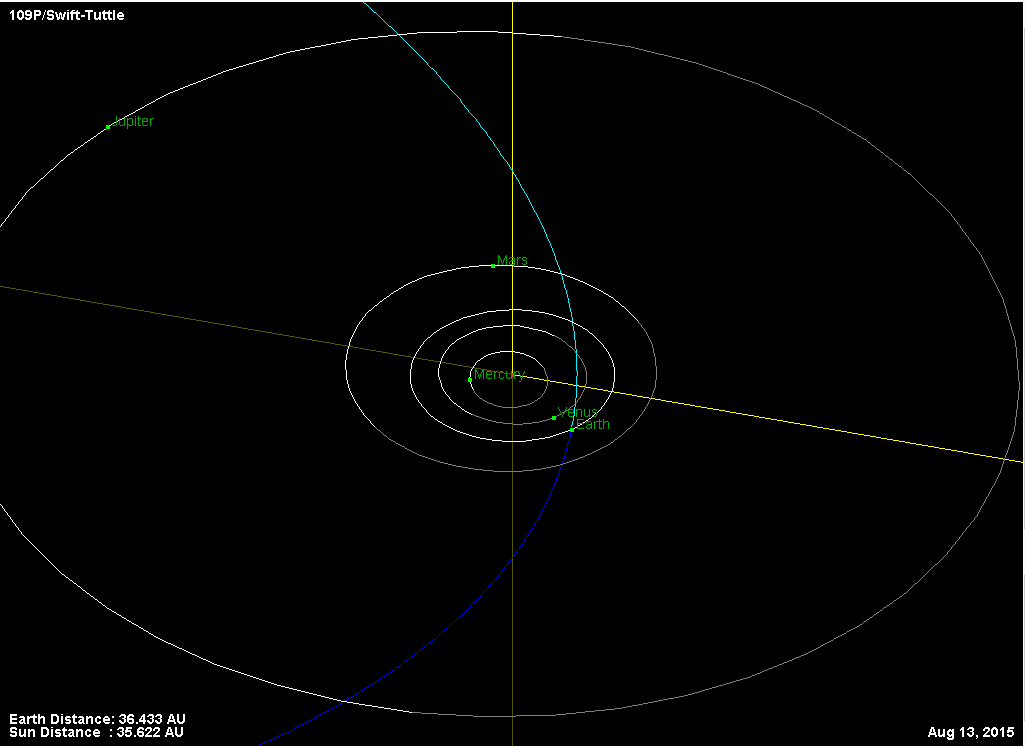
Orbit of Comet 109P/Swift-Tuttle. Blue line is the comet’s orbit, coming from above (North). Credit NASA / JPL / Applet by Osamu Ajiki (AstroArts), and further modified by Ron Baalke (JPL)
The distances in the lower left corner are the comet’s current distances from the Earth and Sun. AU is astronomical units the mean distance between the Earth and Sun. The comet’s last pass through the inner solar system was in 1992. Swift-Tuttle is now out just past the current position of the dwarf planet Pluto. Link to the animation from which the above image was taken and other information on Comet Swift-Tuttle go to http://ssd.jpl.nasa.gov/sbdb.cgi?sstr=109P;cad=1
07/02/2015 -Ephemeris – A belated preview of July’s skies
Ephemeris for Thursday, July 2nd. Today the Sun will be up for 15 hours and 30 minutes, setting at 9:31. The Moon, 1 day past full, will rise at 9:48 this evening and tomorrow the Sun will rise at 6:02.
Lets preview July’s skies a day late. Sorry, it’s been a busy week.. The sun, having reached its northern solstice, is beginning to slide southward again, at first imperceptibly, then with greater speed. The daylight hours will decrease from 15 hours and 30 minutes Today to 14 hours 44 minutes at month’s end. The daylight hours will be slightly shorter south of Interlochen, and slightly longer to the north. The altitude of the sun at local noon, when the sun is due south will decrease from 68 degrees Now to 63 degrees at month’s end. The sun will be a degree lower in the Straits area. Despite the warmth, the earth will reach its greatest distance from the sun on Monday the 6th. The range of the earth’s distance from the sun is 3 million out of 93 million miles.
Times are for the Traverse City/Interlochen area of Michigan. They may be different for your location.
Addendum
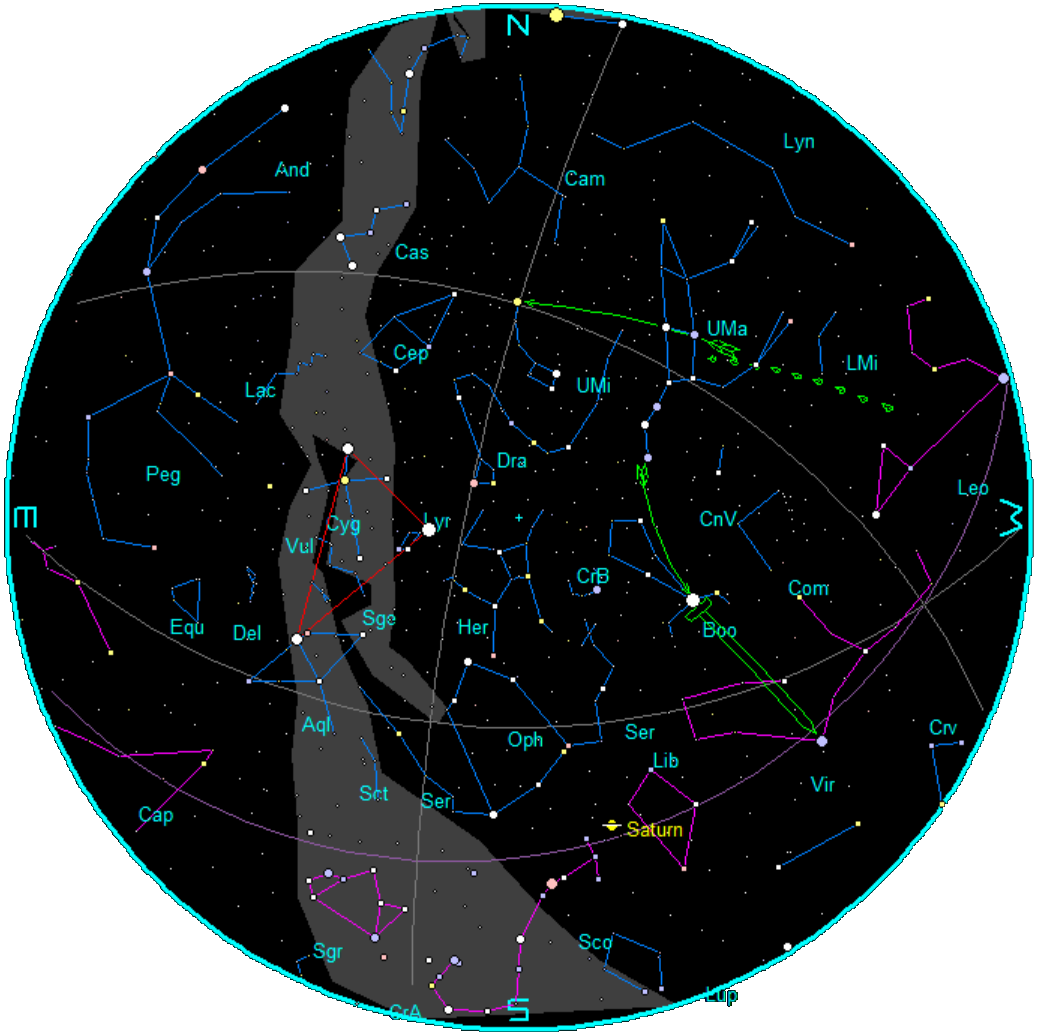
Star Chart for July 2015. Created using my LookingUp program. Click on image to enlarge.
The Moon is not plotted.
The planets and stars are plotted for the 15th at 11 p.m. EDT. That is chart time. Note, Traverse City is located 1 hour 45 minutes behind our time meridian. To duplicate the star positions on a planisphere you may have to set it to 1 hour 45 minutes earlier than the current time.
Evening Astronomical twilight ends at midnight. EDT on July 1st, decreasing to 11:14 p.m. EDT on the 31st.
Morning astronomical twilight starts at 3:32 a.m. EDT on July 1st, and increasing to 4:42 a.m. EDT on the 31st.
Add a half hour to the chart time every week before the 15th and subtract and hour for every week after the 15th.
For a list of constellation names to go with the abbreviations click here.
The green pointer from the Big Dipper is:
- Pointer stars at the front of the bowl of the Big Dipper point to Polaris the North Star.
- Drill a hole in the bowl of the Big Dipper and the water will drip on the back of Leo the Lion.
- Follow the arc of the Big Dipper’s handle to Arcturus
- Continue with a spike to Spica
- The Summer Triangle is shown in red
Calendar of Planetary Events
Credit: Sky Events Calendar by Fred Espenak and Sumit Dutta (NASA’s GSFC)
To generate your own calendar go to http://eclipse.gsfc.nasa.gov/SKYCAL/SKYCAL.html
Times are Eastern Daylight Time on a 24 hour clock. Some additions made to aid clarity.
Conjunctions like the Moon-Jupiter: 4.5° N means Jupiter will appear 4.5° north of the Moon.
 Date       Local   Event
             Time
Jul  01     We    02:48    Moon South Dec.: 18.4° S
     01     We        Venus: 42.4° E
     01     We    22:20    Full Moon
     05     Su    14:54    Moon Perigee: 367100 km
     06     Mo    08:59    Aphelion: 1.0167 AU
     07     Tu    20:07    Moon Descending Node
     08     We    16:24    Last Quarter
     12     Su    13:55    Moon-Aldebaran: 0.9° S
     14     Tu    00:24    Moon North Dec.: 18.4° N
     14     Tu    17:35    Venus-Regulus: 2.3° S
     15     We    21:24    New Moon
     18     Sa    13:34    Moon-Jupiter: 4.5° N
     18     Sa    21:06    Moon-Venus: 0.5° N
     21     Tu    07:02    Moon Apogee: 404800 km
     21     Tu    15:32    Moon Ascending Node
     23     Th    15:18    Mercury Superior Conjunction with the Sun
     24     Fr    00:04    First Quarter
     26     Su    04:43    Moon-Saturn: 2.4° S
     28     Tu    10:23    Delta Aquarid Meteor Shower: ZHR* = 20
     28     Tu    13:34    Moon South Dec.: 18.3° S
     31     Fr    06:43    Full Moon
Aug  01     Sa        Venus: 21.5° E
*ZHR – Zenithal Hourly Rate: Approximate number of meteors per hour when the shower radiant is at the zenith. For more information on this and other meteor showers in 2015 see the International Meteor Organization website calendar section: http://www.imo.net/calendar.
05/05/2015 – Ephemeris – Eta Aquariids, an early visit of Halley’s Comet
Ephemeris for Tuesday, May 5th. Today the Sun will be up for 14 hours and 24 minutes, setting at 8:52. The Moon, 2 days past full, will rise at 10:29 this evening. Tomorrow the Sun will rise at 6:26.
The Eta Aquariid meteor shower will reach peak tomorrow morning. But the Moon will be bright, so only the brightest of them will be seen. However if you’re waiting to see the return of Halley’s Comet, you needn’t wait until the main body of the comet returns in 2061. Halley’s Comet has made many passes of the inner solar system in recorded history, and many more before that, returning to the inner solar system every 76 years or so, before returning to its frigid home beyond Neptune. It’s closest to the Sun, called perihelion is inside Venus’ orbit. On the way in and out it passes close to the Earth’s orbit. It has left a trail of debris, which we pass through in May and again in October.
Times are for the Traverse City/Interlochen area of Michigan. They may be different for your location.
Addendum
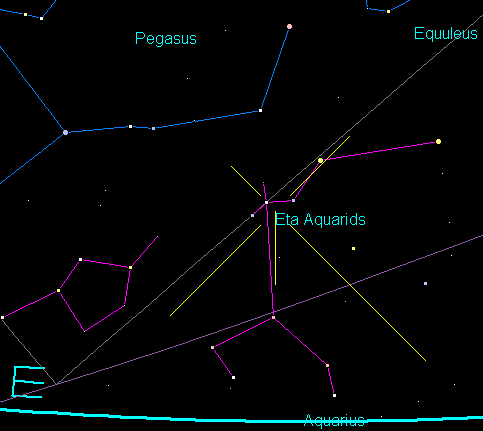
The Eta Aquariid radiant at 5 a.m. The radiant moves slowly to the east with time. Credit: My LookingUp program.
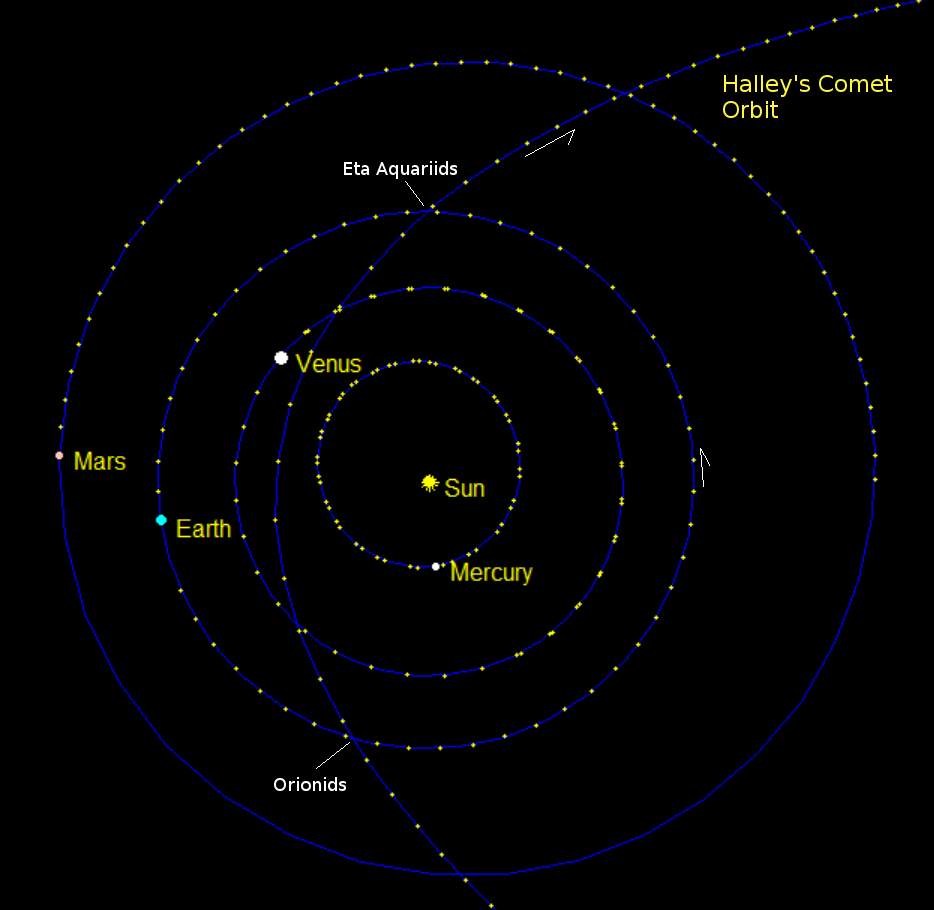
We get two meteor showers from Halley’s Comet. The Orionids, when Halley is approaching the inner solar system, and the Eta Aquariids when it’s leaving. Credit: My LookingUp program.
04/20/2015 – Ephemeris – The Lyrid meteor shower will reach peak Wednesday evening
Ephemeris for Monday, April 20th. The Sun rises at 6:50. It’ll be up for 13 hours and 43 minutes, setting at 8:33. The Moon, 2 days past new, will set at 10:57 this evening.
This week the Lyrid meteor shower will reach its peak. The expected peak will be Wednesday the 22nd at 8 p.m. (24 hr UT). Unfortunately the radiant point will not have risen by then. The radiant, near the star Vega in the constellation of Lyra will rise in the northeast by 10 p.m. It will approach the zenith by 6 a.m. as morning twilight brightens. The normal peak hourly rate is about 18 when the radiant is at the zenith, This year it could be as many as 90 per hour. However Europe and Asia will be prime locations to view the shower near the zenith at peak. The shower is caused by the debris of Comet Thatcher, seen only once in 1861. When comets approach the Sun they shed gas, dust and small bits of rock. When the Earth passes through it we get a meteor shower.
Times are for the Traverse City/Interlochen area of Michigan. They may be different for your location.
Addendum
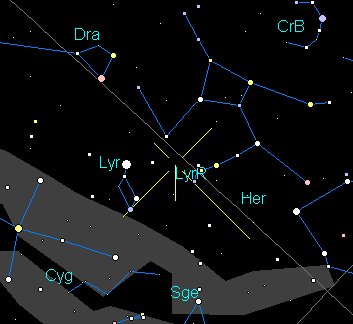
Lyrid meteor radiant is near Lyra and the bright star Vega. Th bright star by “Lyr” is Vega. Create by Bob Moler’s LookingUp program.
01/02/2015 – Ephemeris – Telescope Clinic tonight in Traverse City
Ephemeris for Friday, January 2nd. The sun will rise at 8:20, the latest sunrise of the year. It’ll be up for 8 hours and 53 minutes, setting at 5:13. The moon, 2 days before full, will set at 6:38 tomorrow morning.
Did you or someone in your family get a telescope for Christmas, or have one in a closet or attic because you don’t know how to put it together or operate? Or maybe you are trying to figure out which one to buy. Well, tonight’s your night. The Grand Traverse Astronomical Society will host a telescope clinic at Northwestern Michigan College’s Rogers Observatory on Birmley Road, south of Traverse City starting at 8 p.m. Telescope experts from the society will help you set up your telescope and give you observing tips. So bring ’em if you’ve got ’em. If it’s clear, at 9 p.m., there will be a star party to try out your telescope, or try them out on the lights of Traverse City. Can’t make it? We can help you after any meeting.
Times are for the Traverse City/Interlochen area of Michigan. They may be different for your location.
Addenda
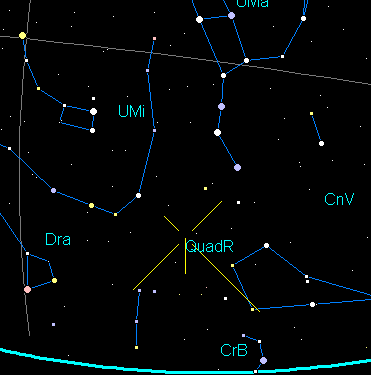
Remember the Quadrantid meteor shower tomorrow evening and into Sunday morning:
The moon will interfere with the meteor shower, so only the brightest will be visible. The radiant will rise from the northeast. The radiant will be nearly overhead at the start of twilight. On a dark night up to 120 meteors per hour may be seen according to the International Meteor Organization.
01/01/2015 – Ephemeris – Happy New Year – a look at January
Ephemeris for New Years Day, Thursday, January 1st. The sun will rise at 8:20. It’ll be up for 8 hours and 52 minutes, setting at 5:12. The moon, 3 days before full, will set at 5:43 tomorrow morning.
Happy New Year. Let’s preview the month of January. We’re a day from the latest sunrise at about the same time as today, 8:20 a.m. and will back down to 8:02 by the 31st. Sunset times are currently increasing by a minute a day from 5:12 p.m. today to 5:49 at month’s end. Listeners near the shore of Lake Michigan will have about the same sunrise time in Ludington, Interlochen/Traverse City, Petoskey and Mackinaw City, but the sunset times will vary markedly. The Quadrantid meteor shower whose radiant is near the end of the Big Dipper’s handle will reach peak on the 3rd, but it will have interference from the full moon,. On the 4th the Earth will be its closest to the sun of the entire year.
Times are for the Traverse City/Interlochen area of Michigan. They may be different for your location.
Addenda
Monthly Star Chart
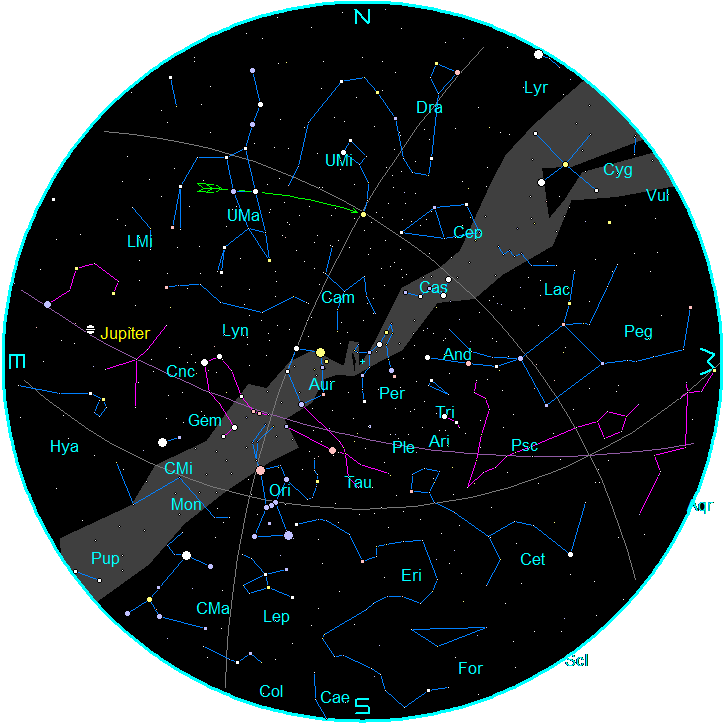
Star Chart for January 2015. Created using my LookingUp program.
The Moon is not plotted. The planets and stars are plotted for the 15th at 9 p.m. That is chart time.
Evening astronomical twilight ends at 6:58 p.m. on January 1st, and increasing to 7:30 p.m. on the 31st.
Morning astronomical twilight starts at 6:34 a.m. on January 1st, and decreasing to 6:22 a.m. on the 31st.
Add a half hour to the chart time every week before the 15th and subtract and hour for every week after the 15th.
For a list of constellation names to go with the abbreviations click here.
The green pointer from the Big Dipper is the pointer stars at the front of the bowl of the Big Dipper that point to Polaris the North Star.
The Quadrantid meteor shower
The moon will interfere with the meteor shower, so only the brightest will be visible. The radiant will rise from the northeast. The radiant will be nearly overhead at the start of twilight. On a dark night up to 120 meteors per hour may be seen according to the International Meteor Organization.
Quadrantid meteor shower radiant at 1:30 a.m.
The Earth at Perihelion
This is the closest the Earth gets to the Sun in its orbit this year. The Sun will be 91,402,000 miles or 147,096,000 kilometers away at around 1 a.m. January 4th, 2015 EST or 6 hr UT January 5th 2015. It makes winter the shortest season because the Earth is moving its fastest during perihelion. It’s only by a few days. And in northern Michigan where it seems that winter overlaps half of fall and spring besides, that few days difference is buried under snow.
Quasi-conjunction between Venus and Mercury on the evening of January 10th.
A quasi-conjunction. Conjunctions occur when two solar system bodies have the same right ascension. Mercury will get to within 0.6 degrees of Venus before retreating back sun-ward.
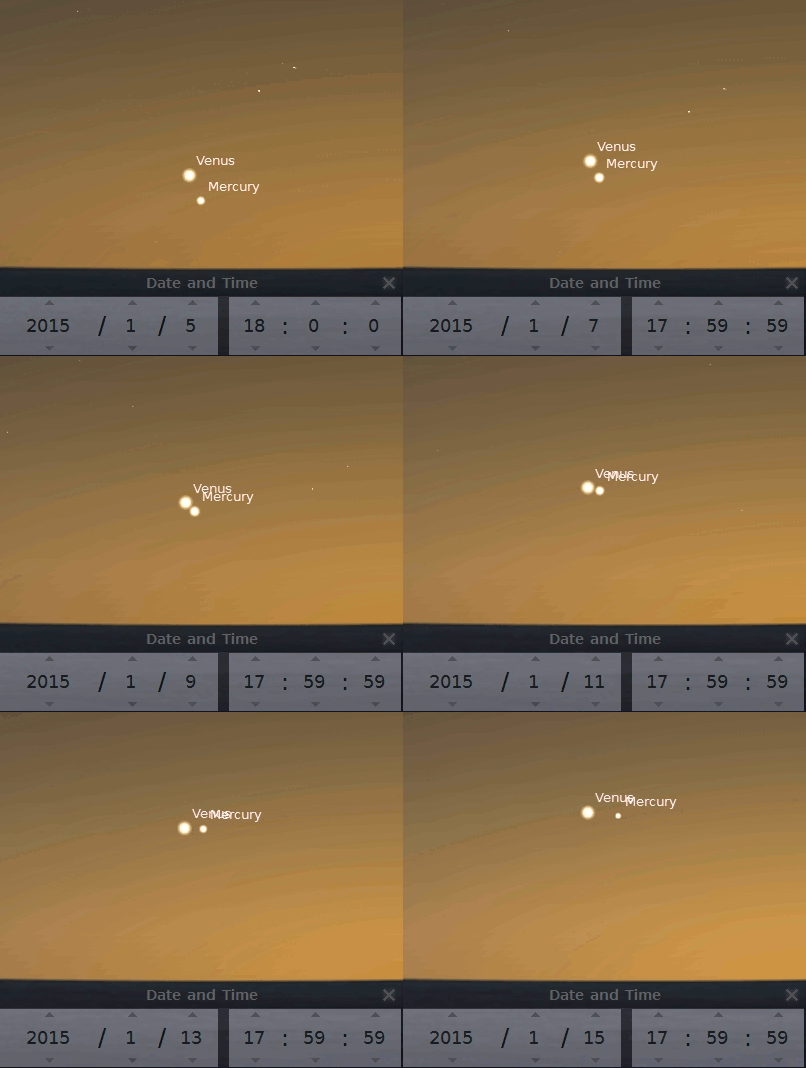
Animation of the Quasi-conjunction of Venus and Mercury. Time span 1/05/2015 to 1/15/2015 at 7 p.m. Created by Bob Moler using Stellarium and GIMP.
Comet C/2014 Q2 (Lovejoy)
Here is a finder chart for 9 p.m. for January. Every other position is marked with the month-day and predicted magnitude. Recently the comet has shown to be brighter than predicted by up to one magnitude. Note that magnitudes in astronomy are like golf scores – the lower the number, the brighter the object. So the comet should reach 4th magnitude.
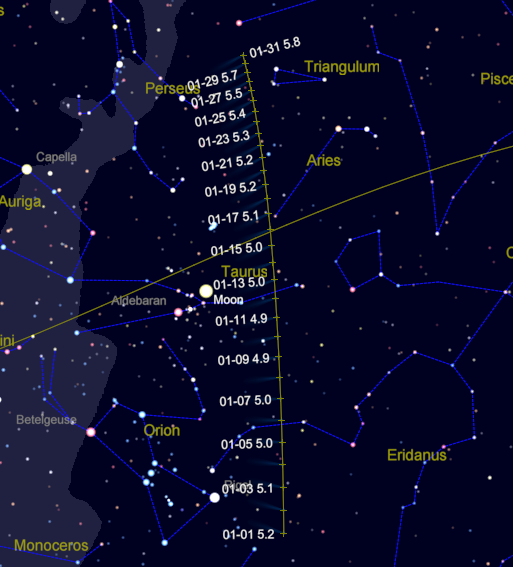
Nightly plot of Comet Lovejoy (C/2014 Q2) for the month of January, 2015 at 9 p.m.
Created using Cartes du Ceil (Sky Charts).
12/08/2014 – Ephemeris – Looking forward to the Geminid meteor shower next weekend
Ephemeris for Monday, December 8th. The sun will rise at 8:06. It’ll be up for 8 hours and 55 minutes, setting at 5:02. The moon, 2 days past full, will rise at 7:28 this evening.
This upcoming weekend is the weekend of the greatest annual meteor shower of the year. They’re the Geminids. I confess to never having seen a Geminid. The reason is that it’s generally too cloudy, and for me too cold. They are now twice as active as the Perseid meteors of August with a 120 per hour peak, when the radiant point in Gemini is overhead. The body that was discovered to produce these meteors doesn’t appear to be a comet. It is designated as an asteroid 3200 Phaethon. Phaethon gets extremely close to the sun at 13 million miles (21 million km) and one of the STEREO Sun monitoring satellites caught it developing a tail when close to the Sun. Phaethon may then be the first known rock comet. I’ll have more later this week.
Times are for the Traverse City/Interlochen area of Michigan. They may be different for your location.
Addendum
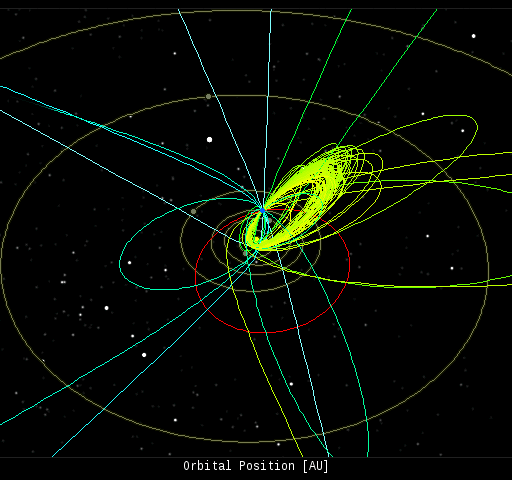
Orbits of last year’s fireballs on the night of December 13-14 as recorded by NASA’s All Sky Cameras. The preponderance of fireballs (bright meteors) are Geminids. These are published daily on Spaceweather.com. Credit: NASA and Spaceweather.com
12/01/2014 – Ephemeris – Previewing December skies
Ephemeris for Monday, December 1st. The sun will rise at 7:59. It’ll be up for 9 hours and 4 minutes, setting at 5:03. The moon, 2 days past first quarter, will set at 3:32 tomorrow morning.
Let’s preview December’s skies. Winter will officially arrive on the 21st at 6:03 p.m., the winter solstice. The noontime sun will dip from 23 ½ degrees to a bit less than 22 degrees above the southern horizon on that day. There will be little movement in the sunset times: In the Traverse City/Interlochen area this will be from 5:03 today, down to 5:02 and then advancing to 5:11 at the end of the month. There is more movement in the sunrise times which will advance from 7:59 this morning to 8:19 on the 31st. The big event in December will be the Geminid meteor shower whose maximum is on the morning of the 14th. But will be hampered by the moon after 12:17 a.m that morning.
Times are for the Traverse City/Interlochen area of Michigan. They may be different for your location.
Addendum
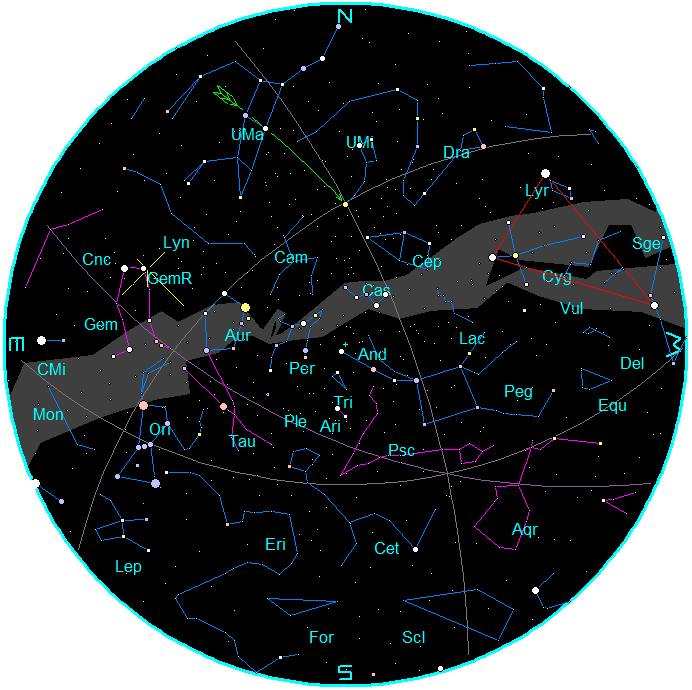
Star Chart for December 2014. Created using my LookingUp program.
The Moon is not plotted. The planets and stars are plotted for the 15th at 9 p.m. That is chart time.
Evening astronomical twilight ends at 6:48 p.m. on December 1st, decreasing one minute by the 9th and increasing to 6:57 p.m. on the 31st.
Morning astronomical twilight starts at 6:14 a.m. on December 1st, and increasing to 6:33 a.m. on the 31st.
Add a half hour to the chart time every week before the 15th and subtract and hour for every week after the 15th.
For a list of constellation names to go with the abbreviations click here.
Also shown is the Summer Triangle in red. Clockwise from the top star is Deneb in Cygnus, Vega in Lyra and Altair in Aquila.
The green pointer from the Big Dipper is:
- Pointer stars at the front of the bowl of the Big Dipper point to Polaris the North Star.
The Geminid radiant is shown in yellow and marked GemR.
11/17/2014 – Ephemeris – The Leonid meteor shower peaks this week
Ephemeris for Monday, November 17th. The sun will rise at 7:41. It’ll be up for 9 hours and 30 minutes, setting at 5:12. The moon, 3 days past last quarter, will rise at 3:30 tomorrow morning.
This week the Leonid meteor shower will again be seen. This is an unremarkable shower most years, but about every 33 years can be spectacular. This year we could see two peaks to the shower. Problem is that the peak activity for the Leonids last only an hour of so. The first is in the afternoon our time today. The radiant rises at midnight and one may be able to spot a few meteors after that. There is another peak calculated to be centered on 4:17 a.m. on Friday the 21st. It is supposed to be debris left by the comet responsible for the Leonids, Tempel-Tuttle back in 1567. Every once in a while the Leonids surprise us. Meteors are the streaks we see when grain sized particles shed by comets zip through the atmosphere at interplanetary speeds.
Times are for the Traverse City/Interlochen area of Michigan. They may be different for your location.
Addendum
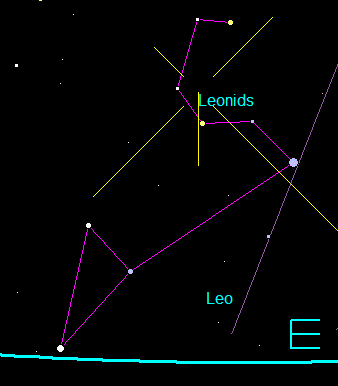
Leo rising at around 2 a.m. on the morning of November 20. Note the radiant in the sickle asterism of Leo. Created using Looking Up, my own program.

A famous woodcut of the 1833 Leonid meteor storm.
10/30/2014 – Ephemeris – Previewing November’s skies
Ephemeris for Thursday, October 30th. The sun will rise at 8:17. It’ll be up for 10 hours and 16 minutes, setting at 6:34. The moon, at first quarter today, will set at 12:49 tomorrow morning.
Let’s look at the skies for the month of November a couple of days early. The sun is still moving south rapidly. Daylight hours in the Interlochen/Traverse City area and will drop from 10 hours and 11 minutes i\on the 1st to 9 hours 6 minutes on the 30th. The altitude, or angle, of the sun above the southern horizon at local noon will be just under 31 degrees Saturday and will descend to 23 and a half degrees on the 30th. The altitude of the sun in the Straits area will be a degree lower. Local noon, this month, will be about 12:30 p.m. when we go back to standard time this weekend. The Leonid meteors have two possible dates this month, the 17th and the 21st. Those on the 21st seem to be best timed for our location on the Earth.
Times are for the Traverse City/Interlochen area of Michigan. They may be different for your location.
Addendum
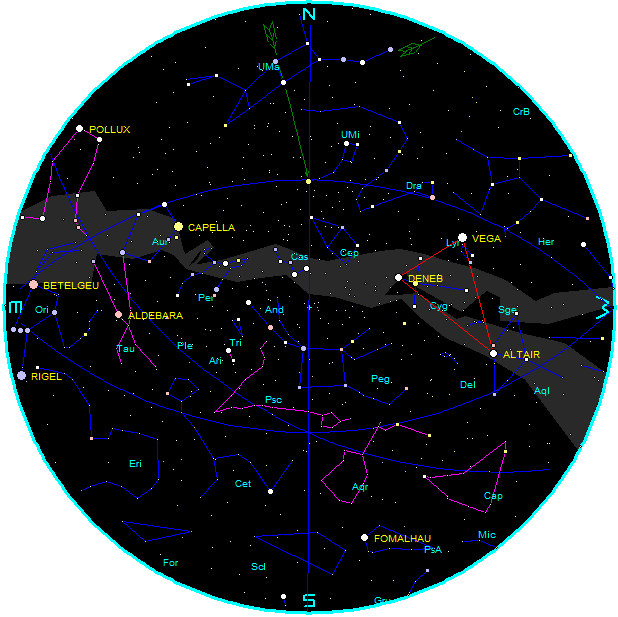
Star Chart for November 2014. Created using my LookingUp program. Created using my LookingUp program.
The Moon is not plotted. The planets and stars are plotted for the 15th at 9 p.m. That is chart time.
Astronomical twilight ends at 7:08 p.m. on November 2nd, decreasing to 6:48 on the 31st.
Add a half hour to the chart time every week before the 15th and subtract and hour for every week after the 15th.
For a list of constellation names to go with the abbreviations click here.
Also shown is the Summer Triangle in red. Clockwise from the top star is Deneb in Cygnus, Vega in Lyra and Altair in Aquila.
The green pointers from the Big Dipper are:
- Pointer stars at the front of the bowl of the Big Dipper point to Polaris the North Star.
 Bob Moler's Ephemeris Blog