Archive
12/01/2016 – Ephemeris – Looking ahead at the last month of 2016
Ephemeris for Thursday, December 1st. The Sun will rise at 8:00. It’ll be up for 9 hours and 3 minutes, setting at 5:03. The Moon, 2 days past new, will set at 7:10 this evening.
Let’s look at this month of December. The hours of daylight will change little except to be darker in the morning and lighter in the evenings. In the Traverse City/Interlochen area sunset will change from 5:03 today, down to 5:02 and then advancing to 5:12 at the end of the month. The earliest sunset will be around the 10th. There is more movement in the sunrise times which will advance from 8 o’clock this morning to 8:20 on the 31st.Dec. Winter will officially arrive at the winter solstice on the 21st at 5:45 a.m. The noontime sun will dip from about 23 ½ degrees today to a bit less than 22 degrees above the southern horizon on that day. Daylight hours will drop from 9 hours 3 minutes tomorrow to 8 hours and 48 minutes on the solstice.
Times are for the Traverse City/Interlochen area of Michigan. They may be different for your location.
Addendum
December Star Charts
Evening
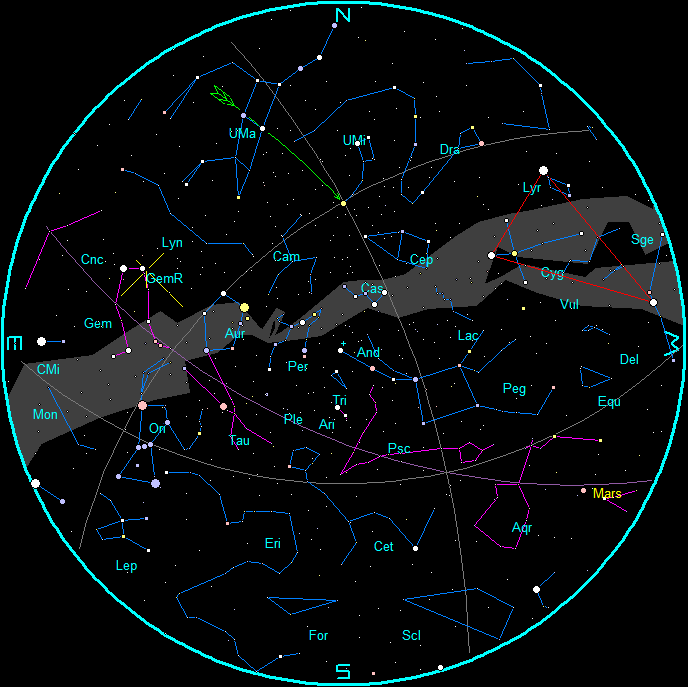
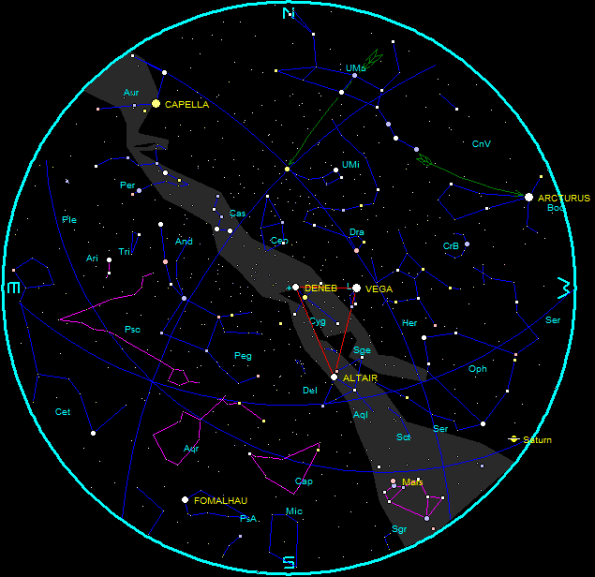
Star Chart for December 2016. Created using my LookingUp program. Click on image to enlarge.
Morning
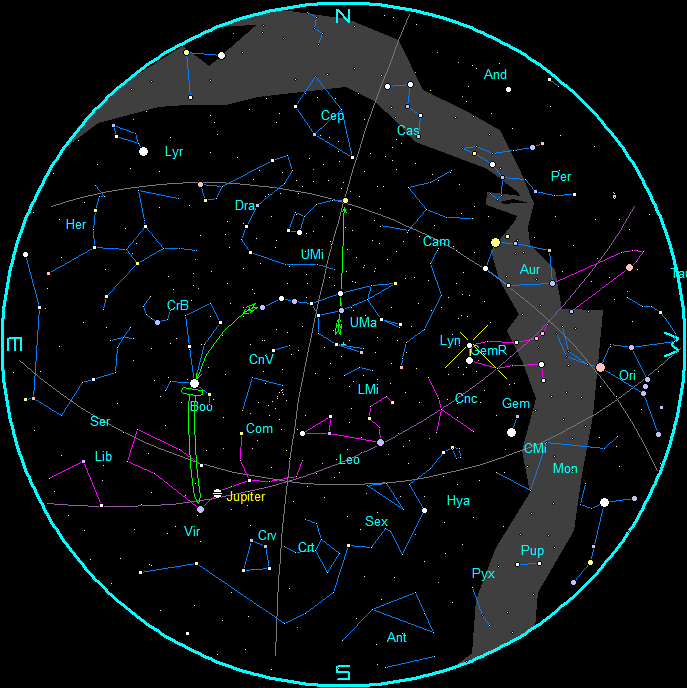
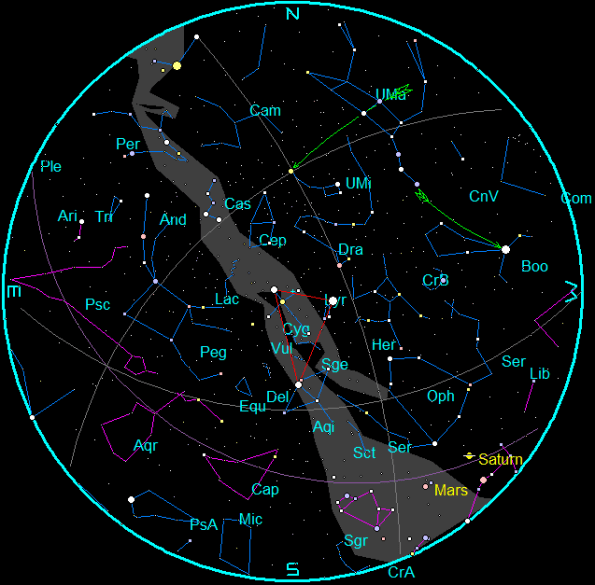
Star Chart for December 2016 mornings. Created using my LookingUp program. Click on image to enlarge.
Since the night time hours are lengthening I’ve decided to add a morning star chart .
The planets and stars are plotted for the 15th at 9 p.m. EST, and again at 6 a.m. Those are chart times. Note, Traverse City is located approximately 45 minutes behind our time meridian. (An hour 45 minutes behind our daylight saving time meridian. during EDT and 45 minutes behind our daylight standard time meridian. during EST). We start the month on daylight time (UT – 4 hours) then fall back to standard time (UT – 5 hours) on the 6th at 2 a.m. To duplicate the star positions on a planisphere you may have to set it to 1:45 or 0:45 earlier than the current time if you were near your time meridian.
Evening nautical twilight ends at 6:12 p.m. EDT on the 1st, decreasing to 6:22 p.m. EST on the 30th.
Morning nautical twilight starts at 6:51 a.m. EDT on the 1st, and drops an hour on the 6th, and then increases again to 7:09 a.m. EST on the 30th.
Add a half hour to the chart time every week before the 15th and subtract a half hour for every week after the 15th.
For a list of constellation names to go with the abbreviations click here.
- Pointer stars at the front of the bowl of the Big Dipper point to Polaris the North Star
- Follow the arc of the handle of the Big Dipper to the star Arcturus, and
- Straighten to a spike to Spica
- The Summer Triangle is outlined in red. Vega in Lyra (Lyr), Deneb in Cygnus (Cyg) and Altair in Aquila (Aql).
- GemR is the Geminid meteor shower radiant.
Calendar of Planetary Events
Credit: Sky Events Calendar by Fred Espenak and Sumit Dutta (NASA’s GSFC)
To generate your own calendar go to http://eclipse.gsfc.nasa.gov/SKYCAL/SKYCAL.html
Times are Eastern Time.
    Date    Time     Event
Dec 01  Th           Venus: 43.2° E
    01  Th  2:56 pm  Moon South Dec.: 18.9° S
    03  Sa  7:34 am  Moon-Venus: 6.3° S
    05  Mo  5:39 am  Moon-Mars: 3.1° S
    06  Tu 12:35 pm  Moon Descending Node
    07  We  4:03 am  First Quarter
    10  Sa  6:03 am  Saturn Conjunction with the Sun
    10  Sa 10:59 pm  Mercury Greatest Elongation: 20.8° East
    12  Mo  6:27 pm  Moon Perigee: 358500 km
    12  Mo 11:14 pm  Moon-Aldebaran: 0.4° S
    13  Tu  6:57 pm  Geminid Meteor Shower: ZHR = 120
    13  Tu  7:05 pm  Full Moon (Super Moon)
    14  We  4:43 pm  Moon North Dec.: 18.9° N
    18  Su  1:14 pm  Moon-Regulus: 1.1° N
    18  Su 11:46 pm  Moon Ascending Node
    20  Tu  8:56 pm  Last Quarter
    21  We  5:45 am  Winter Solstice
    22  Th  3:00 am  Ursid Meteor Shower: ZHR = 10
    22  Th 11:37 am  Moon-Jupiter: 2.7° S
    25  Su 12:55 am  Moon Apogee: 405900 km
    28  We  1:41 pm  Mercury Inferior Conjunction
    28  We 10:30 pm  Moon South Dec.: 19° S
    29  Th  1:53 am  New Moon
Jan 01  Su           Venus: 46.8° E
11/01/2016 – Ephemeris – Previewing November evening and morning skies
Ephemeris for Tuesday, November 1st. The Sun will rise at 8:21. It’ll be up for 10 hours and 9 minutes, setting at 6:30. The Moon, 2 days past new, will set at 8:03 this evening.
The month of November is one early sunsets, especially with the return to standard time next Sunday, and shortening of day light hours. Daylight hours will decrease from 10 hours 9 minutes today to 9 hours 4 minutes at month end. The altitude of the sun above the southern horizon at local noon, which will drop from 31 degrees to 23½ degrees over the month. Apparent local noon this month will be around 12:30 p.m. once the time change happens. The sunset time on the 30th will be only 2 minutes later than the earliest sunset of the year. The sunrise time on the 30th will have 22 minutes to go to the latest sunrise. The Leonid meteor shower will have a peak on the 17th, but the bright Moon will interfere with it.
Times are for the Traverse City/Interlochen area of Michigan. They may be different for your location.
Addendum
November Star Charts
Evening
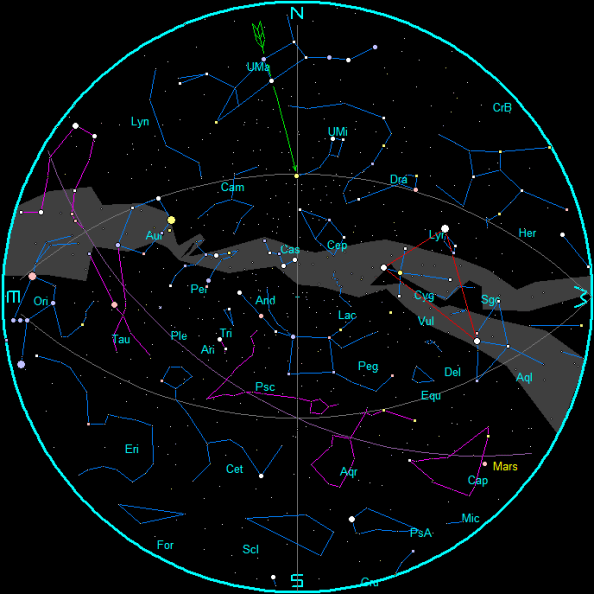
Evening Star Chart for November 2016. Created using my LookingUp program. To enlarge in Firefox right-click on image then click View image.
Morning
Since the night time hours are lengthening I’ve decided to add a morning star chart .
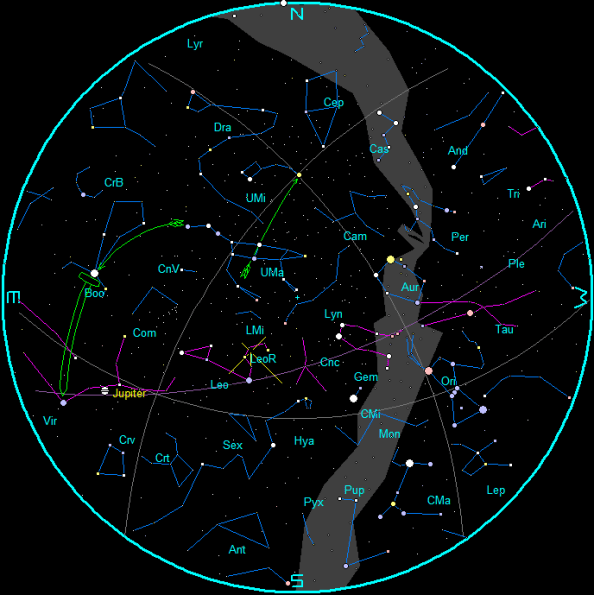
Morning Star Chart for November 2016. Created using my LookingUp program. To enlarge in Firefox right-click on image then click View image.
The planets and stars are plotted for the 15th at 9 p.m. EST, and again at 6 a.m. Those are chart times. Note, Traverse City is located approximately 45 minutes behind our time meridian. (An hour 45 minutes behind our daylight saving time meridian. during EDT and 45 minutes behind our daylight standard time meridian. during EST). We start the month on daylight time (UT – 4 hours) then fall back to standard time (UT – 5 hours) on the 6th at 2 a.m. To duplicate the star positions on a planisphere you may have to set it to 1:45 or 0:45 earlier than the current time if you were near your time meridian.
Evening nautical twilight ends at 7:35 p.m. EDT on the 1st, decreasing to 6:13 p.m. EST on the 30th.
Morning nautical twilight starts at 7:16 a.m. EDT on the 1st, and drops an hour on the 6th, and then increases again to 6:50 a.m. EST on the 30th.
Add a half hour to the chart time every week before the 15th and subtract a half hour for every week after the 15th.
For a list of constellation names to go with the abbreviations click here.
- Pointer stars at the front of the bowl of the Big Dipper point to Polaris the North Star
- Follow the arc of the handle of the Big Dipper to the star Arcturus, and
- Straighten to a spike to Spica
- The Summer Triangle is outlined in red. Vega in Lyra (Lyr), Deneb in Cygnus (Cyg) and Altair in Aquila (Aql).
Calendar of Planetary Events
Credit: Sky Events Calendar by Fred Espenak and Sumit Dutta (NASA’s GSFC)
To generate your own calendar go to http://eclipse.gsfc.nasa.gov/SKYCAL/SKYCAL.html
Times are Eastern Time.
    Date    Time    Event
 Nov 01 Tu          Venus: 37.7° E
    02 We  2:38 pm Moon-Saturn: 4.1° S
    04 Fr  8:04 am Moon South Dec.: 18.7° S
    05 Sa 12:13 am South Taurid Shower: ZHR = 10
    06 Su  2:00 am Eastern Standard Tim starts
    07 Mo  2:51 pm First Quarter
    09 We 10:57 am Moon Descending Node
    11 Fr 11:29 pm North Taurid Shower: ZHR = 15
    14 Mo  6:23 am Moon Perigee: 356500 km
    14 Mo  8:52 am Full Moon (Super Moon)
    15 Tu 11:50 am Moon-Aldebaran: 0.4° S
    17 Th  4:32 am Moon North Dec.: 18.8° N
    17 Th  5:47 am Leonid Shower: ZHR = 15
    21 Mo  3:33 am Last Quarter
    21 Mo  5:08 am Moon-Regulus: 1.4° N
    21 Mo  9:48 pm Moon Ascending Node
    23 We  1:48 pm Mercury-Saturn: 3.4° N
    24 Th  8:47 pm Moon-Jupiter: 2.1° S
    27 Su  3:08 pm Moon Apogee: 406600 km
    29 Tu  7:18 am New Moon
Dec 01 Th          Venus: 43.2° E
09/30/2016 – Ephemeris – Looking ahead to October skies
Ephemeris for Friday, September 30th. The Sun will rise at 7:40. It’ll be up for 11 hours and 44 minutes, setting at 7:24. The Moon is new today, and won’t be visible.
Let’s look at the skies for the month of October. The sun will still be moving south rapidly. Daylight hours in the Interlochen/Traverse City area and will drop from 11 hours and 41 minutes tomorrow to 10 hours, 12 minutes at month’s end.. The altitude of the sun above the southern horizon at local noon will be 42 degrees tomorrow, and will descend to 31 degrees on Halloween, also in the Interlochen area. The Straits area will have the sun a degree lower. Local noon, when the sun is due south will be about 1:30 p.m. Sunrise times will increase from 7:41 tomorrow all the way to 8:20 a.m. in Interlochen and Traverse City on the 31st. Sunset times will decrease from 7:22 p.m. tomorrow to 6:32 when the trick-or-treaters haunt our neighborhoods on Halloween.
Times are for the Traverse City/Interlochen area of Michigan. They may be different for your location.
Addendum
October Star Chart
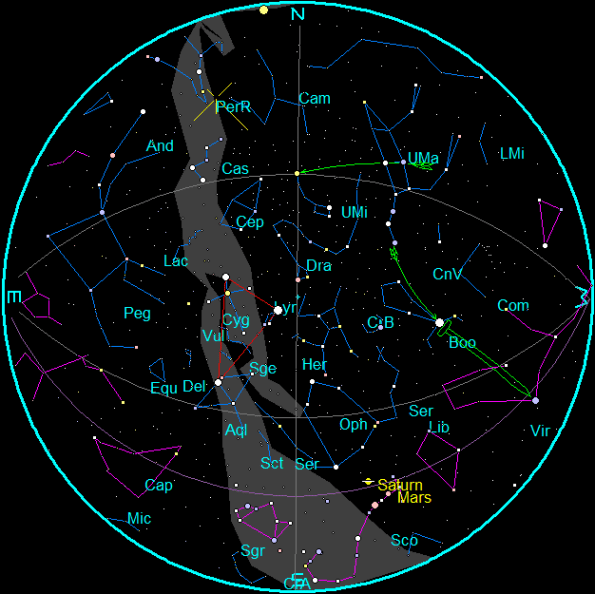
Star Chart for October 2016. Created using my LookingUp program. To enlarge in Firefox right-click on image then click View image.
The planets and stars are plotted for the 15th at 9 p.m. EDT. That is chart time. Note, Traverse City is located approximately 45 minutes behind our time meridian. (An hour 45 minutes behind our daylight saving time meridian.) To duplicate the star positions on a planisphere you may have to set it to 1:45 earlier than the current time if you are near your time meridian.
Evening nautical twilight ends at 8:25 p.m. EDT on the 1st, decreasing to 7:37 p.m. EDT on the 31st.
Morning nautical twilight starts at 6:38 a.m. EDT on the 1st, and increasing to 7:15 a.m. EDT on the 31st.
Add a half hour to the chart time every week before the 15th and subtract a half hour for every week after the 15th.
For a list of constellation names to go with the abbreviations click here.
- Pointer stars at the front of the bowl of the Big Dipper point to Polaris the North Star
- Follow the arc of the handle of the Big Dipper to the star Arcturus
- The Summer Triangle is outlined in red. Vega in Lyra (Lyr), Deneb in Cygnus (Cyg) and Altair in Aquila (Aql).
Calendar of Planetary Events
Credit: Sky Events Calendar by Fred Espenak and Sumit Dutta (NASA’s GSFC)
To generate your own calendar go to http://eclipse.gsfc.nasa.gov/SKYCAL/SKYCAL.html
Times are Eastern Time.
    Date    Time    Event
Oct 01  Sa          Venus: 30.9° E
    03  Mo  1:30 pm Moon-Venus: 5.6° S
    04  Tu  7:02 am Moon Apogee: 406100 km
    06  Th  4:04 am Moon-Saturn: 4.2° S
    08  Sa  2:03 am Moon South Dec.: 18.5° S
    09  Su 12:33 am First Quarter
    13  Th  5:43 am Moon Descending Node
    15  Sa  6:15 am Uranus Opposition
    16  Su 12:23 am Full Moon
    16  Su  7:36 pm Moon Perigee: 357900 km
    19  We  2:18 pm Moon-Aldebaran: 0.3° S
    20  Th  7:38 pm Moon North Dec.: 18.6° N
    21  Fr 12:45 am Orionid Shower: ZHR = 20
    22  Sa  3:14 pm Last Quarter
    25  Tu 12:01 am Moon-Regulus: 1.7° N
    25  Tu  9:45 pm Moon Ascending Node
    26  We  6:54 am Venus-Antares: 3.1° N
    27  Th 11:53 am Mercury Superior Conj.
    28  Fr  5:33 am Moon-Jupiter: 1.6° S
    29  Sa  9:47 pm Venus-Saturn: 3° N
    30  Su 12:38 pm New Moon
    31  Mo  2:29 pm Moon Apogee: 406700 km
Nov 01  Tu          Venus: 37.7° E
09/01/2016 – Ephemeris – Previewing the pivotal month of September’s skies
Ephemeris for Thursday, September 1st. The Sun will rise at 7:05. It’ll be up for 13 hours and 12 minutes, setting at 8:18. The Moon is new today, and won’t be visible.
There’s an eclipse of the Sun in progress now for parts of the southern hemisphere centered on southern Africa. Today is also has the first of two new Moons this month, the second being called the Black Moon. Let’s look at the skies for September. The sun is moving at its greatest speed in its retreat to the south. Daylight hours in the Interlochen/Traverse City area and will drop from 13 hours and 12 minutes today to 11 hours 44 minutes on the 30th. The altitude of the sun above the southern horizon at local noon will be 54 degrees today, and will descend to 42 degrees on the 30th. The official season of summer is getting short too, so enjoy it while you can. Summer ends and autumn begins at 10:21 a.m. on September 22nd.
Times are for the Traverse City/Interlochen area of Michigan. They may be different for your location.
Addendum
September Star Chart
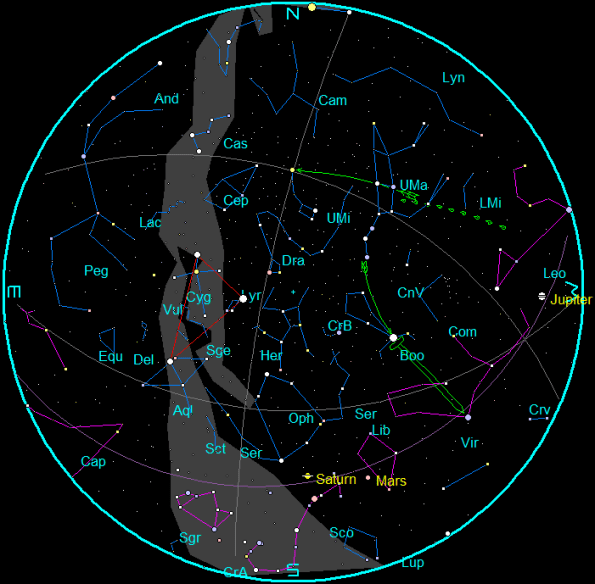
Star Chart for September 2016. Created using my LookingUp program. To enlarge in Firefox right-click on image then click View image.
The planets and stars are plotted for the 15th at 10 p.m. EDT. That is chart time. Note, Traverse City is located approximately 45 minutes behind our time meridian. (An hour 45 minutes behind our daylight saving time meridian.) To duplicate the star positions on a planisphere you may have to set it to 1:45 earlier than the current time if you are near your time meridian.
Evening nautical twilight ends at 9:24 p.m. EDT on the 1st, increasing to 8:27 p.m. EDT on the 30th.
Morning nautical twilight starts at 5:59 a.m. EDT on the 1st, and decreasing to 6:37 a.m. EDT on the 30th.
Add a half hour to the chart time every week before the 15th and subtract a half hour for every week after the 15th.
For a list of constellation names to go with the abbreviations click here.
- Pointer stars at the front of the bowl of the Big Dipper point to Polaris the North Star
- Follow the arc of the handle of the Big Dipper to the star Arcturus
- The Summer Triangle is outlined in red. Vega in Lyra (Lyr), Deneb in Cygnus (Cyg) and Altair in Aquila (Aql).
Calendar of Planetary Events
Credit: Sky Events Calendar by Fred Espenak and Sumit Dutta (NASA’s GSFC)
To generate your own calendar go to http://eclipse.gsfc.nasa.gov/SKYCAL/SKYCAL.html
Times are Eastern Time.
    Date    Time    Event
Sep 01  Th          Venus: 23.5° E
    01  Th  5:03 am New Moon
    01  Th  5:08 am Annular Solar Eclipse (Atlantic, Africa, Indian Ocean)
    01  Th 11:27 am Moon Ascending Node
    02  Fr 11:16 am Neptune Opposition
    03  Sa  6:33 am Moon-Venus: 1.2° S
    04  Su  8:03 pm Saturn-Antares: 6.1° N
    06  Tu  2:44 pm Moon Apogee: 405100 km
    08  Th  5:23 pm Moon-Saturn: 4.2° S
    09  Fr  7:49 am First Quarter
    10  Sa  6:05 am Moon South Dec.: 18.5° S
    12  Mo  7:38 am Mercury Inferior Solar Conjunction (Will enter the
                    morning sky)
    15  Th  7:55 pm Moon Descending Node
    16  Fr  2:56 pm Penumbral Lunar Eclipse (Not visible in MI)
    16  Fr  3:05 pm Full Harvest Moon
    18  Su 11:12 am Venus-Spica: 2.4° N
    18  Su  1:00 pm Moon Perigee: 361900 km
    21  We  6:13 pm Moon-Aldebaran: 0.2° S
    22  Th 10:21 am Autumnal Equinox (Summer ends and autumn starts)
    23  Fr  5:56 am Last Quarter
    23  Fr 12:44 pm Moon North Dec.: 18.5° N
    26  Mo  2:19 am Jupiter Solar Conjunction (Will enter the morning sky)
    27  Tu  6:32 pm Moon-Regulus: 1.8° N
    28  We  2:59 pm Mercury Greatest Elongation: 17.9° W
    28  We  6:06 pm Moon Ascending Node
    30  Fr  8:12 pm New Moon (Second new Moon this month)
Oct 01  Sa          Venus: 30.9° E
08/01/2016 – Ephemeris – Previewing August skies
Ephemeris for Monday, August 1st. The Sun rises at 6:29. It’ll be up for 14 hours and 38 minutes, setting at 9:07. The Moon, 1 day before new, will rise at 6:19 tomorrow morning.
Let’s look ahead at the month of August in the skies. Daylight hours will decrease from 14 hours and 38 minutes today to 13 hours 15 minutes on the 31st. The altitude of the sun at local noon, that is degrees of angle above the horizon will decrease from 63 degrees today to just over 53 degrees on the 31st. Straits area listeners can subtract one more degree from those angles. Local noon, when the sun is due south, is about 1:43 p.m. The big event of the month will be in the early morning sky: The Perseid meteor shower will reach its peak on Friday morning the 12th. However you’ll have to wait until after 1:30 a.m. for the moon to set. But that will allow viewing of the shower up to 3 hours of the peak. I’ll have more then.
Times are for the Traverse City/Interlochen area of Michigan. They may be different for your location.
Addendum
August Star Chart
Star Chart for August 2016. Created using my LookingUp program. To enlarge in Firefox right-click on image then click View image.
The planets and stars are plotted for the 15th at 10 p.m. EDT. That is chart time. Note, Traverse City is located approximately 45 minutes behind our time meridian. (An hour 45 minutes behind our daylight saving time meridian.) To duplicate the star positions on a planisphere you may have to set it to 1:45 earlier than the current time if you are near your time meridian.
Evening nautical twilight ends at 10:23 p.m. EDT on the 1st, increasing to 9:26 p.m. EDT on the 31st.
Morning nautical twilight starts at 5:14 a.m. EDT on the 1st, and decreasing to 5:58 a.m. EDT on the 31st.
Add a half hour to the chart time every week before the 15th and subtract a half hour for every week after the 15th. Before the 13th also subtract an hour for Standard Time.
For a list of constellation names to go with the abbreviations click here.
- Pointer stars at the front of the bowl of the Big Dipper point to Polaris the North Star
- Follow the arc of the handle of the Big Dipper to the star Arcturus
- Extend the arc to a spike to point to Spica.
- The Summer Triangle is outlined in red. Vega in Lyra (Lyr), Deneb in Cygnus (Cyg) and Altair in Aquila (Aql).
Calendar of Planetary Events
Credit: Sky Events Calendar by Fred Espenak and Sumit Dutta (NASA’s GSFC)
To generate your own calendar go to http://eclipse.gsfc.nasa.gov/SKYCAL/SKYCAL.html
Times are Eastern Time.
    Date    Time    Event
Aug 01  Mo       Venus: 15.3° E
    02  Tu 16:45 New Moon
    04  Th 02:19 Moon-Venus: 3.1° N
    04  Th 18:12 Moon-Mercury: 0.6° N
    05  Fr 03:48 Moon Ascending Node
    05  Fr 07:57 Venus-Regulus: 1° N
    05  Fr 23:28 Moon-Jupiter: 0.2° N
    09  Tu 20:05 Moon Apogee: 404300 km
    10  We 14:21 First Quarter
    12  Fr 08:10 Moon-Saturn: 4° S
    12  Fr 08:26 Perseid Shower: ZHR = 90
    14  Su 09:05 Moon South Dec.: 18.5° S
    16  Tu 16:59 Mercury Elongation: 27.4° E
    18  Th 05:27 Full Moon
    19  Fr 10:14 Moon Descending Node
    20  Sa 01:34 Mercury-Jupiter: 3.8° N
    21  Su 21:20 Moon Perigee: 367000 km
    24  We 01:09 Mars-Antares: 1.8° N
    24  We 21:11 Mars-Saturn: 4.3° N
    24  We 23:41 Last Quarter
    25  Th 12:21 Moon-Aldebaran: 0.2° S
    27  Sa 07:17 Moon North Dec.: 18.5° N
    27  Sa 17:53 Venus-Jupiter: 0.1° N
    28  Su 16:09 Mercury-Venus: 5° N
Sep 01  Th       Venus: 23.5° E
06/30/2016 – Ephemeris – Previewing July’s skies
Ephemeris for Thursday, June 30th. Today the Sun will be up for 15 hours and 31 minutes, setting at 9:32, and it will rise tomorrow at 6:01. The Moon, 3 days past last quarter, will rise at 3:49 tomorrow morning.
Lets preview July’s skies. The sun, having reached its northern solstice, is beginning to slide southward again, at first imperceptibly, then with greater speed. The daylight hours will decrease from 15 hours and 30 minutes tomorrow to 14 hours 40 minutes at month’s end. The daylight hours will be slightly shorter south of Interlochen, and slightly longer to the north. The altitude of the sun at local noon, when the sun is due south will decrease from 68 degrees tomorrow to 63 degrees at month’s end. Despite the warmth, the earth will reach its greatest distance from the Sun on Monday the 4th where the fireworks will begin in earnest when the Juno spacecraft lights its rocket engine to enter orbit Jupiter.
Times are for the Traverse City/Interlochen area of Michigan. They may be different for your location.
Addendum
July Star Chart
Star Chart for July 2016. Created using my LookingUp program. To enlarge in Firefox right-click on image then click View image.
Star Chart for July 2016. Created using my LookingUp program. To enlarge in Firefox Right-click on image then click View image.
The planets and stars are plotted for the 15th at 11 p.m. EDT. That is chart time. Note, Traverse City is located approximately 45 minutes behind our time meridian. (An hour 45 minutes behind our daylight saving time meridian.) To duplicate the star positions on a planisphere you may have to set it to 1:45 earlier than the current time if you are near your time meridian.
Evening nautical twilight ends at 10:57 p.m. EDT on the 1st, increasing to 10:24 p.m. EDT on the 31st.
Morning nautical twilight starts at 4:35 a.m. EDT on the 1st, and decreasing to 5:2 a.m. EDT on the 31st.
Add a half hour to the chart time every week before the 15th and subtract a half hour for every week after the 15th. Before the 13th also subtract an hour for Standard Time.
For a list of constellation names to go with the abbreviations click here.
- Pointer stars at the front of the bowl of the Big Dipper point to Polaris the North Star
- A leaky Big Dipper drips on Leo
- Follow the arc of the handle of the Big Dipper to the star Arcturus
- Extend the arc to a spike to point to Spica.
- The Summer Triangle is outlined in red. Vega in Lyra (Lyr), Deneb in Cygnus (Cyg) and Altair in Aquila (Aql).
Calendar of Planetary Events
Credit: Sky Events Calendar by Fred Espenak and Sumit Dutta (NASA’s GSFC)
To generate your own calendar go to http://eclipse.gsfc.nasa.gov/SKYCAL/SKYCAL.html
Times are Eastern Time. Some additions made to aid clarity.
    Date    Time      Event
Jul 01  Fr            Venus: 6.8° E
    01  Fr  2:45 a.m. Moon Perigee: 366000 km
    01  Fr 11:58 p.m. Moon-Aldebaran: 0.4° S
    03  Su  4:06 p.m. Moon North Dec.: 18.6° N
    04  Mo  7:01 a.m. New Moon
    04  Mo 11:59 a.m. Aphelion: 1.0168 AU
    06  We 11:12 p.m. Mercury Superior Conj.
    07  Th  7:33 p.m. Moon-Regulus: 1.9° N
    08  Fr  9:42 p.m. Moon Ascending Node
    09  Sa  6:08 a.m. Moon-Jupiter: 0.9° N
    11  Mo  8:52 p.m. First Quarter
    13  We  1:24 a.m. Moon Apogee: 404300 km
    16  Sa  1:11 a.m. Moon-Saturn: 3.8° S
    17  Su 11:41 p.m. Moon South Dec.: 18.6° S
    19  Tu  6:57 p.m. Full Moon
    23  Sa  3:49 a.m. Moon Descending Node
    26  Tu  7:00 p.m. Last Quarter
    27  We  7:25 a.m. Moon Perigee: 369700 km
    27  We  4:32 p.m. Delta Aquarid Shower: ZHR = 20
    29  Fr  6:53 a.m. Moon-Aldebaran: 0.3° S
    30  Sa 11:55 a.m. Mercury-Regulus: 0.3° N
    31  Su 12:52 a.m. Moon North Dec.: 18.5° N
Aug 01  Mo            Venus: 15.3° E
05/31/2016 – Ephemeris – Previewing June’s bright skies
Ephemeris for Tuesday, May 31st. Today the Sun will be up for 15 hours and 20 minutes, setting at 9:20, and it will rise tomorrow at 6:00. The Moon, 2 days past last quarter, will rise at 3:55 tomorrow morning.
Tomorrow will be the first of June, so let’s preview June skies. There will be a lot of sunlight in June. The daylight hours will increase a bit from 15 hours and 21 minutes tomorrow to 15 hours and 34 minutes on the 20th, the solstice, retreating back to 15 hours 31 minutes at month’s end. At this time of the year the sunset times for Ludington, Interlochen, Petoskey and Mackinaw City are very nearly the same.* However the sunrise times are at their most divergent. With Ludington’s sunrise being 14 minutes later than Mackinaw City’s. The altitude of the sun above the southern horizon at local noon will increase from about 67 and a half degrees to 68 and three-quarters on the 20th. Local noon, when the sun is actually due south will occur at about 1:43 p.m.
Times are for the Traverse City/Interlochen area of Michigan. They may be different for your location.
* See http://ephemeris.bjmoler.org/calendar.htm
Addendum
June Star Chart
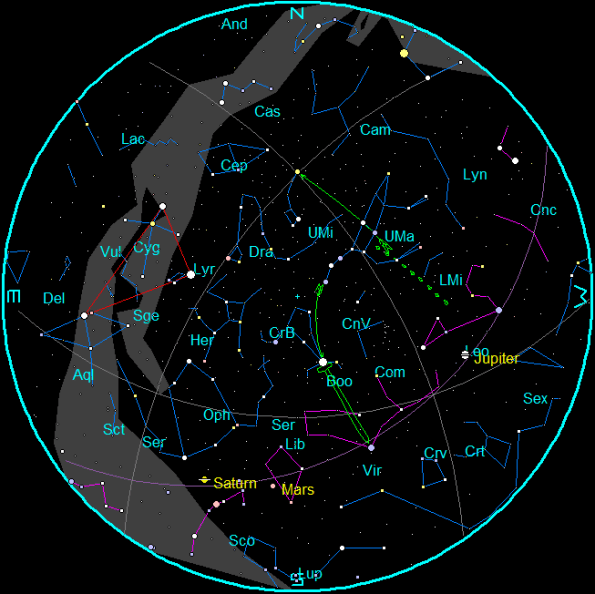
Star Chart for June 2016. Created using my LookingUp program. To enlarge in Firefox Right-click on image then click View image.
The planets and stars are plotted for the 15th at 11 p.m. EDT. That is chart time. Note, Traverse City is located approximately 45 minutes behind our time meridian. (An hour 45 minutes behind our daylight saving time meridian.) To duplicate the star positions on a planisphere you may have to set it to 1:45 earlier than the current time if you are near your time meridian.
Evening nautical twilight ends at 10:45 p.m. EDT on the 1st, increasing to 10:57 p.m. EDT on the 30th.
Morning nautical twilight starts at 4:36 a.m. EDT on the 1st, and decreasing to 4:35 a.m. EDT on the 30th.
Add a half hour to the chart time every week before the 15th and subtract a half hour for every week after the 15th. Before the 13th also subtract an hour for Standard Time.
For a list of constellation names to go with the abbreviations click here.
- Pointer stars at the front of the bowl of the Big Dipper point to Polaris the North Star
- A leaky Big Dipper drips on Leo
- Follow the arc of the handle of the Big Dipper to the star Arcturus
- Extend the arc to a spike to point to Spica.
- The Summer Triangle is outlined in red. Vega in Lyra (Lyr), Deneb in Cygnus (Cyg) and Altair in Aquila (Aql).
Calendar of Planetary Events
Credit: Sky Events Calendar by Fred Espenak and Sumit Dutta (NASA’s GSFC)
To generate your own calendar go to http://eclipse.gsfc.nasa.gov/SKYCAL/SKYCAL.html
Times are Eastern Time. Some additions made to aid clarity.
    Date    Time      Event
Jun 01  We            Venus: 1.5° W
    03  Fr  1:43 a.m. Saturn Opposition
    03  Fr  5:47 a.m. Moon-Mercury: 0.7° N
    03  Fr  6:55 a.m. Moon Perigee: 361100 km
    04  Sa 11:00 p.m. New Moon
    05  Su  4:59 a.m. Mercury Greatest Elongation: 24.2° W
    06  Mo  5:13 a.m. Moon North Dec.: 18.6° N
    06  Mo  5:34 p.m. Venus Superior Conjunction with the Sun.
    10  Fr 10:47 a.m. Moon-Regulus: 2.2° N
    11  Sa  3:35 p.m. Moon-Jupiter: 1.6° N
    11  Sa  6:20 p.m. Moon Ascending Node
    12  Su  4:10 a.m. First Quarter
    13  Mo  6:06 a.m. Mercury-Pleiades: 6.8° S
    15  We  8:00 a.m. Moon Apogee: 405000 km
    18  Sa  8:40 p.m. Moon-Saturn: 3.6° S
    18  Sa 11:39 p.m. Mercury-Aldebaran: 3.8° N
    20  Mo  7:02 p.m. Full Moon
    20  Mo  2:52 p.m. Moon South Dec.: 18.6° S
    20  Mo  6:35 p.m. Summer Solstice
    26  Su  1:28 a.m. Moon Descending Node
    27  Mo  2:19 p.m. Last Quarter
Jul 01                Venus: 6.8° E
04/29/2016 – Ephemeris – Let’s preview the merry skies of May
Ephemeris for Arbor Day, Friday, April 29th. The Sun rises at 6:34. It’ll be up for 14 hours and 10 minutes, setting at 8:45. The Moon, at last quarter today, will rise at 3:01 tomorrow morning.
Sunday starts the month when the promise of spring is finally fulfilled. Daylight hours in the Interlochen/Traverse City area will increase from 14 hours and 16 minutes Sunday to 15 hours 20 minutes on the 31st. The altitude, or angle, of the Sun above the southern horizon at local noon will ascend from 60 degrees Sunday to 67 degrees at month’s end. The altitude of the sun in the Straits area will be a degree lower than that but your daylight will be a few minutes longer. The big event of May will be the transit of the tiny planet Mercury across the face of the Sun on May 9th. I’ll have more on that next week. Also Mars will be in opposition from the Sun on the 22nd which due to its elliptical orbit will actually be closest to us 8 days later on the 30th at 46.779 million miles (75.284 million km).
Times are for the Traverse City/Interlochen area of Michigan. They may be different for your location.
Addendum
May Star Chart
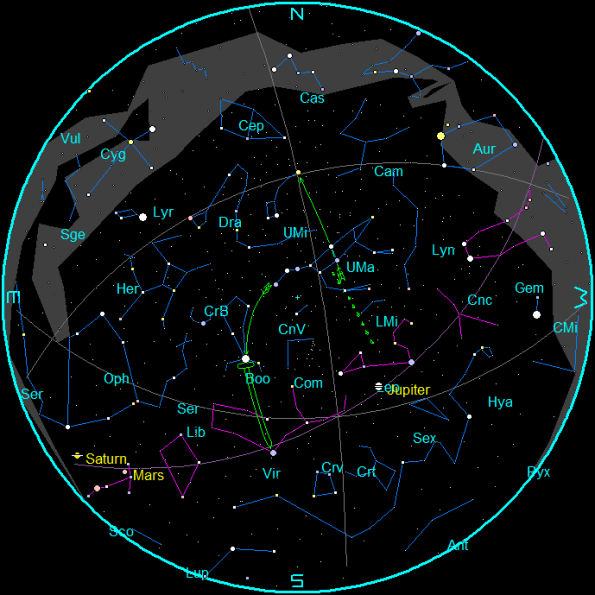
Star Chart for May 2016. Created using my LookingUp program. To enlarge in Firefox Right-click on image then click View Image.
The planets and stars are plotted for the 15th at 11 p.m. EDT. That is chart time. Note, Traverse City is located approximately 45 minutes behind our time meridian. (An hour 45 minutes behind our daylight saving time meridian.) To duplicate the star positions on a planisphere you may have to set it to 1:45 earlier than the current time.
Evening nautical twilight ends at 10:00 p.m. EDT on the 1st, increasing to 10:43 p.m. EDT on the 31st.
Morning nautical twilight starts at 5:20 a.m. EDT on the 1st, and decreasing to 4:38 a.m. EDT on the 31st.
Add a half hour to the chart time every week before the 15th and subtract a half hour for every week after the 15th. Before the 13th also subtract an hour for Standard Time.
For a list of constellation names to go with the abbreviations click here.
- Pointer stars at the front of the bowl of the Big Dipper point to Polaris the North Star
- A leaky Big Dipper drips on Leo
- Follow the arc of the handle of the Big Dipper to the star Arcturus
- Extend the ac to a spike to point to Spica
Calendar of Planetary Events
Credit: Sky Events Calendar by Fred Espenak and Sumit Dutta (NASA’s GSFC)
To generate your own calendar go to http://eclipse.gsfc.nasa.gov/SKYCAL/SKYCAL.html
Times are Eastern Time. Some additions made to aid clarity.
    Date   Time      Event
May 01 Su            Venus: 9.8° W
    02 Mo  9:27 p.m. Moon Descending Node
    04 We  2:45 p.m. Eta Aquarid Shower: ZHR = 60
    06 Fr 12:14 a.m. Moon Perigee: 357800 km
    06 Fr  3:30 p.m. New Moon
    08 Su  4:21 a.m. Moon-Aldebaran: 0.5° S
    09 Mo  7:12 a.m. Mercury transit begins
    09 Mo 10:57 a.m. Mercury mid-transit
    09 Mo  2:42 p.m. Mercury transit ends
    09 Mo  5:54 p.m. Moon North Dec.: 18.4° N
    13 Fr  1:02 p.m. First Quarter
    14 Sa  3:06 a.m. Moon-Regulus: 2.5° N
    15 Su  5:30 a.m. Moon-Jupiter: 2.2° N
    15 Su  4:39 p.m. Moon Ascending Node
    18 We  6:06 p.m. Moon Apogee: 405900 km
    21 Sa  5:15 p.m. Full Moon
    22 Su  7:15 a.m. Mars Opposition
    22 Su  5:59 a.m. Moon-Saturn: 3.5° S
    24 Tu  7:16 a.m. Moon South Dec.: 18.5° S
    29 Su  8:12 a.m. Last Quarter
    30 Mo 12:45 a.m. Moon Descending Node
    30 Mo  5:36 p.m. Mars closest to the Earth 0.50321 AU
Jun 01 We            Venus: 1.5° W
Transit of Mercury
May 9, 2016 7:12 a.m. (11:21 UT) to 2:42 p.m. (18:42 UT)
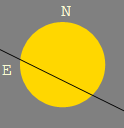
The track of Mercury across the face of the Sun. Mercury will travel from upper left to lower right. Mercury will not be visible until it impinges upon the disk of the Sun. Credit IOTA’s program Occult4.

The map showing where the transit is visible in whole or in part. If using Firefox enlarge the map by right clicking on it and select View Image.
04/01/2016 – Ephemeris – Let’s preview April skies
Ephemeris for April Fools Day, Friday, April 1st. The Sun will rise at 7:22. It’ll be up for 12 hours and 48 minutes, setting at 8:11. The Moon, 1 day past last quarter, will rise at 4:23 tomorrow morning.
The 4th month of the year begins today. Daylight hours in the Interlochen/Traverse City area and will increase from 12 hours and 48 minutes today to 14 hours 13 minutes on the 30th. The altitude, or angle, of the sun above the southern horizon at local noon will be 50 degrees today and will ascend to 60 degrees on the 30th. The altitude of the sun in the Straits area will be a degree lower. The actual time of local apparent noon this month for the Interlochen/Traverse City area, when the sun passes due south, will be about 1:43 p.m. Jupiter and Mercury are the evening planets this month, with Mercury making its brief appearance away from the Sun’s sunset glow around mid-month.
Times are for the Traverse City/Interlochen area of Michigan. They may be different for your location.
Addendum
April Star Chart
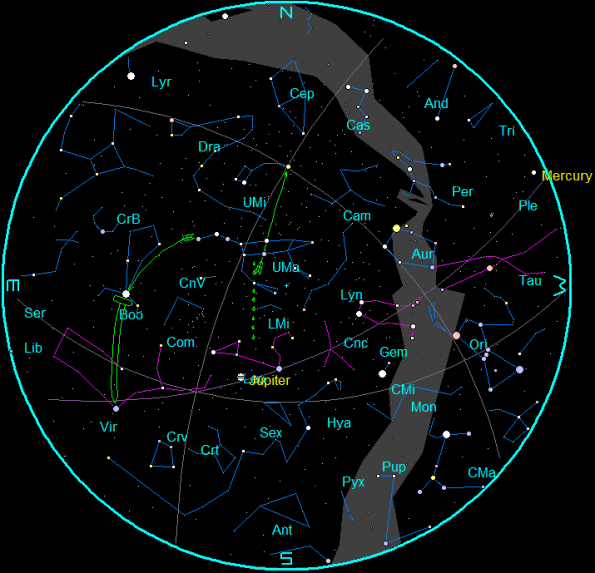
Star Chart for April 2016. Created using my LookingUp program. To enlarge in Firefox Right-click on image then click View image.
Star Chart for April 2016. Created using my LookingUp program. To enlarge in Firefox Right-click on image then click View image.
The planets and stars are plotted for the 15th at 10 p.m. EDT. That is chart time. Note, Traverse City is located approximately 45 minutes behind our time meridian. (An hour 45 minutes behind our daylight saving time meridian.) To duplicate the star positions on a planisphere you may have to set it to 1:45 earlier than the current time.
Evening nautical twilight ends at 9:15 p.m. EDT on the 1st, increasing to 9:59 p.m. EDT on the 30th.
Morning nautical twilight starts at 5:21 a.m. EDT on the 1st, and decreasing to 4:37 a.m. EDT on the 31st.
Add a half hour to the chart time every week before the 15th and subtract a half hour for every week after the 15th. Before the 13th also subtract an hour for Standard Time.
For a list of constellation names to go with the abbreviations click here.
- Pointer stars at the front of the bowl of the Big Dipper point to Polaris the North Star
- A leaky Big Dipper drips on Leo
- Follow the arc of the handle of the Big Dipper to the star Arcturus
- Extend the ac to a spike to point to Spica
Calendar of Planetary Events
Credit: Sky Events Calendar by Fred Espenak and Sumit Dutta (NASA’s GSFC)
To generate your own calendar go to http://eclipse.gsfc.nasa.gov/SKYCAL/SKYCAL.html
Times are Eastern Time. Some additions made to aid clarity.
    Date    Time(EDT) Event
Apr 01  Fr            Venus: 17.4° W
    05  Tu  1:27 p.m. Moon Descending Node
    06  We  4:30 a.m. Moon-Venus: 0.7° S
    07  Th  7:24 a.m. New Moon
    07  Th  1:36 p.m. Moon Perigee: 357200 km
    09  Sa  5:28 p.m. Uranus Conjunction
    10  Su  6:05 p.m. Moon-Aldebaran: 0.4° S Occultation*
    12  Tu  8:12 a.m. Moon North Dec.: 18.3° N
    13  We 11:59 p.m. First Quarter
    16  Sa  8:46 p.m. Moon-Regulus: 2.7° N
    18  Mo 12:42 a.m. Moon-Jupiter: 2.4° N
    18  Mo  9:59 a.m. Mercury Elongation: 19.9° E
    18  Mo  2:04 a.m. Moon Ascending Node
    21  Th 12:05 p.m. Moon Apogee: 406400 km
    22  Fr  1:24 a.m. Full Moon
    22  Fr  1:30 a.m. Lyrid Shower: ZHR = 20
    25  Mo  3:28 p.m. Moon-Saturn: 3.7° S
    27  We 12:44 a.m. Moon South Dec.: 18.4° S
    27  We 12:33 p.m. Mars-Antares: 4.9° N
    28  Th  4:32 a.m. Mercury-Pleiades: 6.5° S
    29  Fr 11:29 p.m. Last Quarter
May 01  Su            Venus: 9.8° W
* Occultation 6:29 - 7:38 p.m. In daylight - Grand Traverse Area
  See Friday April 9th post.
03/01/2016 – Ephemeris – Previewing March skies
Ephemeris for Tuesday, March 1st. The Sun will rise at 7:19. It’ll be up for 11 hours and 11 minutes, setting at 6:31. The Moon, at last quarter today, will rise at 2:15 tomorrow morning.
Let’s look at the skies for the month of March. The sun will pass the celestial equator as the promising season of spring will begin. Daylight hours in the Interlochen/Traverse City area and will increase from 11 hours and 11 minutes today to 12 hours 45 minutes on the 31st. The altitude, or angle, of the sun above the southern horizon at local noon will be 38 degrees today and will ascend to nearly 50 degrees on the 31st. Jupiter will reach opposition from the Sun on the 8th and enter the evening sky. That evening our time a total solar eclipse will be visible from Indonesia to the Pacific Ocean. Spring will begin on the 20th at 12:31 a.m. Easter, announced by the full moon on the 23rd will be celebrated on the 27th for western churches.
Times are for the Traverse City/Interlochen area of Michigan. They may be different for your location.
Addendum
March Star Chart
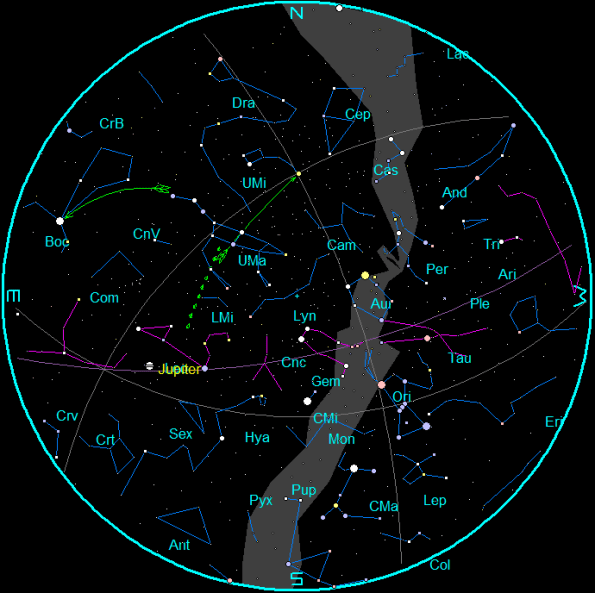
Star Chart for March 2016. Created using my LookingUp program. To enlarge in Firefox Right-click on image then click View image.
The planets and stars are plotted for the 15th at 10 p.m. EST. That is chart time. Note, Traverse City is located 45 minutes behind our time meridian. To duplicate the star positions on a planisphere you may have to set it to 45 minutes earlier than the current time.
Evening astronomical twilight ends at 7:34 p.m. EST on the 1st, increasing to 9:14 p.m. EDT on the 31st.
Morning astronomical twilight starts at 6:16 a.m. EDT on the 1st, and decreasing to 6:20 a.m. EST on the 31st.
Add a half hour to the chart time every week before the 15th and subtract a half hour for every week after the 15th. Before the 13th also subtract an hour for Standard Time.
For a list of constellation names to go with the abbreviations click here.
- Pointer stars at the front of the bowl of the Big Dipper point to Polaris the North Star
- A leaky Big Dipper drips on Leo
- Follow the arc of the handle of the Big Dipper to the star Arcturus
Calendar of Planetary Events
Credit: Sky Events Calendar by Fred Espenak and Sumit Dutta (NASA’s GSFC)
To generate your own calendar go to http://eclipse.gsfc.nasa.gov/SKYCAL/SKYCAL.html
Times are Eastern Time. Some additions made to aid clarity.
    Date  Time(EST) Event
Mar 01  Tu          Venus: 24.9° W
    01  Tu  6:11 pm Last Quarter
    02  We  1:53 am Moon-Saturn: 3.9° S
    03  Th  9:19 am Moon South Dec.: 18.2° S
    07  Mo  5:54 am Moon-Venus: 3.5° S
    08  Tu  4:58 am Jupiter Opposition from the Sun
    08  Tu  8:54 pm New Moon
    08  Tu  8:58 pm Total Solar Eclipse* (Indonesia & Pacific)
    09  We  1:31 am Moon Descending Node
    10  Th  2:02 am Moon Perigee: 359500 km
    13  Su  2:00 am Daylight Saving Time starts (EDT) Boo Hiss!
    14  Mo  9:44 am Moon-Aldebaran: 0.3° S
    15  Tu  1:03 pm First Quarter
    16  We  1:01 am Moon North Dec.: 18.2° N
    20  Su 12:31 am Vernal Equinox – Yea Spring!
    20  Su  3:05 pm Moon-Regulus: 2.8° N
    21  Mo 11:57 pm Moon-Jupiter: 2.3° N
    22  Tu  8:58 pm Moon Ascending Node
    23  We  7:48 am Penumbral Lunar Eclipse (not visible from here)
    23  We  8:01 am Full Moon
    23  We  4:05 pm Mercury Superior Conjunction with the Sun
    25  Fr 10:16 am Moon Apogee: 406100 km
    28  Mo  2:45 pm Moon-Mars: 4.6° S
    29  Tu 10:58 am Moon-Saturn: 3.8° S
    30  We  6:12 pm Moon South Dec.: 18.2° S
    31  Th 11:17 am Last Quarter
Apr 01              Venus: 17.4° W

* Coverage on NASA-TV-2 & www.exploratorium.edu/eclipse from 8 p.m. to 9 p.m.
Comet Catalina
Comet Catalina has become too faint to be seen in binoculars as it heads out of the solar system. To follow the comet further go to Seiichi Yashida’s Weekly Bright Comets page. Comet Catalina is no longer the brightest comet on the list, and is currently listed second. Click on it [C/2013 US10 ( Catalina )] for finder charts and other information.
When last we saw the comet was headed toward the constellation. But it’s headed almost straight away from the Earth now, and the Earth’s motion around the Sun is making the comet appear to start a loop north of Perseus. Another proof that Copernicus was right.
 Bob Moler's Ephemeris Blog